
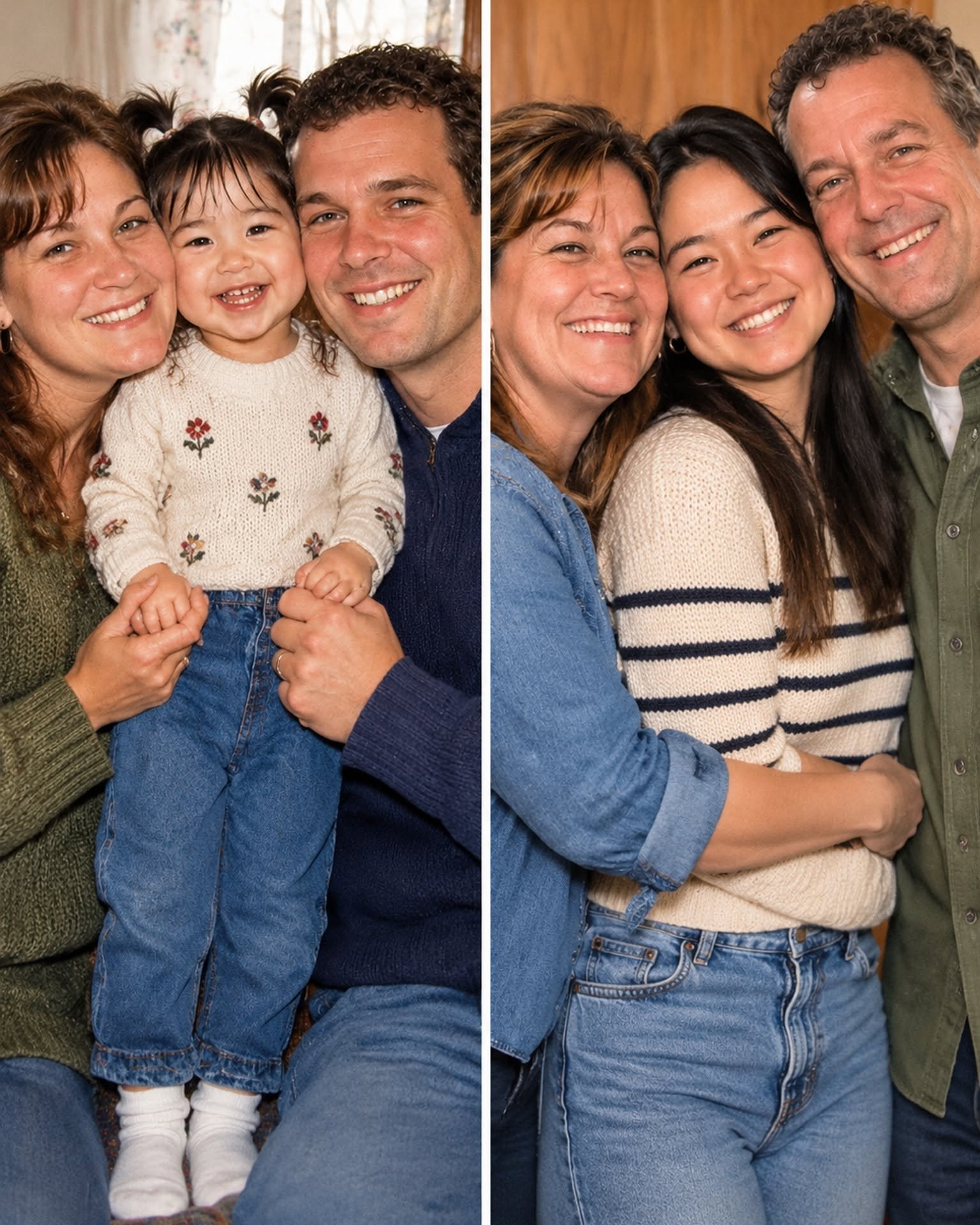
Part 1: The Handwriting He Recognized
My husband recognized the handwriting before I told him the package had come from China. He stopped in the kitchen doorway, still holding his car keys, and stared at the unfolded letter in my hand. Behind me, a tiny green sweater lay across our kitchen table.
“Richard? Do you know who sent this?”
His keys struck the floor.
For nearly twenty years, I had believed our family began with a sound: a baby crying beneath a bus-stop bench. Until that moment, I had never considered that Richard might have been listening for her before I was.
The package arrived on a Tuesday in October 2024. Our daughter, Maya, was nineteen, a college sophomore studying elementary education. She had called that morning to complain about a group project and remind me that turning twenty next month did not make her too old for my chocolate cake.
I was still smiling about that when the delivery driver knocked.
The box held two envelopes, several photographs, photocopied documents, and the sweater. Its sleeves were scarcely longer than my fingers. On top was a letter written in careful English.
“Dear Julia, thank you for raising my daughter.”
I read the sentence standing up. By the second paragraph, I had pulled out a chair.
The writer called herself Lin Zhao. She said she had spent years wondering whether contacting us would bring comfort or cause harm. She wasn’t asking for money. She wasn’t asking Maya to leave her family.
“But she is nearly twenty now. She deserves a beginning that is true. Please ask your husband whether you arrived at that bus stop by accident.”
That was when Richard came home.
We had been forty-one when we moved temporarily to China for his engineering contract in 2004. After ten years of infertility treatment and disappointment, we had stopped discussing parenthood as something that might still happen.
Richard worked long days. I taught conversational English twice a week and learned the neighborhood by walking it. We had settled into the quiet manners of people trying not to hurt each other with hope.
One December morning, he suggested a market across town. He seemed unusually concerned about which bus we caught. When traffic delayed us, he checked his phone repeatedly. At the time, I thought he was worrying about getting back for work.
We stepped off the bus into cold air. I heard a thin cry, stopped, and turned toward the shelter.
“Do you hear that?”
Richard was already looking toward the bench.
The basket was tucked underneath it. Inside lay a baby girl wrapped in a faded blanket patterned with small blue birds. Her cheeks were wet. One hand had worked free of the fabric.
I remember kneeling so quickly that my knee struck the pavement. I wrapped her in my coat while Richard called emergency services and struggled through the address in Mandarin.
An ambulance took her to the hospital. A police officer asked me what I had seen. I kept saying that I had only heard her, as though that distinction mattered.
We were told she was about six weeks old and needed treatment for exposure. Later, we learned she was recovering. I began sleeping again only after that.
We asked whether adoption might be possible, and the answer was neither simple nor encouraging. Finding a child did not give us a right to raise her. We contacted a licensed agency, completed assessments, assembled documents, and waited while authorities dealt with her circumstances.
Months later, we were told that her birth mother had come forward and that a formal decision about adoption had followed. The summary we received described a parent unable to provide care. It did not tell us her name.
Our application moved through the official process. There were interviews, additional questions, and stretches when nothing happened. We understood that another outcome remained possible until the placement was approved.
In late 2005, the adoption became final. We named her Maya. That January, we brought her home to Pennsylvania.
Those were the facts I knew. Around them, I had built the story I told our daughter: we went to a market, heard a cry, and found each other.
Now Richard stood across the kitchen from me, looking at a letter that suggested he had known where to listen.
“Her name is Lin,” he said.
“I can read her name.”
He bent to retrieve his keys, then put them on the counter with unnecessary care.
“She translated for the company sometimes.”
I looked down at the photograph nearest my hand. A young woman sat on a narrow bed holding a newborn. The baby wore the green sweater.
“You knew Maya’s mother?”
“Yes.”
The refrigerator motor switched off. In the sudden quiet, I heard a truck passing outside and our neighbor calling her dog. Everything beyond the kitchen continued as usual.
“Did you know her when we found Maya?”
Richard pulled out a chair but didn’t sit.
“Jules, there are things I should have explained.”
I had spent enough years beside him to recognize that careful voice. He used it when an expensive repair was worse than expected, when a doctor wanted another test, when he hoped the first sentence might soften the next.
I moved the box away from him.
“Start with one thing. Did you know there would be a baby at that stop?”
He looked at the photograph.
“I knew Lin was supposed to be there.”
For years, I had remembered the bus running late as the small accident that nearly kept us from Maya. Now I needed to know what we had actually been late for.
Part 2: What He Had Heard
Richard said he had first met Lin while she was translating safety instructions for visiting engineers. She was twenty-two, pregnant, and trying to hold together a job and a rented room after her relationship with the baby’s father ended.
He had helped her make telephone calls and once arranged a ride to a clinic. She knew he was married. Eventually, she learned that we had wanted a child for years.
“Did you tell her that because she asked?” I said.
“I don’t remember how it came up.”
“Try.”
He sat down then.
“I told her we’d considered adoption. I said we could offer a child a good home.”
I waited.
“More than once,” he added.
I thought about the evenings he had come home tired and distracted. I had assumed we were both struggling with the same disappointment. Meanwhile, he had been discussing our future with someone whose own future was collapsing.
“Why didn’t you tell me about her?”
“Because nothing was certain. I didn’t want to get your hopes up.”
“You let me hold a freezing baby on a sidewalk. You weren’t protecting me from hope.”
He pressed his palms together between his knees.
After Maya’s birth, Lin had contacted him again. She needed childcare so she could return to work. They arranged to meet near the market before her shift. Richard had suggested I come without telling me why.
“I thought if you met her, we could talk together.”
“About helping her?”
He hesitated.
“About what might be possible.”
I opened the second envelope. It contained a photocopy of a letter Lin had written before the birth, followed by a translation she had prepared for me.
She thanked Richard for listening. She asked about inexpensive childcare and whether anyone knew of a room where a mother and infant could stay.
The last paragraph was underlined in the copy.
“I am frightened, but I want to keep my daughter. Please help me find a way.”
I slid it across the table.
“What part of that sounded like an adoption request?”
“Things became worse afterward.”
“Did she tell you she had changed her mind?”
His silence lasted long enough to become an answer.
I returned to Lin’s account. She had brought Maya to the stop expecting to discuss temporary help. She had already been warned about missing work. When our bus failed to arrive, she panicked.
She placed the basket beneath the bench, sent Richard a message, and left.
“I told myself he would arrive within minutes,” she wrote. “I made that belief an excuse for leaving. It was dangerous. I do not ask you to call it something else.”
I stopped reading. For years, anger at an unknown woman had lived beside my gratitude. I had imagined someone turning away without looking back. Now I could see another possibility, but it did not make the unattended basket safe.
“What did her message say?” I asked.
Richard rubbed his forehead.
“That she couldn’t wait. That the baby was under the bench. That she would explain later.”
“You read that on the bus?”
“Just before we arrived.”
“And you said nothing.”
“I thought she might still be nearby. I thought perhaps I’d misunderstood.”
“But after I found her?”
His eyes filled.
“Then I knew.”
I remembered him beside me on the pavement, placing a hand between my shoulders. I had thought we were sharing the same astonishment. He had known there was a woman somewhere who might be expecting to collect her child from us.
“Did you tell the police?”
“I gave them her name and the company’s number when they questioned me separately. They contacted her through work.”
That distinction mattered. He had not concealed every fact from everyone. He had chosen the person he would keep uninformed.
“Why didn’t I know that?”
“You were at the hospital. Then everything became complicated, and I—”
“Had another chance to tell me.”
He nodded.
Lin’s letter explained that she had later met with officials. She had tried to arrange a way to care for Maya. Eventually, after discussions about her circumstances and options, she had consented to adoption. She said she had not known which family would be selected.
The decision at the bus stop and the later adoption were separate events. I read those pages twice, refusing to let Richard’s concealment turn them into one convenient story.
“Did you speak to her privately during the adoption process?”
“No. We were told to use the proper channels.”
“Did you offer her money?”
“No.”
“Did you ever tell her we were the family approved?”
He shook his head.
Years later, a former colleague had shown Lin a public photograph from Richard’s company retirement announcement. Maya and I stood beside him. Lin recognized Richard, then began asking careful questions.
The colleague eventually helped her contact a forwarding service. She had waited months before sending the package, unsure whether she had any right to intrude.
“I am not asking Maya to call me Mother,” she wrote. “I only wish she could know that I wanted her, even when I failed to find a way to raise her.”
I went upstairs and found the folder containing our adoption papers. Richard remained at the table when I returned.
The summary I remembered was there: birth parent located, circumstances assessed, consent documented. Nothing about a translator. Nothing about a planned meeting.
“When Maya asked why nobody knew who left her,” I said, “you heard her.”
He covered his face.
I remembered Maya at thirteen, sitting on the stairs after a school assignment about family history. She had asked whether we thought her birth mother ever wondered about her.
Richard had told her that some questions might never have answers.
I opened Lin’s letter to the final page. There was one sentence I had missed beneath her contact information.
“If Richard tells you he did not understand what I wanted, please ask him to translate the letter himself.”
Part 3: The Story Belonged to Her
The next morning, I arranged for an independent translator to review the Chinese documents. I sent copies, not originals, and explained that I needed accuracy rather than an opinion about my marriage.
Richard offered to organize everything.
“You can give me anything you still have,” I said. “You cannot manage this.”
He brought down an old storage drive and two folders from the study. There were no surviving messages from the phone he had used in 2004. I disliked that absence, but an absent record was not proof of another lie. We would have to distinguish what could be checked from what could only be admitted.
The translator’s preliminary response came that afternoon. Lin’s English version accurately reflected her old letter. She had asked for help keeping her child. There was no offer to relinquish her.
I placed the printed response beside Richard’s breakfast plate the following morning.
“I understood her,” he said before I asked.
I sat opposite him.
“Then why did you tell me you weren’t certain?”
He looked toward the window.
“Because I thought if things were hard enough, she might change her mind. And I wanted her to.”
There it was, without the softer language about possibilities and protecting me. He had wanted a child. He had heard a frightened woman asking for help and kept offering the answer that might give him one.
“I don’t know whether I affected her final decision,” he said.
“Neither do I. That doesn’t excuse what we do know.”
He agreed to write down his account, including what he remembered telling the police. I contacted our former adoption agency about accessing whatever records were still available. No one promised a quick answer, and I did not ask them to.
Then we had to call Maya.
I refused to leave a message that sounded like a family emergency without explaining enough to let her choose what happened next. When she answered, I told her we were physically safe and that a woman identifying herself as her birth mother had written.
There was a long silence.
“Is it real?”
“Some details appear consistent. We’re checking the documents. There’s also something your father needs to tell you.”
“Tell me now.”
Richard sat beside me at the table. On speakerphone, he described knowing Lin, arranging the meeting, and receiving the message.
Maya interrupted only once.
“Before Mom found me?”
“Yes.”
I heard a door close at her end. When she spoke again, her voice was lower.
“Send me scans of everything. Not a summary.”
We did.
She chose to come home Friday. I offered to collect her, but she wanted the train ride alone. When I met her at the station, she hugged me hard, then stepped back before I could ask how she was.
“I need you not to tell me what the letters mean yet.”
“All right.”
At home, Richard stood when she entered. Maya left her backpack by the stairs and sat at the far end of the table.
“Did you know her name when I asked about her in middle school?”
“Yes.”
“Did you know how to find her?”
“I knew where she had worked. I didn’t know where she was by then.”
“But you could have tried.”
He nodded.
She watched him for several seconds.
“I used to think the one thing you couldn’t help me with was information. You let me thank you for being honest about not knowing.”
Richard started to cry. Maya looked down at her hands.
I wanted to put an arm around each of them and somehow make the scene survivable. Instead, I stayed still. Comfort offered too quickly could become another way of asking her to make room for him.
“I’m sorry,” he said.
“I heard you. I’m not ready to do anything with that.”
She asked for the package and carried it upstairs.
Richard followed her with his eyes.
“Should I go after her?”
“No.”
He spent that night at a hotel. I had asked for space before Maya arrived, and she knew the decision was mine. I would not let her believe she had broken up our household by asking questions.
Later, she came down holding the sweater.
“She says she knitted it before I was born.”
“Yes.”
“Can something be important even if you don’t remember it?”
I moved over on the sofa. She sat beside me.
“I think so.”
She turned one tiny cuff inside out. A loose thread had been carefully worked into the seam.
“I’m angry with her too,” she whispered.
“You’re allowed.”
“And I want her to write again.”
“You’re allowed that too.”
The next day, Maya asked to see the blanket from her baby box. I had kept it through every move, folded beneath photographs and hospital paperwork.
She spread it beside Lin’s photograph. The same blue birds crossed the fabric. Near one corner was a small uneven repair, visible in both.
It wasn’t proof of everything. It was enough to make Maya touch the photograph with one finger.
That afternoon, she drafted a reply asking about her birth, her health history, and what Lin had expected Richard to do that morning. She described college but withheld her address and phone number. For now, they would communicate through an email account she created for that purpose.
Before sending it, she read me the final question.
“Did you think my father was helping you keep me, or helping himself adopt me?”
Her finger hovered over the mouse.
Then she clicked Send, and we waited for an answer none of us could control.
Part 4: Room for the Truth
Lin answered six days later. Maya read the message privately before asking me to sit with her.
“She didn’t avoid it,” she said.
Lin wrote that Richard had offered adoption several times. She had understood that he wanted a family, but she had believed their meeting was about immediate help with childcare. She had not promised him her daughter.
“I cannot tell you what your father intended in his heart,” she wrote. “I can tell you what I asked him for. I can also tell you that leaving you unattended was my decision. His lateness did not make it safe.”
She described the later months without asking Maya to excuse them. Relatives had refused help. A childcare arrangement had fallen through. Officials had discussed her circumstances with her, and she had eventually agreed to adoption.
“I did not know the family who would raise you. I hoped they would love you. I am grateful that they did. Gratitude does not mean every part of what happened was right.”
Maya read that paragraph aloud twice.
We did not arrange a reunion immediately. She exchanged letters with Lin for several weeks, sometimes answering quickly, sometimes leaving a message unopened through an entire weekend. I learned not to ask every evening whether she had heard anything.
The records review moved more slowly. With Maya’s written authorization, our former agency helped locate surviving material and referred us to counsel familiar with intercountry adoption records. We paid for translations and accepted that some information might no longer be recoverable.
The available documents supported the broad sequence we had been given: emergency care, identification of the birth mother, subsequent proceedings, and a documented consent before our placement. Nothing reviewed suggested a private handover to Richard or a payment to Lin.
That did not answer every question about pressure, choice, or what assistance might have changed. It did establish that Maya’s adoption had not simply been arranged beneath a bus-stop bench.
“I needed to know that,” she said when we reviewed the findings. “But it doesn’t make Dad’s part smaller.”
“No,” I said. “It doesn’t.”
Richard began individual counseling. I attended separately, then agreed to joint sessions. He rented a small apartment nearby rather than treating the hotel stay as a gesture that should earn him a return date.
During our first joint session, he said he had been afraid I would see him differently if he confessed.
“You gave me no chance to see you truthfully,” I said.
He began to explain how desperately we had wanted a child, then stopped.
“That’s something we shared,” he said. “The lying was mine.”
It was the first time I had heard him separate those things without being asked.
Maya set her own boundaries. No surprise visits. No requests that I carry messages between them. No questions about Lin unless Maya invited them. Richard wrote an apology that did not ask for forgiveness, and she kept it without promising to reread it.
By her twentieth birthday in November, they were speaking again. She invited him to dinner but asked that he leave afterward. He did.
There was chocolate cake. Maya argued with me about whether she needed leftovers, then packed half of them herself. For an hour, we were ordinary. I was grateful for that hour without mistaking it for an ending.
In January, Maya decided she wanted a video call with Lin. They arranged an interpreter so neither woman would have to struggle through important questions in a second language.
Maya asked me to sit nearby, outside the camera frame. Richard was not invited. He accepted that without asking whether he might be included next time.
When Lin appeared on the screen, Maya’s hand closed around mine. Lin wore a plain gray blouse and had twisted her hair into a low braid. She looked at Maya without speaking until the interpreter gently asked whether she could hear us.
“Yes,” Lin said in English. “I can hear.”
Maya let out an unsteady breath.
“Hi. I’m Maya.”
They spoke for forty minutes. There were difficult pauses and a few unexpected laughs. Maya asked whether Lin liked drawing. Lin turned the camera toward a sketchbook on her desk.
Afterward, Maya sat with the closed laptop in her lap.
“She’s a person,” she said.
I waited.
“I know that sounds obvious. But she’s been a question for so long.”
By spring, Richard and I had begun spending time together outside counseling. Sometimes dinner went well. Sometimes an old memory arrived with a new meaning, and I needed to go home alone.
I could acknowledge his patience without calling the damage repaired. Whether we resumed living together would depend on how we lived now, not how many years we had already invested.
One afternoon, Maya asked for a copy of the photograph we had taken when she first came home. In it, she sat between us, gripping the edge of Richard’s shirt while I tried to make her smile.
“I want to send it to Lin,” she said. “Is that okay?”
“It’s your photograph too.”
She studied it.
“This part was real, wasn’t it?”
I knew which part she meant.
“Yes. So were the midnight fevers and the terrible recorder concerts.”
“I was excellent at the recorder.”
“You were enthusiastic.”
She laughed, and then her face crumpled. I held her while she cried, not because she had chosen me over anyone, but because she had asked me to stay.
Later, we placed the green sweater in her baby box beside the blue-bird blanket. Lin’s letters went into a new folder that Maya labeled herself. She took copies back to college and left the originals with me for safekeeping.
At the door, she turned around.
“Can I call tomorrow? Not about all this. I have a lesson plan that might be a disaster.”
“Of course.”
For years, I had believed a chance discovery made me her mother. Now I knew our beginning contained choices I had never been allowed to see. Some would always hurt.
But the next afternoon, my phone rang between her classes. Maya wanted to know whether second graders could grow beans in paper cups.
I pulled out a chair, reached for a pencil, and asked her to tell me the plan.