
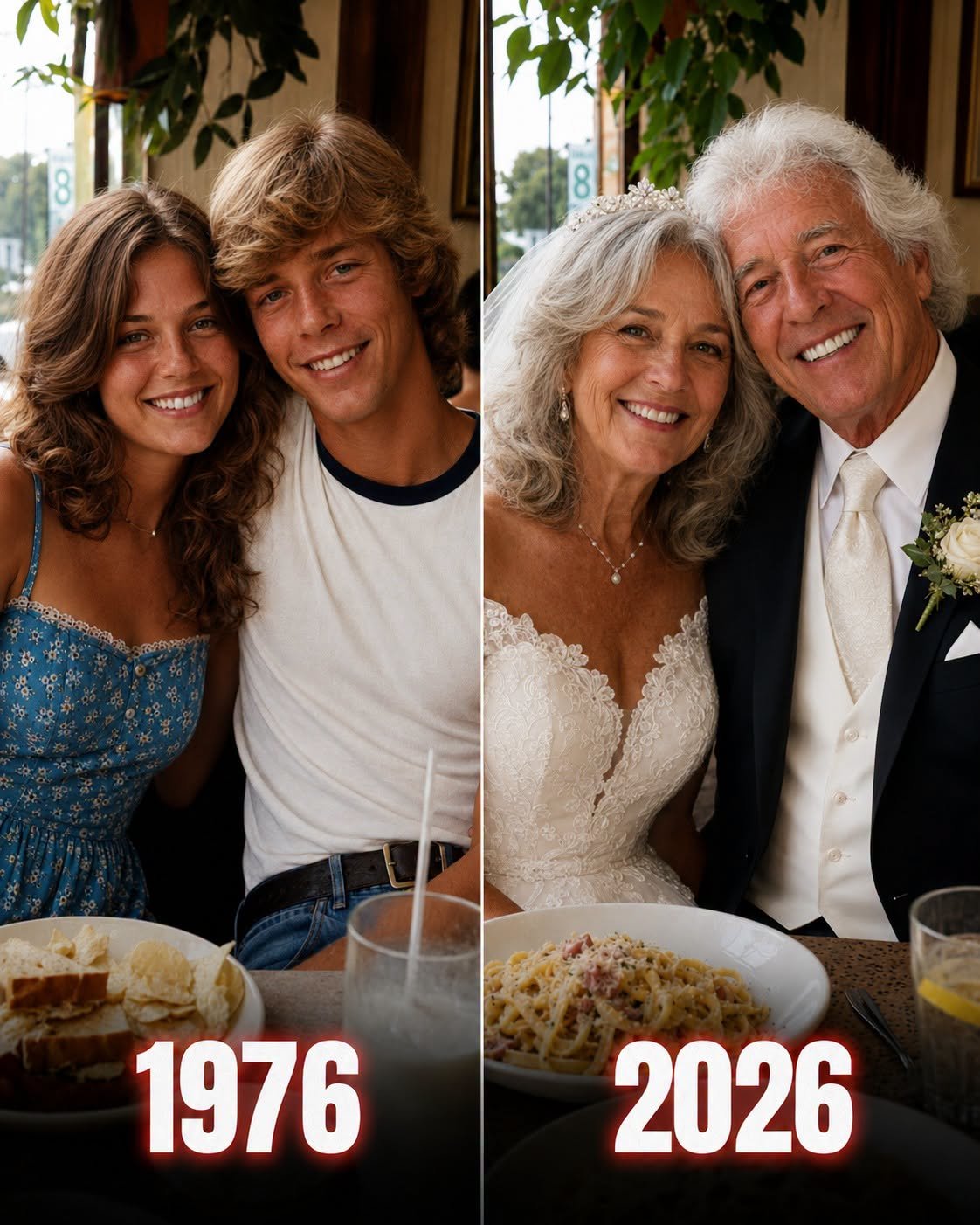
The Confession After ‘I Do’
On the morning I married Daniel, I believed the longest sorrow of my life had finally come to an end. By sunset, I understood that some endings only open the door to truths we were never prepared to hear.
Our ceremony had been small and quiet. There were no grand decorations, no crowded dance floor, and no need for either of us to pretend we were young again. We were both seventy, our hair silver and our hands marked by years the other had not witnessed. Yet when Daniel slipped the ring onto my finger, his eyes held the tenderness of the boy I had loved in high school. For a few shining hours, fifty missing years seemed to fold themselves away.
Afterward, I asked him to take me to the little Ohio cafe where our story had begun. I wanted our first meal as husband and wife to happen in the booth where we had once planned our future. I imagined coffee, pie, and perhaps a few happy tears. Instead, Daniel sat across from me in his wedding suit, turning his cup in slow circles without taking a sip.
I knew that habit. He used to do it whenever he was afraid to say something important.
“Daniel,” I said softly, “what is it?”
His hands stopped. He stared at the dark surface of his coffee as if the right words might rise from it.
“Sybil, there was never an accident.”
My cup paused halfway to my lips. For months, Daniel had told me that an accident had taken his memory and separated him from everyone he loved. That explanation had never answered every question, but after half a century of wondering whether he was alive, I had wanted to believe it more than I had wanted to examine it.
“What did you say?”
“I did not lose my memory.” His voice cracked. “I lied because I was ashamed of the real reason I stayed away.”
Only hours earlier, I had promised to spend the rest of my life beside him. Now the man I had waited fifty years to find could not meet my eyes.
“Then tell me where you were,” I said. “Tell me why you let me believe you had disappeared from the world.”
Daniel reached toward me, but I drew my hand into my lap.
“Someone made me believe you no longer wanted me,” he whispered. “Someone you know better than almost anyone.”
A chill moved through me despite the warmth of the cafe. I looked at the booth, the two cups, and the man I had just married. The past was no longer safely behind us. It had taken a seat at our table.
“Begin at the beginning,” I told him. “And this time, do not protect me from the truth.”
A Promise Halfway Between Us
Fifty years earlier, Daniel and I had been high school sweethearts with enormous plans and almost no money. We were leaving for colleges in different states, and the distance frightened me more than I admitted. A small cafe in Ohio stood roughly halfway between our campuses, so we stopped there before the semester began.
Daniel spent ten minutes turning his cup around and around while I watched him.
“If you keep doing that, you will carve a circle into the table,” I teased.
“I am thinking.”
“That has always been dangerous.”
He laughed, then reached across the booth and took my hand. His expression changed from playful to serious so quickly that my heart began to race.
“Four years is not forever, Sybil.”
“It feels close enough.”
“Then let us make it smaller. When college is over, we will come back here, and I will ask you properly to marry me.”
“Is this your proposal?”
“No. This is the promise before the proposal.” His thumb brushed over my knuckles. “Wait for me.”
“Only if you wait for me too.”
“I will.”
Because we could not afford frequent trips, we agreed to meet at that cafe every August 15. It became our private holiday, a date that belonged only to us.
The first summer, Daniel arrived before I did. He gave me a delicate silver necklace that must have cost more than he could spare.
“You were not supposed to bring a gift,” I protested.
“It is not a gift,” he said with a grin. “It is an investment in my future wife.”
The following year, his car broke down. He rushed through the door fifty-eight minutes late, breathless and apologizing.
“You counted every minute?” he asked.
“Every single one.”
By our third August 15, the waitress had refilled my coffee twice, and the chair opposite me remained empty. At first I counted minutes. Then I counted hours. Finally, I stopped looking at the clock because each glance felt like another small humiliation.
“Are you sure he is coming, honey?” the waitress asked as afternoon faded toward evening.
“Yes,” I answered, although fear had already begun to press against my ribs. “Please leave his cup. He will want coffee when he gets here.”
She left it untouched until closing time.
Daniel never walked through the door.
The next morning I called his parents. His mother, Ruth, had known me since high school, and the tremor in her voice frightened me before she finished saying my name.
“Daniel missed our meeting,” I said. “Is he sick? Did something happen?”
There was a long silence. Then Ruth began to cry.
“We cannot find him either, sweetheart. His room is empty. He is gone.”
His parents contacted the authorities. Weeks passed, but there was no evidence that Daniel had been hurt. He was an adult, and everything they found suggested that he had left deliberately.
Everyone else eventually accepted that explanation. I could not. The Daniel I knew might have been delayed, frightened, or confused, but he would never erase me without a word. At least, that was what I told myself each night as I reread his final letter and searched between its lines for a goodbye that was not there.

Fifty Augusts and One Empty Chair
My mother worried that my promise had become a cage. One evening, she found me at the kitchen table with Daniel’s last letter unfolded beside a dinner I had barely touched.
“You cannot put your whole life on hold because of something you promised at twenty,” she said gently.
“I am not putting my life on hold.”
“Then why do you return to that cafe every year?”
I folded the letter along its worn creases. “Because it is the last place where I know he promised to find me.”
My closest friend, Mary, became the person who held me together. We had known each other since high school, and after Daniel vanished, she spent so much time at my parents’ house that she seemed almost like another daughter. When grief left me speechless, she sat beside me. When anger made me restless, she walked with me for miles.
But even then, her comfort carried an edge I did not understand.
A few weeks after Daniel disappeared, she found me crying over one of his letters.
“What if he is hurt somewhere?” I asked.
“Or what if he is not?” Mary replied.
I stared at her.
“People change when they leave home,” she continued carefully. “Maybe he met someone. Maybe the person you loved is not the person he became.”
“Daniel would not abandon me.”
Mary took my hand. “You knew the boy he was. None of us can be certain about the man.”
The words hurt, but I believed they came from love. For fifty years, I believed Mary was trying to free me from a hope that might destroy me.
I did not stop living. I built a career, traveled when I could, cared for my parents as they grew older, and went on dates when friends insisted. There was laughter in my life, useful work, and people I genuinely cherished. Waiting for Daniel did not consume every day. It simply occupied one locked room in my heart that no one else could enter.
Every August 15, I returned to Ohio and sat in the same booth.
When Mary and I were fifty, she came with me for the first time. She watched the empty chair across from us for so long that I finally asked what she was thinking.
“This is hurting you,” she said. “Each year you come back and reopen the same wound.”
I looked down at my coffee. “Then do not come with me next year.”
She did not. At sixty, I made the trip alone. By seventy, I told myself the visit was only a ritual, not an expectation. I no longer imagined the bell over the door ringing or Daniel calling my name.
Then, on the fiftieth anniversary of the day he disappeared, I entered the cafe and found a gray-haired man sitting in our booth.
“Excuse me,” I began. “That is my…”
He looked up and slowly rotated his coffee cup between his hands.
The years fell away so suddenly that I had to grip the back of a chair.
“Daniel?”
His eyes filled. “Do you still keep track of how late I am?”
“You are fifty years late,” I whispered.
He rose, and I touched his cheek because sight alone was not enough. I needed to feel the warmth of him. I needed proof that the person I had mourned was standing in front of me.
“Where have you been?”
“There was an accident, Sybbie,” he said. “I lost my memory. I only recently began to remember you, this place, and August 15.”
His explanation was imperfect. Some answers came too quickly; others arrived after long pauses. But for fifty years, my first question had been whether Daniel was alive. He was. For a while, that answer was powerful enough to silence all the others.
Learning the Stranger I Still Loved
During the months that followed, Daniel and I tried to bridge the distance between the teenagers we had been and the elderly strangers we had become. We shared photographs, told stories about the parents we had lost, and learned each other’s ordinary habits. Sometimes love returned in flashes so familiar that it frightened me. At other times, I looked at him and felt the full weight of everything I did not know.
One evening, he burned a chicken so badly that smoke filled the kitchen and I had to open two windows.
“You have had half a century to learn to cook,” I said.
“I was occupied with other things.”
“What things?”
His smile disappeared. “Staying alive.”
I set down the towel in my hand. “Your story changes whenever I ask about those years. Sometimes you say you remember nothing. Sometimes you speak as if you remember too much.”
“I am doing my best, Sybil.”
I wanted to push, but I was afraid. Truth had already taken fifty years from us, and some foolish part of me worried that another hard question might take whatever time remained.
A week later, I invited Mary to dinner. I wanted the two people who mattered most to me to meet again properly. The instant she stepped through the door and saw Daniel, her purse slipped from her hand.
“Daniel?”
He stood so abruptly that his chair scraped the floor. “Hello, Mary.”
The color vanished from her face. “How can you be here?”
That question stayed with me long after she hurried home.
“You two know more about each other than either of you has admitted,” I told Daniel.
“We were all at school together.”
“Do not hide behind your memory again.”
He pressed his fingers to his forehead and asked me to leave it alone for one night. I agreed, not because I believed him, but because I was not yet ready for the answer.
Months later, Mary stood behind me before the wedding, trying to fasten a bracelet around my wrist. Her fingers slipped twice.
“Your hands are shaking,” I said, meeting her eyes in the mirror.
“I am fine.”
“What are you keeping from me?”
Her eyes shone with tears. “I only want you to be happy.”
It sounded loving. It was also not an answer.
During the ceremony, I noticed Daniel glance toward her twice. I told myself that old people carried old ghosts, and that marriage did not require us to exorcise every one of them before saying our vows.
Then we returned to the cafe, and Daniel admitted that the accident had never happened.

The Letter That Took Our Future
“Who convinced you to disappear?” I asked him across the cafe table.
Daniel’s hesitation gave me the answer before he spoke. Mary’s pale face, her fallen purse, and her trembling hands came together in my mind.
“Mary,” I said.
He nodded. From inside his jacket, he removed a yellowed envelope and placed it between us with the care one might use for something poisonous.
“She came to my college a few days before our third August meeting,” he said. “She told me you had fallen in love with someone else.”
“And you believed her?”
“Not at first. Then she gave me this.”
The letter inside was written in handwriting that looked disturbingly like mine. It told Daniel not to come on August 15. It said I was tired of arranging my future around a childhood promise, asked him never to contact me again, and ended with my name.
I read it twice. The second time, the words blurred.
“I did not write this.”
“I know that now.”
“But you did not know it then.”
He shook his head.
“Was one forged letter enough to make you erase fifty years?”
“There was more. Three days later, I called your house. Mary answered.”
I tightened my grip on the page. “Why was she there?”
“She said she was helping you through the breakup. I could hear someone crying in the background. Mary told me it was you and said you had begged her not to put me on the phone.”
The memory struck with cruel clarity. I had been crying because Daniel had failed to come. I had not known whether he was injured, missing, or dead. Mary had stood in my home, listened to my grief, and transformed it into proof that I no longer loved him.
“What happened after the call?”
“She wrote to me for several months. At first she said you were struggling and that I needed to honor your choice. Then she began asking about me.”
My stomach turned. “She made herself the bridge between us after she destroyed the road.”
Daniel looked down. “She told me she understood what it was like to love someone who did not return that love. Eventually I realized what she wanted, and I stopped answering.”
I folded the letter, though my hands had begun to shake. Mary had not merely lied once. She had watched me search for Daniel, comforted me through his absence, and allowed me to build an entire life around a mystery she had created.
I asked Daniel to give me an hour alone. Then I called the woman who had been my closest friend for most of my life.
The Friend Who Watched Me Wait
Mary arrived twenty minutes later. I placed the forged letter on the coffee table between us. She saw it and went so still that I knew there was no innocent explanation left.
“How long did it take you to copy my handwriting?” I asked.
“Sybil, please…”
“How long?”
Tears gathered in her eyes. “I had practiced it since high school. I used to copy your notes.”
“Why would you do that?”
Mary stared at the floor. When she spoke again, her voice sounded strangely young.
“Daniel and I had English together. We stayed after class sometimes and argued about books, especially Shakespeare. He would notice a line in a sonnet that I had already underlined. I thought it meant we understood each other in a way no one else did.”
A cold realization settled inside me. “You mistook being understood for being loved.”
“I told myself he was afraid to admit what he felt. I thought you were standing between us.”
“So you removed me.”
“I believed that once you were gone, he would finally see me.”
“And when he did not?”
Mary closed her eyes. “I kept writing.”
“To comfort him?”
“At first.”
“And later?”
Her shoulders collapsed. “I wanted him to need me.”
The confession hurt, but not as much as what came after it. Mary had been twenty when she forged the letter. Twenty-year-olds could be jealous, frightened, and catastrophically foolish. But she had not remained twenty.
“What about when we were thirty?” I asked. “What about every year after that?”
She covered her mouth.
“When my mother died, I sat beside you and said Daniel was the one person I wished I could call. You held me while knowing why I could not reach him.”
“I was ashamed.”
“You were afraid that honesty would cost you our friendship.”
She did not deny it.
“And the year you came to the cafe with me? You watched me look at his empty chair. You told me my hope was making me ill, yet you knew exactly who had emptied that chair.”
Mary’s face crumpled. “I know.”
“No,” I said. “You do not get to turn this into one mistake you regret. I can feel compassion for the lonely girl who made a terrible choice. I cannot excuse the woman who renewed that choice every day for fifty years.”
For a moment, the room held every version of our friendship: two schoolgirls sharing secrets, young women grieving lost dreams, middle-aged daughters caring for aging parents, and old friends drinking coffee together. I mourned all of them at once.
Then I opened the front door.
“Go home, Mary.”
“May I call you?”
“Not now.”
“Will you ever forgive me?”
I met her eyes. “This time, you will have to be the one who waits without knowing whether someone you love will return.”
She left without another word. I closed the door and leaned against it, listening to the silence. Losing Daniel had once felt like a death without a body. Losing Mary was different. She was alive, only a few steps away, but the friendship I had trusted no longer existed in the form I remembered.

The Day We Stopped Walking Away
When Daniel returned, I did not allow him to begin with an apology. I had spent too many years living inside other people’s explanations. This time, I wanted answers.
“Mary lied to you,” I said. “But she did not force you to disappear for fifty years. Why did you never come looking for me?”
He sat down slowly. “At first, I wanted to. I showed the letter to a friend. He said our yearly meeting sounded romantic, but that college changed people. He told me you were probably dating someone else and building the life you had always wanted.”
“So you believed him too?”
“I believed the thing I feared most.” Daniel rubbed his palms together. “I left school and cut everyone off. I was ashamed to face my parents after ruining my future. Years later, I finally told them I was alive, but I asked them not to tell you where I was.”
That truth hurt almost as much as Mary’s. Daniel had not been trapped by amnesia. He had been trapped by fear, and he had chosen the prison himself.
“You had decades to check whether the letter was real.”
“I know.”
“Why did you not do it?”
At last, he looked directly at me. “Because I was a coward. If I searched for you and discovered that you had chosen someone else, I would lose the last piece of hope I had. As long as I did not know, I could pretend leaving had protected my dignity instead of proving my fear.”
There was no noble excuse in his answer, only honesty. It did not erase the years, but it was the first thing he had given me that was entirely true.
“What made you come back?”
“The night before August 15, I could not sleep. I kept seeing that booth. I told myself that if there was even the smallest chance you still went there, I had to face whatever waited for me.”
“And if I had not come?”
“Then I would have earned the empty chair.”
I sat beside him. I did not tell him everything was forgiven, because it was not. Love was not a magic cloth that could wipe fifty years clean. Marriage did not cancel accountability. If we were going to remain together, trust would have to be built in the time we still had, one honest answer at a time.
“I am angry,” I told him.
“You have every right to be.”
“And I may be angry for a long while.”
“Then I will stay for as long as you allow me, and I will answer every question.”
I took his hand, not because the past had stopped hurting, but because he was finally present enough to face it with me.
One year later, on August 15, we returned to the Ohio cafe. Daniel paused outside the door.
“We do not have to go in,” he said.
I looked through the window at the booth that had held a promise, fifty years of absence, and one devastating confession.
“Yes, we do,” I replied. “That place belongs to my life too. I will not surrender it to what happened.”
I entered first. Daniel started toward the chair across from me, the one I had spent half a century watching.
I touched the seat beside mine.
“Not over there,” I said. “Sit here.”
He sat beside me.
The waitress approached with a smile. “Two coffees?”
“Two coffees,” I said, glancing at Daniel, “and two slices of the sweetest pie you have.”
For fifty years, August 15 had been the date of an unanswered promise. It had taught me how long a person could wait, how deeply fear could wound, and how betrayal could hide inside familiar hands.
That year, it became something else.
It became the day we stopped waiting across an empty table and finally chose to sit side by side.