
Part 1 — Six Empty Chairs
I had imagined my 60th birthday a hundred different ways, but none of them looked like this.
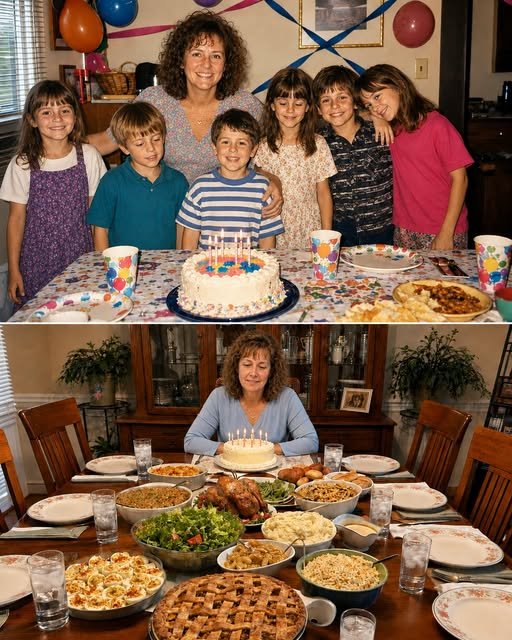
The dining room was glowing with candlelight. Seven plates sat neatly around the table. The roast I had started preparing that morning was cooling in the kitchen, and six empty chairs seemed to stare back at me.
I had been waiting for four hours.
Four long hours.
At first, I hadn’t been worried. My children were adults now. They had jobs, families, traffic, responsibilities. Being twenty minutes late was normal.
Even an hour could be forgiven.
But four?
That silence was harder to explain.
I looked at the clock again.
9:03 p.m.
My birthday dinner had been supposed to begin at five.
I pressed my palms against the edge of the table and tried not to cry.
There had been a time when silence was the one thing I couldn’t find in this house.
When their father and I married, he used to talk endlessly about having children.
“I want a noisy house,” he’d say, laughing. “One where somebody’s always yelling from another room and there’s never enough space at the table.”
He got his wish.
Over ten years, we had six children: Mark, Jason, Caleb, Grant, Sarah, and Eliza.
Four boys and two girls.
Our home had been filled with slammed doors, cartoons blaring from the living room, school projects covering the kitchen counters, shoes abandoned in hallways, and arguments over who had eaten the last cookie.
Back then, I sometimes dreamed about having five peaceful minutes to myself.
Funny how life works.
Years later, I would have given almost anything to hear those footsteps racing through the hallway again.
Their father hadn’t felt the same.
One day, after years of complaining that he felt trapped and restless, he started talking to a woman he’d met online overseas.
Within months, he packed a suitcase.
He told me he needed to “find himself.”
I remember standing in the doorway while six confused children watched their father walk away.
From then on, I became the one who stayed.
I packed lunches.
I attended parent-teacher conferences.
I learned how to stretch one paycheck farther than it had any right to go.
I stayed awake through fevers, heartbreaks, failed exams, bad decisions, and teenage arguments.
And somehow, eventually, all six grew up.
That was why this birthday mattered so much to me.
I wasn’t asking for presents.
I didn’t need a fancy restaurant or an expensive trip.
I only wanted one evening with my children around the same table.
So I had cooked everyone’s favorites.
I used the good plates I’d been saving for special occasions. I even ironed the cloth napkins that morning, laughing at myself as I did it.
At four o’clock, I had checked through the blinds every few minutes.
At five, I sent a message to our family group chat.
Drive safely. Dinner’s ready whenever you get here.
Sarah began typing.
Three little dots appeared on my screen.
Then disappeared.
No message followed.
At six, I started calling.
Mark went to voicemail.
Jason went to voicemail.
Caleb went to voicemail.
Eliza went to voicemail.
Grant’s phone seemed to send me directly there without even ringing.
By seven, I reheated the food.
By eight, I stopped trying.
And shortly after nine, I sat alone at the head of the table with six untouched place settings around me.
I finally lowered my face into one of those carefully ironed napkins and cried.
Not because they were late.
Because somewhere deep down, I wondered if this was what my life had become.
A mother everyone loved—but nobody had time for.
Then someone knocked on the front door.
Not the quick, familiar knock of one of my children.
Three firm knocks.
Official.
My tears stopped immediately.

Part 2 — The Note
I wiped my face and hurried to the door.
A young police officer stood beneath the porch light.
He looked barely older than some of my children.
Clean uniform. Serious expression. Hands held carefully in front of him.
“Are you Linda?” he asked.
My stomach dropped.
No mother wants a police officer asking her name at nine o’clock at night.
“Yes.”
He reached into his pocket and pulled out a folded piece of paper.
“This is for you.”
I stared at it.
My name had been written across the front.
And I knew that handwriting.
Grant.
My fingers suddenly felt cold.
Of all my children, Grant had always been the one who kept me awake at night.
He was impulsive, stubborn, funny, reckless, and somehow determined to learn every lesson the difficult way.
When the phone rang after midnight, Grant was usually the first name that flashed through my mind.
I unfolded the note.
There was only one message.
Mom, don’t call anyone. Don’t ask questions. Just listen to him and get in the car.
For a moment, the words wouldn’t make sense.
Then fear slammed into me.
I looked at the officer.
“Is Grant alive?”
His expression shifted.
Only slightly.
But I saw it.
“Ma’am, I need you to come with me.”
“Is my son alive?”
He looked away for half a second.
That half second nearly destroyed me.
“Please,” I whispered. “Just tell me.”
“He’ll explain everything.”
My knees weakened.
Behind me, the dining room remained exactly as I had left it.
Candles burning low.
Dinner waiting.
Six empty chairs.
“My children were supposed to be here tonight,” I said, almost to myself.
The officer’s expression softened.
“I’m sorry.”
Those two words frightened me more than anything else he’d said.
I grabbed my cardigan and purse.
Before leaving, I glanced back at the table one last time.
I had no idea whether I would return to that house as the same woman.
Part 3 — The Ride
I had never sat in the back of a police cruiser before.
The door closed behind me with a thick metallic sound.
My heart hammered harder.
The inside smelled faintly of disinfectant, vinyl, and something old I couldn’t identify.
Fear, maybe.
The officer climbed into the driver’s seat.
“Where are we going?”
“Not far.”
“Where?”
“Somewhere safe.”
I leaned forward.
“Safe from what?”
He didn’t answer.
“Did Grant do something?”
“Ma’am—”
“Don’t call me ma’am. Tell me whether my son is hurt.”
His hands tightened on the steering wheel.
“You’ll understand soon.”
“That isn’t an answer.”
“No,” he admitted quietly. “It isn’t.”
Then my phone vibrated.
For one hopeful second, I thought Grant had finally called.
Instead, it was Mark.
Mom, please don’t freak out. Just trust us.
I stared at the words.
Trust us?
After four hours of silence?
I typed back immediately.
WHERE ARE YOU?
The message showed as delivered.
Not read.
I looked toward the front seat.
“You know my son.”
The officer remained silent.
“You know Grant, don’t you?”
After a pause, he said, “Yes.”
My pulse jumped.
“Are my children in danger?”
“No.”
“Then why am I sitting in the back of a police car?”
He exhaled slowly.
“Please hold on a little longer.”
I wanted to scream.
Instead, I gripped my phone until my fingers hurt.
Then the cruiser turned into a familiar parking lot.
I looked through the window.
The community center.
For years, I had sat on hard bleachers inside that building watching school performances, youth basketball games, award ceremonies, and community events involving one child or another.
But tonight, the parking lot was unusually full.
And several vehicles looked familiar.
Mark’s SUV.
Sarah’s sedan.
Jason’s truck.
I stared at them.
Then at the officer.
“What is going on?”

Part 4 — The Surprise That Went Wrong
He parked and opened the door for me.
My legs felt unsteady as I stepped out.
I marched toward the entrance before he could guide me.
“If this is somebody’s idea of a joke,” I warned, “it isn’t funny.”
He said nothing.
The moment we entered, the room exploded with light.
“HAPPY—”
Jason’s voice died halfway through the word.
Everyone froze.
There were balloons everywhere.
Streamers.
Flowers.
A huge cake.
And across the far wall hung a banner:
HAPPY 60TH, MOM!
Five of my children stood beneath it.
Mark.
Jason.
Caleb.
Sarah.
Eliza.
For several seconds, nobody moved.
I should have felt relieved.
Instead, anger rushed through me so quickly that I almost shook.
“So this is where you were.”
“Mom—” Mark began.
“I waited four hours.”
His face fell.
“Please let us explain.”
“Four hours, Mark.”
Jason stepped forward.
“We weren’t ignoring you. This was supposed to be a surprise.”
“A surprise?”
Eliza’s smile disappeared completely.
“We thought you’d love it.”
“I cooked dinner for all of you.”
Sarah looked suddenly alarmed.
“Why did a police officer bring you here?”
I ignored her.
“I sat at that table alone while every one of you ignored my calls.”
Mark rubbed his forehead.
“Grant was supposed to get you.”
My anger paused.
“What?”
Jason nodded.
“We’ve been decorating since this afternoon. Grant said he’d handle bringing you here.”
“He was supposed to arrive around seven,” Sarah added.
I stared at them.
“Seven?”
Mark looked at his phone.
“He should have been here already.”
The room changed instantly.
Everyone seemed to realize the same thing.
Grant wasn’t there.
Mark called him.
No answer.
Sarah called.
Nothing.
Jason muttered something under his breath.
I slowly turned toward the officer who had brought me.
“You gave me a note written by Grant.”
He didn’t respond.
“You told me Grant would explain.”
Still nothing.
My fear returned all at once.
“Where is my son?”
The officer opened his mouth.
Then headlights swept across the windows.
Another police cruiser entered the parking lot.
Nobody spoke.
A door slammed outside.
Footsteps approached.
And then Grant walked through the entrance.
Wearing a police uniform.
A badge gleamed on his chest.
Jason stared at him.
“No way.”
Sarah’s mouth dropped open.
Caleb looked as though someone had switched him off.
Eliza covered her lips with both hands.
I couldn’t move.
Grant lifted his hands carefully.
“Okay,” he said. “Before everybody kills me… happy birthday, Mom.”
I found my voice.
“What are you wearing?”
He blinked.
“A uniform.”
Mark stared at him.
“You’re a police officer?”
Sarah recovered first.
She stormed toward him.
“Have you completely lost your mind? Mom thought something terrible happened to you!”
Grant’s face changed.
His eyes went immediately to mine.
“Mom?”
“You sent a police officer to my house.”
His confidence vanished.
“Yeah.”
“You left me alone for four hours.”
His shoulders dropped.
“I didn’t know about that.”
“You told me not to ask questions. You had him put me into a police car.”
“I thought—”
“You thought what?”
Grant swallowed.
“I thought it would be dramatic.”
Sarah made an outraged sound behind me.
Grant rushed on.
“I wanted him to bring you here, then I’d walk in wearing the uniform. I thought you’d be shocked for thirty seconds, and then everybody would laugh.”
I stared at him.
“You didn’t think.”
“No,” he admitted. “I didn’t.”
The shame on his face was real.
For once, he had no joke ready.
No excuse.
“I thought Grant was picking you up earlier,” Mark said quietly. “We didn’t realize you were sitting there waiting.”
Eliza’s eyes filled with tears.
“We thought you knew somebody was coming.”
I looked around the room.
Five guilty faces.
One terrified son in uniform.
The happiest surprise they could imagine had accidentally touched the deepest fear I carried.
Being left behind.
Part 5 — What Grant Had Been Hiding
Grant took a cautious step toward me.
“I didn’t tell anyone about the academy.”
I looked at his badge again.
“The academy?”
He nodded.
“I’ve been training for months.”
“Months?”
“I didn’t tell any of you.”
Jason shook his head.
“You? A cop?”
Grant shot him a look.
“Thanks for the confidence.”
“That’s not what I meant.”
“Kind of sounded like it.”
Normally, their bickering would have made me laugh.
That night, I couldn’t.
“Why didn’t you tell me?” I asked.
Grant’s expression softened.
“Because I didn’t want people waiting for me to fail.”
The room became quiet.
He looked at his brothers and sisters.
Then back at me.
“I’ve messed up a lot. Everybody knows that.”
“Grant—”
“It’s true.”
He rubbed the back of his neck.
“I’ve quit jobs. I’ve made stupid choices. I’ve spent years pretending nothing mattered because that was easier than admitting I didn’t know what I was doing.”
His voice lowered.
“When I applied to the academy, I didn’t tell anybody because I couldn’t stand the idea of everyone asking about it if I washed out.”
I felt some of my anger weaken.
“Did you think I expected you to fail?”
His answer came immediately.
“No.”
That surprised me.
He stepped closer.
“You’re the only person who never did.”
My throat tightened.
“You used to tell me I could do anything if I would stop acting like I didn’t care.”
I remembered saying that.
Many times.
Usually while standing in the kitchen with Grant sitting across from me after another bad decision.
“You told me I was better than the way I was behaving,” he continued. “Even when I didn’t believe you.”
I swallowed.
“I said it because I didn’t want you becoming like your father.”
Silence.
The words hung between us.
Grant’s eyes became glassy.
He nodded slowly.
“I know.”
For years, I had wondered whether those conversations had gone in one ear and out the other.
Apparently they hadn’t.
Grant touched the badge on his chest.
“That’s part of why I did this.”
“You became a police officer because of your father?”
“No.”
He looked directly at me.
“I became one because I wanted to prove I didn’t have to disappear when things got hard.”
Something in my chest cracked open.
Grant’s voice became quieter.
“I wanted to show you that I’m not him.”
Then he smiled faintly, though his eyes were wet.
“And… I wanted you to be proud of me.”
All my anger did not vanish.
But suddenly it had to share space with something else.
Pride.
I reached toward him and touched the badge.
It was cool beneath my fingertips.
“This is real?”
A nervous laugh escaped him.
“Very real.”
“You really did this.”
“Yeah.”
My eyes filled.
“You scared me half to death.”
His expression collapsed.
“I know.”
“I thought I’d lost you.”
“I’m sorry.”
“No, Grant. I mean I truly thought something terrible had happened.”
“I know, Mom.”
His voice broke.
“I’m so sorry.”
That was when I started crying again.
Not the quiet tears I had shed alone at my dining table.
These were different.
Messier.
Heavier.
Grant stepped forward and wrapped his arms around me.
At first, gently.
Then tightly.
“I’m here,” he whispered.
I held him.
“I’m here, Mom.”
And for the first time that evening, I believed it.
Part 6 — Showing Up
Behind us, Sarah began crying.
“I’m sorry too, Mom.”
Mark stepped closer.
“We all are.”
Jason looked down.
“We really messed this up.”
Eliza wrapped an arm around my waist.
“We wanted everything to be perfect.”
I wiped my face.
“That’s the problem.”
They looked at me.
“Life isn’t perfect.”
My voice trembled, but I continued.
“Families aren’t perfect. Birthdays aren’t perfect. Surprises aren’t perfect.”
I looked from one child to the next.
“But you know what matters?”
Nobody answered.
“Showing up.”
Grant lowered his head.
“You can forget decorations. You can burn dinner. You can buy the wrong cake. I don’t care.”
I took a breath.
“But don’t disappear.”
Mark nodded slowly.
I continued.
“I spent years raising all of you after your father decided leaving was easier than staying. Maybe that’s why tonight hurt as much as it did.”
Their expressions changed.
“I know you’re adults. I know you’re busy. I don’t expect you to call me every hour.”
Sarah wiped her eyes.
“But four hours of silence from all six of you made me feel like I had somehow become optional.”
“Oh, Mom,” Eliza whispered.
Grant stepped closer.
“You’re not.”
“Then don’t make me guess.”
He nodded.
“No more disappearing.”
His voice was firm now.
“Not me.”
I studied him.
“You promise?”
“I promise.”
The officer who had brought me cleared his throat from near the doorway.
Apparently everyone had forgotten he was still there.
“Ma’am… I’m Nate.”
I raised an eyebrow.
He looked deeply uncomfortable.
“For what it’s worth, I’m sorry. Grant told me this was supposed to be funny.”
Sarah immediately pointed at him.
“Leave while you’re still ahead, Nate.”
Jason laughed unexpectedly.
Nate gave a small nod.
“Understood.”
Then he disappeared through the door.
For the first time all night, I laughed too.

Part 7 — Officer Trouble
Once the tension finally broke, the room changed.
Jason clapped his hands.
“Okay. Everybody nearly gave Mom a heart attack. Great teamwork. Can we feed her now?”
Mark started passing out plates.
Caleb turned on the food warmers.
Eliza appeared beside me with a glass of water as though I had just crossed a desert.
Sarah pulled out a chair.
“Sit down.”
“I’m capable of sitting by myself.”
“I know. Sit anyway.”
So I did.
Grant lowered himself into the chair beside me.
He still looked uncomfortable in his uniform, as if he hadn’t decided whether he deserved to enjoy the party after what he’d done.
I nudged his arm.
“Eat something, Officer Trouble.”
He looked at me cautiously.
Then smiled.
“Yes, ma’am.”
I pointed a finger at him.
“Don’t start.”
That made everyone laugh.
Dinner wasn’t the one I had cooked at home.
But that didn’t matter anymore.
Mark tried cutting the cake into equal pieces and somehow produced twelve completely different shapes.
Jason began telling a story that had no clear beginning or ending but still made us laugh until Sarah told him to stop because her stomach hurt.
Caleb, always the quiet one, kept looking at Grant’s uniform and shaking his head as though he couldn’t believe it.
Eliza took approximately two hundred photographs.
And eventually, Sarah leaned close to me.
“I really am sorry.”
I covered her hand.
“I know.”
“We weren’t trying to hurt you.”
“I know that too.”
She looked down.
“I should’ve answered your message.”
“Yes.”
That startled a small laugh from her.
I squeezed her fingers.
“Just promise me something.”
“Anything.”
“Don’t let being busy become an excuse for being gone.”
Her eyes shimmered again.
“Okay.”
Later, after dinner, Grant leaned toward me.
“There’s something else.”
I narrowed my eyes.
“If another police officer appears, I’m leaving.”
He laughed.
“No more police officers.”
“Good.”
“My graduation ceremony is next week.”
I stared at him.
“Graduation?”
“Official ceremony.”
He rubbed his hands nervously.
“I saved you a seat.”
My heart tightened again, but this time in the best possible way.
“Just me?”
He nodded.
“Front section.”
There was something almost boyish in his expression.
The same look he had worn at eight years old before asking me to watch him jump from the highest diving board at the community pool.
“Will you come?”
I smiled.
“My son graduates from the police academy and thinks there’s any possibility his mother won’t be there?”
His shoulders relaxed.
“So that’s a yes?”
“It’s a yes.”
His smile became enormous.
Part 8 — The Sound I Had Missed
Before the night ended, I looked down the long table.
All six of my children were there.
Mark was arguing with Jason.
Sarah was fixing Eliza’s hair for a photo.
Caleb was stealing icing from the cake.
Grant sat beside me in his uniform.
For a moment, I simply watched them.
Then I tapped my glass.
“Listen.”
They slowly quieted.
“I want a family rule.”
Jason groaned.
“We’re all forty, Mom.”
“Then you’re old enough to follow instructions.”
Everyone laughed.
I continued.
“No disappearing.”
Their smiles softened.
“Not on birthdays. Not on holidays. Not on ordinary Tuesdays. Not because work is busy. Not because you’re embarrassed. Not because you think someone else will make the call.”
I looked at Grant.
“And definitely not because you think frightening your mother with a police officer is funny.”
He winced.
“Fair.”
Mark raised his hand.
“Deal.”
Sarah followed.
“Deal.”
Eliza nodded.
“Deal.”
Caleb lifted his glass.
“Deal.”
Jason sighed dramatically.
“I guess I’m legally required to say deal.”
“Jason.”
“Deal.”
Finally, Grant placed his hand over mine.
“Deal.”
His voice was quiet.
“And I’ll prove it.”
I squeezed his fingers.
Then they brought out the cake.
The candles were new.
The ones I had lit at home had probably burned themselves into little pools of wax beside six empty chairs.
But these flames were bright.
And when my children began singing “Happy Birthday,” they were loud, badly synchronized, and terribly off-key.
It was perfect.
I closed my eyes for a second and listened.
Suddenly, I remembered their father when we were young.
A loud house, he had once said.
A table that’s never empty.
We had lost many things since then.
A marriage.
Years.
Trust.
Versions of ourselves we could never get back.
But sitting there at sixty, surrounded by my six grown children, I realized something.
Families don’t survive because nothing ever goes wrong.
They survive because people decide to come back to the table.
Because someone apologizes.
Someone forgives.
Someone answers the phone next time.
Someone stays.
My birthday had started with silence so painful I thought it might swallow me.
It ended with laughter bouncing off the walls.
Not perfect.
Not like the old days.
But maybe I didn’t need the old days anymore.
Grant squeezed my hand as everyone shouted at me to make a wish.
I looked around at six familiar faces.
Then I leaned toward the candles.
I already had my wish.
For one more night, the room was loud.
The table was full.
And I wasn’t alone.