
PART 1: THE SECRET INSIDE MAMA’S FLOUR TIN
My mother kept her pantry organized with almost obsessive precision. Canned vegetables were sorted by expiration date, sugar stayed in the same glass jar she had owned for decades, and even the spices were arranged alphabetically because Beverly Parrish believed everything had its proper place.
But there was one thing in that pantry nobody was ever allowed to touch: an old white enamel flour tin decorated with a faded blue pattern. It always sat on the highest shelf, and although I had seen it countless times growing up, Mama treated it differently from everything else she owned.
When I was twelve, I once reached for the tin because I wanted to make biscuits and couldn’t find enough flour. Mama immediately slapped my hand away, startling me so badly that I burst into tears.
Later, she made me cocoa and sat beside me at the kitchen table, gently stroking my hair while apologizing. She never explained what was inside the tin, though, and after returning it to the highest shelf, she made it clear that I should never touch it again.
Mama was like that whenever something hurt too much to discuss. She rarely confronted painful subjects directly, preferring to quietly close the door until everyone around her learned not to ask what was behind it.
She died at seventy-eight after suffering a stroke in her sleep. The hospice nurse believed it had happened quickly and that Mama probably hadn’t known what was happening, and because I desperately needed that version to be true, I accepted it.
Her funeral took place on Thursday, and by Friday morning my older brother Russell had decided we should clear out the house within two days. Russell had always handled grief by staying busy, so while he packed the living room, I began sorting through the kitchen and pantry.
Eventually, I found myself staring at the flour tin again. For the first time since childhood, there was nobody left to tell me not to touch it.
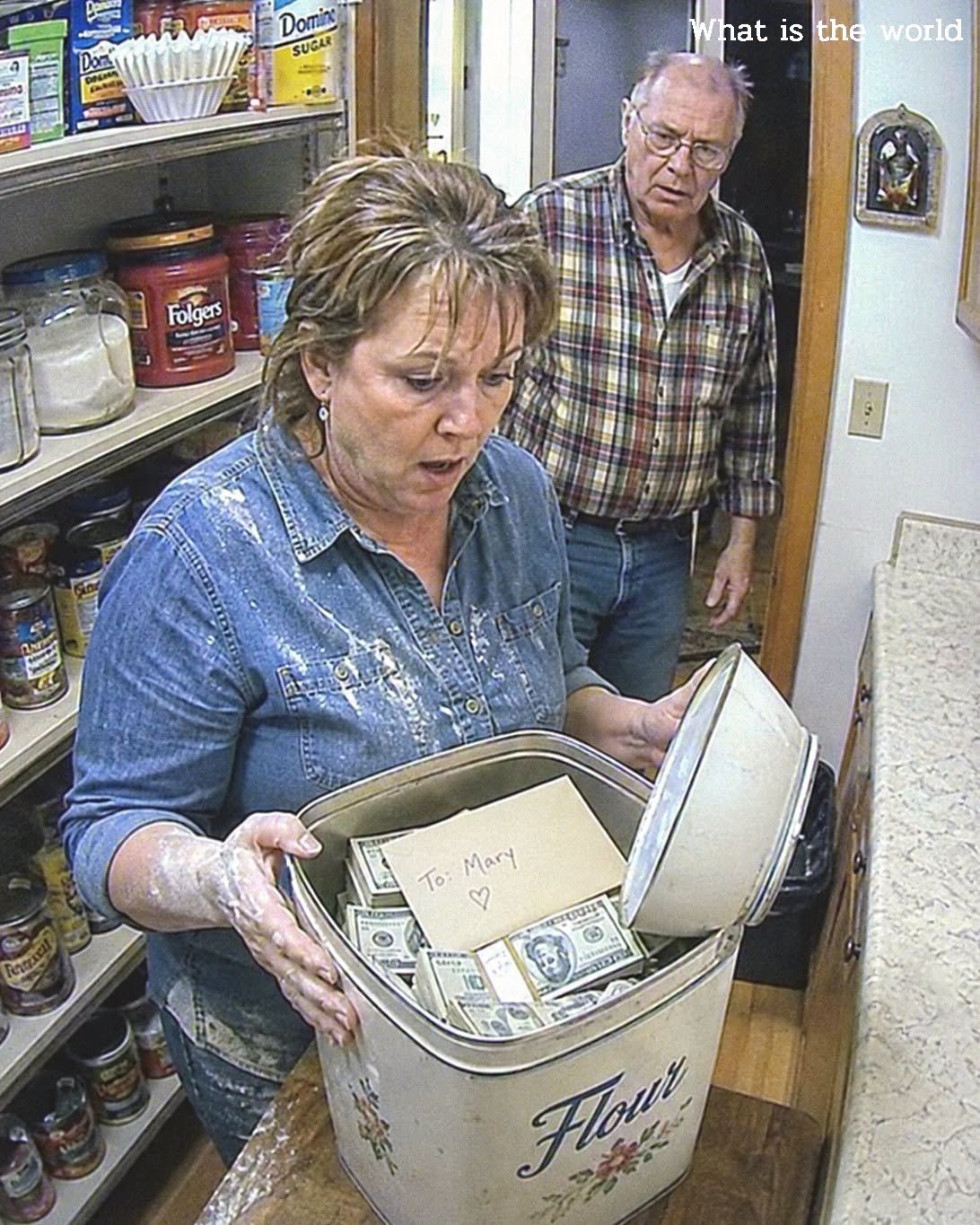
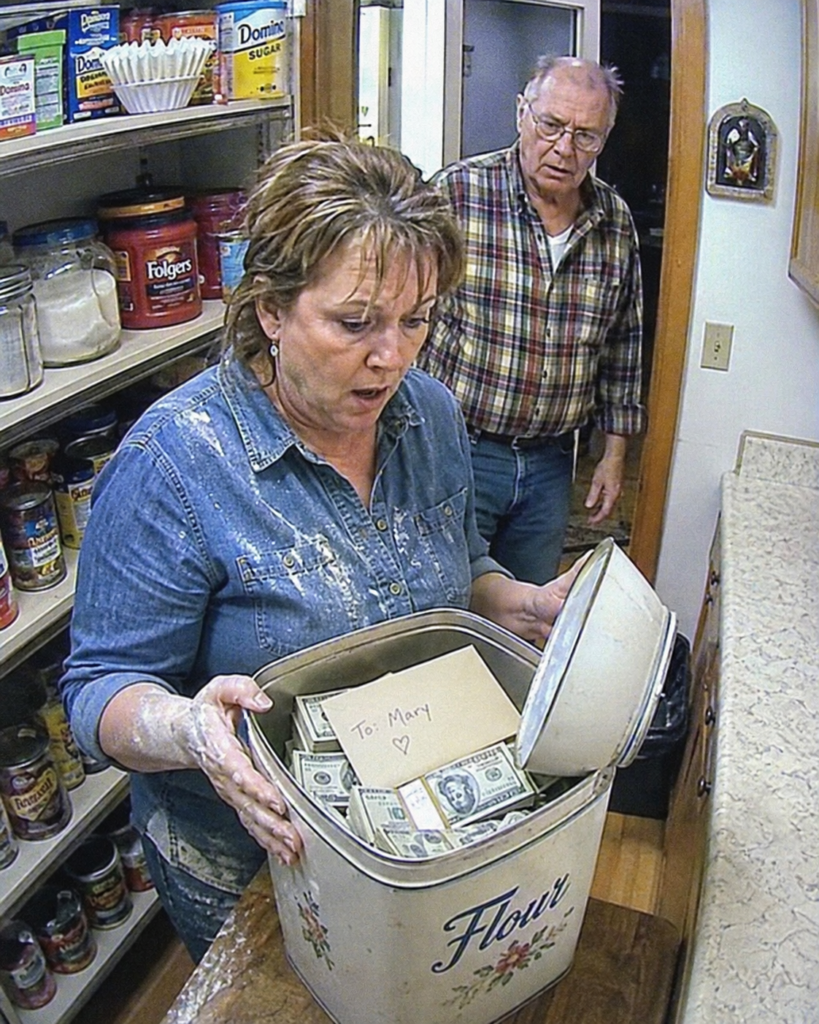
The moment I lifted it from the shelf, I knew something was strange because it was much heavier than a container of flour should have been. I carried it to the counter, removed the lid, and discovered there wasn’t a single cup of flour inside.
Instead, the tin was packed with cash. Bundles of twenties, fifties, and hundred-dollar bills were held together by old rubber bands, and beneath them was an envelope with one name written across the front in Mama’s handwriting.
Linda.
Not Russell. Not “my children.” Just me.
Russell entered the kitchen and stopped when he saw what I had found.
“What is that?”
“I found it in Mama’s flour tin.”
He looked from the stacks of bills to the envelope.
“Probably grocery money she forgot about.”
We counted everything and arrived at $18,940, far too much money to dismiss as forgotten grocery cash. My hands were already shaking when I opened the envelope and found three handwritten pages inside.
The first sentence immediately stopped me.
“I’m sorry, Linda.”
Then I read the next line.
“I should have told you what Wayne did with your settlement.”
I lowered myself into Mama’s usual kitchen chair as memories from more than thirty years earlier came rushing back. When I was seventeen, a delivery truck had backed into me outside a grocery store, leaving me with serious injuries and forcing me to miss weeks of school.
The trucking company’s insurance eventually offered a settlement, and my stepfather Wayne handled all the paperwork. He told Mama and me that the settlement had been $42,000, most of which supposedly went toward medical bills, while whatever remained would be kept in an account until I turned eighteen.
When my eighteenth birthday arrived, Wayne announced that nothing remained. He claimed unexpected expenses had consumed the account and even produced official-looking paperwork to prove it, and because I was eighteen and understood nothing about insurance settlements or financial records, I believed him.
I cried, found a job at a hardware store, and eventually moved forward with my life. Mama cried too, and for decades I assumed those tears had come from watching her daughter lose money she desperately needed.
Sitting in her kitchen with that letter in my hands, I finally understood that Mama had been crying for another reason.
She already knew the truth.
Behind me, Russell suddenly spoke.
“Don’t start digging up old things.”
Something about his tone immediately bothered me, and when I turned toward him, he wouldn’t meet my eyes.
“You knew.”
“I don’t know what’s in that letter.”
“Russell.”
He looked away.
“How much did Wayne take?”
Russell walked back into the living room without answering. His silence told me enough, so I continued reading.
Mama explained that five years after my accident, she had discovered paperwork showing that Wayne had lied from the beginning. My settlement hadn’t been $42,000.
It had been $63,000.
Wayne had taken every dollar.
Mama confronted him after finding the documents, and although he denied everything for two days, he eventually admitted what he had done. But Mama didn’t leave him, report him, or tell me the truth because after losing my biological father and struggling financially, she had become terrified of losing the stability Wayne represented.
Her letter didn’t try to make that decision sound noble. She admitted plainly that when forced to choose, she had protected her marriage instead of protecting her daughter.
One sentence hurt more than everything else.
She had chosen her comfort over my justice.
But apparently Mama’s guilt never disappeared. Instead, she began secretly taking small amounts of money from Wayne whenever she believed he wouldn’t notice.
Five dollars here. Ten dollars there. Sometimes slightly more.
Every bill went into the flour tin.
She continued for eleven years, and even after Wayne eventually left her, Mama kept adding whatever she could from her pension, Social Security, tax refunds, birthday money, and a small inheritance. Dollar by dollar, the amount eventually reached the $18,940 now sitting on the kitchen counter in front of me.
It wasn’t enough to replace the $63,000 Wayne had stolen, and Mama knew that. But it represented everything she had managed to recover after spending decades carrying the guilt of what she had allowed to happen.
Then I reached the final page.
Unlike the others, it had been folded separately and sealed with yellowing tape. Mama had written one instruction across the outside.
“Read this at First County Bank. Not in the house.”
I put every dollar back into the flour tin and closed the lid. Then I walked past Russell without another argument, carried Mama’s secret to my car, and drove directly toward the bank.
At that point, I believed I had already discovered the truth.
I hadn’t.
Mama had spent the final fourteen months of her life preparing for exactly what would happen when I walked through those bank doors.
PART 2: WHAT MAMA HAD PREPARED
First County Bank had been part of our family’s life for decades. Mama had banked there for forty years, and I had used the same branch for thirty, so when I walked through the doors shortly after five carrying an old flour tin filled with $18,940, I expected nothing more than an uncomfortable conversation about her accounts.
A teller named Dana greeted me, and I explained that my mother had recently died and that I had discovered documents connected to her finances. The moment Dana entered Beverly Parrish’s name into the computer, however, her expression changed, and she quietly excused herself before returning with branch manager Gerald Watts.
Gerald looked at me, then at the flour tin tucked beneath my arm.
“Mrs. Parrish, please come into my office.”
Once the door closed behind us, Gerald sat across from me and folded his hands on the desk.
“Your mother came to see me.”
“When?”
“About fourteen months ago.”
He opened a drawer and placed a folder in front of me. Mama had apparently known that her health was declining, and instead of leaving behind only an apology, she had spent more than a year preparing for the possibility that I would eventually discover the flour tin and follow her instructions to the bank.
Inside the folder were copies of the original settlement documents from my accident. The real amount was printed clearly across the paperwork: $63,000, exactly as Mama had written in her letter.
There was also a copy of the false disbursement statement Wayne had shown us decades earlier. Bank records revealed that an account had been opened in my name and later emptied, confirming that the story I had believed since I was eighteen had been fabricated.
Then I discovered something even more important. Mama had consulted an attorney, and the legal memorandum inside the folder described Wayne’s actions in unmistakable terms: fraud, misappropriation of a minor’s funds, falsification of documents, and theft.
Mama had instructed Gerald to keep everything confidential until after her death. She apparently believed that if I eventually opened the flour tin, the final note would lead me directly to the evidence she had spent months collecting.
“What can be done now? Wayne is dead.”
Gerald explained that Mama had asked exactly the same question. According to the attorney she consulted, Wayne’s death didn’t necessarily erase every legal option because the original payment had come from a corporate insurance company, and documentation proving the full $63,000 settlement still existed.
The man responsible might have been gone, but the financial trail he left behind was not.
“She arranged all of this?”
Gerald nodded.
“Your mother was very thorough.”
Then he reached into another drawer and removed a second envelope. Written across the front in Mama’s handwriting were the words:
“For Linda, when she is sitting across from Mr. Watts.”
Gerald had kept that envelope untouched for fourteen months. When I opened it, I found a much shorter letter than the one hidden inside the flour tin, but what Mama wrote finally explained why she had gone to such extraordinary lengths before she died.
She knew money could never restore the decades I had lost. She couldn’t return the opportunities that $63,000 might have given an eighteen-year-old version of me, nor could she undo the fact that she had remained silent when I deserved the truth.
What she could do was leave me the $18,940 she had saved, provide the evidence proving what Wayne had done, and arrange for people who understood the legal system to help me recover whatever might still be recoverable. At the end of the letter, Mama asked for only one thing.
She hoped someday I could forgive her.
Strangely, I didn’t cry. Instead, sitting in that bank office, I began seeing my mother as something more complicated than simply “Mama.”
For thirty years, she had carried the shame of choosing her marriage over me. That secret had followed her through Sunday dinners, birthdays, ordinary telephone calls, and every moment when she could have confessed but couldn’t force herself to say the words.
Eventually, Mama realized she might never be brave enough to tell me face-to-face, so she created a system that would tell me after she was gone. The flour tin, the letters, the bank manager, the attorney, and fourteen months of careful preparation were all pieces of a path she had built specifically for me to follow.
I returned to Mama’s house carrying the folder and the attorney’s information. Russell was waiting in the kitchen with coffee already made, which was his usual way of apologizing before he was ready to actually say the words.
I told him everything I had discovered at the bank, including the real settlement amount, Wayne’s false documents, Mama’s attorney, and the years she had spent secretly trying to replace what had been taken from me. Russell listened without interrupting.
“I didn’t know how much he took.”
“But you knew something.”
Russell admitted that Wayne had once told him there had been “complications” involving my settlement. Russell had been young at the time and accepted the explanation without asking enough questions.
“Did you always believe him?”
Russell stared into his coffee.
“I stopped thinking about it.”
That wasn’t the same thing as believing Wayne, and both of us knew it.
Then I asked the question that had been bothering me since opening the flour tin.
“Mama left the money to me. Not both of us.”
Russell nodded.
“Do you know why?”
He finally met my eyes.
“Because it was yours. It was always yours.”
The following Monday, I called Philip Crenshaw, the attorney Mama had consulted. He wasn’t surprised to hear my voice because Mama had told him that sooner or later, I would discover everything and contact him.
What followed wasn’t quick or simple. The trucking company involved in my original accident had merged with another business, the insurer had reorganized, decades-old records had to be retrieved, and a forensic accountant had to compare the legitimate settlement documents against Wayne’s fabricated paperwork.
The process lasted eleven months.
Eventually, the insurance company agreed to resolve the claim for $41,000. They didn’t formally accept responsibility for Wayne’s actions, but the surviving records established enough evidence of what had happened that they agreed to settle.
Combined with the $18,940 Mama had hidden inside the flour tin, I recovered almost $60,000.
It wasn’t the full $63,000 Wayne had taken, and it certainly didn’t include decades of lost interest. More importantly, receiving that money in my late forties could never replace receiving it at eighteen, when it might have paid for college, helped me buy a home, funded a business, or simply given me choices I never had.
That version of my life could never be returned.
But during those eleven months, I began understanding something about Mama that I hadn’t understood when I first read her confession. She couldn’t erase the moment when she failed me, so she had spent the rest of her life trying to repair whatever pieces she still could.
Five dollars at a time. One document at a time. One letter at a time.
Mama had failed me when I needed her most, and nothing could change that. But she had also spent decades trying to make that failure right.
For the first time, I understood that both things could be true at once.

PART 3: WHAT WE CARRY FORWARD
I kept Mama’s flour tin. After everything was settled, I washed it carefully and placed it on my own kitchen counter, but I decided to leave it empty because turning it into a planter or storage container somehow felt unnecessary. The chipped blue pattern already carried enough meaning on its own.
Some mornings, while making coffee, I look at that tin and remember being twelve years old again. I remember Mama slapping my hand away when I reached for it, then making cocoa afterward and sitting beside me with her hand gently resting on my hair.
Back then, I never understood why her apology seemed heavier than the incident itself. Now I knew she was already carrying a secret that would remain between us for decades.
Mama had made an enormous mistake when she discovered what Wayne had done and chose silence instead of telling me the truth. She protected the stability of her marriage rather than fighting for justice for her daughter, but she also spent the next thirty years trying, imperfectly and quietly, to repair that decision.
Russell and I began talking more often after the funeral as well. Several months later, he drove down from Memphis without any particular reason and sat with me at my kitchen table, staring at the same flour tin.
“I should have done more when we were younger.”
“You were twenty-two.”
“Still.”
I looked at him for a moment.
“Still.”
But even that wasn’t the entire truth. Six months after Mama’s funeral, Russell called me one Tuesday evening and finally admitted there was more about Wayne and the settlement that he had never told me.
“I need to tell you the full version.”
Russell explained that Wayne had spoken to him about my settlement before it was even finalized. Russell had actually been twenty-one when Wayne claimed the payout would be smaller than expected because of supposed “legal complications,” using impressive-sounding phrases such as “tax strategy” and “financial restructuring.”
Wayne also instructed him not to discuss the matter with Mama or me because it would only create unnecessary concern. Russell was barely an adult and Wayne was the authority figure in our house, so he believed him.
By the time I turned eighteen and Wayne announced that my money was gone, however, Russell already suspected something wasn’t right. Admitting that suspicion would also have meant confessing that Wayne had previously asked him to keep quiet, so embarrassment and guilt convinced him to say nothing.
Eventually, Russell moved to Memphis, and distance made avoiding the past much easier. But according to him, he had never completely stopped thinking about what happened.
“I thought about it every year.”
“My birthday?”
“Your birthday. Christmas. Everything. I kept telling myself you were okay. You had built a good life.”
“I did build a good life.”
“I know. But that doesn’t make what I did right.”
For once, Russell didn’t defend himself or offer an excuse.
“I’m sorry, Linda.”
We talked for almost an hour about Wayne, Mama, our childhood, and the strange kind of family we had become. We had loved one another, but whenever something painful happened, we learned to hide it rather than discuss it.
Nobody had deliberately taught us to live that way. It simply became the family habit, and over time, silence turned into avoidance, avoidance created distance, and secrets became so normal that they started looking like personality instead of inherited behavior.
In her own deeply imperfect way, Mama had finally broken that pattern. She wrote everything down, collected the evidence, contacted an attorney, entrusted documents to a bank manager, and created a system that guaranteed the truth would eventually reach me even if she couldn’t bring herself to say it while she was alive.
It was decades too late, but it made me determined not to repeat the same pattern with my own daughter. She was twenty-six and living in Atlanta, and during one of our regular Sunday conversations, I finally told her the entire story.
“Do you forgive Grandma?”
I thought carefully before answering.
“I think I understand her more than I forgive her.”
My daughter waited while I searched for the rest of the answer.
“Maybe understanding is where forgiveness begins. So I suppose I’m at the beginning.”
Then she asked another question.
“What do you think Grandma feared most?”
I looked toward the flour tin.
“That I would believe she chose Wayne over me.”
“Did she?”
There was no honest way to soften the answer.
“In that moment, yes.”
My daughter remained quiet while I considered everything Mama had done afterward.
“But everything she did afterward was her trying to choose me.”
That was the hardest truth for me to accept. Mama loved me, and Mama failed me, and those facts didn’t cancel each other out.
For years, I believed I had to choose between seeing her as the mother who betrayed me or the mother who loved me. Eventually, I understood that both women had always been the same person.
I eventually started making Mama’s biscuits again using the old handwritten recipe card I had brought home from her kitchen. I hadn’t made them since childhood because somewhere in my memory, biscuits had become connected to the morning she slapped my hand away from that mysterious flour tin.
One Sunday, I bought a completely new flour container and followed Mama’s recipe. When the biscuits came from the oven, warm and buttery, the smell instantly carried me back to her kitchen.
I could picture Mama protecting that tin, making cocoa afterward, touching my hair, and carrying a truth she wasn’t strong enough to tell me. The old container had somehow become the place where both versions of my mother could exist together: the woman who failed me and the woman who spent thirty years trying to repair that failure.
I invested some of the money we recovered and used another portion to repair my roof. I also took a trip to the Georgia coast with my daughter and donated money to a scholarship fund at my old high school in Mama’s name.
None of those choices were extravagant. They simply felt like a small return of the freedom that should have belonged to me when I was eighteen.
The flour tin still sits empty on my kitchen counter. Some mornings it brings back grief, while on others, looking at that faded blue pattern gives me something closer to peace.
Not because Mama’s choices had somehow become acceptable. They hadn’t.
And not because the past could be repaired completely. It couldn’t.
But I finally understood that the tin had contained much more than $18,940. It held eleven years of five- and ten-dollar bills quietly recovered from Wayne, decades of guilt, fourteen months of careful preparation, legal records, handwritten letters, and one mother’s attempt to reveal a truth she had never found the courage to speak aloud.
One day, that flour tin may belong to my daughter. But unlike Mama, I don’t want my child discovering the most important truths about me after I’m gone.
I want to tell her difficult things while I’m still here. I want Russell and me to have the conversations our family once avoided, and I want our generation to stop turning painful truths into secrets simply because speaking them feels uncomfortable.
I’m not always successful, but I’m trying. Every Sunday, I still make Mama’s biscuits, and little by little, I’m getting better at them.
Maybe that’s what Mama’s flour tin ultimately taught me.
Honesty takes practice.
Forgiveness takes practice.
Families take practice.
And for now, that is enough.