
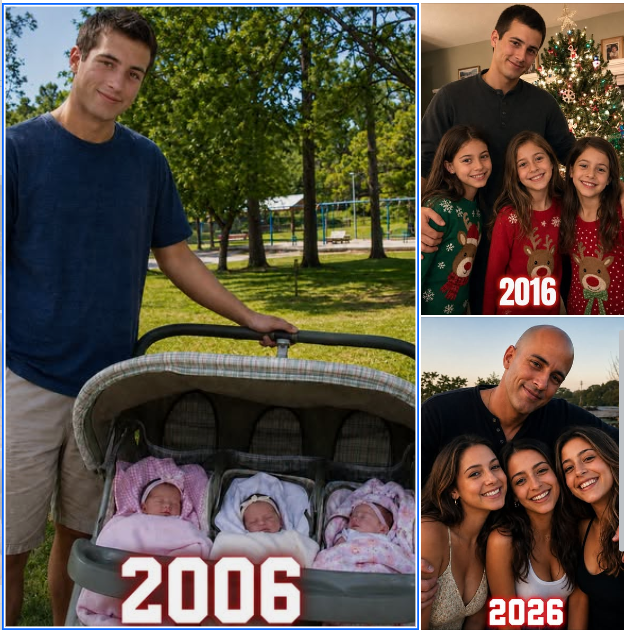
Part 1 — The First Time They Called Me Dad
The first time one of my little sisters called me Dad, I smiled at her, walked into the bathroom, locked the door, and cried.
Emma was barely two years old.
That afternoon, I was sitting cross-legged on the living-room floor in the middle of what looked like the aftermath of a tiny hurricane. Plastic blocks covered the carpet. Three sippy cups sat within arm’s reach. Crushed cereal had somehow found its way under the couch, beneath the coffee table, and probably into places I wouldn’t discover for another year.
Grace had fallen asleep with her cheek pressed against the sofa.
Sophie had managed to remove one sock and make it disappear.
Emma climbed onto my lap and placed a wooden cow in my hand.
“Daddy, moo.”
For a moment, I thought I had heard her wrong.
“What did you say?”
She frowned impatiently, pushed the wooden cow against my chest, and repeated herself.
“Moo, Daddy.”
I froze.
Before I could respond, Grace stirred awake.
Sophie wandered over.
Within seconds, all three girls were surrounding me, calling me some version of “Dad” while demanding that I imitate every animal in their wooden farm set.
I handed the cow back to Emma.
“One second.”
Then I walked as calmly as I could into the bathroom.
I closed the door.
Sat on the toilet lid.
And buried my face in my hands.
I cried harder than I had in years.
Not because I was unhappy.
Because somewhere along the way, without any of us deciding it, I had stopped feeling like their older brother.
And they had stopped seeing me as one.
A tiny finger suddenly appeared underneath the bathroom door.
Then a second.
Then a third.
“Daddy?”
I laughed through my tears.
“You three are supposed to be asleep.”
Of course, they weren’t.
Technically, Emma, Grace, and Sophie were my sisters.
But life had stopped caring about technicalities long before that day.
Two years earlier, I had been twenty-three years old and convinced my real life was finally about to begin.
I had graduated.
I had received an offer for a good job in Chicago.
A real salary.
Benefits.
My own apartment.
For the first time, I could imagine a future that belonged entirely to me.
I went home that afternoon planning to tell Mom the news.
Instead, I found her packing a suitcase.
And three newborn babies screaming down the hall.
Part 2 — The Day Our Mother Walked Away
Dad had died only weeks after the triplets were born.
Mom had never recovered from it.
I knew she was exhausted.
I knew she barely slept.
I knew grief had hollowed her out.
Still, nothing prepared me for what I saw when I walked into her bedroom.
Drawers were hanging open.
Clothes were scattered across the bed.
Mom was shoving shirts into a suitcase with angry, frantic movements.
“Mom?”
She didn’t turn around.
The babies continued crying from the nursery.
“Mom, what are you doing?”
Her hands stopped for only a second.
“I can’t do this anymore, Aaron.”
I gave a nervous little laugh because the alternative was admitting I was terrified.
“Okay. Then don’t do whatever this is.”
She turned to face me.
Her eyes were dry.
That frightened me more than tears would have.
“I’ve already spent my life raising a child,” she said.
I stared at her.
“What?”
“I’m not starting over with three more.”
The words didn’t make sense.
I looked toward the hallway, where the babies were still crying.
“Those are your daughters, Mom. They’re three months old.”
“I know.”
“Then stop packing.”
She grabbed another sweater.
“I want to live while I still can.”
My stomach dropped.
“You’re exhausted. That’s all. Go sleep. I’ll take care of them tonight.”
“No.”
“One night.”
“Aaron—”
“One day, then. Please. Tomorrow we’ll call somebody. We’ll ask for help. We’ll figure something out.”
She pulled the zipper closed.
I followed her downstairs.
When she reached the front door, I stepped in front of it.
“Mom, please.”
She stared at me.
“They need you.”
Her hand tightened around the suitcase handle.
Then something happened that I would replay in my mind for the next twenty years.
She stopped.
She looked toward the staircase.
For one brief second, I believed she had changed her mind.
I thought maybe the mother I remembered was still somewhere inside her, fighting to stay.
Then her eyes returned to mine.
“I’m sorry.”
She stepped around me.
Opened the door.
And left.
I stood there watching her car disappear until there was nothing left to see.
Behind me, three babies were crying.
By the time I closed the front door, Chicago no longer mattered.
The next morning, I called the company that had hired me.
The woman from human resources sounded confused.
“You haven’t even started yet.”
“I know.”
“We could postpone your start date.”
“I can’t move anymore.”
There was a pause.
“Is there an emergency?”
I looked into the living room.
Three bassinets.
Three bottles cooling on the counter.
One baby screaming while the other two appeared to be preparing to join her.
I swallowed.
“Yeah,” I said quietly. “There is.”
That phone call ended the life I had expected to have.
And began the one I never could have imagined.

Part 3 — Brother, Guardian, Father
People later told me I had “given up” my future.
I hated that phrase.
Nothing about what happened felt like one dramatic sacrifice.
There was no single moment when I became a parent.
It happened through a thousand exhausting little moments.
Social workers came to the house.
There were temporary arrangements, interviews, background checks, court hearings, and endless paperwork.
One woman once sat across from me and asked carefully,
“Aaron, do you understand what raising three infants will require?”
At that exact moment, Grace spit formula down the front of my shirt.
Emma began crying.
Sophie heard Emma and apparently decided crying was now a group activity.
I looked at the social worker.
“They have me.”
At first, I was their brother taking care of them temporarily.
Then I became their guardian.
Eventually, I became their legal parent.
Somewhere in between, without noticing exactly when, I simply became Dad.
Our life was chaotic.
I learned how to hold one baby against my chest while feeding another.
Every bottle was labeled.
Whenever someone got sick, I taped medication schedules to the refrigerator because the girls had an impressive ability to share every germ that entered the house.
Money was always tight.
I stretched every dollar until there was nothing left to stretch.
Dating became nearly impossible.
“What do you mean you have three kids?” someone would ask.
“They’re technically my sisters.”
That explanation never made things less complicated.
One woman lasted three dates.
Then one evening, she asked me,
“So when do you get your own life back?”
I didn’t answer immediately.
When I got home that night, Emma had a fever.
Grace had fallen asleep wearing my baseball cap.
And Sophie had drawn what she insisted was a horse in purple marker directly onto the refrigerator.
I spent twenty minutes scrubbing the refrigerator.
Then I changed Emma’s sheets.
I gently removed the baseball cap from Grace’s head.
Afterward, I called the woman.
I told her we weren’t going to work.
She had spoken as though the girls were an obstacle standing between me and my real life.
But by then, I understood something she didn’t.
They were my real life.
Reese—our mother—never came back.
Not for birthdays.
Not for Christmas.
Not when Emma broke her arm at nine.
Not when Grace won a statewide essay competition.
Not when Sophie graduated as valedictorian and kept pretending she wasn’t searching the audience until she finally spotted me standing there.
Year after year passed.
I stopped expecting Reese to return.
Eventually, the girls stopped asking about her.
We became our own family.
And then, twenty years after the afternoon she walked away, my mother came back into our lives.
Not in person.
Through a letter.
Part 4 — The Letter They Hid for Two Years
My forty-third birthday should have been ordinary.
Sophie was usually late.
Emma usually complained about whatever restaurant we picked.
Grace always brought something thoughtful and then claimed it was “nothing.”
That night, however, all three arrived together.
And none of them was smiling.
That was the first sign something was wrong.
During dinner, Emma barely touched her food.
Grace looked as though she had been crying before she arrived.
Sophie avoided my eyes.
Finally, I put my fork down.
“Okay. What happened?”
Silence.
Grace’s expression collapsed first.
Then Emma reached beneath her chair and took out an old envelope.
Sophie spoke quietly.
“We should have given you this two years ago.”
My chest tightened.
“What is that?”
Grace began to cry.
“Mom sent it to us when we turned eighteen.”
The word Mom sounded strange coming from her.
I stared at them.
“Mom?”
Emma nodded.
“She sent us a package.”
Her fingers tightened around the envelope.
“This was inside.”
I looked at the writing on the front.
I recognized it immediately.
Reese’s handwriting.
Older.
Less steady.
But unmistakably hers.
“If it’s for me,” I asked, “why did she send it to you?”
Sophie finally looked at me.
“She said she wrote it years ago but never had the courage to send it.”
“Then why give it to you?”
Grace wiped her cheeks.
“Because she wanted us to know what really happened.”
Emma looked down at the table.
“But she made us promise never to let you read it.”
I stared at my daughters.
“Why?”
Sophie’s voice broke.
“Because she thought if you knew the truth, you might see us differently.”
I almost laughed.
“What could possibly make me look at you differently?”
No one answered.
Emma slowly pushed the envelope across the table.
I took it.
For reasons I still can’t explain, my hands were trembling before I even opened it.
The paper smelled old, as though it had spent years folded away somewhere dark.
The first sentence made my stomach drop.
My dear son, I left because I learned what none of you were ever supposed to know…
I stopped reading.
Grace covered her mouth.
Then I forced myself to continue.
Mom wrote about the weeks surrounding Dad’s death.
She wrote about how overwhelmed she had become caring for three newborn babies.
She wrote about how Dad had noticed she was falling apart.
And then I reached a sentence that made me look up.
Your father had already made arrangements in case I couldn’t manage the girls alone.
I stared at Emma.
“What arrangements?”
Her eyes filled with tears.
“Keep reading.”
So I did.
Dad had spoken privately with a married couple our family had known for years.
I remembered them.
They had been at Christmas gatherings when I was younger.
They were older than Dad and had wanted children for a long time but had never been able to have any.
According to the letter, they adored the triplets.
Dad had trusted them.
He had talked with them about taking care of all three girls together if something happened and Mom couldn’t cope.
After Dad died, they approached Mom again.
They offered to take all three babies.
Not years later.
Not someday.
Immediately.
There had been another possible home waiting for Emma, Grace, and Sophie.
And Mom had known about it.
My hands began to shake harder.
I looked at the girls.
“She refused?”
Sophie nodded.
“Why?”
No one spoke.
So I returned to the letter.
And found the sentence that changed the way I remembered the last twenty years.
I refused them because I knew you were coming home.
I read it again.
Then again.
The next lines were even harder.
Mom wrote:
I knew you, Aaron. I knew if I left those babies in your arms, you would never let them go.
The room seemed to disappear around me.
She continued.
She had known I was coming home that afternoon.
She had known I would never abandon my infant sisters.
And if she simply walked away, she could leave knowing the girls would remain with someone she trusted.
Me.
She hadn’t merely left.
She had chosen her replacement.
Without asking him.
Without telling him there was another possibility.
Without giving him the chance to decide.
Mom admitted that at first she told herself she only needed time.
Then time became months.
She met someone.
She began another life.
And eventually, returning became harder than continuing to stay away.
For twenty years, I had believed grief had simply broken her.
Now I understood the truth was more complicated.
She had been desperate.
But she had also made a decision.
A decision that changed four lives.
And she had made it knowing exactly what I would do.

Part 5 — “You Lost Your Whole Life Because of Us”
I lowered the letter.
No one moved.
Emma was the first to speak.
“Dad?”
I folded the paper carefully because I needed something for my hands to do.
Sophie stared at me.
“There were people who would’ve taken us.”
Her voice was barely above a whisper.
“You didn’t have to.”
Emma stood suddenly, sending her chair scraping backward.
“You could’ve gone to Chicago.”
I said nothing.
“You could’ve had the job,” she continued. “You could’ve had your own life.”
Her face crumpled.
“You lost everything because of us.”
“No.”
The word came out sharper than I intended.
Emma flinched.
I stood.
“What exactly do you think ‘everything’ was?”
No one answered.
I picked up my keys.
“Come on.”
Grace blinked.
“Where are we going?”
“I need to show you something.”
The first place I took them was the apartment where we had lived when they were little.
It looked smaller than I remembered.
I stood outside and pointed toward an upstairs window.
“Three cribs couldn’t fit properly in the bedroom,” I told them. “So for a while, I slept in the living room.”
Sophie stared at me.
“You never told us that.”
“You never asked.”
She immediately looked guilty.
I nudged her shoulder.
“That wasn’t an accusation.”
Then I pointed toward the entrance.
“And Grace screamed every night for about three months.”
Grace looked offended.
“I absolutely did not.”
“You absolutely did.”
Sophie snorted.
Emma started laughing.
For the first time that evening, the tension loosened.
For a minute, there was no letter.
No mother who had disappeared.
No lost opportunities.
Just the four of us remembering the ridiculous years when survival meant making it until bedtime.
Then we went to the grocery store where I had worked night shifts when money was especially tight.
An older employee recognized me.
She stared at me, then at the girls.
Her eyes widened.
“No.”
I laughed.
“Yep.”
She pointed at them.
“The babies?”
Emma groaned.
“We’re apparently going to be babies forever.”
The woman laughed.
Then she remembered the three plastic laundry baskets I used to bring everywhere.
One marked E.
One marked G.
One marked S.
I had used them to organize diapers, clothes, snacks, bottles, medicine, and every other emergency item three little girls could possibly require.
I had kept those battered baskets long after the girls stopped needing them.
Sophie used to climb inside hers.
Grace used hers to hide crackers.
Emma once fell asleep inside one while we were moving.
The employee shook her head with a smile.
“Your brother worked himself half to death raising you girls.”
Without thinking, I corrected her.
“Dad.”
The word left my mouth naturally.
Silence followed.
The girls stared at me.
I hadn’t even realized what I had said.
But they had.
Our final stop was the old playground.
We had spent hundreds of Sundays there because, when the girls were little, free entertainment was usually the only kind I could afford.
The equipment had changed.
The trees were taller.
But sitting there with my three daughters beside me, I could almost see their younger selves running across the grass.
Emma sat next to me.
“Dad…”
I looked at her.
“Mom was right about one thing.”
I waited.
“You had another choice.”
I nodded.
“Yes.”
Grace looked down at her hands.
“Do you wish you had known?”
That question hurt more than anything written in the letter.
I looked at Emma.
Then Grace.
Then Sophie.
“I wish she had told me.”
Sophie’s eyes filled again.
“You deserved the choice.”
“So did you.”
They became quiet.
I leaned forward.
“Yes, I could have gone to Chicago.”
Emma began crying.
“I could have accepted that job. I could have let someone else raise you.”
Grace looked away.
Sophie wiped her eyes.
“But listen carefully.”
All three looked at me.
“Wishing I had been given the choice is not the same thing as wishing I had chosen differently.”
No one spoke.
So I said it again.
“Don’t confuse wanting the choice with wanting a different answer.”
Sophie broke first.
She threw her arms around me.
Grace followed.
Emma held out for about three seconds before joining us.
Suddenly, three grown women were crushing me on an old playground bench.
I laughed into someone’s hair.
“You’re killing me.”
“Good,” Emma muttered.
Apparently twenty years of revenge had finally arrived.
Part 6 — What My Mother Never Understood
When we returned home, Mom’s letter was still lying on the kitchen counter.
I looked at it once.
I had read every word.
I understood why she had hidden the truth.
Maybe she had been ashamed.
Maybe she had spent years convincing herself she had done what she needed to survive.
Maybe she genuinely believed knowing the truth would make me resent the girls.
But she had been wrong about that.
Completely wrong.
A few minutes later, the girls disappeared into the spare room.
Then I heard several loud crashes.
I called down the hallway.
“What are you doing?”
“No questions!” Sophie shouted.
“That usually means I should be asking more questions.”
“Stay there!”
A minute later, they marched into the living room.
Each of them was carrying one of the old plastic laundry baskets.
The plastic had faded with age.
The marker had nearly worn away.
But the letters were still there.
E.
G.
S.
Emma grinned.
“Apparently Dad is a hoarder.”
“I prefer historically sentimental.”
Grace rummaged through hers and pulled out my old baseball cap.
She laughed.
“You kept this?”
“Apparently.”
Then Sophie reached into her basket and triumphantly held up one tiny sock.
I stared at it.
“No.”
Her smile widened.
“Yes.”
I burst out laughing.
“Is that the sock you lost when you were two?”
“No idea.”
“It took me three weeks to find that thing.”
Emma dropped onto the carpet.
Grace followed.
Soon the three of them were sitting on the living-room floor, digging through pieces of their childhood and arguing about which basket had belonged to whom.
For twenty years, I had believed my mother left because she thought motherhood had stolen her future.
Then I learned she had also believed those three girls would steal mine.
But there they were.
Emma, Grace, and Sophie.
My sisters.
My daughters.
The children who had turned my tiny apartment into chaos.
The girls who had kept me awake all night.
The teenagers who had tested every ounce of patience I possessed.
The women who still called me Dad.
Had my life gone the way I imagined when I was twenty-three?
Not even close.
I never made it to Chicago.
I never lived in that apartment I had pictured.
I never found out what the version of Aaron who took that job might have become.
And for the first time, I understood that it was okay to grieve the fact that the choice had been taken away from me.
Mom should have told me.
She should have trusted me enough to decide for myself.
But there was something else she never understood.
A life can change without being ruined.
A future can disappear and be replaced by another one.
And sometimes the life you never planned becomes so deeply yours that you cannot imagine yourself anywhere else.
Grace patted the carpet beside her.
“Come sit down, Dad.”
I looked toward the kitchen.
Mom’s letter was still there.
For two decades, her decision had shaped my life.
That evening, for a few hours, her words had threatened to rewrite everything I remembered.
But I realized I didn’t have to let them.
She had made her choice.
Years later, I finally understood mine.
I walked past the letter.
Crossed the living room.
And sat down on the floor between my daughters.
Sophie immediately shoved the tiny sock into my hand.
Emma started arguing that her basket had clearly been the best organized.
Grace called her a liar.
I laughed until my sides hurt.
And as I sat there surrounded by three faded laundry baskets and the women I had raised, one truth became clearer than anything my mother had written.
She had been right about me all those years ago.
If she left those babies in my arms, I would never let them go.
What she never understood was this:
Twenty years later, I still wouldn’t.
Not because I had no other choice.
But because they were my family.
And despite everything—
I would choose them again.
Every single time.