
Part 1 — The Empty Seat Beside Us
Before my husband died, Sundays were loud in our house.
Very loud.
Austin loved football with the kind of enthusiasm that made the entire living room feel like part of the stadium.
I had never been much of a fan myself. I knew the basics, but Austin could talk for twenty minutes about a single play and somehow make it sound like a life-or-death strategy meeting.
Our daughter Kelly adored every second of it.
She learned football sitting beside him on the couch, usually with a bowl of popcorn balanced precariously in her lap.
When she was six, Austin pointed toward the television during a game.
“Okay, Kel. What does the safety do?”
She narrowed her eyes at the screen as though carefully considering the question.
“Stops everybody from being safe?”
Austin stared at her for half a second.
Then he burst out laughing.
“Well, not exactly. But I admire the logic.”
By the time Kelly was seven, she knew enough about football to argue with grown men.
She knew players.
Positions.
Penalties.
Coaches.
She could identify formations before I even understood that a formation had happened.
And, more importantly, she learned exactly how to use football against her father.
“Dad, I can’t go to bed yet. The game isn’t finished.”
“It’s already past bedtime.”
“But you said fourth quarters build character.”
Austin frowned.
“I absolutely never said that.”
Kelly looked at me.
“Mom?”
I tried not to smile.
“It sounds like something you might have said.”
Austin pointed at me.
“You’re supposed to be on my side.”
Kelly grinned.
Twenty minutes later, she was still awake.
Football belonged to the two of them.
I mostly watched from the opposite end of the couch, pretending to understand why they were yelling at the television.
Then one ordinary morning, Austin kissed me goodbye before work.
He reminded Kelly to finish her spelling homework.
He said, “Love you.”
And left.
That afternoon, a police officer knocked on my door.
Austin had been killed in a car accident.
There are moments that divide your life so completely that everything afterward feels like it belongs to someone else.
That knock was mine.
For months, our house became unbearably quiet.
The football games stopped.
Kelly stopped asking about scores.
Austin’s team jersey remained draped over the back of his favorite chair exactly where he had left it.
I could not move it.
Neither could Kelly.
Every Sunday, she still sat beside me on the couch.
But instead of watching football, she stared at the empty cushion where her father should have been.
Sometimes I caught myself listening for him from another room.
His laugh.
His voice.
The sound of him arguing with a referee who obviously could not hear him through the television.
Nothing came.
Grief had taken someone noisy and somehow left silence everywhere.
Then, about six months after the accident, Kelly came into the kitchen while I was making lunch.
“Mom?”
“Yeah?”
“What time does the game start?”
I froze.
“What game?”
She gave me a look that was so much like Austin that my chest tightened.
“Dad’s team.”
I glanced at my phone.
“Four thirty.”
She hesitated.
“Can we watch it?”
I tried not to make too much of the moment.
I knew that if I reacted too emotionally, she might retreat.
So I simply nodded.
“Of course.”
Kelly walked into the living room.
A minute later, I followed.
She was standing beside Austin’s chair, holding his jersey.
Then she slipped it over her head.
It hung nearly to her knees.
She climbed onto the couch.
And for the first time since Austin died, football returned to our house.
Part 2 — The Birthday Surprise
After that Sunday, Kelly watched every game.
Some weekends were easier than others.
Sometimes she laughed.
Sometimes she shouted at the television.
Sometimes the team would make a play Austin would have loved, and Kelly would suddenly become very quiet.
I learned not to ask too many questions in those moments.
Grief has strange rhythms.
Children understand more than adults sometimes give them credit for, but they don’t always have the language to explain what they feel.
Football became one of the ways Kelly stayed connected to her father without having to say, I miss him, every five minutes.
As her eighth birthday approached, I wanted to give her something special.
Money had been tighter since Austin’s death.
There was one income now.
One parent handling everything.
One person paying bills, repairing things, remembering appointments, packing lunches, worrying about the future.
Still, for months I had been quietly putting money aside.
Twenty dollars here.
Ten dollars there.
Skipping little things I didn’t really need.
Finally, I had enough.
Two tickets to a home game.
They weren’t front-row seats.
They weren’t luxury seats.
But they were close enough to the field that Kelly would be able to see the players clearly during warmups.
The moment I handed her the tickets, she screamed.
“Are these real?”
I kept a straight face.
“No. I printed fake football tickets just to traumatize you on your birthday.”
“Mom!”
I laughed.
“Yes. They’re real.”
Kelly launched herself into my arms.
Then, with her cheek against my shoulder, she whispered something that made my eyes sting.
“Dad always said he was going to take me.”
I held her tighter.
“I know.”
That night, she put the tickets beside her bed before going to sleep.
The evening before the game, Kelly disappeared into her bedroom with markers, poster board, and an expression of serious concentration.
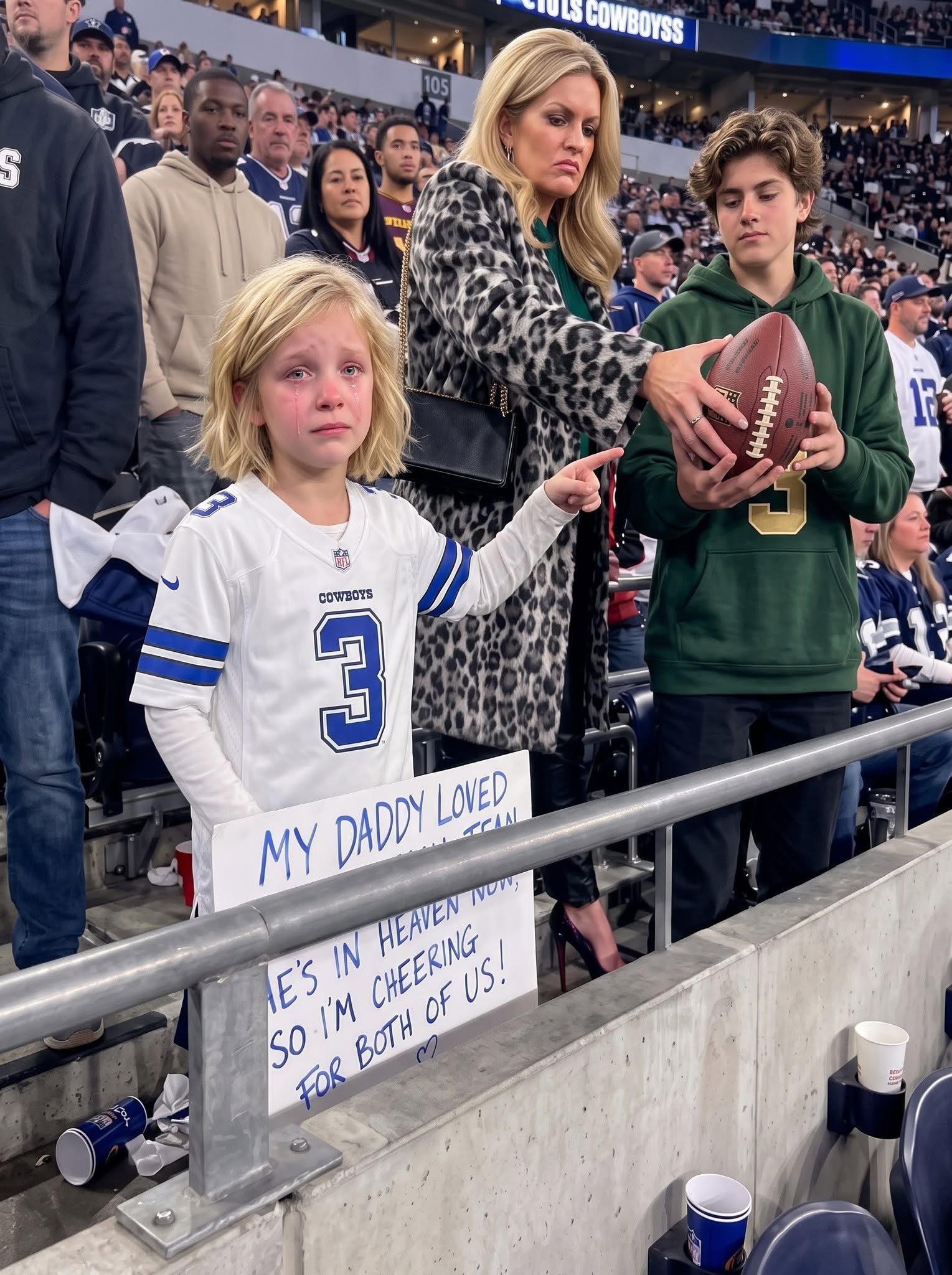
About an hour later, she returned carrying a handmade sign.
The blue letters were uneven.
Some leaned sideways.
One word had clearly been rewritten after she ran out of space.
But none of that mattered.
It read:
MY DADDY LOVED THIS TEAM. HE’S IN HEAVEN NOW, SO I’M CHEERING FOR BOTH OF US.
I stopped breathing for a moment.
Kelly studied my face nervously.
“Is it bad?”
I turned away quickly and wiped beneath one eye.
“No.”
“You’re crying.”
“I’m allowed to cry.”
“Because it’s bad?”
I looked at her.
“Because it’s perfect.”
Her face relaxed.
I carefully folded the sign so it wouldn’t get damaged.
That night, after Kelly went to bed, I stood alone in the living room.
Austin’s jersey was still over his chair.
I touched the sleeve.
“I wish you were coming with us,” I whispered.
Then I went upstairs.

Part 3 — The Moment Marcus Saw Her
The stadium was louder than Kelly had imagined.
The moment we walked through the gates, she looked as though someone had plugged her directly into an electrical outlet.
She wanted to see everything.
The merchandise stands.
The field.
The giant screen.
The players warming up.
She carried her sign in front of her as though it were the most valuable thing she owned.
People noticed it.
One man passing us slowed down long enough to read the message.
He gave Kelly a gentle thumbs-up.
“Your dad had good taste.”
Kelly smiled.
“Thanks.”
Another fan stopped near the concession stand.
“Sorry about your father, kiddo.”
Kelly answered quietly,
“Thank you. He would’ve loved being here.”
Every time she said that, my heart hurt a little.
But it was a different kind of hurt than before.
There was pride mixed into it.
Our seats were close enough to the field that we had an excellent view of warmups.
Kelly immediately began narrating everything for me.
“That’s Marcus.”
“I know.”
She turned sharply.
“You do not.”
“I know who Marcus is.”
“Mom, he was Dad’s favorite player.”
“I knew that part.”
Marcus was a veteran receiver Austin had defended with almost unreasonable loyalty through good seasons, bad seasons, questionable coaching decisions, and what he once called “the most criminally misunderstood offense in the league.”
Kelly knew all of this.
Of course she did.
She stood near the railing holding her sign.
Marcus jogged past once without noticing.
Then he came back.
His eyes moved toward our section.
He slowed.
Then stopped.
I watched his expression change as he read the sign.
He read it once.
Then again.
Then he pointed directly at Kelly.
She grabbed my sleeve.
“Mom.”
“I see him.”
“He’s pointing at me.”
“I know.”
Her eyes became enormous.
Marcus reached for a football.
Then he motioned toward Kelly.
A few people around us realized what was happening.
One man behind us shouted,
“Make room! It’s for the little girl!”
Marcus tossed the ball.
For one terrifying second, I thought someone taller was going to grab it.
Instead, it dropped directly into Kelly’s arms.
She clutched it against her chest.
The entire world seemed to stop.
Her mouth opened.
No sound came out.
Then she screamed.
“MOM!”
She was laughing and crying at the same time.
“Mom, look!”
“I see it!”
“Marcus threw me a ball!”
“I noticed!”
“Daddy would’ve lost his mind!”
That nearly broke me.
I laughed through the tears gathering in my eyes.
“He would’ve told everybody he caught it himself.”
Kelly hugged the football even tighter.
And for a few beautiful seconds, everything was exactly what I had hoped that day might become.
A little girl had received something magical.
Something she could connect to her father.
Something good.
Then a hand reached across me.
And the football disappeared from Kelly’s arms.
Part 4 — “My Son Deserves It More”
At first, I didn’t understand what had happened.
Kelly gasped.
I turned.
A woman sitting beside us had taken the football.
She immediately handed it to the teenage boy next to her.
He looked about fourteen.
Old enough to understand exactly what had just happened.
He stared down at the ball as though it had suddenly become dangerous.
I looked at the woman.
“What are you doing?”
She adjusted her coat.
“My son should have it.”
For a second, I honestly thought she must be joking.
“What?”
“He’s played football for three years.”
I stood up.
“That player threw the ball to my daughter.”
The woman rolled her eyes.
“He threw it into the stands.”
“No. He pointed directly at her.”
“So?”
Behind me, Kelly whispered,
“Mom.”
I looked down.
Her eyes had filled with tears.
That changed everything.
Until then, I had been confused.
Now I was furious.
I held my hand out toward the woman.
“Give it back.”
She laughed.
Actually laughed.
“No.”
“Give my daughter her football.”
“My son deserves it.”
“Why?”
“Because he actually understands football.”
I stared at her.
She glanced at Kelly.
Then she said,
“Girls don’t understand football. My son deserves it more.”
Several people around us reacted immediately.
One man behind our row said,
“Seriously?”
The woman ignored him.
She looked at Kelly’s handmade sign.
Then she added something I still wish Kelly had never heard.
“This probably won’t even matter to her tomorrow. Buy her a doll or something.”
Kelly wiped her cheek.
I felt anger rise so quickly that for a second I had to remind myself that my daughter was watching me.
The teenage boy—Ethan, I later learned—looked mortified.
He held the football loosely.
“Mom…”
His mother silenced him with a glance.
I stepped closer.
“That ball means something to her.”
The woman shrugged.
“Well, it means something to my son too.”
Before I could answer, the people behind us suddenly started yelling.
Not at the woman.
Toward the field.
I turned.
Marcus was staring directly into our section.
He wasn’t smiling anymore.

Part 5 — The Stadium Saw Everything
Marcus pointed toward Kelly.
Then toward the football in Ethan’s hands.
A staff member standing near the sideline followed his gesture.
The next few seconds happened so quickly that I barely understood them.
Marcus reached for a microphone.
The noise inside the stadium dipped.
Then his voice came through the speakers.
“I threw that ball to the little girl holding the sign.”
Kelly grabbed my hand.
Her fingers squeezed mine so tightly that my knuckles hurt.
Marcus kept looking toward us.
“The young man holding it knows who it belongs to.”
The giant stadium screen changed.
Suddenly our entire row was displayed above the field.
Me.
Kelly.
The woman.
And Ethan.
Holding the football.
The woman’s confidence disappeared instantly.
“Ethan,” she whispered.
He stared at the screen.
Then at Kelly.
An usher and a security officer appeared at the end of our row.
The woman immediately pointed at me.
“She’s been harassing me!”
Someone behind us laughed in disbelief.
“Lady, we all watched you take the ball.”
The security officer looked at Ethan.
His mother began,
“The player threw it into the crowd—”
“Mom.”
Ethan’s voice was quiet.
But firm.
She turned toward him.
“What?”
“Stop.”
Her face tightened.
“I was trying to help you.”
“I didn’t ask you to.”
“Ethan—”
“He threw it to her.”
For the first time, the woman seemed genuinely speechless.
Ethan looked at the football.
Then at Kelly.
“I said I wanted a game ball someday,” he continued. “I didn’t mean somebody else’s.”
He stepped toward us.
Then held out the football.
“I’m sorry.”
Kelly hesitated.
She looked at me.
I nodded.
She took it.
“It’s okay.”
Ethan shook his head.
“No. It wasn’t.”
His mother’s face turned bright red.
I glanced toward the field.
Marcus was still watching.
When Ethan returned the ball, Marcus gave him a small nod.
Not dramatic.
Not triumphant.
Just an acknowledgment that the boy had eventually done the right thing.
Then the giant screen switched back to warmups.
I thought it was over.
It wasn’t.
The usher leaned toward me.
“Would you and your daughter mind staying here for a few minutes?”
My first thought was that somehow there was another problem.
“Why?”
He smiled slightly.
“Someone wants to meet her after warmups.”
Kelly’s eyes widened again.
Part 6 — “What Was Your Dad’s Name?”
A few minutes later, the usher led us down a concrete hallway beneath the stadium.
Kelly carried the football pressed against her chest the entire way.
She kept looking at me.
“Am I in trouble?”
“No.”
“Are you sure?”
“Mostly.”
Her eyes narrowed.
“Mom.”
“I’m kidding.”
We reached a door near the players’ tunnel.
It opened.
Marcus was standing on the other side.
Kelly stopped so suddenly I almost walked into her.
Her mouth fell open.
“Oh my God.”
Marcus smiled.
“Hey.”
Kelly immediately moved halfway behind me.
Apparently, she could argue football strategy with strangers but could not speak to her favorite player when he was standing six feet away.
Marcus crouched slightly.
“You’re Kelly, right?”
She nodded.
“I read your sign.”
Kelly held the football tighter.
Marcus’s voice softened.
“What was your dad’s name?”
“Austin.”
He nodded.
“Austin.”
Then he smiled.
“My dad taught me football too. Pretty much everything I knew when I was your age.”
Kelly’s expression softened.
“Dad taught me everything too.”
Then she pointed at me.
“Because Mom doesn’t understand penalties.”
I looked at her.
“Excuse me?”
Marcus laughed.
Kelly finally smiled.
He pointed toward the football.
“Can I borrow that for a second?”
Kelly handed it over.
Marcus took a marker from his pocket.
“Usually I just sign my name.”
Then he looked at me.
“How do you spell Austin?”
My throat tightened immediately.
“A-U-S-T-I-N.”
Marcus carefully wrote beneath his signature.
Then he handed the football back to Kelly.
She read the message.
For Kelly and Austin — keep cheering together.
Her finger traced Austin’s name.
Once.
Then again.
Her lips began trembling.
And suddenly she was crying.
Not quiet tears.
Full eight-year-old sobbing.
Marcus looked alarmed.
“Good crying?”
Kelly nodded hard.
“Good crying.”
I laughed while wiping my own face.
“Thank you.”
Marcus shook his head.
“I’m glad she was here.”
Then he looked at Kelly again.
“I have one more question.”
She sniffed.
“What?”
“If your mom says it’s okay, would you like to stand by the tunnel during player introductions?”
Kelly stared at him.
Then whipped around toward me.
“Mom.”
I laughed.
“Yes.”
“Mom!”
“I already said yes!”
She bounced in place.
And for the first time in a long time, the tears on my daughter’s face had nothing to do with losing her father.
They were there because something wonderful had happened.
Part 7 — Ethan
When the team ran onto the field, Kelly screamed until her voice turned raspy.
She stood beside the tunnel clutching the signed football against her chest.
The noise.
The lights.
The players rushing past.
For those few minutes, she looked completely alive.
I watched her more than I watched the team.
And somewhere inside all that joy was grief.
I knew it.
She knew it.
But grief wasn’t winning that moment.
Life was.
After the game, we were walking through the concourse when we saw Ethan.
His mother stood several feet away talking angrily on her phone.
Ethan noticed us.
He lifted one hand.
“Hey.”
Kelly stopped.
He came closer.
“I’m sorry again.”
Kelly shrugged.
“You already apologized.”
“I still should’ve given it back immediately.”
She considered this seriously.
“Probably.”
Then, after a moment, she added,
“But I might’ve hesitated too.”
I bit the inside of my cheek to keep from laughing.
Ethan smiled.
“I hope the rest of your day was better.”
Kelly held up the football.
“It was.”
He nodded.
Then we walked away.
I never spoke to his mother again.
I didn’t need to.
That afternoon wasn’t ultimately about her.
It was about Kelly.
It was about Marcus noticing a little girl’s sign.
It was about strangers speaking up.
It was about a teenage boy being brave enough to admit when his mother was wrong.
And it was about my daughter getting something back that had almost been taken from her.
Not just a football.
A memory.

Part 8 — The Question I Couldn’t Answer
That evening, Kelly placed the signed football on the coffee table.
Then she carefully draped Austin’s jersey over his old chair.
She stood looking at both for a while.
I watched from the doorway.
“You okay?”
She nodded.
“Dad would’ve been jealous.”
I smiled.
“Extremely.”
“He would’ve touched the ball too much.”
“Constantly.”
“And told everybody Marcus threw it to him.”
“Absolutely.”
Kelly smiled.
Then her eyes returned to the writing on the football.
For Kelly and Austin — keep cheering together.
“Mom?”
“Yeah?”
She stayed quiet for a few seconds.
Then she asked,
“Do you think Dad saw everything today?”
There are questions adults wish they had better answers for.
That was one of mine.
I could have given her something certain.
Something comforting.
But I had spent too much of the previous year learning how little control we have over certainty.
So I sat beside her.
“I don’t know.”
She looked at me.
I touched her hair.
“But I hope he did.”
Kelly nodded.
“Me too.”
A few weeks later, she wrote Marcus a thank-you letter.
She spent nearly an hour on it.
At the bottom she added one final sentence without asking me for help.
The football is beside my dad’s jersey now. I think he would like that.
I had to leave the room after reading it.
Part 9 — Sundays Became Ours
Life did what it always does.
It continued.
There were school mornings.
Laundry.
Homework.
Grocery shopping.
Bills.
Birthdays.
Bad days.
Unexpected good ones.
Sunday football remained part of our routine.
It was never exactly the same without Austin.
It never will be.
His chair is still in the living room.
Before kickoff, Kelly still takes his jersey and places it across the back.
The signed football stays on the coffee table nearby.
Sometimes I wonder whether keeping those things there means we haven’t moved on.
Then I remind myself that healing doesn’t require pretending someone wasn’t here.
Last Sunday, Kelly and I were watching a replay.
I was sitting at my usual end of the couch.
She sighed loudly.
“Mom.”
“What?”
“Come closer.”
“I’m comfortable.”
She patted the cushion beside her.
“Dad would’ve explained that play to you already.”
I looked at Austin’s chair.
Then I moved closer to her.
“Fine. Explain it.”
Kelly leaned toward the television.
“Okay. Watch the safety.”
I nodded thoughtfully.
“The person who stops everybody from being safe?”
She slowly turned her head.
The look she gave me was pure disbelief.
“That was when I was six!”
“I remember important things.”
“That is not what a safety does.”
“Then educate me.”
She rolled her eyes.
And then she started explaining.
Coverage.
Routes.
Where the quarterback was looking.
What the defender should have done.
I understood maybe half of it.
But suddenly, I wasn’t really watching the television.
I was watching her.
The way her hands moved when she became excited.
The seriousness in her expression.
The little crease between her eyebrows.
The way she explained football with the same patient confidence Austin once used with her.
And I realized what was happening.
She was teaching me now.
Exactly the way he had taught her.
I glanced toward Austin’s empty chair.
For so long, that chair had represented only what was missing.
His laugh.
His voice.
His body beside us.
All the Sundays we were supposed to have.
Then I looked back at Kelly.
She was smiling.
And for the first time since Austin died, I understood something I hadn’t been ready to understand before.
The empty place beside us was real.
It would always be real.
But it wasn’t the only thing left.
Austin was there in Kelly’s love of the game.
In the facts she remembered.
In the jokes we repeated.
In the jersey on the chair.
In the football on the table.
In the way she pointed at the television and patiently explained something I still barely understood.
Grief had once made me believe that losing Austin meant everything connected to him would eventually become painful.
Instead, some of those things became bridges.
Football had been theirs.
Now, somehow, it was becoming ours.
Kelly pointed at the screen again.
“Mom, are you even listening?”
I smiled.
“Of course.”
“What did I just say?”
I hesitated.
She stared at me.
Then we both started laughing.
And for once, the sound filled the room without making the silence beside us hurt quite so much.