
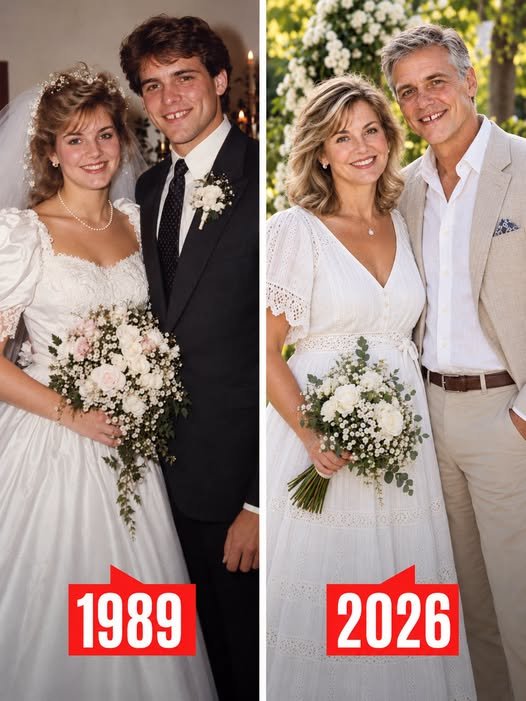
After thirty-seven years of marriage and two years spent clawing my husband back from cancer, I believed our vow renewal would be the day we finally exhaled. Instead, eight words from an eight-year-old cracked open a secret I never saw coming — and made me ask what surviving had actually done to my marriage.
Part One: The Girl Who Wouldn’t Let Go of the Rings
“I’m not giving Grandpa the rings yet.”
A ripple of laughter moved through the folding chairs. Someone thought it was a joke — a flower girl getting stage fright, maybe, or milking her moment.
I didn’t laugh. Neither did Robert.
He stood beneath the white rose arch Millie had spent a week wiring together, one hand lifted halfway toward Lucy, our eight-year-old granddaughter, frozen at the top of the aisle. She wore a pale-blue dress and clutched a small ring box to her chest — the one she’d covered in crooked gold hearts with a glue stick and more determination than skill.
“Lucy.” Robert’s voice had gone careful. “What are you doing, sweetheart?”
She didn’t answer him. She looked at me instead, and something in her face had hardened into a decision.
“Not until Grandpa tells you what he does every Friday with that woman.”
The backyard went dead silent. I felt my knuckles whiten around my bouquet.
Lucy’s arm shot out, one small finger aimed at the last row of chairs. I turned. A woman near the back had gone the color of paper.
I knew her. Marianne. I’d met her once during Robert’s treatment — she’d shown up with a casserole, sat beside his recliner, talked with him in a low voice while I stood at the sink pretending not to listen. Robert had introduced her as someone from his support group. That had been months ago. I had no idea she was still anywhere near his life.
“Kirsten.” Robert said my name the way he used to say it before a scan came back.
“Answer your granddaughter.”
He glanced past me, at the rows of our family watching. “Can we go inside and talk about this?”
“You invited her, Robert. She’s sitting in our daughter’s backyard at our vow renewal. Answer her.”
His jaw tightened. “I did invite her.”
A murmur rolled through the guests. Millie, our daughter, moved closer to Lucy and set a hand on her shoulder without saying a word — and I was grateful for that. I didn’t need rescuing. I needed the truth.
“What happens on Fridays?” I asked.
Robert opened his mouth. Lucy got there first.
“They dance.”
My bouquet suddenly weighed twenty pounds. Robert closed his eyes like he’d been waiting for that exact sentence to land.
“You dance with her?”
“It isn’t what you think, Kirst.”
“Then tell me what it is.”
He took one step toward me. I stepped back. He stopped where he stood.
“I wanted it to be a surprise. My leg still locks up some mornings — I didn’t want to stumble in front of everyone today. Marianne’s been helping me practice.”
Lucy nodded, very serious. “He’s still bad at it.”
Somewhere behind me, somebody laughed nervously. On any other day, I might have laughed too. At our first wedding, thirty-seven years earlier, Robert had stepped clean through the hem of my dress and nearly reversed us into the cake.
Then the cancer came, and dancing stopped being the kind of thing we worried about.

Part Two: What Two Years of Survival Cost Us
For two years our whole world had shrunk down to hospital corridors, pill organizers lined up like soldiers on the counter, saltines stashed in my purse for the drive home, and the recliner where Robert slept because lying flat had become its own kind of pain. After one round of chemo left him too weak to climb our own stairs, he’d gripped my fingers and whispered, “If I make it through this, marry me again.”
“Only if you dance with me this time,” I’d told him.
That promise became the thing our family held onto instead of saying the word we were all afraid of. Millie planned flowers and menus before every scan, like ritual could keep bad news away. Lucy declared she’d be the one carrying the rings, because — in her words — “Grandpa can’t be trusted with anything important.”
Three months ago, Robert’s doctor finally said the word we’d barely let ourselves hope for out loud.
Remission.
So we planned this day. And now it turned out another woman had spent weeks teaching my husband the dance he’d promised only to me.
“That’s all Lucy saw,” Robert said quietly.
Something about the sentence snagged in my chest before I could name why. Not that’s all there was. That’s all Lucy saw.
I lowered the bouquet. “Then what didn’t she see?”
His face shifted, and the fear that moved across it wasn’t the fear of a man caught red-handed. I knew Robert’s frightened face intimately — I’d watched it before every scan, every set of results, every treatment that left him hollowed out and unable to eat.
“We started talking after group meetings almost a year ago. The Fridays became regular once you went back to book club.”
A year. A whole year of Fridays.
Millie was the one who’d pushed me back toward book club in the first place. “Dad knows how to work a phone, Mom. You need some time that isn’t about him.” Robert had kissed my cheek and told me to go, please. So I did. Fridays slowly became mine again — two hours a week where I laughed about things that had absolutely nothing to do with cancer.
I turned toward Marianne. She was already on her feet.
“I should go.”
“No,” I said. “Please stay.”
Robert’s head snapped toward me. “Kirsten, she doesn’t need to be pulled into this.”
“I wasn’t asking you.” He went quiet. I looked back at Marianne until she sat down again.
Then I faced my husband. “Tell me everything.”
He dragged both hands down his face. “Marianne and I started talking during treatment. She understood things nobody else around me did.”
“I was there the entire time.”
“I know.”
“You keep saying that like being present was the whole job. I was your wife, Robert. Not your nurse. Not your witness. Your wife.”
Part Three: The Night I Found the Couch Empty
A memory surfaced, sharp and unwelcome. After his fourth round of chemo, I’d woken at two in the morning to an empty half of the bed. I found him downstairs on the couch, staring into the dark like it owed him an answer.
I sat beside him. “Talk to me.”
“I’m fine. Go back to bed.”
I didn’t move. “You’ve been down here alone?”
“I’m tired, Kirsten.”
“Then why aren’t you sleeping?”
His jaw had gone tight in a way I recognized. “Can we not do this? Turn every rough night into a crisis?”
“You’re scared,” I said.
“I’m not.”
“Then tell me what this is.”
He looked away. “Please. Stop looking at me like I’m already dying.”
I’d stood up before he could see me cry, told him we were both exhausted, and let it go. Then I’d shut myself in the bathroom and cried where he couldn’t hear.
Standing under the roses now, I looked at him and asked the question I’d carried since that night without knowing it. “Did you call Marianne after that? The night on the couch — you know exactly what I’m asking.”
He didn’t answer. That silence was its own answer.
“What did you tell her that you wouldn’t tell me?”
His eyes filled. “Things I couldn’t say to you.”
“What things?”
He glanced toward our family, toward the folding chairs full of people who loved us. “Robert,” I said, “we are well past protecting appearances.”
He swallowed hard. “I told her I was terrified I wasn’t going to make it. I told her I kept picturing you waking up next to me one morning and realizing I’d stopped breathing in the night. I hated watching you run yourself into the ground taking care of me.”
“You told her all of that.”
“Yes.”
“But when I asked you — the same question, in the same house — you shut the door on me.”
“I thought you already had enough to carry.”
“You let me carry everything, Robert. Everything except the truth.”
“I slept every night with my hand on your chest because I was afraid you’d stop breathing. I built my entire life around keeping you alive.”
“And somehow your fear found somewhere else to live.”
“I wasn’t trying to hurt you.”
“No. But you were still deciding for me.”
The yard had gone utterly silent. Then Marianne spoke for the first time.
“Kirsten — I told him you deserved to know.”
I turned to her. “Did you know he was hiding this from me?”
“Not at first.”
“And later?”
She hesitated half a second too long. “Yes.”
Her eyes didn’t waver from mine. “I’m sorry you were the one person who never knew how frightened he really was. But nothing happened between us. Nothing intimate. Nothing romantic. I need you to know that.”
And for the first time all afternoon, nobody in that yard was defending what had happened. They were finally just naming it plainly. Strangely, knowing there’d been nothing romantic didn’t make the ache any smaller.
“Then why did the Fridays keep happening?” I asked.
Robert looked at Marianne. She gave the smallest shake of her head — this part was his to answer, not hers.
“When treatment ended, everyone expected me to just feel normal again,” he said.
“But you didn’t.”
“No.”
“Neither did I,” Marianne said quietly. I looked at her. “People kept telling me how lucky I was. They meant it kindly. But every headache still terrified me, every follow-up appointment still felt like a verdict. Robert understood that in a way no one else around me did.”
“She did the same for me,” Robert said.
I swallowed hard. “And where, exactly, was I supposed to put my fear?”
He went very still. I stepped closer.
“I gave you everything you needed to survive this. But do you know what I never got to do?”
“Kirsten—”
“I never got to sit on our porch and tell my own husband that I was terrified too. I never got to say I was scared of losing you and hear that you were scared right back. I never got to fall apart, Robert, because you’d already decided for both of us that I was carrying enough.”
His face changed, something in it finally cracking open. “You thought you were protecting me.”
“I did.”
“You protected me right out of our marriage.”
Silence again. I turned to Marianne. “You thought he’d vanish the moment he got well. That you’d become one more person he outgrew.”
She nodded. “Part of me believed that.”
“I didn’t want to be the person who left the second the crisis ended,” Robert said.
I faced him. “So instead you kept showing up for her. And hiding it from me.”
“Yes.” A breath. “Yes.”
Millie stepped in close. “Mom — do you need a minute? We can call the whole thing off.”
“I just need to understand, Millie. That’s all I need.” She stayed beside me anyway, quiet and steady.
I turned back to Robert. “What actually happened on those Fridays?”
“Mostly coffee. Talking. The dancing only started a few weeks ago.”
Lucy’s hand shot into the air like she was back in her second-grade classroom. “He told me not to tell Grandma.”
Robert’s eyes went wide. “About the dance, Lucy.”
She frowned up at him. “You said it was our secret.”
And that was the moment everything clicked into place — she had understood the secret exactly the way an eight-year-old would understand it.
I crouched down in front of her. “You thought Grandpa was hiding something bad from me.”
She nodded, solemn. “People aren’t supposed to have secret girlfriends when they’re married.”
Robert put his face in his hands. “Marianne is not my girlfriend, Lucy.”
Her lip started to tremble. “Did I ruin the wedding?”
I touched her cheek. “No, sweetheart. You didn’t create one bit of this.” I looked up at Robert. “The adults did that all on their own.”
“What can I do, Grandma?”
“Nothing. This one isn’t yours to fix.”
I stood, handed Millie my bouquet, and asked her to stay with Lucy. Then I looked at my husband, and at the woman he’d been keeping from me for a year.
“Inside. Both of you.”

Part Four: Behind the Closed Door
Robert started to protest. “We’re past appearances,” I told him. “But the rest of this belongs to the three of us, not forty wedding guests.”
We shut ourselves in Millie’s living room. For a long moment, nobody said anything. Marianne twisted the edge of a napkin between her fingers until it was ruined. Robert looked like a man who hadn’t slept in days.
“I never wanted this to happen,” he said finally.
“I believe that.” He looked almost startled. “I also believe you when you say nothing romantic happened between the two of you.”
His shoulders eased, just slightly.
“But that doesn’t erase everything else, Robert.”
He nodded.
I sat down. “I understand why Marianne matters to you.”
“Do you?” He lowered himself into the chair across from me.
“You both survived something the rest of us can only imagine from the outside. You both know what it’s like to come out the other side and still flinch, still wait for the next piece of bad news.”
His eyes filled again. “That’s exactly it.”
“And I respect that you didn’t just walk away from her the moment you started getting better. That says something decent about you.” He looked down at his hands. “But I’m your wife, Robert. I don’t need to understand cancer the exact way Marianne does. I need you to respect me enough to tell me when someone becomes that important to you.”
“I should have.”
“Yes. You should have.”
I leaned forward. “And there’s something else we need to talk about.”
“What?”
“Lucy.”
His whole face tightened.
“You asked an eight-year-old to keep a secret from her own grandmother.”
“It was just the dance, Kirsten — I wanted it to be a surprise, that’s all.”
“I understand what you meant.” I didn’t let him finish. “But Lucy didn’t hear ‘don’t ruin Grandma’s surprise.’ She heard that Grandpa had met another woman while Grandma was out, and that it had to stay hidden. That’s the story she carried in her head for weeks.”
Robert closed his eyes.
“She’d been counting down to today for months. And instead of walking those rings down the aisle proudly, she stood in front of everyone we know, terrified that she was helping you hide something from me.”
“I did that to her.”
“Yes. You did.”
He sat with that for a long moment. Then, quietly: “I’m sorry.”
I waited.
“I was so focused on surprising you, and on not becoming one more person who abandoned Marianne, that I never once stopped to think about what I was asking of either of you.”
I nodded slowly. “That is exactly what I needed you to see.”
Marianne’s grip on the ruined napkin finally loosened. “Kirsten, I never wanted to be something hidden inside your marriage.”
I looked at her. “I believe you. I do.”
She nodded, but her eyes dropped to the floor. “That doesn’t mean I’m not hurt by any of this.”
“I know.”
She stood, smoothing the crumpled napkin flat against her palm. “I think it’s time I left.”
Robert started to speak. Marianne shook her head before he could. “No. Today belongs to the two of you.” She held my gaze one more second. “Thank you for letting me stay long enough to say that.”
I gave her a small nod. She set the ruined napkin down on the table and walked out.
Part Five: Choosing the Marriage
Robert looked toward the window. “What do you want to do about today?”
I thought about the string lights strung across the yard. The photographer waiting patiently by the arch. Lucy on the patio with the ring box she’d decorated with her own hands.
“I don’t want to cancel it.”
“Are you sure?”
“I’m sure I don’t want secrecy to be the thing this day is remembered for.”
He swallowed. “And Marianne? What happens to that friendship now?”
“I’m not asking you to choose between us.”
His eyes held steady on mine.
“But I do need you to choose your marriage whenever a choice actually has to be made. That means no more hidden Fridays.”
“No more hidden Fridays.”
“No more deciding on my behalf what I can and can’t handle.”
“I won’t do that again.”
“And if you’re scared — you say the word scared out loud, to me, the same night you feel it.”
His voice dropped low. “I can do that.”
I stood. “Then can we still renew our vows today?”
“Yes,” he said. “But we’re not pretending none of this happened.”

Part Six: What Lucy Was Waiting to See
When we walked back outside, Lucy’s eyes found mine instantly. I held out my hand to her.
“Ready to finish what you started?”
She glanced past me, toward Robert. He crouched down to her level.
“I’m sorry I put you in the middle of something that was never yours to carry.”
She studied him for a long moment, the way only a child can study an adult who’s just been caught. “Are you still keeping secrets?”
“No.”
She looked to me for confirmation.
“Not anymore,” I told her.
That was all she needed. She picked the ring box back up and carried it the rest of the way down the aisle herself.
Later, when our old wedding song finally played, Robert held out his hand and smiled at me, nervous in a way I hadn’t seen from him in years. Halfway through the song, his leg gave — just slightly, just enough that some old instinct in me nearly reached out to steady him.
He caught himself before I could. Looked at me.
“I’m okay.”
This time, I believed him — not because nothing was wrong, but because he’d finally learned he didn’t have to say he was fine when he wasn’t.
I rested my hand on his shoulder instead of catching his fall.
“Then keep dancing.”
And he did.