
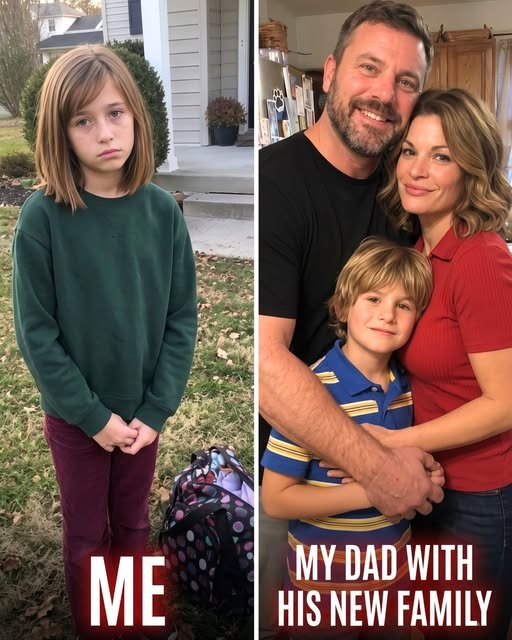
When I was ten, my father dropped me at his aunt’s house with a grocery bag of clothes and a promise to come back tomorrow. He never did. Twenty years later, he called from a hospital bed, begging me to come hear the one thing he had never explained.
Part 1: The Girl in the Photograph
I was fastening an earring in front of the mirror when something crashed in the kitchen below.
“Nothing’s broken!” my husband yelled.
“Which means something is absolutely broken!” his mother yelled back, and the whole house burst out laughing.
I smiled at my reflection. It was my thirtieth birthday, and the house was full of noise — pots clanging, cousins arguing over the music, someone counting candles out loud and getting the number wrong. After a lifetime of wanting something I couldn’t name, I finally knew what it was. It was this. A home where people noticed if I wasn’t in the room.
My eyes drifted to the small silver frame on the dresser. My mother was laughing in that picture, one hand raised against the sun, as if she’d just been caught off guard by something wonderful.
The noise downstairs seemed to soften.
Feeling wanted hadn’t always come this easily. Mom died without warning when I was very small, and after that, it was just Dad and me in a house that suddenly felt too big and too quiet.
On the nights I cried for her, he’d sit on the edge of my bed and smooth my hair.
“You’ve still got me, sweetheart,” he’d whisper. “You’ll always have me.”
And I believed him. Why wouldn’t I? He was all I had left.
Part 2: The Grocery Bag
I was ten when Dad married Linda. She came with a son, Ben, who was eight, and I tried — I really tried — to be happy about finally having a brother.
But little by little, the shape of our family changed around me.
Dad began leaving work early to cheer at Ben’s games. Meanwhile, I sat on the bench outside my school beside the secretary, watching every car that pulled into the lot and trying not to cry each time it wasn’t his.
Then one afternoon, I came home and found Linda carrying boxes out of my bedroom.
“What are you doing?” I asked.
“Ben’s taking this room.”
“But it’s my room.”
She didn’t even pause. “A growing boy needs space.”
My things were moved into the old sewing room. Once the narrow bed was wedged inside, the closet door could only open halfway. I remember lying there that first night, staring at the ceiling, waiting for Dad to come in and tell me it was a mistake.
He didn’t.
He stopped hugging me after that. Our conversations shrank into small instructions — finish your homework, pick up your shoes, don’t upset Linda. I began to feel like a guest in my own house, one who had overstayed her welcome.
The day Ben ripped Mom’s photo out of my locket during a fight, I ran to Dad with the torn pieces in my hands, sobbing so hard I could barely speak.
He glanced at them, then back at the TV. “He’s younger than you. Let it go.”
So I did. Or I tried to. But something inside me learned to go quiet that day.
Then, one Saturday morning, Dad stuffed a few of my shirts and a pair of jeans into a plastic grocery bag.
“We’re going to visit Aunt Ruth,” he said.
My heart leapt. Linda and Ben weren’t coming. For forty whole minutes in the car, I would have my father all to myself again. I remember chattering the entire drive, desperate to fill every second with him.
Aunt Ruth — Dad’s aunt — lived in a small, tidy house that always smelled of lemon furniture polish. Dad carried my grocery bag inside and set it by her front door.
Then he turned back toward the car.
Something cold twisted in my stomach. “Is Ben coming too?”
“No. Ben’s staying home.”
I grabbed a fistful of his coat. “Then I want to go home too.”
He peeled my fingers away, one by one, gently, as if gentleness made it better.
“I’ll be back tomorrow, sweetheart.”
I believed that too.
The next day, I sat at Aunt Ruth’s front window and watched the road. I watched until the streetlights flickered on. I watched until the glass reflected nothing but my own face.
He never came.
For months, I kept my clothes packed in that grocery bag so I’d be ready to leave the moment his car appeared. Aunt Ruth was stern and reserved — not the kind of woman who tucked me in or asked how I was feeling. But she fed me, sent me to school, and never once made me feel like a burden. In her own quiet way, she raised me.
At first, I asked her every evening whether Dad had called.
Then every few days.
Then, one day, I simply stopped asking. And that silence hurt more than all the questions ever had.

Part 3: The Call
Twenty years later, I stood in my own bedroom while my new family argued downstairs about candles. Everything I had of my first family fit inside a single silver frame.
That was when my phone rang. Unknown number.
“Hello?”
For a few seconds, there was only ragged breathing. Then a voice I hadn’t heard since I was a child said, “It’s Dad.”
My fingers locked around the phone.
His breath rattled through the line. “I’m dying, sweetheart. Please come. There’s something you need to know.”
I couldn’t find my voice. My thumb hovered over the red button. Twenty years of silence. Twenty birthdays without a card. And now, because he was dying, he expected me to come running?
“I don’t expect you to forgive me,” he said quickly, as if he sensed me slipping away. “But you deserve to know why I left you with Ruth.”
My husband appeared in the doorway, still smiling — until he saw my face.
“Who is it?”
I lowered the phone. “My father.”
His eyebrows shot up. “Your father?”
Dad gave me the name of the hospital and begged me again to come. When the call ended, my husband crossed the room and took my hands.
“You don’t owe him anything.”
“I know.”
“Then don’t go.”
Downstairs, laughter rose again. Someone shouted that dinner was ready. I looked toward the sound, toward everything I’d built, and then down at the phone in my hand.
“I spent twenty years wondering why he chose them over me,” I said softly. “If there’s an answer, I need to hear it.”
Part 4: The Hospital Room
We drove to the hospital the next afternoon. When we reached Dad’s floor, I stopped just before the final turn in the corridor.
“Wait here,” I said.
My husband frowned. “Are you sure?”
“If Linda sees you with me, she’ll choose every word carefully. I want to see them the way they really are.”
He didn’t like it, but he nodded and sat down in a row of chairs farther down the hall. I walked the rest of the way alone, my heartbeat loud in my ears.
Linda stood beside the bed. Ben sat slumped in the visitor’s chair. Time had changed them, but not enough to make them strangers. Linda gave me a thin, tight smile. Ben stared at the floor.
And there was Dad — smaller than I remembered, gray and hollow-cheeked, tubes running from his arm. For one dizzying second, I was ten years old again, holding his coat.
“Everyone out,” he said the moment he saw me.
Linda touched his arm. “We agreed you wouldn’t—”
“Out. Both of you.”
Her lips pressed into a hard line, but she followed Ben into the hallway. The door clicked shut. Only then did Dad reach for my hand.
I pulled it back.
“You kept her son,” I said, and my voice shook in a way I hated. “You didn’t keep me. And now you want to see me?”
His mouth trembled. “I know you’ve hated me all these years. But you need to know why I really did it.”
“Then tell me.”
He swallowed hard. After Mom died, he said, there had been debts I never knew about. Bills stacking up faster than he could pay them. The house was nearly taken. Linda had money — and more than that, she had connections and a steady career.
“She told me the fighting between you and Ben couldn’t go on.”
“So you got rid of me.”
“No.” His voice sharpened, then broke. “Ruth offered to take you for a little while. I thought I could fix everything and bring you home.”
“Tomorrow,” I said bitterly. “That’s what you told me.”
He closed his eyes. “I know.”
He said Linda had quietly started paying for my schooling and other expenses. Whenever he talked about bringing me back, she threatened to stop.
“You expect me to believe you stayed with her for me?”
“I was terrified that if I left Linda, you’d lose the little stability you had.”
“And calling me? Was that too expensive too?”
“I asked Ruth about you.”
“Letters?”
His face crumpled. “That was cowardice. Every year I waited made it harder to explain the year before.”
I wanted to hate every word. But the awful thing was that some of it made sense. Aunt Ruth had grumbled about money constantly, and yet somehow there had always been food on the table, new books each fall, and money for every school trip.
Dad leaned toward me, his eyes wet. “You thought I chose Linda over you. I stayed with her because it was the only way I could still do something for you.”
My throat tightened before I could stop it.
“Everything I did,” he whispered, “was for you.”
For the first time in twenty years, I didn’t know what to believe. The little girl inside me — the one who had waited at the window — wanted so badly for this to be true.
Then his gaze slid toward the closed door. “There’s one more thing.”
I went still.
“I’ve set some money aside over the years. It was always meant for you. There are a few papers to take care of, but we can talk about that when you’re ready.”
He said it lightly, almost as an afterthought. But I caught the way his eyes lingered on my face afterward, waiting. Watching.
When I stood to leave, I realized I’d walked in ready to hate him — and I was walking out wondering whether the cruelest thing he’d ever done had really been a clumsy, broken attempt to protect me.
What I didn’t know was that, just down that corridor, someone had overheard a conversation my father never meant me to hear.

Part 5: What My Husband Heard
The moment my husband saw me, he was on his feet.
“We need to go.”
I blinked. “You haven’t even asked what he said.”
“I will. Just not here.”
He said nothing more until the elevator doors slid shut behind us.
“Linda and Ben came down the hall while you were in there,” he said quietly. “They sat maybe ten feet from me. They had no idea who I was.”
A chill crept across my shoulders. “Were they talking about me?”
He nodded. “Did your father mention any papers?”
My stomach dropped.
He waited until we were home, sitting at the kitchen table among the leftover birthday plates, before he told me everything.
“Ben asked if you’d bought it. Linda said your dad knew exactly what would bring you running.” He hesitated, then exhaled slowly. “And then she said, ‘Once she signs, we can stop worrying about it.’”
For a long moment, neither of us moved.
“It sounds bad,” he said finally.
“It sounds strange,” I corrected. “That’s not the same thing.”
I heard how desperate I sounded. Maybe the papers really were about his estate. Maybe Linda’s words meant something innocent. After twenty years of silence, my father had finally opened a door I thought had been locked forever. I wasn’t ready to slam it shut over half a conversation in a hospital hallway.
But I wasn’t ready to walk through it blindly, either.
So I made a quiet decision. Before I confronted anyone, I would find out the truth for myself.
Part 6: Following the Money
Linda was easy to find. Her hospital profile showed years of steady climbing through administration — she now held a senior operations position.
I stared at the screen. “So he was right about that part. She had money. Connections. Stability.”
My husband leaned against the desk. “That doesn’t prove the rest.”
“No. But it doesn’t disprove it either.”
Then I called Aunt Ruth. Her voice had grown thin and papery with age, but she remembered the day Dad left me as clearly as if it had been last week.
“He said he was drowning,” she told me. “Said you’d only be with me until he got back on his feet.”
“Did he ever send money?”
She paused. “There was help with school now and then. I assumed some of it came from him.”
Assumed. The word lodged in my chest like a splinter.
The next morning, I started making calls. By afternoon, I had my answer. Some of those expenses had come out of Aunt Ruth’s own thin savings. The rest came from a scholarship fund.
Not one cent had come from my father.
I sat very still with the phone in my lap. All those years, Aunt Ruth had been quietly sacrificing for me — and she’d never once said a word.
“One piece doesn’t fit,” I told my husband, my voice unsteady. “I need to know why he lied about it.”
So I called Dad.
He sounded almost relieved when I told him I’d been thinking about everything he said. When I casually brought up the money, he explained that I only needed to sign a few routine documents so certain assets could be placed in my name “temporarily.”
“Linda understands all of it,” he said smoothly. “She can walk you through the details.”
That was enough to make me dig deeper.
What I found made my hands go cold. Dad’s name was attached to a long trail of failed businesses, unpaid debts, dissolved companies, and complaints stretching back years. And the papers he wanted me to sign would tie my name — my clean, ordinary name — to one of his current ventures.
This time, I didn’t call Dad.
I took everything to the authorities.
The investigator who reviewed it all looked up at me across the desk. “This is concerning. But we need something that connects him directly to what he’s planning.”
“Then I’ll go back,” I said.
My husband turned sharply. “And if he lies to you again?”
I thought about the ten-year-old girl clinging to her father’s coat, begging him not to leave her. I thought about the grocery bag I’d kept packed for months. I thought about Aunt Ruth, counting out money she didn’t have.
“He will,” I said. “But this time, I won’t be the one who believes him.”
I wasn’t going back to beg for his love. I was going back for the truth — and I was going to make him say it out loud.

Part 7: The Truth, at Last
When I returned to the hospital, my husband stayed by the elevators. Two officers waited farther down the hall, out of sight.
Linda was nowhere to be seen. Hospital management had called her into a meeting about her own part in all this — something Dad knew nothing about.
He smiled when I walked in. “I knew you’d come back.”
“I’ve been thinking,” I said softly, sitting down beside him. “I just want to understand everything before I sign.”
His shoulders loosened with relief.
I asked about the money again, and he repeated the same story about protecting assets and placing them in my name. The words came out so polished that I wondered how many times he’d rehearsed them.
Then I sighed. “I talked to Aunt Ruth.”
His smile flickered.
“She said you really were struggling back then.”
“There. You see?”
“But the school money never came from you.”
His expression hardened. “Records from twenty years ago aren’t perfect.”
“Maybe Linda handled all of it,” I offered gently.
He stiffened.
I kept my tone light, almost sympathetic. “Maybe she was the one holding everything together, and you just went along with whatever she decided.”
“Linda never controlled me.”
“So sending me away was your idea?”
That did it. His pride rose faster than his caution. He sat up straighter.
“She wanted you gone, yes. But I agreed.”
“Why?”
“Because Linda was useful. She had money, connections, a head for business. People trusted her.”
“And Ben?”
He shrugged. “Ben came with Linda.”
Something inside me went very cold and very quiet.
And then he kept talking — almost proudly now. About businesses that vanished before creditors could catch up. Investors he’d misled. People whose names he’d borrowed whenever his own became too dirty to use.
I forced out a small laugh. “So you weren’t protecting me. You just didn’t want me.”
“You were ten,” he said, as if that explained everything. “You cried all the time. You asked questions. You needed things. Linda offered me a better life, and Ruth was willing to take you.”
I had spent twenty years bracing for those words. Strangely, they hurt less than I’d expected. Maybe because somewhere between the hallway and this chair, I had finally stopped hoping for a different answer.
“And now?” I asked. “Why call me after twenty years?”
His lips curled into a smile I would never forget.
“Because twenty years away from me made you perfect.”
He explained it the way someone might explain a clever investment. His name was poisoned by too many failed companies. No one would trust him anymore. But me? I had a clean record. A clean name. He only needed my signature.
The illness was real — but he wasn’t dying. Linda had simply helped make it all look urgent enough to bring me running back to his bedside.
He leaned back against the pillows, satisfied. “So now you understand. Are you going to sign?”
I slipped my hand into my jacket pocket and pressed the button on the small recorder I’d carried in.
He frowned. “What was that?”
“Thank you, Dad,” I said, rising to my feet. “That’s all I needed.”
The door swung open. Two officers stepped inside.
He shot upright. “She set me up!”
I looked down at the man who had once promised I’d always have him.
“No,” I said. “You called me here to use me. I just let you explain how.”
As they led him away, he shouted Linda’s name down the corridor. But Linda was already standing at the far end of the hall, surrounded by hospital executives and investigators, her face drained of color.
I watched them for a long moment. Then I turned and walked toward the elevator, where my husband was waiting with his arms open.
That evening, I drove to Aunt Ruth’s little house. It still smelled of lemon polish. I told her everything — the scholarship, her savings, the father who had never paid a cent. Then I hugged her, hard, the way I never had as a child.
She stiffened at first. Then, slowly, her thin arms came up around me.
For twenty years, I believed my father had given me away. Now I understood the truth: he never gave me anything at all. The people who truly raised me were the ones who stayed — and the only thing I regret is that it took me this long to see it.