
Part One: The Child in Her Arms
My daughter promised she would return before dinner.
Ten days later, Emily appeared in my driveway looking as though she had survived something she could not yet put into words.
Her clothes were dirty. A dark bruise marked the side of her face, and exhaustion had hollowed out her eyes. Yet none of those things shocked me as much as the tiny bundle pressed against her chest.
She was carrying a newborn baby.
A baby I had never seen before.
For ten days, I had imagined every terrible possibility. I had pictured Emily’s car at the bottom of a ravine. I had imagined her injured somewhere, unable to call for help. Every time my phone rang, my heart stopped.
The police had searched for her. Her photograph had appeared on the evening news. Volunteers had walked through fields and wooded areas while I stayed home with her children, Noah and Lily, pretending I still believed their mother would walk through the door at any moment.
Then she finally did.
But she did not come alone.
“Mom,” Emily said as she stepped from the car. “Please don’t ask anything yet.”
Her voice barely carried across the driveway.
I hurried toward her, unsure whether to embrace her or demand answers.
“Where have you been?”
She looked over her shoulder before facing me again.
“Inside. We need to go inside.”
The baby moved beneath the blanket, releasing a weak little cry.
I stared at the child.
“Whose baby is that?”
Emily tightened her arms around the bundle.
“Please, Mom.”
Something about her expression frightened me more than her disappearance had.
I brought her inside and immediately called the police.
Emily did not try to stop me.
That should have reassured me, but it did the opposite.
The first two officers arrived within minutes. One began questioning Emily while the other examined the baby.
Noah, who was seven, and four-year-old Lily watched silently from the hallway. They had been asking about their mother for more than a week. Now that she was finally home, neither child seemed certain they were allowed to approach her.
The baby was wrapped in a faded yellow blanket. She looked impossibly small, with delicate fingers curled against Emily’s sweater.
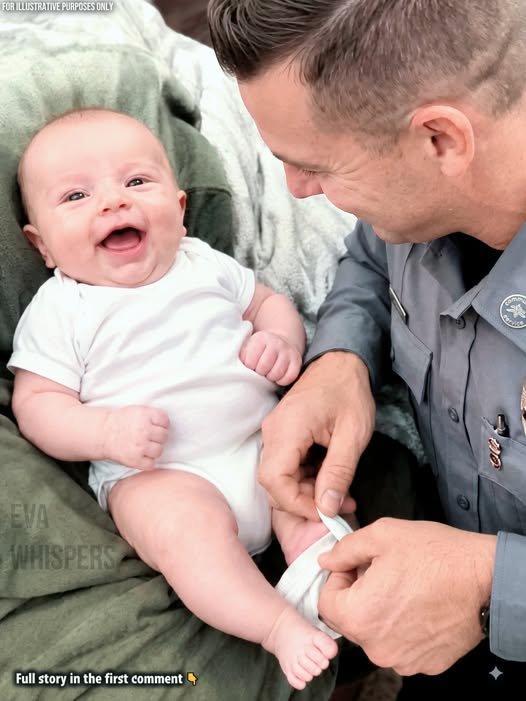
One officer gently removed the sock from her left foot.
A narrow white band circled her ankle.
At first, I assumed it was a hospital identification bracelet. Then I noticed how thin it was. Near the clasp sat a tiny black square, no larger than a fingernail.
The officer’s expression changed immediately.
He lifted his radio.
“Dispatch, request Major Crimes and Child Protection at this address. Possible active tracking device attached to an infant.”
My breath caught.
“A tracking device?”
The second officer closed the curtains and stepped away from the window.
“Ma’am, please stay out of sight.”
Emily sat on the couch with her hands folded tightly in her lap.
She did not look confused by the officer’s discovery.
She looked relieved.
I moved in front of her instinctively.
“What is going on?”
Before she could answer, Noah stepped into the room.
“Mom?”
Emily looked toward him, and her composure nearly broke.
“Take Lily upstairs,” she said softly.
“No,” I said. “You’re coming with us.”
One of the officers shook his head.
“She needs to remain here.”
“She’s my daughter.”
“And the infant may be connected to a criminal investigation.”
Emily flinched at the word criminal.
The baby whimpered. Emily lowered her face and kissed the top of her tiny head.
“I’m sorry,” she whispered.
I did not know whether she was speaking to the baby, to her children, or to me.
Then the blanket slipped slightly.
That was when I saw the baby’s arm.
Several small purple marks dotted her skin.
I leaned closer, my stomach turning.
“What happened to her?”

Emily quickly covered the baby again.
“They were running tests.”
“Who was running tests?”
Her gaze moved toward the curtained window.
When she answered, her voice was barely audible.
“Dr. Voss.”
The name struck me like a blow.
Everyone in our county knew Dr. Adrian Voss. He operated Bellweather Family Center, a private maternity and fertility clinic twenty miles outside town.
Its advertisements played constantly on television.
Bright rooms. Soft music. Smiling mothers holding newborns.
At the end of every commercial, Dr. Voss looked directly into the camera and said, “Every child deserves a safe beginning.”
He had delivered Lily.
Emily had trusted him.
So had I.
The officer crouched beside her.
“Emily, did you take this child from Bellweather?”
“Yes.”
“Without permission?”
“Yes.”
The officer studied her carefully.
“Are you admitting that you kidnapped this baby?”
Emily looked down at the newborn.
“No.”
“Then who does she belong to?”
Emily finally raised her eyes to mine.
“She’s my daughter.”
The room fell silent.
For one strange second, I thought I had misunderstood her.
Then I laughed—a single, sharp sound born entirely from shock.
“That’s impossible. You weren’t pregnant.”
“I know.”
“You would have told me.”
“I couldn’t.”
“You dropped Noah and Lily here ten days ago wearing jeans and a sweater. You were not expecting a baby.”
Tears filled her eyes.
“Mom, I said she’s my daughter. I didn’t say I gave birth to her.”
Two unmarked vehicles arrived shortly afterward.
Detective Mara Cole entered first. She was a small woman in her late forties, with silver beginning to show in her dark hair. Her voice was calm, but there was an authority in it that made everyone listen.
A Child Protection specialist followed her, carrying medical equipment.
They examined the band without removing it.
Then Detective Cole ordered every electronic device in the house turned off.
My phone. The officers’ phones. The television. Even the children’s tablet.
Everything was sealed inside a metal evidence container.
“What is happening?” I asked.
Detective Cole looked at the band around the baby’s ankle.
“It appears to be transmitting.”
“To whom?”
“We’re working on that.”
Emily shook her head.
“It’s transmitting to Bellweather.”
Detective Cole turned toward her.
“How do you know?”
“I saw the system.”
“What system?”
Emily looked at the sleeping child.
“The one they use to track all the babies.”
The Child Protection worker reached for the newborn.
Emily immediately pulled her closer.
“She’s sick.”
“We need to examine her.”
“Don’t take her to County General.”
“Why not?”
“Because Voss has people there.”
Detective Cole sat across from her.
“Emily, you need to tell us everything. Start at the beginning.”
Emily glanced toward the staircase.
“Not while Noah and Lily can hear.”
I took the children upstairs.
Outside their bedroom, Noah caught my hand.
“Grandma, is that baby our sister?”
The question sent a chill through me.
“I don’t know.”
“Mom said her name is Grace.”
I stared at him.
“When did she tell you that?”
“The day she left.”
“Ten days ago?”
He nodded.
“She said that if she came home with a baby, we had to be gentle because the baby had been alone.”
I gripped the railing for support.
Emily had known about Grace before she disappeared.
Whatever had happened during those ten days had not been an accident.
My daughter had walked into danger knowing exactly what she was searching for.

Part Two: The Embryo That Was Never Destroyed
When I returned downstairs, a recorder had been placed on the coffee table.
Emily sat wrapped in one of my blankets. Grace slept in a portable bassinet beside her.
I remained near the doorway, still trying to understand how a newborn child could possibly be my granddaughter when my daughter had not been pregnant.
Emily drew a slow breath.
“Three months ago, I received a letter.”
“Who sent it?” Detective Cole asked.
“There was no name.”
“What did it say?”
Emily’s eyes moved toward the bassinet.
“It said one of my embryos was still alive.”
The words seemed to remove all the air from the room.
Five years earlier, after Lily’s birth, Emily and her former husband, Jake, had considered having another child. Both of Emily’s pregnancies had followed fertility treatment, and several embryos remained in storage.
After Emily and Jake divorced, they signed documents instructing Bellweather to destroy the unused embryos.
Emily had grieved afterward, even though she believed the decision was necessary. I remembered sitting beside her while she cried. A few weeks later, the clinic sent written confirmation that the embryos had been disposed of.
“They confirmed the procedure,” I said.
Emily looked at me.
“They lied.”
Detective Cole leaned forward.
“Bellweather kept one of your embryos?”
“More than one.”
Emily’s hands trembled.
“They implanted one of mine into another woman.”
“Without your consent?”
“Yes.”
“And the woman carrying it?”
“She didn’t consent either.”
The woman’s name was Tessa Lane.
She was twenty-six, unmarried, and had gone to Bellweather after experiencing several pregnancy losses. Dr. Voss told her that she would receive an embryo created from her own egg and donor material.
Tessa trusted him.
For months, she believed the baby growing inside her was genetically hers.
Then, during the twenty-eighth week of her pregnancy, she overheard two nurses arguing outside an examination room. One accused the other of switching patient labels and falsifying identification codes.
Tessa began asking questions.
Within two days, Bellweather staff claimed she had developed a severe psychological condition. They transferred her to a restricted room, removed her phone, and prevented her family from visiting.
“They told everyone she was unstable,” Emily explained. “They told her family she refused to see them.”
“How did she contact you?” Detective Cole asked.
“A nurse helped her.”
“Which nurse?”
“Caroline Mercer.”
Detective Cole exchanged a look with another officer.
I knew the name.
Caroline had been reported missing eight days before Emily vanished. Her face had appeared on the news beside my daughter’s during the search.
Until that moment, everyone had treated their disappearances as separate cases.
They had never been separate.
“Caroline sent the letter?” Detective Cole asked.
Emily nodded.
“She included laboratory results, storage records, and a copy of the destruction form with my signature.”
“And you believed an anonymous package?”
“Not immediately.”
Emily opened her stained jacket and carefully tore part of the lining. A small flash drive had been sewn into the fabric.
“I met Caroline.”
“Where?”
“At a rest stop outside the county.”
“What did she tell you?”
Emily held the drive in her palm.
“That Bellweather had been doing this for years.”
According to Caroline, the clinic targeted embryos that were unlikely to be missed.
Some belonged to couples who had requested destruction. Others came from families who had stopped paying storage fees or moved without updating their addresses.
Dr. Voss marked the embryos as discarded.
But he did not destroy them.
He secretly transferred them into other women or offered them to wealthy clients who were desperate for children and willing to avoid legal scrutiny.
It was not adoption.
It was not ethical embryo donation.
It was a hidden marketplace.
“Some women were allowed to keep the babies they carried,” Emily explained. “Others were never supposed to leave the clinic with them.”
I felt cold despite the warmth of the room.
“What do you mean?”
Emily’s face lost what little color remained.
“Voss decided which families were worthy of receiving them.”
Grace shifted in the bassinet.
Emily watched her closely.
“Tessa was never supposed to take Grace home.”
Bellweather’s private records described Tessa only as a gestational carrier.
After the birth, Grace was scheduled to be transferred to an out-of-state couple who had paid the clinic $240,000.
Tessa knew nothing about the arrangement.
Neither did Emily.
“What happened on the morning you disappeared?” Detective Cole asked.
“Caroline called me at six.”
Emily had brought Noah and Lily to my house because Tessa had gone into labor. She expected to meet Caroline at a motel, collect the evidence, and take it directly to an attorney.
She thought she would be gone for only a few hours.
That was why she promised to return before dinner.
But Caroline never arrived.
Instead, Emily received a video.
In it, Caroline was tied to a chair inside Bellweather. Her face showed signs that she had been hurt, and Dr. Voss stood behind her.
“He knew she copied the files,” Emily said. “He told me to come alone if I wanted her released.”
I covered my mouth.
“You went there by yourself?”
“I didn’t think I had a choice.”
“You could have called the police.”
“No, I couldn’t.”
“Why?”
Emily’s expression hardened.
“Because Voss sent me a photograph of Detective Harris standing inside his office.”
My thoughts stopped.
Detective Harris had led the search for Emily.
He had sat at my kitchen table, looked me in the eye, and promised that he would bring my daughter home.
Every evening, he called me personally.
No witnesses.
No useful camera footage.
No confirmed sightings.
He had spoken as though the investigation had simply reached dead ends.
Now I understood.
Harris had not been failing to find Emily.
He had been making sure no one else did.
Detective Cole reached forward and stopped the recorder.
Without explanation, she left the room.
When she returned several minutes later, two officers who had been standing in my kitchen were gone.
She pressed the recorder button again.
“Continue.”

Part Three: Behind Bellweather’s Locked Doors
Emily entered Bellweather through a rear service door.
Dr. Voss was waiting.
He confiscated her phone and led her into a private recovery wing that did not appear on public building plans.
There, Emily found Tessa sedated and restrained in a hospital bed.
Grace had been born less than an hour earlier.
Caroline was also alive, though she was being held under guard.
Voss presented Emily with documents surrendering every legal claim connected to the embryo.
“He told me that if I signed, he would release Caroline and Tessa.”
“So you signed?” I asked.
“Yes.”
“You gave away your rights to Grace?”
Emily looked at me with an expression filled with pain.
“I was trying to save two women’s lives. I wasn’t thinking about custody.”
After Emily signed, Voss forced her to remain while employees prepared Grace for transport.
That was when she saw the monitoring room.
A wall of screens displayed information about babies throughout the facility. Every infant wore an electronic ankle band like the one attached to Grace.
The screens showed each baby’s location, medical condition, genetic record, and payment status.
Payment status.
The children were arranged like products in an inventory system.
Some names appeared beside green circles.
Others were marked red.
Grace’s file carried a gold symbol.
“What did gold mean?” Detective Cole asked.
“Private transfer completed.”
The people who had purchased the arrangement were expected the following morning.
Emily waited until Voss left the recovery wing.
Caroline had hidden an access card in her shoe. With it, they released Tessa and reached the nursery.
Then the lights went out.
“Caroline cut the power,” Emily explained. “She said the backup system would seal the modern entrances but release the old fire exits.”
The three women ran.
Tessa had just given birth and could barely remain upright. Emily carried Grace while Caroline guided them through an unused corridor.
They reached the employee parking area.
Detective Harris was waiting for them.
“What did he do?” I asked.
“Caroline told us to keep running.”
Emily’s voice cracked.
“She stayed behind to delay him.”
“Did Harris kill her?”
“I didn’t know. I never saw what happened.”
Emily found the keys inside a clinic vehicle and drove away with Tessa and Grace.
Caroline had prepared an abandoned hunting cabin outside the county in case they needed somewhere to hide. It had bottled water, blankets, canned food, and basic medical supplies.
For nine days, Emily and Tessa remained there with Grace.
They used no phones.
They avoided credit cards and public roads.
They stayed away from fuel stations with security cameras.
“Why didn’t you contact us?” I demanded. “Why didn’t you at least tell me you were alive?”
“Because Harris was watching your house.”
Emily’s eyes met mine.
“If I came near you or called you, he would know where Tessa was. He would take Grace before anyone could examine the records.”
I wanted to be angry.
Part of me was angry.
But I also imagined Emily sitting in a cold cabin with a frightened young woman and a sick newborn, knowing that the detective pretending to search for her was actually helping the man hunting them.
On the ninth night, Tessa developed a high fever. Her condition grew worse, and Emily knew they could no longer remain hidden.
She drove across the state line to a hospital where Voss and Harris were less likely to have influence.
Tessa carried the flash drive inside her coat.
Emily left her near the emergency entrance and watched from a distance until medical workers rushed her inside.
“You abandoned her there?” I asked.
“She made me leave.”
Emily wiped her face.
“She said that if we were both caught, Harris could take Grace before anyone opened the files. She told me to bring the baby somewhere safe.”
So Emily drove home.
She came to me because she had nowhere else to go.
Detective Cole rose suddenly.
“We need to move everyone.”
My pulse quickened.
“Why?”
She looked toward the closed curtains.
“Because if Harris was monitoring this address, he now knows Emily is here.”
At that exact moment, headlights swept across the living-room wall.
A vehicle stopped in front of the house.
Then another.
Detective Cole drew her weapon.
“Everyone get down.”
A heavy knock struck the front door.
“County Police!” a man shouted from outside. “We have authorization to recover an abducted infant.”
Emily lifted Grace from the bassinet.
Detective Cole grabbed her arm.
“Leave the baby with the Child Protection officer.”
“No.”
“Emily, listen to me.”
Grace began crying.
Then Detective Harris called my daughter’s name from the porch.
“Emily, you’re not in trouble. Open the door and let us help you.”
His voice was warm and patient.
It was the same reassuring voice he had used every night while pretending to search for her.
Noah appeared halfway down the stairs.
“That’s the policeman who came here before.”
I ran toward him.
A second later, the front window shattered.
A metal canister landed on the carpet, filling the room with thick smoke.
Detective Cole shouted for us to move.
I lifted Lily into my arms. Noah gripped the back of my robe. Emily followed with Grace held securely against her chest.
We fled through the kitchen toward the garage.
An officer opened the side door and immediately fell back when a shot struck nearby.
Emily screamed.
Detective Cole returned fire toward the driveway.
“Get into the van!”
We climbed into an unmarked police vehicle. Detective Cole jumped behind the wheel and reversed out of the garage.
Harris stepped from behind my parked car and raised his weapon.
Before he could fire, another shot echoed through the darkness.
Harris dropped to the ground.
Near the hedge stood a young woman holding a pistol in both hands.
A hospital gown was visible beneath her oversized coat.
It was Tessa.
Two state troopers rushed into the yard behind her.
She lowered the weapon immediately.
“I told them everything!” she shouted.
Detective Cole accelerated away from the house.
For the first time in ten days, I believed my daughter might survive.

Part Four: The Truth About Grace
By sunrise, Bellweather Family Center was surrounded by state police and federal agents.
Dr. Voss attempted to escape through a maintenance tunnel beneath the facility, but officers arrested him before he reached the far exit.
Detective Harris survived his injury and was taken into custody.
Caroline was found alive, locked inside a medication storage room. She was exhausted and badly shaken, but she had survived long enough to help expose everything.
The files on Emily’s flash drive led investigators to twenty-three children born through illegal embryo transfers.
Some were still babies.
Others were approaching their teenage years.
The investigation quickly became more complicated than anyone had expected.
Not every family who had received a child knew that a crime had occurred. Some believed they had completed legitimate fertility or adoption procedures. They had signed documents, undergone background checks, and paid what they thought were legal medical expenses.
Other clients had knowingly paid Dr. Voss to conceal the origin of the embryos and silence questions.
Records showed that Bellweather had altered genetic reports, forged consent forms, changed patient identification numbers, and pressured vulnerable women into surrendering babies.
Grace’s case became the center of the investigation.
Genetic testing confirmed that she had developed from an embryo created with Emily’s egg and Jake’s sperm.
Biologically, Grace was their daughter.
But biology was only part of the truth.
Tessa had carried Grace for months.
She had felt her first movements. She had heard her heartbeat during appointments. She had spoken to her late at night while believing she was carrying her own genetic child.
She had endured labor while strangers prepared to remove the baby and transfer her to people she had never met.
For weeks, reporters asked the same question:
Which woman was Grace’s real mother?
Emily hated the question.
So did Tessa.
It suggested that only one of them could matter.
At the first custody hearing, the courtroom was filled with attorneys, reporters, medical specialists, and social workers. Jake attended with his lawyer, still struggling to understand how a child created years earlier could suddenly exist without his knowledge.
The judge asked whether Emily and Tessa intended to challenge each other for sole custody.
Emily looked toward Tessa.
Then both women looked at Grace, asleep in a carrier between them.
“No,” Emily said.
The judge adjusted her glasses.
“You understand that the court will eventually need to determine legal parentage?”
“I understand,” Emily replied. “But enough people have already made decisions about Grace without asking the women protecting her. Tessa and I are not going to become enemies simply because the law does not know what to call us.”
Tessa’s eyes filled with tears.
She reached across the table.
Emily took her hand.
That moment did not solve the legal questions, but it changed the direction of the case.
Instead of fighting each other, they created a temporary shared-care arrangement.
Tessa moved into the small apartment above Emily’s garage. Everyone said it would last only until the hearings ended.
Eight months later, she was still there.
Grace slept downstairs in Emily’s home.
Tessa handled many of the early-morning feedings because, as she often said, she was awake at that hour anyway.
Emily managed doctor visits, therapy appointments, and the endless paperwork connected to the investigation.
Jake slowly became involved as well. At first, he was overwhelmed and defensive. He had never agreed to Grace’s birth, yet she was undeniably his biological child.
Eventually, he stopped speaking about rights and began asking what Grace needed.
Noah called Tessa “Aunt Tessa.”
Lily called her “the other mommy.”
The phrase made nearly every adult in the room uncomfortable.
Tessa only smiled.
“She understands the situation better than the legal system does,” she once said.
The courts continued examining parentage, custody, medical responsibility, and the rights of children born under fraudulent circumstances.
There was no simple form for Grace’s family.
No official box could explain:
One woman helped create you.
Another woman carried you.
Both women risked everything to bring you home.

Part Five: No More Careless Promises
The tracking band was eventually removed from Grace’s ankle and sealed away as evidence.
A faint pale line remained around her skin.
Every time I noticed it, I remembered the night the officer removed her sock and changed our lives with one sentence.
The case against Dr. Voss grew larger every week.
Former employees came forward. Families requested genetic testing. Adults who had once been patients at Bellweather began questioning whether their stored embryos had truly been destroyed.
Caroline became a central witness.
She carried guilt for not exposing the clinic sooner, but Detective Cole reminded her that she had saved Tessa, Emily, Grace, and many children she might never meet.
Tessa recovered slowly.
Her physical injuries healed before the fear did.
For months, she checked every passing car. She kept the curtains closed and startled whenever someone knocked unexpectedly.
Emily understood.
She had nightmares too.
Sometimes she woke convinced she was back inside Bellweather, standing in front of those monitors while rows of babies blinked across the screen beside colored payment symbols.
They attended counseling separately and together.
Healing did not come through one dramatic moment.
It came in ordinary pieces.
A peaceful breakfast.
Grace laughing for the first time.
Noah helping warm a bottle.
Lily falling asleep beside Tessa during a movie.
Emily calling me simply to say she was running late instead of disappearing into silence.
Our family was not what any of us had imagined.
But it was ours.
One Sunday afternoon, Emily brought all three children to my house.
Noah played in the yard. Lily helped me bake cookies, although most of the flour ended up on the counter and the floor.
Grace slept against Emily’s chest in a soft carrier.
Tessa had gone to meet with an attorney and promised to join them later.
When evening arrived, Emily gathered the children and walked toward her car.
I stood at the doorway watching her.
For a moment, the scene looked almost identical to the morning she had disappeared.
Emily beside the car.
Noah and Lily climbing into the back seat.
Her hand resting protectively over Grace.
The memory of that earlier day returned with painful clarity.
She had smiled.
She had told me not to worry.
She had promised she would be back before dinner.
This time, I did not simply wave from the doorway.
I walked across the yard.
“Are you coming back before dinner?” I asked.
Emily paused.
Then she smiled—not the careless smile she had given me ten days before her disappearance, but a softer one shaped by everything she had survived.
“Yes.”
“Do you promise?”
She adjusted Grace gently and reached down to smooth Noah’s hair.
Then she met my eyes.
“No more promises like that.”
At first, the answer hurt.
Then I understood.
She was not saying she planned to disappear again.
She was saying that none of us could promise that life would follow the plans we made in the morning.
We could only tell the truth.
We could call when we were afraid.
We could ask for help before carrying the danger alone.
And we could keep returning to one another, even when the road home became longer and darker than anyone expected.
I stepped forward and embraced her carefully, mindful of the sleeping baby between us.
“Then just come home safely,” I whispered.
Emily held me with one arm.
“I will do everything I can.”
It was not a perfect promise.
It was better.
It was honest.
A few minutes later, her car disappeared around the corner.
That evening, she returned before dinner.
Noah ran through the door first. Lily followed, laughing about something her brother had said.
Tessa arrived shortly afterward, carrying Grace’s diaper bag and three folders from the attorney’s office.
Emily entered last with Grace sleeping peacefully in her arms.
The pale circle around the baby’s ankle had not completely faded.
Perhaps one day it would.
Perhaps it would always remain—a quiet reminder of the people who had once treated her like property and the women who refused to let them succeed.
Grace would grow up surrounded by a story too complicated to fit into ordinary definitions.
But she would never have to wonder whether she had been wanted.
Emily had walked into Bellweather to find her.
Caroline had risked everything to reveal the truth.
Tessa had fought to protect her.
And I had learned that family was not determined by which name appeared on a form.
Family was the person who stayed.
The person who returned.
The person who reached for you when the world tried to decide that you belonged somewhere else.