
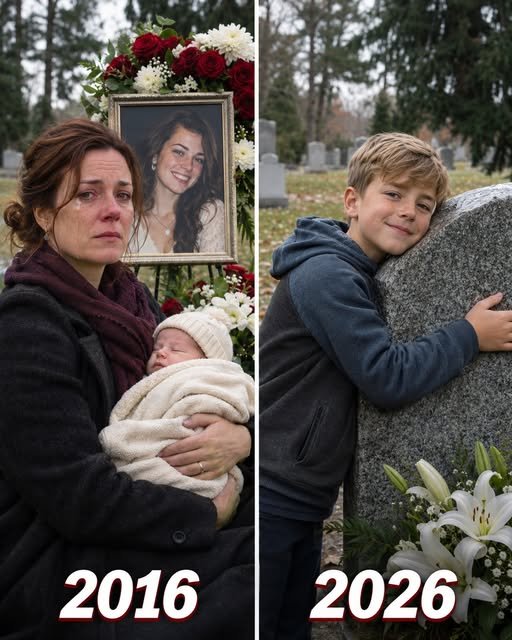
Part 1: The Name She Wouldn’t Give Me
My daughter, Teagan, never talked to me about boys.
At sixteen, she came home at 10:58 every night on an 11:00 curfew. As far as I knew, she’d never had a serious relationship in her life.
So on a Tuesday night in July, when she sat down across from me at the kitchen table and said, “Mom, I’m pregnant,” I thought I’d misheard her.
I actually laughed. One short, stupid laugh.
Then I saw her face.
“You’re eighteen,” I said. “Teagan, you start at Ball State in five weeks. You’re not ready to become a mother this young.”
She reached across the table and grabbed both my hands. Her fingers were ice cold.
“Mom, please. I’m begging you. I love this baby, and I want to have him.”
I’d raised her alone since her father left for Arizona when she was four. I’d learned the only way through a crisis was a plan.
“Okay,” I said. “Then tell me who the father is.”
Her expression changed. It closed like a door.
“I can’t.”
“Can’t, or won’t?”
“Can’t.”
I asked that night. I asked on the way to her first OB appointment. Once, I’m ashamed to say, I asked through a locked bedroom door at one in the morning.
The answer never changed.
“Please trust me, Mom. I’m handling it.”
She was eighteen. In my mind, she was handling nothing.
She deferred college, worked the register at the Dairy Queen on Tillotson Avenue, and covered every baby book in the Muncie library with sticky notes.
In March, two weeks early, she went into labor.
There were complications.
At 4:40 in the morning, a doctor walked into the third-floor waiting room at Ball Memorial. She still had her surgical cap on. She sat down in the chair beside mine, and that was how I knew, before she said a single word.
“I’m sorry. We did everything we could.”
My daughter never came home.
Her baby did.
His name was Lucas. Teagan had written it on a yellow sticky note and stuck it to the inside cover of What to Expect. Underneath, in smaller letters, she’d written: It means light.
I didn’t know it then, but my daughter hadn’t kept her secret from everyone.
She had trusted one person with it.
And it wasn’t me.
Part 2: The Little Cloud
My name is Joanne Pruitt. I was forty-four years old, a records clerk at the Delaware County Courthouse, and suddenly the only parent a six-pound baby boy had.
I made $38,500 a year. Infant daycare cost $185 a week. I did the math on the back of a funeral home envelope and then stopped, because the numbers didn’t care how much I loved him.
I picked up Saturday shifts at the Kroger bakery and slept in four-hour pieces for almost two years.
I wasn’t a saint. I was angry for a very long time. Angry at God. And angry, in a way I never said out loud, at whoever had walked away from my daughter and let her face all of it alone.
Every time I signed a form that asked for Father’s Name, I left the line blank and pressed so hard the pen tore the paper.
Lucas grew up anyway, the way children do. Fast and loud and sweet.
By seven, he was sleeping with a baseball under his pillow. By nine, he was the starting second baseman for the Muncie Southside Little League Cubs, and he made me sit in the exact same spot on the bleachers every game for luck.
He asked about his mother constantly.
I kept a shoebox of DVDs under the TV. Teagan at twelve, opening a karaoke machine on Christmas morning and screaming so loud the dog ran upstairs.
One evening, Lucas sat on the carpet with her senior photo in his lap.
“She’s so beautiful,” he said. “Just like you. I wish I could’ve known her.”
I pulled him into my arms.
“Your mom watches you from a little cloud every day,” I told him. “Believe me, she loves you very much.”
He liked that. For years afterward, he’d point at the sky before every at-bat. One small cloud, one small wave.
He only asked about his father twice.
At six, he accepted “Your mom never told me, sweetheart.” The second time, he was ten, and he wasn’t asking. He was holding a worksheet from Mrs. Delgado’s class. A family tree. One empty branch on the left side.
“What do I put there?” he asked.
I took the worksheet and said I’d think about it.
I put it on the refrigerator under a pizza magnet. It stayed there for three weeks.
There were other things I didn’t think about. Not really.
Every Christmas since Lucas turned two, a plain white card arrived with no return address. Inside was a fifty-dollar bill and four words: For Lucas. Merry Christmas. The postmark always said Fort Wayne. I assumed it was one of Teagan’s old friends from high school, someone who’d moved north for college and felt guilty about not visiting.
And every spring, on the opening day of Little League season, someone left a new baseball on Teagan’s headstone. Just a baseball. No note. I figured it was a girl from her old softball team.
I put every fifty dollars into a savings account. By last year, it had $450 in it.
I never once tried to find out who sent it.
Looking back, I think part of me didn’t want to know. Not knowing meant I didn’t have to share him.
Part 3: The Woman at the Grave
Ten years passed.
On October 14th, the day Teagan would have turned twenty-eight, Lucas and I drove to Beech Grove Cemetery with a bunch of yellow mums from Kroger. They were $7.99. Teagan always said yellow was the only color that didn’t look sad.
We parked near the old stone gate. Lucas was halfway up the hill when he stopped and slapped his forehead.
“Grandma, I made Mom a picture and forgot it in the car!”
“Go,” I said. “I’ll be right there.”
He ran back down toward the parking lot, sneakers sliding on the wet grass.
I kept walking toward Teagan’s grave.
That was when I noticed a woman standing beside the headstone.
She was maybe sixty, in a navy wool coat, with short gray hair. She wasn’t praying. She was just looking down at my daughter’s name the way you look at an old friend across a room.
I’d never seen her before.
“Excuse me,” I said. “Did you know my daughter?”
She turned sharply, like I’d startled her out of a dream.
“You’re Teagan’s mother.”
It wasn’t a question. I froze.
“Who are you?”
She didn’t answer right away. She reached into her purse and pulled out a long, cream-colored envelope. It was sealed. The edges were soft and yellowed, the way paper gets when it’s been handled for a long time.
On the front, in handwriting I would’ve known anywhere, it said: Mom.
“I made your daughter a promise ten years ago,” she said quietly. “Now it’s time you knew the truth.”
I forgot how to breathe.
“Where did you get that?”
“She gave it to me. The night her baby was born.”
My fingers tightened around the mums until the plastic sleeve crackled.
“You’ve had a letter from my daughter for ten years?”
She lowered her eyes. “Yes.”
Before I could say another word, Lucas shouted from the bottom of the hill.
“Grandma! I found it!”
He was running back up, waving the card he’d made. It was a drawing of a baseball diamond with a little cloud above home plate.
The woman glanced at him. Something crossed her face. Grief, maybe. Or recognition.
“Don’t open this in front of him,” she said.
“Who are you?”
“My name is Trudy Kessler. I was a labor and delivery nurse at Ball Memorial for twenty-six years.” She swallowed. “I was Teagan’s nurse.”
My stomach turned over.
She pressed the envelope into my hand. “My number’s on the back. Call me after you read it. Whatever you’re feeling, call me anyway.”
Then she walked down the other side of the hill, past the old oak trees, and got into a silver Buick.
Lucas reached me, out of breath, and laid his card against the headstone.
“Who was that lady?”
I slid the envelope into my coat pocket.
“Someone who knew your mom,” I said.
It was the first time in ten years I’d said those words without knowing what they really meant.
Part 4: Three Lines
That night, after Lucas went to bed, I stood at the kitchen counter holding the envelope for a long time.
The family tree worksheet was still stuck under the pizza magnet, that empty branch staring back at me.
At 10:20, I opened the envelope.
A photograph slid out first.
It was a little square instant-camera print. Teagan was standing on our front porch in her oversized Ball State sweatshirt, maybe five months pregnant, squinting at the sun. Beside her stood a tall, skinny teenage boy with a buzz cut and big ears. A worn leather baseball glove was tucked under his arm.
I knew him. Barely.
He’d been to our house twice during her pregnancy. The first time, he spent three hours on her bedroom floor putting together the crib, and he refused to take the twenty dollars I offered him. The second time, he brought a garbage bag full of baby clothes and said they were from his aunt.
He called me ma’am and wiped his feet twice.
Teagan told me he was “Caleb from chemistry.” Her lab partner. I’d thought, at most, that the poor boy had a crush on her.
I unfolded the letter.
It was three pages long, written in blue ink on hospital stationery. Her handwriting got shakier toward the end.
Mom,
If Trudy is giving you this, then something went wrong tonight, and I’m so sorry.
Lucas’s father is Caleb Ward. Ray Ward’s son.
By the third line, my hands were shaking.
Ray Ward.
Everybody in Muncie knew that name. I knew it better than most.
In eighteen years at the courthouse, I’d processed his paperwork more than once. A disorderly conduct charge outside the VFW. A protective order his own wife filed, then withdrew two weeks later.
He had a roofing business, a loud truck, and a temper people talked about in low voices.
I sat down at the table and kept reading.
Caleb wanted to tell you from the very first day. I’m the one who said no. Please don’t be angry at him for that. Be angry at me.
Mom, you know what his dad is like. Caleb was seventeen. He still lived in that house. When Ray found out about a girl Caleb’s brother got into trouble two years ago, he drove to her parents’ house at midnight and put his fist through their storm door. Caleb’s brother joined the Army three weeks later just to get away.
I couldn’t let Ray Ward anywhere near my baby. And I know you. If you knew, you would have marched straight over to that house to make Ray take responsibility. You would have filed papers. You would have made it right, because that’s what you do.
And then Ray would be in Lucas’s life forever. Grandparents can ask for visitation in Indiana. I looked it up at the library.
I put my hand over my mouth.
She was right. I would have gone straight to that house. I would have done it the next morning.
Caleb and I made a plan. He was going to finish high school and get out, like his brother. Then, when he was older and had a place of his own, he’d tell you himself and be part of Lucas’s life. Really part of it. Not Ray. Just Caleb.
He loves this baby, Mom. He sat on my floor building a crib while you made him pizza he was too nervous to eat.
I asked Trudy to keep this letter for me because I couldn’t keep it at home. You read everything. Don’t deny it.
I laughed out loud in my empty kitchen. Then I started to cry.
If I don’t make it, please don’t hate Caleb for staying quiet. I’m asking him to. I’m asking Trudy to give this to you only when it’s safe for Lucas, when Ray can’t hurt anyone anymore, or when Caleb is ready to stand in front of you himself. Trudy will know when. She promised.
Please let him love our son.
I’m sorry I didn’t trust you with this. I trusted you with everything else.
I love you. Tell Lucas I was brave, even if I wasn’t.
Teagan
I read it twice. Then a third time.
Then I turned the envelope over. On the back, in neat black pen, was a phone number with a 765 area code.
It was 11:47 p.m.
I called anyway.
Trudy answered on the first ring, like she’d been sitting beside the phone all night.
“You read it,” she said.
“Is Ray Ward dead?”
There was a long pause.
“He passed away in August,” she said. “Heart attack. In the parking lot of the Menards on Wheeling Avenue.”
I closed my eyes.
“And Caleb?”
“Caleb called me the day after the funeral,” she said. “He’s been waiting ten years to make that call.”
Part 5: The Diner on Madison Street
I met Trudy the next morning at Greek’s Pizzeria & Diner on Madison Street, where the coffee is bad and the pie is good.
I’d called in sick for the first time in four years.
Trudy was already in a corner booth with two coffees in front of her.
“Ten years,” I said. “You watched me bury my daughter, and you said nothing.”
“I know.” She set her cup down. “Nothing I say will make that better. I just want you to know I never forgot.”
She told me about that night.
Teagan had been in labor for nineteen hours. Around three in the morning, when the epidural kicked in and the room got quiet, she asked Trudy for a pen and some paper. She wrote for almost forty minutes.
“She asked me if I could keep a secret,” Trudy said. “I told her I’d been keeping secrets in that hospital since before she was born.”
Then Teagan told her everything. About Caleb. About Ray. About the plan.
“I thought she’d give it to you herself in a week,” Trudy admitted. “I put it in my locker. I didn’t think about it again until…”
She stopped.
“Until she died,” I said.
“Until she died.”
“There was a boy in the hallway,” Trudy said. “Outside the double doors. Seventeen. Still in his practice uniform. He had a baseball glove in his hands, and he was holding it like it was the only thing keeping him on his feet.”
My chest went tight.
“Caleb.”
She nodded. “He’d been sitting there since midnight. He didn’t come into the waiting room because you were there.”
I stared at her.
I’d walked down that hallway at least twice. I must have walked right past him.
“After the doctor talked to you,” Trudy said, “I went out and told him. He didn’t make a sound. He just sat down on the floor right there in the hallway.”
“Why didn’t you give me the letter then?”
“I almost did,” she said. “Twice. I stood outside the family room with it in my hand. But that boy grabbed my sleeve and begged me. He said, ‘If my dad finds out, he’ll go after that baby just to win.’ He was shaking. And I’d seen Ray Ward in our ER waiting room more than once, Ms. Pruitt. Usually with someone else’s blood on his knuckles.”
She looked down at her coffee.
“I made a choice. Maybe it was the wrong one. I’ll have to live with that. But I read her letter that night, and she was very clear about when.”
I wanted to be furious with her. But I kept thinking about that line. If you knew, you would have marched straight over to that house.
I would have. I knew I would have.
“Where is he now?” I asked.
“Fort Wayne,” Trudy said. “He’s an electrician. He coaches a twelve-and-under travel team on weekends.”
Fort Wayne.
The postmark.
The fifty-dollar bills.
I set my cup down so hard coffee sloshed over the rim.
“He sends Lucas money every Christmas.”
Trudy didn’t look surprised. “I figured he did something like that.”
“And the baseballs. On her grave.”
“Every opening day,” she said softly. “He told me.”
I pressed my napkin to the spilled coffee and didn’t look at her for a long time.
Then Trudy said the thing I’d been afraid of since I opened the envelope.
“He wants to meet you, Joanne. And when you’re ready, if you’re ever ready, he’d like to meet his son.”
If I said yes, I’d be letting a stranger into the only family I had left. A stranger who had stayed hidden for ten years. I’d be risking Lucas’s whole world on a boy I’d met twice, whose father had once put his fist through a stranger’s door.
If I said no, I’d be doing exactly what Teagan had been afraid of. Deciding everything myself. Building a wall and calling it protection.
And someday Lucas would find out that his father had been ninety minutes away the whole time, and I had closed the door.
“I need to think,” I said.
Trudy slid a folded piece of paper across the table. A phone number.
“Take as long as you need,” she said. “He’s already waited ten years. He told me he’d wait ten more.”
Part 6: The Boy Who Built the Crib
I thought about it for nine days.
I read Teagan’s letter every night. I stared at that family tree worksheet until I couldn’t stand it.
On the ninth night, Lucas came into the kitchen in his pajamas while I was paying bills.
“Grandma, can I ask you something?”
“Always.”
“Do you think my dad ever thinks about me?”
I put the pen down.
“What makes you ask that, bud?”
He shrugged. “Owen’s dad came to the game Saturday. He doesn’t even live with Owen. He lives in Anderson. But he came.”
He said it like it was nothing, looking at the floor.
I pulled him into my lap even though he was getting too big for it.
“I think,” I said carefully, “that some people think about you more than you’d ever guess.”
The next morning, I called the number.
He answered on the fourth ring.
“This is Caleb.”
His voice was deeper than I remembered. Of course it was. He’d been a boy.
“Caleb, this is Joanne Pruitt. Teagan’s mother.”
The line went completely silent. For a second, I thought the call had dropped.
Then I heard him let out a long breath.
“Yes, ma’am,” he said. “Thank you for calling me.”
We met that Saturday at the empty baseball field in Heekin Park. Lucas was at a birthday party until three.
Caleb was already sitting on the bottom bleacher when I pulled in.
He was twenty-seven now. Still tall, still a little skinny. His ears hadn’t changed. He wore a Fort Wayne TinCaps cap and a canvas work jacket with Ward Electric stitched on the chest.
When he saw me, he stood up and took the cap off.
He was holding a baseball glove. Old, cracked leather, the laces replaced with newer ones.
The same glove from the photograph.
“Ms. Pruitt,” he said.
“Sit down, Caleb.”
He sat. I sat a few feet away. Neither of us said anything for almost a minute.
“I walked past you in that hallway,” I finally said. “Didn’t I?”
He nodded. “Twice. You had your purse in one hand and your keys in the other. You looked like you were holding on to them so you wouldn’t fall over.”
He took a breath. “I wanted to tell you right there. But Teagan had made me promise, and my dad’s truck was out in the parking lot, and I was seventeen and I was a coward.”
“You were a kid.”
“I was a kid who let a dying girl’s plan be my excuse for ten years.” He turned the glove over in his hands. “I don’t want you to tell me it’s okay. It isn’t.”
He told me the rest.
How his father kicked him out three days after graduation. How he slept on his brother’s couch in Fort Wayne and got into the electrical apprenticeship at Ivy Tech. How he stopped speaking to his father at twenty-one.
“Why didn’t you come then?” I asked. “When you were twenty-one?”
“Because he was still alive,” Caleb said. “And he still lived nine minutes from your house. He found out about Lucas, Ms. Pruitt. About four years ago. Somebody from high school told him. He called me drunk and said, ‘That’s my grandson. I’ve got rights.’”
My blood went cold.
“He never came near us.”
“I know. Because I told him if he ever went near you, I’d tell every customer in Delaware County what he did to my mother. He had a business to protect. That was the only thing he ever cared about.”
He finally looked at me.
“I didn’t stay away because I didn’t care. I stayed away because as long as nobody could prove anything, there was nothing for him to fight over.”
I thought about the fifty-dollar bills. The baseballs on the headstone. The man in the TinCaps cap behind the left-field fence at a tournament in Kokomo two summers ago, who left before the last inning. I’d noticed him because he never cheered for either team.
“That was you,” I said. “In Kokomo.”
His ears turned red. “I’m sorry. I just wanted to see him play once.”
“He went two for three that day.”
“I know,” Caleb said. “He turned a double play in the fourth. He’s got a quick glove.”
And then he did something I wasn’t ready for.
He held out the old glove.
“Teagan gave me this,” he said. “She bought it at the Goodwill on Broadway for six dollars, the week before junior year. She said a catcher should have a glove older than he is. I want Lucas to have it. Whenever you think it’s right. Even if you never let me meet him.”
I didn’t take it. Not yet.
I looked at him for a long time. “Here’s how this is going to work,” I said.
He sat up straight, like he was in front of a judge.
“You don’t show up at games unannounced. You don’t send gifts without asking me. We do this slowly. You and I have lunch, the two of us, at least twice more before he knows anything. And when we tell him, we do it together, at my kitchen table, and we tell him the truth. All of it. Including the part where you stayed away.”
“Yes, ma’am.”
“And if he’s not ready, we wait. As long as it takes.”
“Yes, ma’am.”
“And stop calling me ma’am. It’s Joanne.”
For the first time, he smiled. It was a little crooked.
Teagan’s son smiled exactly the same way.
Part 7: The Empty Branch
We had lunch three times before Thanksgiving, once at a Cracker Barrel off I-69, halfway between Muncie and Fort Wayne.
Caleb told me things about Teagan I’d never known.
That she’d named Lucas in the bleachers at one of his games, writing names on her hand in ballpoint pen. That she ate pickles dipped in peanut butter and made him swear never to tell me.
“She was so scared of disappointing you,” he said.
“She never could have.”
“She knew that,” he said. “She told me that too. She said that’s what made it worse.”
On the first Sunday in December, the three of us sat at my kitchen table.
I’d made grilled cheese, because Lucas will listen to anything over grilled cheese.
Caleb sat across from him with his hands folded so tightly his knuckles went white.
“Lucas,” I said, “this is Caleb. He knew your mom. He knew her better than almost anyone.”
Lucas looked at him with polite interest. “Were you her friend?”
Caleb glanced at me. I nodded.
“I was more than her friend, buddy,” he said. “I’m your dad.”
Lucas didn’t move. He held his sandwich halfway to his mouth for what felt like a full minute.
Then he looked at me.
“Grandma, is that true?”
“It’s true, sweetheart. I only found out a few weeks ago.”
“Where were you?” Lucas asked Caleb.
Not angry. Like he was checking a math problem.
Caleb didn’t dodge it.
“Fort Wayne,” he said. “And I stayed away for a long time. There were reasons, and some of them were good reasons, and some of them were me being scared. Your grandma’s going to help me explain all of it as you get older. But I’m not going to pretend I was here, because I wasn’t. And I’m sorry.”
Lucas thought about that.
Then he asked, “Do you like baseball?”
Caleb laughed, and it cracked halfway through. “Yeah. I like baseball a lot.”
“What position?”
“Catcher.”
Lucas nodded slowly, like this was very important information.
“Okay,” he said, and took a bite of his grilled cheese.
That was it. That was the whole first conversation. Kids are like that sometimes. They take the earthquake and file it next to what’s for dessert.
The questions came later, mostly at bedtime.
“Why didn’t my mom tell you?” he asked me once.
“Because she was trying to protect you,” I said. “And because she knew I’d try to fix it too fast.”
“Would you have?”
“Absolutely.”
He seemed to like that answer.
Caleb drove down every other Saturday. The first few visits were stiff. They played catch in the backyard while I watched from the kitchen window, pretending to wash the same pan for forty minutes.
By February, I let Caleb take him to the batting cages in Yorktown alone.
I sat in my living room the entire two hours with my phone in my hand. It was one of the hardest things I’ve ever done.
They came back at 4:15, both red-cheeked and grinning, arguing about whether a sinker and a two-seam fastball were the same pitch.
Lucas finally filled in his family tree.
On the empty branch on the left side, in his careful, crooked handwriting, he wrote: Caleb Ward. Catcher.
Mrs. Delgado gave him a star.
Part 8: Opening Day
On opening day of Little League season, Lucas took the field for the Southside Cubs as their new starting catcher. He’d asked to switch positions in February. He’d been practicing in the backyard every night.
He was wearing his mother’s six-dollar Goodwill glove.
It was too big for him. Caleb had restitched the pocket and oiled the leather three times.
I sat in my lucky spot on the bleachers. Caleb sat beside me. Not behind the left-field fence. Not in the far corner. Right next to me, in his TinCaps cap, eating sunflower seeds and spitting the shells into a paper cup because I’d told him I’d make him sweep the bleachers if he didn’t.
Trudy came too, with a thermos of coffee, telling everyone she’d delivered half the kids on both teams.
Before his first at-bat, Lucas stepped out of the box, looked up, and pointed at the sky.
One small cloud. One small wave.
Then he turned and pointed at the bleachers. At me.
And then, after a second, at Caleb.
Caleb didn’t say anything. He just put his hand over his mouth and kept it there.
Lucas struck out swinging.
He didn’t care. Neither did we.
After the game, the three of us drove to Beech Grove Cemetery.
Lucas carried a brand-new baseball. He’d signed it himself with a Sharpie: To Mom. Opening Day. Love, Lucas.
He set it on top of Teagan’s headstone, right where a baseball had appeared every spring for nine years.
“Did you used to do this?” he asked Caleb.
“Every year,” Caleb said.
“Can we do it together now?”
Caleb looked at me. I nodded.
“Yeah, buddy. We can do it together.”
I stood a few steps back and let them have that moment.
I’ve thought a lot about my daughter’s secret this past year.
For ten years, I believed someone had abandoned her. That I was the only person who had ever loved her son enough to stay.
I was wrong about almost all of it.
She wasn’t alone. She had a scared seventeen-year-old boy who built a crib on her bedroom floor and sat outside a hospital door all night with a baseball glove in his hands. She had a nurse who kept a promise for ten years, even when it cost her sleep.
And she had me. She always had me.
She just knew me well enough to know that sometimes, the people who love us most are the ones who’d fight hardest, and sometimes, the fight isn’t what the child needs.
I keep her letter in the shoebox with her DVDs now. Someday I’ll give it to Lucas, including the part where she says, Tell Lucas I was brave, even if I wasn’t.
Because she was.
She was eighteen, and she figured out how to protect her son from a danger I never even saw coming.
This past Christmas, a white card arrived in my mailbox. No fifty-dollar bill this time. Just a photo of Lucas and Caleb playing catch in my snowy backyard, red noses and matching crooked grins.
On the back, Caleb had written: Thank you for opening the door.
It’s on my refrigerator now, under the pizza magnet.
Right where the empty branch used to be.