
The Sunday She Vanished
Emma was eight years old when she disappeared.
It happened on a Sunday morning in late September, the kind of morning that seemed too peaceful to hold a tragedy. The sky was pale blue, the air smelled of fallen leaves, and Emma wore her favorite yellow sweater with tiny white clouds stitched across the front.
Every Sunday, my husband, Mark, took her to the river at the edge of our neighborhood to feed the ducks. It was their ritual.
Emma would fill a paper bag with oats and a few forbidden breadcrumbs. Mark would promise they would use only the oats. Then they would exchange a secret smile that told me otherwise.
That morning, she kissed my cheek and shouted, “We’ll be back before pancakes!”
Those were the last words I heard her say for ten years.
Mark returned alone.
He stumbled through the front door just after ten, his face drained of color. His hands shook so badly that he dropped his phone twice before calling the police.
“Where’s Emma?” I asked.
He looked at me, but no answer came.
For twenty minutes, he could not form a complete sentence. Finally, he whispered, “She was right there. I turned around for one second. She was just gone.”
The sound that came out of me did not sound human.
Three Weeks of Searching
Within an hour, the riverbank was crowded with police officers, firefighters, neighbors, volunteers, and search dogs.
They searched the trails, woods, drainage tunnels, and every yard within two miles. Divers entered the river. Helicopters circled overhead. Emma’s school photograph appeared on television screens, grocery store windows, and telephone poles.
For three weeks, people searched from sunrise until dark.
They found Emma’s paper bag near the water.
They found one red hair ribbon caught on a thorn bush.
They found nothing else.
No useful footprints. No clear witness. No security footage. No ransom call.
Six months later, Detective Aaron Bell came to our house and sat at the kitchen table.
“The current is deeper than it looks,” he said gently. “Sometimes a child falls, and the river does not give us the answers we want.”
I stood so quickly my chair crashed backward.
“My daughter did not fall into that river.”
He did not argue, but I could see what he believed.
Eventually, everyone believed it.
Everyone except me.
The Quiet Collapse of a Marriage
I kept Emma’s room exactly as she had left it.
Her stuffed rabbit remained beneath the blanket. Her crayons stayed in a purple cup. A half-finished drawing of three ducks floated beneath a crooked orange sun.
Every morning, I opened her curtains.
Every night, I turned on the lamp beside her bed.
Mark never asked me to stop, but he stopped entering the room.
For years, I told myself I did not blame him. I knew no father would choose to carry the pain I saw in his face.
But grief does not always speak honestly.
Sometimes it sleeps beside you and builds a wall one brick at a time.
I blamed him when he forgot to lock the back door. I blamed him when I saw fathers holding their daughters’ hands in parking lots. I never said, “You lost her.”
I did not have to.
Three years after Emma disappeared, Mark moved into the spare room. Two years later, he rented a small apartment across town.
We never divorced. Maybe neither of us could bear to officially end the family Emma might someday return to.
He still came by every Sunday. Sometimes we drank coffee in silence. Sometimes we talked about Emma. Sometimes we talked about anything but her.
And every day for ten years, I drove past the river, as if looking hard enough would reveal what everyone else had missed.

The Morning of the Rubber Ducks
The tenth anniversary of Emma’s disappearance fell on a Tuesday.
At six in the morning, my neighbor’s dog began barking and would not stop. Then I heard Mrs. Carver calling from her yard.
“Sarah? You need to come outside!”
I opened the back door.
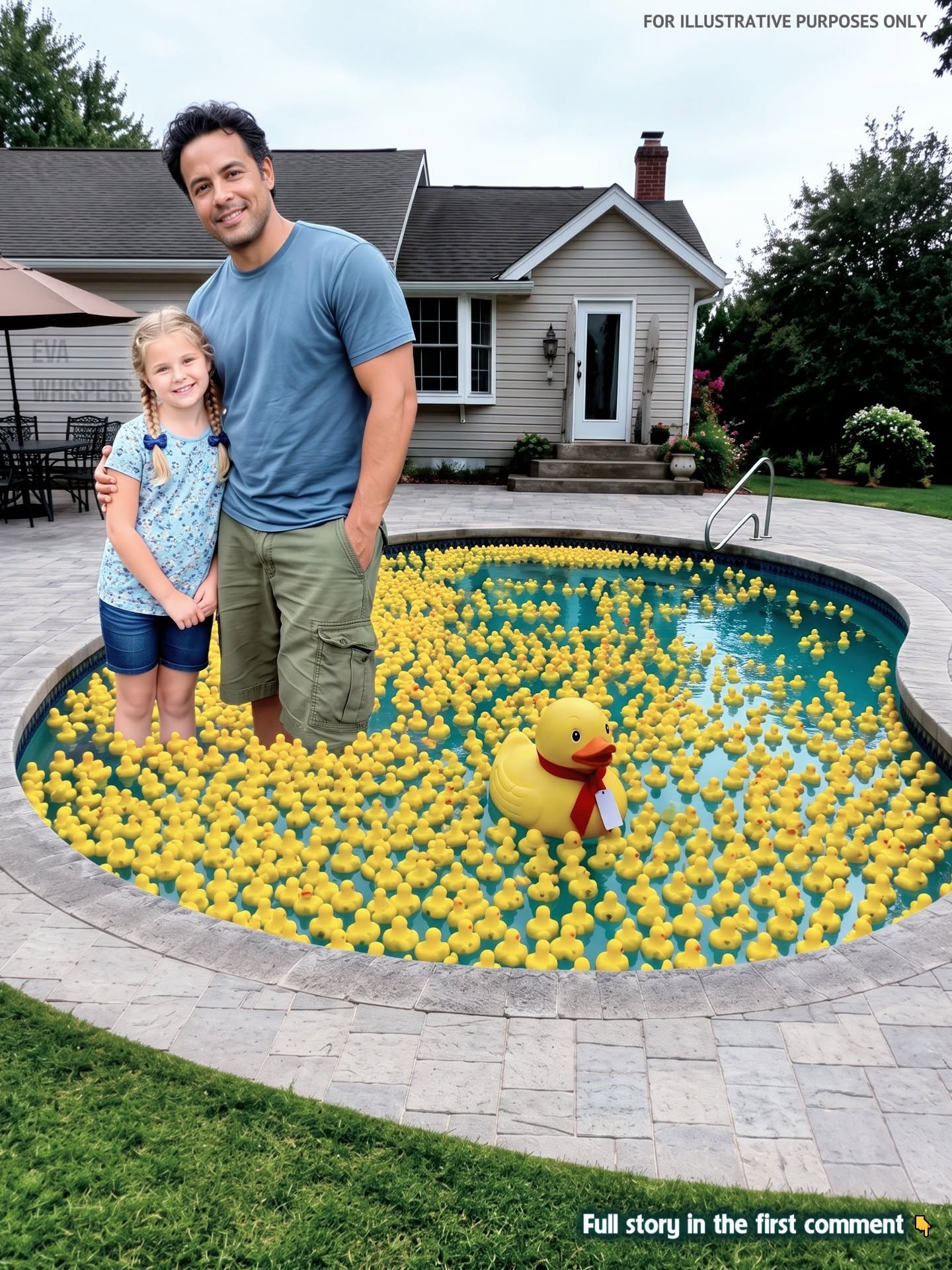
My swimming pool was completely covered with rubber ducks.
Hundreds of them.
Tiny yellow ducks. Blue ducks. Pink ducks. Ducks wearing hats and crowns. They floated so tightly together that I could barely see the water.
In the center was one enormous yellow duck.
A red ribbon was tied around its neck. Attached to it was a folded note inside a plastic sleeve.
I did not stop to put on shoes.
I waded into the pool wearing my pajamas, pushing ducks aside with both arms. The water reached my chest, but I barely felt the cold.
I grabbed the large duck and tore the note free.
The first sentence made my heart stop.
“You spent ten years blaming the wrong person, and you still have a chance to see your daughter.”
Then I read the second line.
“Ask your sister Julia why Emma has been living under the name Maya Reed.”
I screamed.
Mrs. Carver ran through the gate and found me standing in the pool, clutching the note to my chest.
I climbed out, grabbed my phone, and called the police.
The Name I Had Buried
Julia was my younger sister.
We had once shared a bedroom, secrets, clothes, and dreams. As adults, everything became complicated.
Julia was charming and impulsive, always searching for a new beginning. She changed jobs, cities, and relationships whenever life disappointed her. She loved Emma deeply—or so I had believed.
For years, Julia had wanted a child of her own. When that never happened, she became bitter whenever I talked about motherhood. She accused me of taking my family for granted.
A month before Emma disappeared, Julia arrived unannounced and offered to take her on a weekend trip. Mark and I said no because Emma had school activities and Julia had recently moved without telling anyone.
Julia exploded.
“You think you’re the only person who knows how to love her,” she said.
Then she looked at Emma and added, “One day, you’ll understand who truly listens to you.”
I told Julia to leave.
The next morning, she apologized by text.
On the day Emma vanished, Julia told police she had been two hours away at a craft fair. Vendors remembered seeing her there in the afternoon. No one confirmed what time she arrived.
Four months later, she moved away. At first, she sent postcards. Then they stopped.
Our parents were gone. We had no other siblings. Eventually, Julia became a name I avoided and a memory I buried.
Now that name was on the note.
The Case Reopens
Detective Bell had retired, but when he heard what happened, he came to the station.
The police examined the note, plastic sleeve, rubber ducks, and nearby security footage. A camera showed a dark van entering our neighborhood at 3:17 in the morning. A hooded person carried bags through my side gate.
The license plate was covered.
At the bottom of the note was an address I had been too shaken to notice.
A motel seventy miles away.
Room 214.
Beneath it were six words:
“Come with the detective who believed you.”
Detective Bell read the sentence twice.
“I never stopped wondering,” he admitted. “The evidence pointed toward the river, but there was always something wrong about that ribbon.”
“What?”
“It was tied in a clean knot. A child running through brush would not lose it that way. Someone placed it there.”
My knees weakened.
Someone had created a trail toward the river.
For the first time in ten years, hope did not feel like something I had invented to survive.
It felt real.
Room 214
The police would not allow me to go alone.
Mark arrived fifteen minutes later. When I told him about Julia, he stared at me as if I had spoken another language.
Then he covered his face.
“I saw a woman near the boathouse,” he said. “A yellow coat. I told the police, but I couldn’t see her face. Julia had a yellow coat.”
I remembered it too.
At the motel, officers surrounded the building. Detective Bell stood beside me. Mark held my hand for the first time in years.
An officer knocked on the door of Room 214.
The door opened.
A young woman stood inside.
She was tall and thin, with long brown hair. Her face was older than the one in my photographs, but her eyes were exactly the same—gray-green, with a tiny gold mark near the left pupil.
Emma’s eyes.
My knees gave way.
The young woman covered her mouth.
For several seconds, neither of us moved.
Then she whispered, “Mom?”
Ten years of grief broke open at once.
I crossed the space between us and wrapped my arms around her. She was real. Warm. Taller than me. Trembling so hard I could feel it through both our bodies.
Mark reached us a moment later.
Emma looked at him and began crying.
“Dad, I’m sorry.”
He shook his head. “No, sweetheart. You never have to say that.”
We stood in the doorway of a cheap motel room, three people holding one another as if the world might separate us again.
This time, we did not let go.

What Julia Had Done
Emma was not alone.
A woman named Caroline Reed sat near the window. Caroline was Julia’s former partner—and the person who had filled my pool with rubber ducks.
For years, Julia told Caroline that Maya was her daughter from a private relationship. She claimed the father had disappeared and the records were complicated by frequent moves.
Caroline believed her.
Julia homeschooled Emma for several years, then enrolled her in small private programs using altered documents. They moved through three states in ten years.
At first, Emma cried for us constantly.
Julia told her that Mark had caused an accident at the river and that I had died while searching for her. She said the police wanted to place Emma with strangers and hiding was the only way to keep her safe.
Emma was eight years old.
She remembered our faces, but children trust the adults controlling their world. Over time, fear covered her memories like dust.
Julia changed her name to Maya. She cut her hair and removed every photograph of her old life.
But she could not erase everything.
Emma still dreamed about a blue bedroom, a stuffed rabbit, pancakes on Sunday mornings, and a swimming pool behind a white house.
And ducks.
Two months before the anniversary, Caroline found a locked suitcase in a storage room. Inside were newspaper clippings about Emma’s disappearance, the yellow coat Julia had worn, and a photograph of our family.
Caroline confronted her.
Julia finally confessed.
She had watched Mark and Emma at the river because she knew their Sunday routine. When Mark turned to retrieve the paper bag that had blown toward the path, Julia called Emma from behind the boathouse.
Emma trusted her aunt.
Julia said I had been hurt and they needed to hurry. Then she drove away using the service road behind the trees.
Later, she returned and planted the ribbon. The craft fair gave her an afternoon alibi.
Caroline wanted to call the police immediately, but Emma—now eighteen—begged for a little time. Her entire identity had collapsed overnight. She did not know which memories were true. She feared we would hate her for not finding us sooner.
Caroline agreed to bring her near our town. Julia discovered their plan and disappeared before police could reach her.
That was when Emma came up with the rubber ducks.
“I needed you to know it was really me,” she said. “I thought the ducks would make you understand before anyone could call it a cruel joke.”
The biggest duck had been her idea too.
When she was little, Mark used to tell her every group of ducks had one brave leader who made sure the others reached home.
“I wanted to be the big duck,” she said through tears. “I wanted to lead myself home.”
The Arrest
Julia was arrested three days later at a bus station in another state.
I did not go to see her.
For years, I had imagined demanding answers if I ever discovered someone had taken Emma. But no explanation could return the stolen years.
Julia had convinced herself that her love excused what she had done.
It did not.
Love does not erase another person’s life.
Love does not require lies and isolation.
Love does not steal.
The court process took months. Emma gave her statement privately with support from a counselor. Mark and I attended when she wanted us there and stayed away when she needed space.
We learned not to treat her like the eight-year-old girl who had vanished.
She was eighteen.
She had favorite songs we had never heard, habits we did not recognize, and memories that did not include us. She had been called Maya longer than she had been called Emma.
So we asked what she wanted to be called.
“Emma Maya,” she said at last. “Both names are part of me. One was taken from me. The other helped me survive.”
We respected that.
Learning Each Other Again
Bringing Emma home was not the ending.
It was the beginning.
The first night, she stood in the doorway of her old bedroom and stared at the stuffed rabbit.
“You kept it?”
“I kept everything.”
The room looked like a museum of someone she had once been. The clothes no longer fit. The books were too young. The walls belonged to a child.
The next week, we redecorated together. She chose soft green walls, new shelves, and a desk by the window.
She kept the rabbit.
Mark visited every day.
At first, Emma was guarded with him. Julia’s lies had twisted her clearest memory into fear. Mark never pressured her. He answered every question, even the painful ones.
One evening, she asked, “Why did you let go of my hand?”
He looked down.
“I didn’t,” he said. “You were beside me. I turned to grab the bag. I thought you were safe because you were three steps away.”
Emma reached across the table and placed her hand over his.
“I believe you.”
Mark cried quietly.
So did I.
That was when I understood what my silent blame had done to him.
“I’m sorry,” I whispered.
He looked at me for a long time.
“We were both trying to survive,” he said.
It was not instant forgiveness or a magical repair.
But it was a door opening.
Returning to the River
Six months after Emma came home, she asked us to return to the river.
On a bright Sunday morning, the three of us walked the old path together.
The river looked smaller than I remembered. The boathouse had been repainted. New railings lined the bank. Children tossed oats into the water.
Emma carried a paper bag.
When we reached the place where she had disappeared, she stopped.
Then she pulled out three rubber ducks.
One small.
One medium.
One large.
She placed them on the water.
The current carried them side by side.
“I thought coming back would make everything hurt more,” she said. “But this place didn’t take me. Julia did. I don’t want to be afraid of the river anymore.”
Mark put one arm around her.
I stood on her other side.
The ducks drifted forward, still together.
The Words That Gave Us a Future
Emma is twenty now.
She is studying social work because she wants to help children and families who feel lost inside systems they do not understand.
She still goes by Emma Maya.
Mark moved home last year.
We are not the same people we were before our daughter disappeared. Our marriage is slower now, more honest. We say painful things before silence turns them into walls.
I kept the largest rubber duck. It sits beside a new family photograph.
I kept the note too.
For a long time, I thought its most important words were:
“You spent ten years blaming the wrong person.”
They were not.
The most important words were:
“You still have a chance to see your daughter.”
That chance did not restore the birthdays we missed. It did not return Emma’s childhood or erase Mark’s pain.
But it gave us something grief had nearly convinced us was impossible.
A future.
Every Sunday morning, when the weather is good, we make pancakes.
Then we walk to the river with a bag of oats.
We feed the ducks.
And we always come home together.