
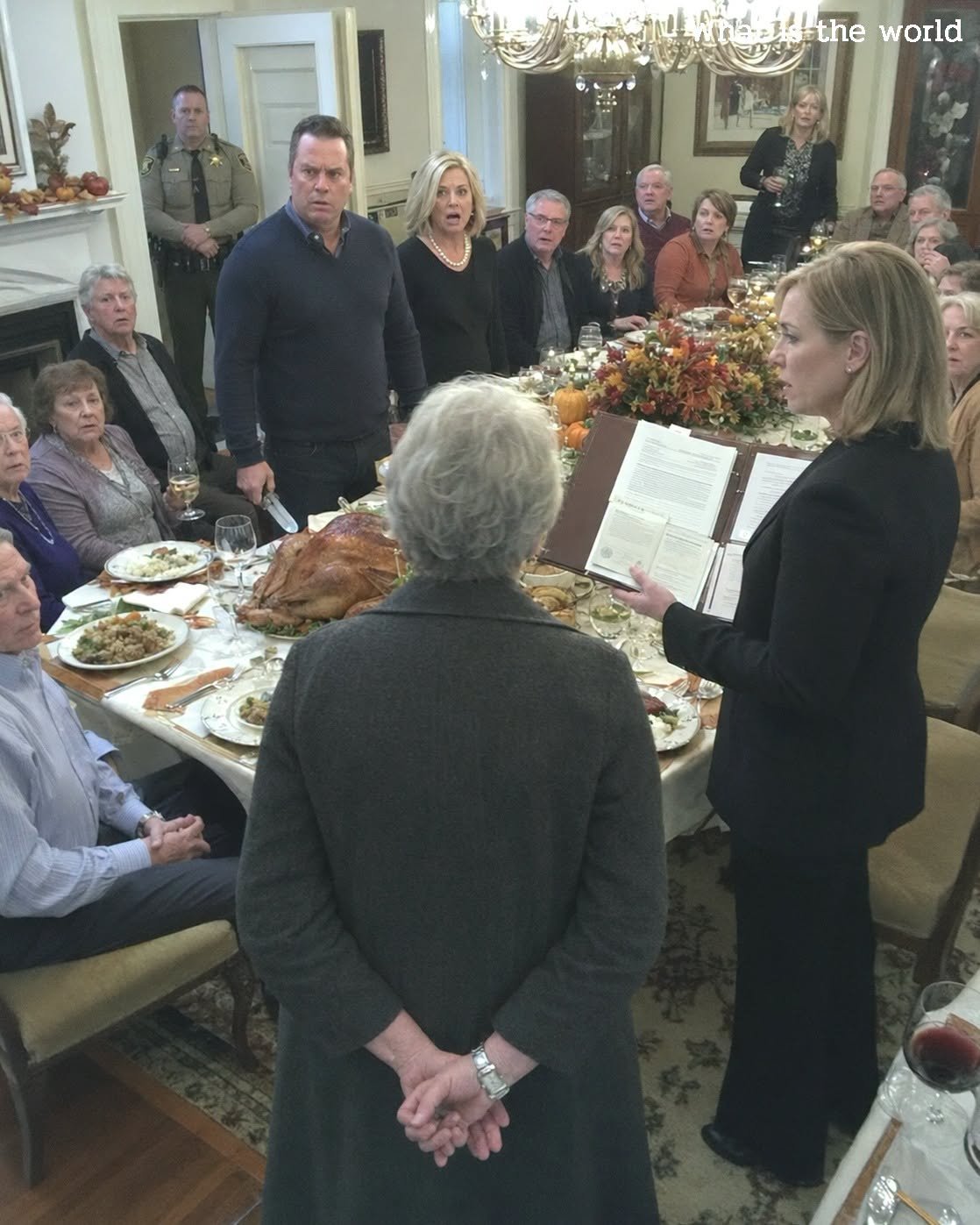
The room became so quiet that I could hear the ticking of the grandfather clock Walter had restored with his own hands.
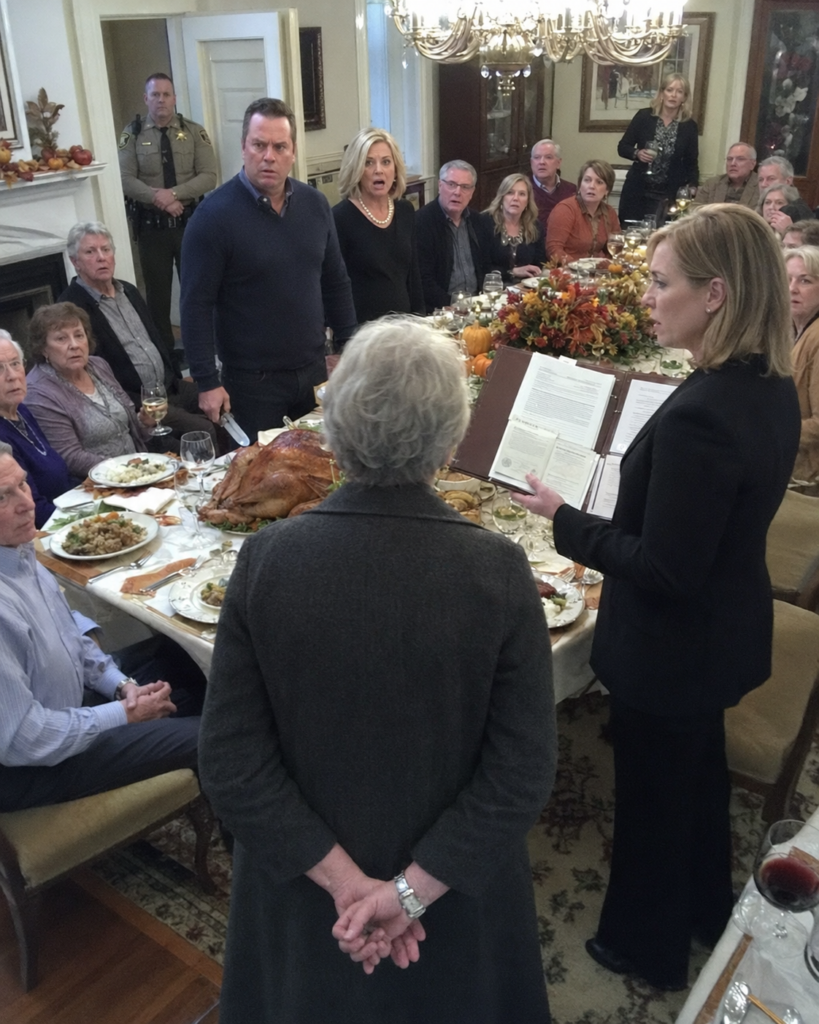
For years, that clock had marked every Thanksgiving dinner, every birthday celebration, every Christmas morning. It had sat proudly in the corner of the dining room while my family gathered beneath the same roof.
But on that Thanksgiving afternoon, it was no longer a symbol of family.
It was a witness.
Brooke stared at the documents spread across the table as if they were written in another language.
Daniel looked between his wife and me, confused.
“Mom,” he whispered, “what is this?”
I looked at my son—the boy I had raised, the child whose scraped knees I cleaned, whose college tuition I helped pay, whose first apartment deposit I covered when he was twenty-two.
And for the first time in my life, I saw him not as my little boy.
I saw him as a man who had allowed someone else to take advantage of me.
Evelyn calmly turned the first page toward everyone.
“This is the deed that was submitted three weeks ago,” she explained. “It claims ownership of this property was transferred from Holly and Walter to Daniel and Brooke.”
A few relatives leaned closer.
Marlene crossed her arms.
“Maybe Walter signed something before he passed,” she said.
Evelyn didn’t even look surprised by the accusation.
“No,” she replied. “Because the filing date was four years after Mr. Walter Bennett’s death.”
The room shifted.
A few people exchanged uncomfortable glances.
Brooke suddenly found her voice.
“This is ridiculous. It has to be a mistake.”
“A mistake?” Evelyn asked.
Brooke swallowed.
“Yes. Maybe the paperwork was prepared earlier and filed later.”
Evelyn opened another document.
“That would be impossible.”
She tapped the page.
“The notary record shows the signatures were witnessed on the same day the deed was submitted.”
She paused.
“And according to the notary’s statement, both Walter Bennett and Holly Bennett were present.”
My hands tightened slightly.
Because that was the part that made my stomach turn.
Someone had not simply changed paperwork.
Someone had recreated a version of my life.
They had forged my husband’s name.
They had pretended I had agreed.
They had built an entire future around a lie.
Daniel looked at Brooke.
“You told me Mom wanted us to take over the house.”
Brooke’s expression changed.
Only for a second.
But I saw it.
Fear.
“You misunderstood,” she said.
“No, I didn’t.”
His voice was quieter now.
“You said she was moving to the cabin permanently because she wanted a simpler life.”
I looked at him.
That sentence hurt more than anything Brooke had said.
Because it meant my son had accepted the story without ever asking me.
Brooke quickly stepped forward.
“Everyone calm down. This is still family.”
I almost laughed.
Family.
That word had been used so many times to convince me to sacrifice something.
My time.
My money.
My comfort.
My home.
But family was never supposed to mean one person gives while everyone else takes.
Evelyn closed the folder.
“This is no longer a family disagreement. This is a potential fraud investigation.”
The deputy moved slightly closer.
Not aggressively.
Just enough to remind everyone that this had crossed a line.
The relatives who had criticized me earlier suddenly became very quiet.
Marlene lowered her eyes.
The same woman who had written that I was being dramatic in the group chat now seemed fascinated by the pattern on the carpet.
Brooke’s confidence disappeared.
“But the house was basically ours,” she said.
I looked at her.
“Basically?”
She looked away.
“You lived here for six years,” I continued. “You decorated rooms. You hosted parties. You told people you owned it. But you never paid the mortgage, the taxes, the repairs, or the insurance.”
Daniel’s face changed.
“You paid everything?”
I stared at him.
“Yes.”
He looked genuinely shocked.
That hurt too.
Not because he didn’t know the numbers.
Because he never bothered to ask.
Evelyn handed him a folder.
“Your mother has records of every payment.”
Daniel opened it slowly.
Inside were years of statements.
Roof repairs.
Plumbing emergencies.
Insurance bills.
Property taxes.
Thousands of dollars spent protecting a home that everyone else had started treating as theirs.
Brooke stepped closer.
“You’re really going to do this to us over Thanksgiving?”
I looked around the room.
At the decorations.
At the expensive candles Brooke had bought.
At the thirty plates arranged perfectly on the table.
The entire event had been designed to prove that she belonged here.
But she had forgotten one important thing.
A person cannot inherit something they never owned.
“No,” I said softly.
“I’m doing this because you tried to take something that was never yours.”
For the first time, nobody interrupted me.
Nobody told me I was overreacting.
Nobody reminded me that they were family.
Because now they understood.
I was not the tired widow they thought they could control.
I was the woman who had spent forty years building a life.
The woman who knew every bill, every signature, every document.
The woman who had finally stopped confusing kindness with surrender.
The bank investigator arrived less than an hour later.
He reviewed the documents carefully.
Then he asked Brooke one question.
“Mrs. Parker, can you explain why the loan application lists you and your husband as property owners when county records show Mrs. Bennett has owned this home since 1987?”
Brooke opened her mouth.
Nothing came out.
Daniel sat down.
He looked older than he had that morning.
Not because of the investigation.
Because he finally understood what had happened.
His mother had not abandoned him.
His mother had not refused Thanksgiving.
His mother had simply said no.
And that one small word had exposed everything.
The investigation continued for several weeks.
The fraudulent deed was removed from the records.
The bank canceled the loan application.
And Brooke was forced to admit that she had created the entire plan after hearing about rising property values in our neighborhood.
She believed the house was worth more than $700,000.
She believed she could quietly transfer ownership, take the loan, and convince everyone it was already decided.
What she never considered was that I would fight back.
Or that I had spent years protecting the very documents she needed to destroy me.
Daniel eventually apologized.
Not immediately.
Not perfectly.
But he did.
He told me he had been embarrassed about losing his job years earlier and had allowed Brooke to make decisions because he was afraid of conflict.
I listened.
But forgiveness did not mean returning to the way things were.
The locks were changed.
The house remained mine.
And Daniel and Brooke moved into a rental apartment three months later.
As for Thanksgiving?
I never hosted another thirty-person dinner because someone ordered me to.
The following year, I invited only the people who came because they wanted to see me—not because they needed something from me.
I cooked a small meal at the cabin on Blue Heron Lake.
Just eight people.
The fire was warm.
The food was simple.
And Walter’s old watch rested on my wrist while I watched the sunset over the water.
For the first time in years, my home felt like home again.
Because I finally understood something I should have learned long ago:
A house is built with wood and stone.
But a home is protected by the people who respect the person who built it.
And sometimes, the strongest thing a mother can do for her family…
is finally stop letting them walk over her.
EPILOGUE: The House That Became Mine Again
Six months later, I stood on the front porch of my house with a cup of coffee in my hands.
The new locks gleamed in the morning sunlight.
For the first time in years, I didn’t feel like a guest in my own home.
Daniel had started coming by on Sunday afternoons.
Sometimes we talked.
Sometimes we sat in silence.
He never asked for money anymore.
He never assumed I would fix his problems.
And slowly, carefully, we began rebuilding something that had been broken long before the forged deed.
One Sunday, he looked around the living room and said, “Mom, I’m sorry I ever called this our house.”
I smiled sadly.
“It was always okay for you to call it home, Daniel.”
He looked at me.
“But it was never okay to forget whose home it was.”
He nodded.
“I know.”
After he left, I walked into Walter’s old study.
The original deed was inside the safe, exactly where it had always been.
I touched the folder and smiled.
Not because I had won.
But because I had finally stopped being afraid of losing people who only stayed when I surrendered something.
That Thanksgiving, I set the table for six.
No thirty guests.
No demands.
No family group chat telling me what I was supposed to do.
Just quiet laughter, warm food, and people who were there because they loved me.
As I watched the sunset through the dining-room window, I thought about the woman I had been a year earlier.
She had spent her whole life believing that being a good mother meant giving until there was nothing left.
Now I knew better.
Love could open the door.
Love could offer a second chance.
But love should never require you to hand over the keys to your own life.
I closed the curtains and turned off the dining-room light.
For the first time in years, I locked my front door without fear.
Not to keep my family out.
But to remind myself that I was finally allowed to decide who came in.