

The bank manager placed the sealed envelope on the counter, then looked at me with an expression I couldn’t understand.
“Mrs. Whitmore,” she said quietly, “before you open this, I need you to sit down.”
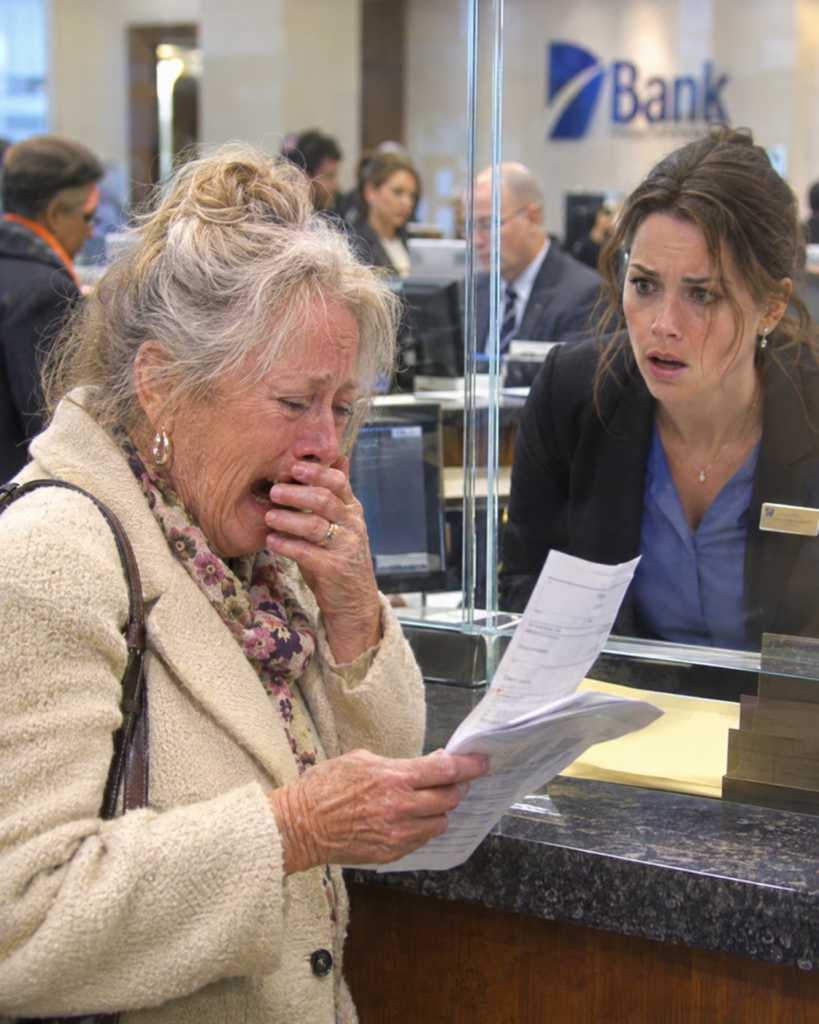
My name is Eleanor Whitmore. I was sixty-five years old, wearing a faded gray coat I’d owned for nearly twelve winters, and carrying a handbag whose broken zipper I’d repaired with a safety pin.
I had come to the bank because I was running out of choices.
I looked down at the envelope.
My full name was written across the front.
Eleanor Margaret Whitmore.
In Gregory’s handwriting.
I recognized the long curve of the E and the sharp angle of the W.
For thirty-seven years, I’d seen that handwriting on grocery lists, birthday cards, mortgage documents, and little notes he used to leave beside my coffee cup.
Now, five years after our divorce, it was staring back at me.
I suddenly felt as though I couldn’t breathe.
“Please,” I whispered. “Just tell me how much money is in the account.”
The manager pulled out a chair.
“Mrs. Whitmore, the available balance is considerably higher than the original amount.”
I gripped the counter.
“How much higher?”
She turned the computer screen slightly, careful to keep it from the view of other customers.
Then she pointed to a number.
I stared.
Read it again.
And felt the room tilt beneath me.
$487,216.43.
For several seconds, I couldn’t understand what I was seeing.
There were too many digits.
Too many numbers.
Too much money.
I had expected three thousand dollars.
Perhaps less, if Gregory had lied.
But nearly half a million?
My knees weakened.
The manager reached for my arm.
“Mrs. Whitmore?”
I whispered, “There must be a mistake.”
She shook her head.
“We’ve verified the account information.”
I looked at her.
“That’s impossible.”
She gently guided me toward a chair.
“Let’s go somewhere private.”
I followed her into a small office with cream-colored walls, a polished wooden desk, and a window overlooking the street.
Outside, Minneapolis traffic moved through the gray morning.
People hurried along the sidewalk carrying coffee cups and briefcases.
The world continued as though nothing had happened.
But inside that office, my entire life had just been turned upside down.
The manager introduced herself as Patricia Reynolds.
She offered me water.
I declined.
My hands were shaking too badly to hold a glass.
Patricia placed the envelope in front of me.
“Mrs. Whitmore, this letter was deposited with the bank five years ago. Our records indicate that you were to receive it when you first requested access to the account after that date.”
I stared at the envelope.
“Gregory left it?”
“Yes.”
“Why?”
Patricia’s expression softened.
“I believe the letter may explain.”
I looked down.
The envelope was sealed.
For five years, it had waited for me.
Through every freezing winter.
Every unpaid bill.
Every night I went to sleep hungry.
Every morning I woke wondering how much longer I could continue.
I had carried that bank card like a wound.
And all along, something extraordinary had been waiting behind it.
But before I opened the letter, one terrible thought crossed my mind.
Why he hadn’t contacted me after the larger deposits were made.
Why he’d let five years pass without making sure I knew the money existed.
The more I thought about it, the more I realized I needed answers.
Not because I wanted him back.
Not because I wanted to reopen our marriage.
But because I wanted to understand the truth.
One afternoon, I called the number listed beneath his address.
It rang four times.
Then a woman answered.
“Hello?”
My stomach tightened.
For a moment, I couldn’t speak.
“Hello?” she repeated.
I swallowed.
“I’m looking for Gregory Whitmore.”
There was a pause.
“May I ask who’s calling?”
“My name is Eleanor.”
Silence.
Then the woman’s voice softened.
“Oh.”
My heart began pounding.
“Is he there?”
Another pause.
“Mrs. Whitmore, my name is Helen. I’m Gregory’s sister.”
I closed my eyes.
Helen.
Of course.
Gregory’s younger sister had moved to Wisconsin years earlier.
We hadn’t spoken since the divorce.
“Helen,” I whispered.
“Eleanor.”
Her voice trembled.
“I wondered if you would ever call.”
I gripped the phone.
“Where is Gregory?”
There was a long silence.
Then Helen said something that made my knees weaken.
“Eleanor, Gregory has been very ill.”
I sat down.
“What?”
She took a breath.
“He’s been receiving treatment for a serious heart condition.”
My chest tightened.
“How long?”
“Several years.”
I closed my eyes.
“Why didn’t anyone tell me?”
Helen’s voice broke.
“He asked us not to.”
I felt anger rise.
“Of course he did.”
She was silent.
I continued.
“He always thought he could decide everything for everyone.”
Helen sighed.
“I know.”
I looked toward the window.
“Is he dying?”
She hesitated.
“His health is fragile. But I don’t want to frighten you unnecessarily. He’s receiving medical care.”
I swallowed.
“Does he know I found the account?”
“No.”
I looked down at the letter.
Then whispered, “I need to speak with him.”
Helen was quiet.
Finally, she said, “I’ll ask whether he’s willing.”
Two days later, she called back.
“Eleanor?”
“Yes?”
“Gregory would like to see you.”
I closed my eyes.
For five years, I had imagined what I would say if I ever saw him again.
Sometimes I imagined shouting.
Sometimes I imagined walking past him without a word.
Sometimes I imagined asking whether he’d ever loved me.
But now, with the opportunity finally before me, I felt strangely uncertain.
I didn’t know whether I wanted to see him.
I only knew I needed to understand what had happened.
Rebecca offered to drive me to Wisconsin.
I accepted.
The journey took several hours.
We passed fields.
Small towns.
Quiet roads lined with trees.
I watched the landscape through the window.
My hands rested on my lap.
The navy coat lay folded beside me.
Rebecca glanced over.
“Mom, are you nervous?”
I smiled sadly.
“Yes.”
She reached for my hand.
“You don’t have to do this.”
I nodded.
“I know.”
She looked at me.
“Then why are you going?”
I stared out the window.
“Because I spent five years wondering why my marriage ended.”
My voice trembled.
“And I don’t want to spend the rest of my life wondering.”
When we arrived, Helen met us outside a modest house near the edge of town.
She looked older.
Her hair was completely gray.
But her smile was familiar.
She hugged me tightly.
“Eleanor.”
I held her.
For a moment, we were two women who had once shared family dinners, holidays, and decades of memories.
Then Helen stepped back.
“He’s inside.”
I took a breath.
Rebecca squeezed my hand.
“I’ll wait here.”
I nodded.
Then followed Helen into the house.
The living room was simple.
A comfortable sofa.
A small fireplace.
Bookshelves.
Photographs.
And an old wooden clock ticking softly on the mantel.
Gregory sat in an armchair near the window.
When I saw him, I stopped.
He looked so different.
Thinner.
Older.
His hair almost completely white.
His shoulders narrower.
But his eyes were the same.
The same blue-gray eyes I’d looked into on our wedding day.