
The Child He Had Waited For
By the time the contractions finally eased, I had been in labor for twelve hours. The ceiling above my hospital bed drifted in and out of focus while I tried to breathe through the exhaustion. My whole body felt emptied out, yet my arms ached with a fierce need to hold the baby I had carried for nine months.
Across the room, my husband, Aaron, paced beside the window with his phone in his hand. He could not stop smiling. Every few seconds, he glanced toward the door as though pure impatience might make the nurse appear sooner.
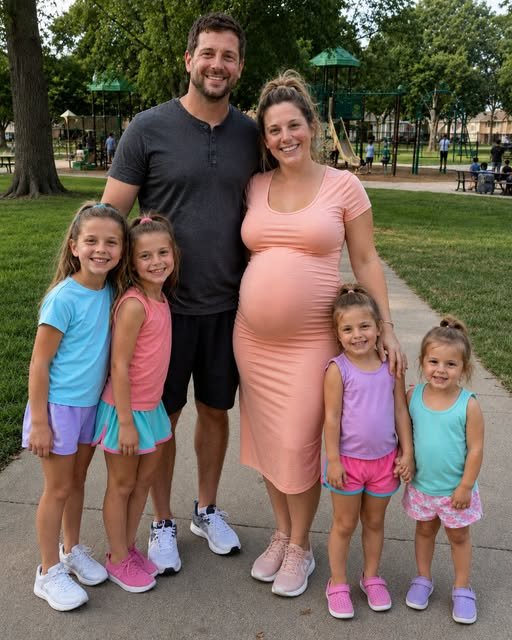
At home, our four daughters – Lily, Grace, Chloe, and four-year-old Ava – were waiting with my sister, Diana. They had spent the morning making a banner for their new brother. According to Diana’s latest message, Ava had contributed by drawing three crooked stars and chewing the paper off a blue crayon.
Aaron laughed as he read the message aloud. Then he clasped my hand and said, almost breathlessly, “Can you believe it, Elena? After all these years, we finally have a boy.”
I squeezed his fingers. “We have a baby,” I reminded him gently. “And he belongs to both of us.”
Aaron nodded, but I understood what he meant. He had loved our daughters in his own way, yet each birth had carried a shadow he never quite managed to hide. After Ava was born, he had kissed her tiny forehead, called her beautiful, and then murmured, “Maybe the next one will be a son.”
I had not wanted a fifth pregnancy. Four children already filled our home with noise, love, laundry, and needs that never seemed to sleep. Still, Aaron had dreamed of a boy for years. He had painted the smallest bedroom slate blue, arranged a wooden train on a shelf, and spoke about teaching a son everything his own father had taught him. Eventually, it became easier to agree to try again than to keep watching hope fade from his face.
The final months of the pregnancy were difficult. My doctor ordered bed rest, Aaron worked extra hours, and I could barely manage the school runs. That was when Michael, Aaron’s closest friend since adolescence, stepped in. He brought groceries, collected the girls, took Chloe to ballet, and once sat through an entire pediatric appointment with Ava while she explained every detail of her imaginary kingdom.
Michael had been woven into our lives for so long that I thought of him as family. Aaron seemed grateful too, although one evening he came home early and found Michael and me laughing over coffee. He smiled, but later asked how often Michael visited when he was away. I dismissed the question as fatigue. I did not realize suspicion had already found a place to hide.
The doctor finally entered with the news we had been waiting for. Our son was healthy – seven pounds, four ounces. A nurse named Rachel rolled the bassinet beside me, and Aaron’s entire face changed. His eyes filled as he stared down at the small, sleeping bundle.
“A son,” he whispered, as though the word itself were a miracle.
When Rachel placed the baby in his arms, Aaron held him with extraordinary tenderness. For one shining moment, the long labor, the difficult pregnancy, and every private doubt inside me seemed worthwhile. I watched my husband bend over our child and believed our family had reached the happiness he had spent years chasing.
Then Rachel took the baby back to change his gown. She opened the swaddle and turned him gently onto his side.
Aaron’s smile disappeared.
The Mark on Our Son’s Back
At first, I thought Aaron had noticed something medically wrong. He leaned closer to the bassinet, staring at the small of our son’s back with such intensity that fear shot through me.
“What is it?” I asked. “Is something wrong with him?”
Aaron did not answer. His face had gone pale, and his jaw moved as if he were arguing with a thought he could not bear to speak aloud.
Rachel looked from him to me. Aaron asked her to give us a moment, and after checking that the baby was comfortable, she quietly stepped outside.
The instant the door closed, I asked again. “Aaron, please. Tell me what you saw.”
He finally turned toward me. The joy in his eyes had hardened into something distant and accusing.
“Michael,” he said.
I stared at him, certain I had misunderstood. “What about Michael?”
Aaron pointed toward the bassinet. “The baby has his birthmark. Same crescent shape. Same place on his lower back.”
A memory surfaced: Michael climbing from a swimming pool two summers earlier while Lily clung to his shoulders. His shirt had lifted, revealing a pale, curved mark just above his waist. I remembered it only because its shape was unusual. Still, the conclusion Aaron had drawn was so absurd that a startled laugh escaped me.
“Aaron, that proves nothing. This is your child.”
He began listing every occasion when Michael had been in our home while he worked late. Each favor that had once made our lives easier now sounded like evidence in a case he had been building without telling me.
I reminded him that he had asked Michael to help. I reminded him that I had been heavily pregnant, in pain, and caring for four children. I reminded him that Michael was his oldest friend. None of it reached him.
My milk came in as I sat there, staining the front of my hospital gown. When I pushed myself upright, the fresh stitches pulled so sharply that my vision flashed white. Even then, all I could think about was making my husband see me – not the fear in his head, not an old doubt, but me.
I reached for his wrist. “Order a paternity test today. I will sign whatever is required. Then this ends.”
He jerked away as though my touch offended him. “I don’t need a laboratory to explain what I can see.”
Those words cut deeper than the accusation itself. Eight years of marriage, four daughters, and a life built side by side had been outweighed by one patch of skin on a newborn’s back.
I pleaded with him to stay until we could think clearly. Instead, he told me to take the baby to Diana’s after my discharge because he could not bear to have us in the house. He did not kiss our son goodbye. He did not look at me again.
The door closed behind him, leaving me in a silent room with the child he had wanted for years.
Three days later, Diana brought me and the children to her home. I still wore my hospital bracelet. Grace’s handmade banner lay folded on the staircase, its corner bent, the words WELCOME HOME HENRY painted in four colors. She asked whether we should save it until their father came for us. I told her yes because I could not yet explain that he might not come.
Aaron ignored my calls. His only message said that a lawyer would contact me about a separation.
I wanted to keep calling until he listened, but Diana took the phone from my shaking hands. “Stop trying to convince someone who has decided not to hear you,” she said. “You know the truth. Now prove it in a way he cannot twist.”
That afternoon, I ordered a paternity test. Diana retrieved Aaron’s toothbrush from our bathroom, and I swabbed Henry’s cheek while he slept. The procedure took seconds. Sitting in the post office parking lot with the sealed envelope on my lap took nearly an hour. Mailing it felt like accepting that my word had never been enough.

Proof Changed the Question
Waiting for the result gave my mind too much room to wander. I replayed every visit Michael had made, every cup of coffee, every harmless conversation. I knew I had done nothing wrong, yet Aaron’s certainty made me examine my own memories as if guilt could be hidden inside them.
Four days after we arrived at Diana’s, Michael appeared on the porch carrying a stuffed bear. He looked bewildered and hurt. Aaron had blocked his number, and he wanted to know what had happened.
I could not bring myself to repeat the accusation. I told him the baby was fine and that we needed a little time. As he set the bear beside the door, an old memory stirred. At Aaron’s father’s funeral, Michael had remained long after most mourners left. He had stood apart from the family, staring at the coffin with grief that seemed strangely personal. When I asked whether he was all right, he said only that he had known Aaron’s father for a long time.
I had assumed he meant through Aaron. Now the memory felt unfinished.
One week after I mailed the samples, an email arrived. I opened the report at Diana’s kitchen table. The sentence was clinical and absolute: Aaron’s probability of paternity was 99.99 percent.
Relief came first, quick and bright. Then anger rose beneath it.
A few days earlier, I would have called Aaron crying and begged him to bring us home. But the woman who had begged in the hospital no longer existed. I remembered the way he had pulled away from me, the ease with which he had condemned me, and the newborn he had abandoned without waiting for facts.
I forwarded the report without a greeting, explanation, or plea.
Aaron arrived at Diana’s within the hour. His eyes were swollen, and remorse seemed to bend his whole body. I opened the door but remained in the doorway.
“I read it over and over,” he said. “Elena, I was terribly wrong. Please let me see Henry. Please let me hold my son.”
I did not step aside. “The test answered whether Henry is yours. It did not answer why he carries the same mark as Michael.”
Aaron looked lost. For the first time, he seemed to understand that the birthmark had never proved betrayal; it had exposed a question neither of us knew how to ask.
I told him to call Michael.
Aaron hesitated, then dialed. When Michael answered, Aaron asked where his crescent-shaped mark came from. Silence stretched across the line.
Finally Michael asked, “Is the baby with you?”
Aaron said yes.
Michael’s voice changed. “Then both of you need to come to my house. There is something I should have told you years ago.”
Diana stayed with the children while Aaron and I drove across town. We sat in Michael’s kitchen with untouched cups of coffee between us. No one seemed willing to begin.
At last Michael looked directly at Aaron. “That mark runs in your father’s family,” he said. “He had it too.”
Aaron frowned. “How would you know that?”
Michael lowered his eyes. “Because your father was also my father.”
The room became so quiet that I could hear the refrigerator humming behind me.
The Brother Who Had Been Beside Him All Along
Aaron stared at Michael as though the man across the table had become a stranger. They had met at fourteen, spent holidays together, stood beside each other at weddings and funerals, and shared nearly every milestone of adulthood. Now all those years rearranged themselves around a truth Aaron had never been allowed to know.
Michael explained that his mother had been involved with Aaron’s father long before the boys met. He learned the truth at seventeen, after asking why he resembled the man who often seemed unusually interested in his life. Aaron’s father admitted everything but demanded secrecy. Michael could remain close to Aaron as a friend, he said, but could never claim a place in the family as his son or Aaron’s brother.
“He made me promise,” Michael said. “I was young, and I was afraid he would disappear completely if I refused.”
Aaron’s voice shook. “You knew all this time? Every birthday, every holiday – you knew?”
Michael nodded, tears gathering in his eyes. He said that after their father died, he considered confessing. But by then the secret had lived too long. He feared Aaron would see only the years of deception and cut him out of his life.
Then the funeral memory finally made sense. Michael had stood behind everyone else because he had been mourning his own father while pretending to be merely a family friend.
“You were the only family I had left,” he told Aaron. “I thought silence was the only way to keep you.”
Aaron covered his face. The anger that had driven him from the hospital collapsed into grief. In a matter of days, he had discovered a brother, learned that his father had built their relationship on a secret, and nearly destroyed his marriage because he mistook inherited resemblance for proof of infidelity.
I felt compassion for both men, but compassion did not erase what Aaron had done to me. Their father’s choices explained the birthmark. They did not explain why my husband had trusted suspicion more than the woman who had shared his life.
Aaron reached toward me. “Elena, I betrayed you. I know that now.”
I stood and put on my coat. “You and Michael have years of truth to work through. I came for the answer about Henry, and I have it.”
Aaron asked me to wait, but for once I did not stay simply because he wanted me to. I left the brothers at the kitchen table and returned to Diana’s house, where my children were sleeping under borrowed blankets and my newborn son knew nothing about the storm that had greeted his arrival.
That night, I sat beside Henry’s bassinet and studied the tiny crescent on his back. It was no longer a mark of accusation. It was a thread connecting him to a family history full of love, fear, cowardice, and secrets.
I understood why Aaron had been shocked. I could even understand why the resemblance frightened him. What I could not accept was how quickly fear had become a verdict. He had not paused, asked questions, or agreed to the test I offered. He had looked at me at my most vulnerable and chosen to believe the worst.
For years, I had confused keeping the peace with protecting my family. I had agreed to another pregnancy when my body and heart were already tired. I had swallowed small disappointments because confronting them seemed more dangerous than carrying them. In the hospital, that habit ended. Aaron had made a decision without me, and its consequences could not disappear simply because the laboratory proved him wrong.

The Life I Chose to Protect
Aaron returned the next morning. He stood on Diana’s porch looking as if he had not slept. He promised counseling, patience, complete honesty – anything I asked. He said he loved me, loved all five of our children, and wanted us home.
I looked past him toward the quiet street and remembered the home I had left: the blue nursery, the wooden train, the banner our daughters had expected to hang above Henry’s crib. Part of me still wanted to walk back into that picture and pretend the last week had never happened.
But love could not make the hospital room disappear.
“I begged you to remain with me,” I said. “I asked for a test. I asked you to look me in the eyes. You left anyway.”
Aaron said he had been frightened and furious, that he had not been thinking clearly.
“That is exactly what scares me,” I replied. “When you were hurt, you did not come to me for the truth. You punished me for a story you created in your own mind. You required evidence before you would believe me, but you needed none at all before calling me unfaithful.”
He began to cry. He asked whether one terrible mistake truly had to end our marriage.
I told him it was not only one moment. The accusation had revealed years of unspoken resentment: his disappointment after each daughter’s birth, his insistence on trying again, his quiet jealousy of Michael, and my habit of making myself smaller so he would remain content. The birthmark had not created those fractures. It had illuminated them.
From the hallway, Henry began to fuss. Aaron glanced toward the sound and asked again to hold him.
I did not want to keep a father from his child, and I told Aaron we would arrange a safe, respectful way for him to be present in all five children’s lives. But I would not return home simply to relieve his guilt. Forgiveness, if it came, would not be the same as reconciliation.
Aaron reached for my hand. This time, I stepped back before he could take it.
“I spent years choosing what would make you happy,” I said quietly. “Now I have to choose what makes me and the children feel secure. I cannot rebuild a marriage where my character depends on the next piece of evidence.”
His shoulders fell. There was no dramatic argument after that. Only the painful silence of two people realizing that an apology, however sincere, cannot return trust to the moment before it was broken.
I went inside and lifted Henry from the bassinet. His small body settled against my chest, warm and trusting. Upstairs, our daughters were beginning to wake. I could hear Ava asking Diana whether breakfast could include chocolate, and Grace reminding her that the banner still needed to be hung somewhere.
For the first time in many years, I did not measure my decision by Aaron’s disappointment. Protecting my family no longer meant sacrificing myself to preserve the appearance of togetherness. It meant building a home where my daughters would learn that love must include trust, where my son would never be valued more because he was a boy, and where I would not have to prove my worth to the person beside me.
I carried Henry toward the sound of his sisters. Behind me, Aaron remained on the porch, facing the consequences of the choice he had made in that hospital room.
I did not feel triumphant. I felt heartbroken, exhausted, and uncertain about the future. Yet beneath all of that was something steady I had not felt in a long time.
I was no longer abandoning myself to keep someone else from leaving.
This time, I was choosing a life built on dignity, safety, and truth – for my children, and for me.