
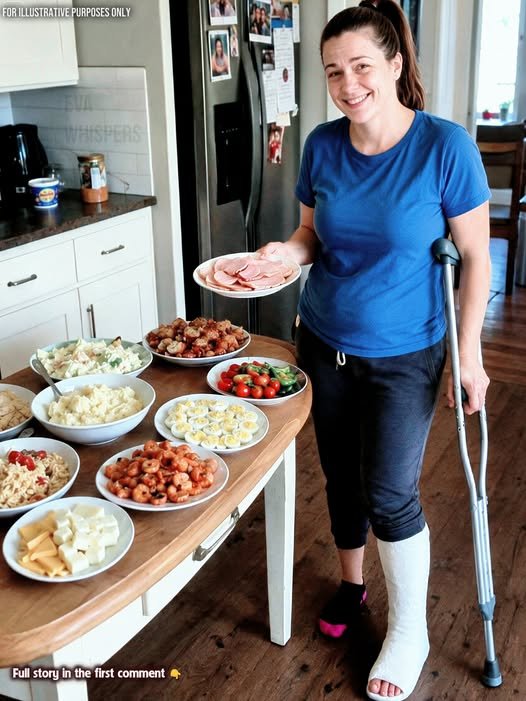
Part 1: The Cake Was All He Saw
The first question my husband asked after I nearly collapsed was not whether I had injured myself again.
He did not ask if the pain in my broken leg had become worse.
He did not even ask whether I needed to return to the hospital.
Instead, Donald stared at the damaged birthday cake and said, “Can it be repaired?”
I was clinging to his mother, Diane, with nearly all my weight. One of my crutches had slid several feet across the kitchen floor after its rubber tip landed in a puddle of water. A fierce ache traveled from my ankle to my knee, and my hands trembled as I tried to steady myself.
The glass cake stand had struck the edge of the counter. The cake had not fallen, but a deep split ran through the smooth frosting I had spent hours perfecting.
Donald had hurried in from the backyard wearing new swim trunks and carrying a half-finished drink. Music still played near the pool, where thirty guests were waiting for food and cake.
His attention remained fixed on the frosting.
“Please tell me that isn’t ruined,” he said.
For a moment, Diane seemed too stunned to respond. Then she tightened her arms around me and helped lower me into a chair.
“Your wife almost fell,” she said sharply.
Donald shrugged. “But she didn’t.”
I looked at the man I had been married to for twelve years.
My shirt was damp with sweat. Flour covered the front of it. My cast felt tighter than it had that morning, and every movement sent another wave of pain through my leg.
Still, Donald glanced toward the patio door.
“Talia, everyone’s waiting.”
Something inside Diane changed when she heard those words.
Something inside me changed too.
For years, both of us had protected Donald from the consequences of his selfishness. His mother had defended him because he was her son. I had defended him because he was my husband.
That afternoon, neither of us was willing to do it anymore.
Three weeks earlier, I had broken my leg after missing the final step on our back porch. I had been carrying a basket of clean laundry when my foot twisted beneath me.
I remembered the sharp crack, the basket tumbling onto the grass, and the sudden pain that left me unable to move.
Donald had been in the kitchen.
“Are you all right?” he had shouted through the open door.
He did not come outside until I called his name twice.
At the hospital, the doctor clearly explained that I needed to keep my weight off the injured leg. I was supposed to rest, elevate it, and avoid unnecessary activity.
Donald sat beside me during the appointment. He nodded seriously and even asked the doctor a few questions.
For the first two days, he acted like the attentive husband everyone believed him to be. He brought me coffee, prepared toast, and arranged pillows beneath my cast.
By the third day, his plate was once again sitting beside the sink.
By the end of the week, he was asking when I expected to be “back to normal.”
That phrase stayed with me.
To Donald, normal meant that his clothes appeared clean in the closet, appointments were remembered, groceries arrived before anything ran out, family gifts were purchased, and meals were prepared without him having to think about them.
Normal meant I carried the invisible weight of our life so smoothly that he could pretend it weighed nothing.
A week before his birthday, I was lying on the couch with an ice pack over my cast when he walked into the room holding a handwritten list.
He looked delighted with himself.
“I’ve got good news,” he announced. “The guest list is finished.”
I lowered the ice pack. “What guest list?”
“For my birthday party.”
“What party?”
“The pool party next Saturday.” He looked down at the paper. “Thirty people. I kept it small.”
I stared at him, wondering whether I had misunderstood.
Then I looked at my leg, which was stretched across two cushions.
“You think thirty guests is small?”
“For this house, yes. And some of them don’t eat much.”
“That’s reassuring. Perhaps the people who do eat can prepare the food.”
His smile disappeared.
“I was thinking appetizers, ribs, a few salads, cocktails, and that layered cake you make.”
“You were thinking I would prepare all of that?”
“It’s my fortieth birthday, Talia. I want it to feel special.”
I tapped the cast lightly. “And this is my broken leg.”
He glanced at it as though he had temporarily forgotten why I was on the couch.
“You can sit while you chop things.”
I could hardly believe how reasonable he thought he sounded.
“I suggested dinner with you and your mother,” I reminded him. “You invited thirty people without even speaking to me.”
“A quiet dinner sounds miserable for a fortieth birthday.”
“Then hire a caterer.”
“That would cost too much.”
“Order prepared food from the grocery store.”
“I don’t want people thinking we served something cheap.”
His answer made the truth painfully clear.
He was more concerned about impressing his friends than protecting his injured wife.
“So you would rather have me spend the day cooking on one leg?”
“You’re making it sound worse than it is.”
“I’m repeating your plan.”
Donald crossed his arms.
“My mother used to host parties twice this size.”
“Your mother was not wearing a cast.”
“She still would have found a way.”
There it was—the comparison he used whenever he wanted more from me.
Diane had raised two children, hosted every holiday, remembered every birthday, and produced meals that appeared on the table as if by magic. Donald spoke of her endurance as though it were evidence that every wife should quietly accept exhaustion.
“Call the guests,” I said. “Tell them the plan has changed.”
“I’m not canceling my birthday.”
“Then you can cook for it.”
“I’m not spending my birthday trapped in the kitchen.”
The response came so quickly that he revealed more than he intended.
He understood perfectly well that cooking for thirty people would be exhausting.
He simply believed the exhausting work belonged to me.
After a long argument, we reached an agreement. Donald would order the main dishes. I would prepare three simple appetizers and his cake.
“Nothing else,” I said.
“All right.”
“Repeat it.”
He sighed dramatically. “Three appetizers and the cake.”
I believed the discussion was over.
I should have known better.

Part 2: He Knew I Would Save Him
Two days before the party, I found Donald leaning against the kitchen counter, scrolling through his phone.
“Send me the confirmation for the food order,” I said.
He kept his eyes on the screen. “I didn’t place it.”
For several seconds, I thought he was joking.
“What do you mean?”
“The price was ridiculous.”
“That was our agreement.”
“You cook better than a caterer anyway.”
I tightened my hand around the crutch.
“Donald, I agreed to appetizers and a cake.”
“I already told everyone about your ribs.”
My disbelief turned into anger.
“You promised thirty people a meal I never agreed to make?”
He pointed toward several grocery bags that had been delivered earlier.
“All the ingredients are here. You always figure these things out.”
The casual confidence in his voice hurt more than the words themselves.
He had not forgotten our agreement.
He had deliberately ignored it because he believed I would rescue him from embarrassment.
“Then you can cook the ribs yourself,” I said.
He laughed as though I had made an impossible suggestion.
At four o’clock on the morning of the party, my alarm sounded.
I lay awake in the darkness, staring at the ceiling.
I could have stayed in bed.
I could have allowed thirty guests to arrive and discover that Donald had arranged nothing. They could have found bags of uncooked food, a few bowls of chips, and whatever explanation he invented.
For a few minutes, I seriously considered it.
Then I imagined people walking into the kitchen, opening cabinets, and asking what had happened. I imagined Donald telling them that I had been too stubborn or disorganized to prepare the food.
I hated that their judgment mattered to me.
I hated even more that Donald knew it mattered.
That was how he controlled me. He created a problem, then trusted that my pride, loyalty, or sense of responsibility would force me to solve it.
So I got out of bed.
I rolled my office chair into the kitchen and used it to move between the counter, refrigerator, and stove. I worked in short, painful intervals, balancing on my uninjured leg whenever I had to stand.
By seven, I had prepared two dips, arranged a vegetable platter, washed ingredients for the salads, and baked the cake layers.
By nine, my shoulders ached from using the crutches. My good leg shook whenever I stood. I had barely eaten.
Donald entered the kitchen looking refreshed and cheerful. His hair was neatly styled, and he was wearing the expensive swim trunks he had purchased for the occasion.
He dipped one finger into a bowl of sauce.
“It needs more salt.”
I pushed the salt shaker toward him.
“Then today is full of exciting opportunities for you.”
He either missed the sarcasm or chose to ignore it.
“When will the ribs be done?”
“They’re in the large pot. I need you to move it to the other burner.”
He looked toward the backyard, where the first decorations were fluttering beside the pool.
“I can’t stay in here. I’m hosting.”
I stared at him.
“So am I, apparently.”
With an irritated sigh, he lifted the pot and dropped it onto the counter. Sauce splashed across the tiles and onto my shirt.
“I also need help carrying the trays,” I said.
“It’s my birthday, Talia.”
“And it’s still my broken leg.”
He grabbed a handful of chips and walked outside.
Minutes later, the music became louder.
Guests began arriving shortly before noon.
For the next hour, people wandered into the kitchen looking for ice, cups, napkins, bottle openers, and extra drinks. Each time the patio door opened, I caught a glimpse of Donald laughing near the pool.
He moved from group to group, accepting gifts and compliments.
Not once did I see him look toward the kitchen.
Eventually, someone outside called, “The food smells incredible!”
Donald laughed proudly.
“Talia insisted on doing everything herself. You know how she gets when she takes on a project.”
My knife stopped halfway through a tomato.
A guest answered, “She must love you very much.”
“She loves entertaining,” Donald said. “I couldn’t keep her out of the kitchen if I tried.”
My fingers tightened around the knife handle.
He had not merely abandoned me with the work.
He had rewritten the entire situation so that he appeared considerate and I appeared eager.
The patio door opened again.
Misha, the wife of Donald’s longtime friend Theo, stepped inside carrying an empty ice bucket.
Her eyes traveled over the crowded counters, the dirty pans, and the trays waiting to be carried outside. Then she looked down at my cast.
“Tals, why are you doing all of this?”
“Apparently, the food refused to prepare itself.”
She did not laugh.
“Donald told everyone you wanted to handle the party.”
My throat tightened.
“He said that?”
“He also said you rejected the idea of hiring a caterer.”
For a moment, I could not answer.
Misha placed the ice bucket on the counter.
“Tell me what I can do.”
“You’re a guest. Go enjoy the party.”
“So are twenty-nine other people, and none of them are trying to cook while balancing on one leg.”
“I can manage.”
Even I could hear how weak the words sounded.
Misha moved closer.
“You do not have to make this situation look acceptable just to protect him.”
My eyes began to burn.
That sentence reached something inside me that I had been trying to ignore all morning.
After a pause, I pointed toward two serving trays.
“Could you take those outside?”
“Of course.”
Before she left, she squeezed my shoulder.
“I’ll come back for the rest.”
“You don’t have to.”
“I know,” she said gently.
That was the difference.
Misha helped because she chose to.
Donald expected me to help because he believed I had no choice.
A few minutes later, Diane entered carrying a wrapped present and a covered casserole dish.
She stopped in the doorway.
Her cheerful expression faded when she saw me sitting beside the stove, surrounded by half-finished dishes.
“What are you doing in here, honey?”
“Finishing the cake.”
“I can see that. Why are you alone?”
I continued spreading frosting over the first layer.
“Donald wanted a proper celebration.”
Diane glanced through the window toward her son, who was standing beside the pool with a drink in his hand.
“He has always loved being the center of a big occasion.”
Her tone was affectionate, and disappointment tightened in my chest.
Then she looked around again.
“Where is the food he ordered?”
“He canceled the order.”
“Why?”
“He decided it cost too much.”
Diane’s expression changed.
“Did he help you prepare any of this?”
I kept my eyes on the cake.
“Talia?”
“No, Diane.”
Her mouth tightened into a thin line.
“He told me you were excited to host.”
“Donald also thinks leaving a wet towel on the bedroom floor counts as putting it somewhere.”
A small smile appeared on her face, but it vanished when I shifted in the chair and inhaled sharply.
“How much pain are you in?”
“I’m all right.”
“No, you aren’t.”
I set the frosting knife down.
“The doctor told me to stay off the leg.”
“Donald knows that?”
“He was sitting beside me when the doctor said it.”
Diane became very still.
I had spent years carefully softening the truth whenever I spoke to her about her son. I never wanted to seem disrespectful or create conflict between them.
That day, I no longer had the energy to protect his image.
“He told me you would have managed a party like this without complaining,” I said.
Diane looked at the kitchen counters.
After a long silence, she pulled out a chair and sat beside me.
“He is probably right,” she admitted. “I would have done it.”
I stared at her, unsure whether she was defending him.
Then she continued.
“Donald’s father expected every holiday, birthday, and family gathering to appear effortless. He rarely helped unless someone else was watching. I kept telling myself that enduring it quietly made me a strong wife.”
“Did it?”
She looked through the window at her laughing son.
“No. It only made life easier for everyone except me.”

Part 3: The Celebration Became a Reckoning
The cake was finally assembled, but it needed to be moved to the other counter.
Diane stood immediately.
“I’ll carry it.”
“It’s all right. I can do it.”
The words left my mouth automatically.
I had been saying some version of them for years.
I’m fine.
I can handle it.
Don’t worry about me.
Before Diane could stop me, I reached for my crutches and pushed myself upright.
The rubber tip of the left crutch landed in a shallow puddle of water that someone had tracked inside from the pool.
It slid.
My body lurched sideways.
Diane caught me beneath the arms just before I hit the floor. The cake stand slammed into the counter, cracking the frosting down the center.
Pain surged through my leg.
That was when Donald rushed into the kitchen.
He looked at the cake and asked whether it could be fixed.
Diane stared at him as though she were seeing a stranger.
“Your wife almost fell.”
“But she didn’t.”
Donald finally glanced at me.
“You’re okay, aren’t you?”
The question was not an expression of concern.
It was a request.
He needed me to say yes so the music could continue, the guests could eat, and he could return to his party without feeling responsible.
For twelve years, I had given him the answers that made his life easier.
This time, I refused.
“No,” I said. “I am not okay.”
Donald blinked.
Diane helped me into the nearest chair and carefully lifted my leg onto another seat.
Then she turned toward her son.
“This party is over.”
Donald gave an uncomfortable laugh.
“Mom, don’t create a scene.”
Diane walked past him, crossed the patio, and switched off the music.
The sudden silence spread across the backyard.
Conversations stopped. Guests lowered their drinks. Every face turned toward her.
“Before anyone eats cake,” Diane announced, “my son has something to explain.”
Donald followed her outside.
“Mom, this is ridiculous.”
I reached for my crutches.
Misha appeared beside me almost immediately.
“You don’t have to go out there,” she whispered.
“Yes,” I said. “I do.”
She walked beside me as I made my way slowly toward the patio.
Thirty guests stood around the pool. Some looked confused. Others had begun to understand.
Donald’s face had turned red.
Diane pointed toward the kitchen.
“Tell everyone why Talia has been preparing this party since four o’clock this morning.”
Donald looked around at his friends.
“She wanted to.”
“No,” I said.
Every head turned toward me.
I stood in the doorway wearing a flour-stained shirt, with damp hair sticking to my forehead and my cast visible beneath me.
Donald forced a smile.
“Talia, this has gone far enough.”
“No,” I replied. “It went too far when you watched your injured wife work all day and expected her to call it love.”
His jaw tightened.
“This is a private conversation. We should discuss it inside.”
“We already discussed it inside. You ignored me.”
No one moved.
I could hear the soft hum of the pool filter and the distant sound of a car passing on the street.
Diane stepped beside me.
“He told Talia that I would have hosted this party without complaining,” she said. “He was right. I probably would have.”
Donald turned to her with relief, apparently believing she had come to his defense.
Then she continued.
“I spent years confusing silence with strength. I made endless sacrifice look normal, and I allowed my son to grow up believing that women would carry every responsibility he refused to hold.”
“Mom, stop,” Donald said.
“No. I should have stopped this years ago.”
Donald looked around at the guests.
“She could have said no.”
“I did say no,” I answered. “You simply knew I would protect you from what happened afterward.”
His mouth opened, but no words came.
I adjusted my grip on the crutches.
“I will not clean up this party. I will not repair the cake. I will not explain your behavior or make excuses for you.”
Donald stared at me.
“This is my home too.”
“I know. That is why you have two choices. You can stay somewhere else tonight, or I will leave with Diane. Either way, you will not come near me until you can describe what you did without blaming me, the guests, the cost of catering, or your birthday.”
A heavy silence followed.
Then Theo, Donald’s oldest friend, cleared his throat.
“You can stay at our place tonight.”
Donald looked shocked.
“You’re taking her side?”
Theo’s expression remained serious.
“I’m taking the side of the person who has been cooking since before sunrise with a broken leg.”
Donald looked toward Misha, but she did not defend him.
Diane returned to the gift table and picked up the package she had brought.
Donald reached for it.
“Can we at least finish celebrating my birthday?”
She pulled the gift away.
“I brought you our family’s handwritten recipe book. I thought passing it to you would be a meaningful tradition.”
Then she placed the book in my hands.
“But a tradition without respect is simply another burden handed to someone else.”
Donald stared at the book.
“That was supposed to be mine.”
Diane met his eyes.
“You are not ready for it.”
The party ended almost immediately.
Some guests left quietly, offering me awkward apologies even though they had done nothing wrong. Others began gathering cups, carrying dishes into the kitchen, and packing the leftover food.
Donald stood near the pool while the celebration he had demanded disappeared around him.
For once, no one rushed to rescue him from the discomfort he had created.
Misha brought me a plate filled with food.
“Have you eaten anything today?”
I looked down at the dishes I had spent hours preparing for everyone else.
“No.”
“Then you’re eating now.”
She pulled out a chair, sat beside me, and stayed there until I took the first bite.

Part 4: Choosing Myself
Donald left with Theo that evening.
Diane remained with me.
She cleaned the kitchen without asking me where anything belonged. She packed the leftovers, wiped the sauce from the floor, and brought fresh ice for my leg.
For the first time in weeks, someone helped me without behaving as though my injury were an inconvenience.
The next morning, Donald sent a message.
“I’m sorry the party got out of control.”
I read it twice.
Even after everything that had happened, he was still trying to separate himself from his choices. According to his message, the party had somehow lost control on its own.
I replied with five words.
“The party didn’t. You did.”
A few minutes later, he tried calling.
I did not answer.
Instead, I sent him a longer message explaining what would need to happen before I even considered allowing him to return home.
He would arrange professional help while I recovered.
He would attend counseling with me.
He would acknowledge that his behavior was not a misunderstanding or a stressful reaction to turning forty. It was part of a pattern in which he expected me to carry the physical and emotional labor of our marriage while he accepted the benefits.
Most importantly, he would understand that an apology did not automatically earn forgiveness.
For years, I had treated forgiveness like another household responsibility—something I needed to provide quickly so everyone could return to normal.
But I no longer wanted our old version of normal.
Diane prepared coffee and set the cup beside me.
She did not ask me to move.
She did not mention the dishes or the laundry.
She simply sat in the chair across from me.
“I owe you an apology too,” she said.
“You didn’t invite thirty people.”
“No, but I taught him what marriage looked like.”
I opened the family recipe book she had given me. The pages were worn and stained from decades of holiday meals. Notes filled the margins in different colors of ink.
Diane rested her hand on the cover.
“I thought endurance was the same as love,” she continued. “I thought being needed meant I was valued. Whenever Donald behaved selfishly, I told myself he would mature. Sometimes I even defended him because admitting the truth felt like admitting I had failed as a mother.”
“You didn’t make his choices for him.”
“No, but I helped make excuses for them.”
Her eyes filled with regret.
“I am sorry, Talia.”
I looked at the woman sitting across from me.
For years, Donald had compared me to her as though her sacrifices were a standard I had failed to meet. Now I understood that many of those sacrifices had not been freely given.
They had been expected.
And expectations repeated long enough had become family tradition.
“Then we stop excusing it now,” I said.
Diane nodded.
We closed the recipe book between us.
Donald remained away for several days.
At first, his messages focused on the public humiliation.
He said his friends looked at him differently.
He complained that his birthday had been ruined.
He accused his mother of embarrassing him in front of everyone.
I did not argue.
Each time, I repeated the same point: his embarrassment was not the problem. His behavior was.
Eventually, the tone of his messages began to change.
He admitted that he had canceled the catering because he assumed I would step in.
He admitted that he lied to the guests because he did not want them to think he had forced me to cook.
He admitted that when I nearly fell, his first concern had been the cake because the cake represented the perfect party he believed he deserved.
Those admissions did not erase what happened.
But for the first time, he was naming his choices without hiding behind excuses.
Whether our marriage could be repaired remained uncertain.
I did not promise him that counseling would save us. I did not promise that I would forget the image of him standing in the kitchen, staring at cracked frosting while I shook in his mother’s arms.
Some moments reveal more than years of conversation.
That moment showed me exactly how invisible I had become inside my own marriage.
But it also gave me something I had not expected.
Clarity.
I had spent twelve years anticipating Donald’s needs, preventing his discomfort, and cleaning up the consequences of his decisions. I had believed that keeping everything together was proof that I loved my family.
In reality, I had been holding so much together that Donald never had to learn what happened when he let something fall.
His fortieth birthday was the first time I stopped catching everything for him.
The cake remained cracked.
The dishes waited for someone else.
The guests saw the truth.
And Donald finally faced the weight he had placed on me.
That morning, as sunlight filled the kitchen, Diane brought me breakfast and placed another pillow beneath my cast.
No one asked me to stand.
No one asked me to serve.
No one expected me to turn pain into proof of devotion.
Donald had spent years assuming I would carry everything he handed me.
For the first time, I set the burden down.
And chose myself.