
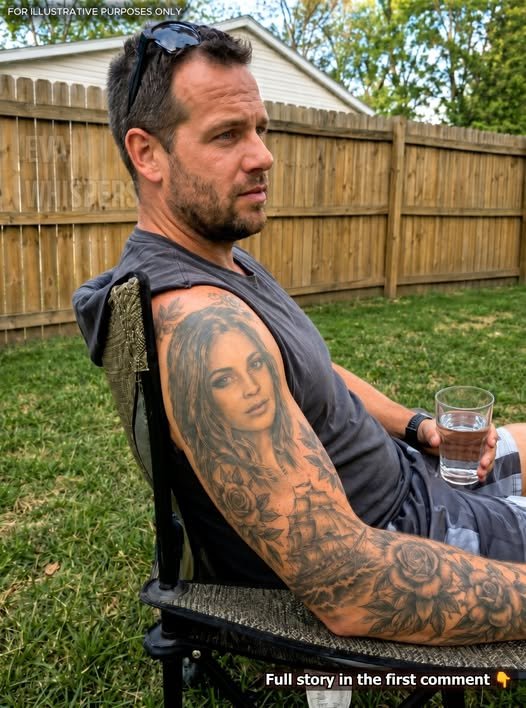
For 12 years, I stared at the woman’s face tattooed on my husband’s shoulder and wondered why he refused to tell me who she was. Then I met her by accident in a bakery, and the look of fear on her face told me I had been asking the wrong question all along.
From the first day I met Ryan, I noticed the tattoo.
It was not a name. It was not a flower. It was not one of those abstract designs people claimed had some deep, mysterious meaning.
It was a woman’s face.
A full portrait.
She looked young, maybe in her early 20s, with dark hair, thoughtful eyes, and an expression that always seemed strangely sad.
At first, I did not ask about it. We were dating then, and I was trying very hard to be the kind of girlfriend who did not feel threatened by things that had existed before she arrived.
But the tattoo was impossible to ignore.
Every time Ryan wore a sleeveless shirt, there she was. Every time we went swimming, there she was. Every time he rolled over in bed, there she was.
Watching.
Eventually, curiosity got the better of me.
“Who is she?”
Ryan barely glanced at the tattoo.
“Nobody.”
That answer bothered me.
Not enough to start a fight, but enough for me to remember.
The Explanation That Never Felt True
Years later, after we got engaged, I asked him again. This time, he laughed, as if the whole thing were too small to matter.
“There isn’t some big story.”
“So who is she?”
“My buddy was learning realistic tattoos. He downloaded a random photo online and needed somebody to practice on.”
I stared at him.
“That’s your explanation?”
“It’s the truth.”
Even then, I knew he was lying.
I just did not know why.
After we got married, the tattoo began to bother me more. Not because I thought Ryan was cheating, but because people do not permanently tattoo strangers onto their bodies.
Not like that.
Not with that much detail.
Eventually, I asked him to cover it. Not remove it, just cover it. Anything would have been better—a compass, a mountain, a dragon. I did not care.
At first, he argued.
Then he agreed.
Then months passed.
His tattoo artist moved away. Money was tight. Work was busy. There was always a reason.
Eventually, I stopped asking. Not because I had stopped caring, but because I was tired.
Tired of losing the same argument.
Tired of competing with a woman whose name I did not even know.
So I taught myself to ignore her.
Or at least I thought I had.
Until last week.

The Woman in the Bakery
I was standing in line at a bakery when the woman in front of me turned slightly.
My stomach dropped.
I knew that face.
Not from school. Not from work. Not from anywhere in real life.
I knew it from my husband’s shoulder.
For a second, I genuinely thought I was imagining things. Then she turned a little more, and there was no mistaking it.
The same eyes.
The same mouth.
Even the tiny beauty mark near her jaw.
She was older now, but unmistakably her.
My hands began to shake. I must have stared for a full minute. Finally, before I could lose my nerve, I stepped forward.
“Excuse me.”
She turned.
“This is going to sound strange, but do you know someone named Ryan?”
The reaction was immediate.
Every trace of color vanished from her face. She took a small step backward.
What I saw on her face was not confusion or surprise.
It was fear.
My pulse started hammering.
“Are you okay?” I asked.
For several seconds, she did not answer. Then she looked past me toward the bakery door, as if checking whether someone was watching.
When she finally spoke, her voice was barely above a whisper.
“Ryan?”
I nodded.
Her expression somehow became worse. The fear was still there, but now there was something else too.
Sadness.
“Is he okay?”
The question caught me completely off guard. I had expected denial, maybe embarrassment. I had not expected concern.
“He’s fine.”
The woman closed her eyes briefly, and relief flashed across her face. Then she looked at me again.
“Why are you asking about him?”
I swallowed, because suddenly this conversation felt far more complicated than I had expected.
“Because my husband has your face tattooed on his shoulder.”
For a moment, she only stared at me.
Then she slowly sat down in the nearest chair.
“Ryan did what?”
My heart skipped.
“You didn’t know?”
She slowly shook her head.
“No.”
For a few seconds, neither of us spoke. Then the woman looked down at her coffee.
“If Ryan still hates me,” she said quietly, “I understand.”
The sentence did not fit anything I had imagined.
Hates her?
Maybe she was an ex. Maybe she had broken his heart. But if that was true, why would he tattoo her face on his shoulder?
Nothing about this made sense.
“How do you know him?” I asked.
A sad smile touched her face.
“I knew him a long time ago.”
That was not an answer.
Before I could press further, she stood.
“I should go.”
“Wait.”
She hesitated, and my pulse quickened.
“Who are you?”
For a moment, I thought she might tell me.
Instead, she shook her head.
“That’s a conversation you need to have with your husband.”
Then she turned and walked away.
Ryan’s Reaction
The entire drive home, my mind ran wild.
Ex-girlfriend.
Old friend.
Secret daughter of a family friend.
Nothing fit.
No explanation accounted for all the pieces—not the tattoo, not the lies, and definitely not the fear I had seen on her face.
By the time I pulled into our driveway, I had worked myself into a state. Ryan was sitting on the porch. The moment he saw me, he smiled.
I did not smile back.
His expression immediately changed.
“What happened?”
I walked straight up to him.
“I met her.”
The smile vanished.
For a second, Ryan just stared at me. Then all the color drained from his face.
Not guilt.
And definitely not panic about being caught.
Fear.
The same fear I had seen in the bakery.
“Who?” he asked.
“You know who.”
“The woman from your tattoo.”
Ryan looked like I had punched him. For several seconds, he said nothing.
Then he asked, “You talked to her?”
I crossed my arms.
“Interesting choice of words.”
He ignored that.
“Did she seem okay?”
The question hit me like a slap.
Not “What did she say?”
Not “How did you find her?”
Not “What happened.”
“Did she seem okay?”
I stared at him.
“Who is she?”
Ryan rubbed both hands across his face. The gesture looked exhausted, defeated, almost resigned.
“Her name is Sloane.”
At least now she had a name.
“Who is she?”
Again.
This time, Ryan looked away. For a long moment, I thought he was not going to answer.
Then he quietly said, “The person I hurt more than anyone else.”
The words stopped me cold.
Not loved.
Not lost.
Hurt.
A strange feeling settled in my chest. The story I had spent 12 years imagining was suddenly collapsing.
“What does that mean?”
Ryan was silent.
Then he stood.
“Come inside.”

The Truth at the Kitchen Table
We sat at the kitchen table, the same table where we had celebrated birthdays, paid bills, and planned vacations.
Now it felt like I was sitting across from a stranger.
Ryan stared at the wood grain for several seconds before speaking.
“When I was 16, my dad was one of the most respected people in town.”
I frowned.
His father had died years before I met him, and the little I had heard about him had always been positive.
Teacher.
Coach.
Volunteer.
One of those people everybody seemed to admire.
Ryan laughed bitterly.
“That’s the version everyone remembers.”
A knot formed in my stomach.
“Sloane accused him of something.”
He stopped. Swallowed. Then started again.
“She said he’d crossed a line he never should have crossed.”
The kitchen suddenly felt smaller.
“What happened?”
Ryan looked at me.
“The town destroyed her.”
The words landed hard.
“Nobody believed her.”
His voice had become very quiet.
“Not me. Not my mom. Not anyone.”
I felt sick.
“We called her a liar.”
His eyes drifted toward the window.
“We called her worse things, too.”
The shame in his voice was unmistakable.
For the first time since I had known him, Ryan looked genuinely ashamed of who he had once been.
“I was a kid,” he said. “But that’s not an excuse.”
Silence settled between us.
Then I asked the question I already knew the answer to.
“Was she telling the truth?”
Ryan closed his eyes.
“Yes.”
The word barely escaped him, and somehow it carried 12 years of weight behind it.
When he opened his eyes again, they looked glassy.
“Proof came out years later. Not right away. Not when it mattered.”
His laugh held no humor.
“That’s how these things work sometimes.”
The room felt painfully quiet.
“What happened to her?”
Ryan looked down.
“She left town.”
I thought back to the fear I had seen in the bakery. The sadness. The exhaustion. The way she had looked over her shoulder before answering a simple question.
Her reaction suddenly made sense, at least part of it.
“What does any of this have to do with the tattoo?”
Ryan stared at me, and for a moment, he looked genuinely surprised, as if he had forgotten that the tattoo was the original question.
Then he gave a small, broken smile.
“The tattoo came later.”
I froze.
“What?”
“It wasn’t before.”
The room went completely silent.
For 12 years, I had assumed the tattoo represented some relationship that existed before me.
An old love.
An old obsession.
Something he could not let go of.
Ryan shook his head.
“I got it after I learned the truth.”
Nothing in my imagination had prepared me for that answer.
“Why?”
His eyes drifted toward the living room. Then toward the hallway.
Anywhere except me.
Finally, he spoke.
“Because I spent years helping destroy an innocent person.”
The words hit harder than I expected.
Ryan swallowed.
“I wanted to remember.”
“Remember what?”
His answer came instantly.
“Her.”
I frowned.
Ryan looked down at the tattoo.
“I chose her face because I never wanted to forget who paid the price for being right.”
He swallowed.
“Or what happens when people choose the easy story instead of the true one.”
Silence stretched between us.
Then he said, “I didn’t get the tattoo because I loved her.”
His voice cracked.
“I got it because I couldn’t forgive myself. I should’ve told you years ago.”
I looked at him.
“So why didn’t you?”
Ryan laughed bitterly.
“Because every time you asked, I imagined having to explain what I’d done.”
His eyes dropped to the table.
“And every time, I chose the coward’s way out.”
For a long time, neither of us spoke.
I kept looking at Ryan, trying to reconcile the man sitting across from me with the story he had just told.
Twelve years of marriage, and somehow I had never come close to the truth.
The Apology He Never Made
Finally, I asked the question that had been bothering me since the bakery.
“Why did Sloane look scared when I mentioned your name?”
Ryan’s expression immediately darkened. He already knew the answer.
“She thought I still blamed her.”
“Did you?”
A painful smile touched his face.
“Back then? Absolutely.”
He leaned back in his chair.
“I was 16. My dad was my hero. He coached my baseball team. Helped me with homework. Showed up to every game.”
His eyes drifted toward the window.
“When Sloane came forward, it felt impossible.”
The next words sounded like they physically hurt.
“So I made her the villain.”
Silence.
“I wasn’t the only one.”
His laugh held no humor.
“The whole town did.”
I thought about Sloane standing in the bakery. The fear. The caution. The way she had looked over her shoulder before answering a simple question.
Her reaction suddenly made perfect sense.
“Did you ever apologize?”
Ryan stared at the table.
“No.”
The answer surprised me.
Not because I thought he did not want to, but because I had expected the guilt to have driven him to it years ago.
“I tried once.”
He rubbed his forehead.
“I drove past her house. Sat in my truck for almost an hour.”
“What happened?”
“I left.”
The answer broke my heart a little.
Not because it excused him.
But because it did not.
“I told myself she’d be better off without hearing from me.”
He shook his head.
“Truth is, I was a coward.”
For a moment, neither of us spoke.
Then I stood.
Ryan looked up.
“Where are you going?”
I grabbed my keys.
“To finish a conversation.”
“Elsie.”
“I’ll be back.”
“Elsie.”
But I was already gone.
Meeting Sloane Again
The bakery manager recognized me. I left my phone number and a short message asking Sloane to call if she was willing to talk.
I honestly did not expect anything to come of it.
An hour later, my phone rang.
The next thing I knew, I was sitting across from Sloane in a small park two blocks away.
She looked nervous.
I understood why.
“Ryan told you.”
It was not a question.
I nodded.
For several seconds, Sloane stared at her coffee. Then she laughed softly.
The sound carried no joy.
“I always wondered what happened to him.”
The sentence surprised me.
“After everything?”
She looked up.
“Especially after everything.”
I did not understand.
Sloane seemed to notice.
“You know the strange part?”
She smiled sadly.
“The people who hurt you the most are rarely the people you worry about.”
The words lingered between us.
Then she sighed.
“I spent years hoping Ryan would figure it out.”
My throat tightened.
“When he didn’t, I stopped hoping.”
I thought about the tattoo, about the guilt Ryan carried around every day.
“He did figure it out.”
Sloane looked away.
“A little late.”
I could not argue with that.
For a moment, we sat in silence.
Then I asked, “If he apologized now, would it matter?”
Sloane stared at me.
Not angry.
Not bitter.
Just tired.
Finally, she shrugged.
“I don’t know.”
It was the most honest answer she could have given.

Twenty Years in a Doorway
Three days later, Ryan knocked on Sloane’s door.
I stayed in the car.
This was not my conversation.
It had never been.
From where I sat, I watched the door open.
Then stop.
For a long moment, neither of them moved.
Twenty years of history stood between them in a doorway.
Eventually, Sloane stepped aside.
Ryan went in.
The meeting lasted nearly two hours.
When he finally returned, his eyes were red. I did not ask what happened, not immediately.
We drove almost ten minutes before he finally spoke.
“I apologized.”
I nodded.
“And?”
Ryan stared out the window. Then he laughed softly, a sound that held more relief than humor.
“She forgave me.”
The words hung in the air.
For some reason, they made me emotional.
Maybe because forgiveness is rarer than people think.
Maybe because I had spent 12 years believing the tattoo represented love, when all along it represented regret.
“What did she say?”
Ryan smiled.
A real smile this time.
“The first thing?”
I nodded.
His smile widened slightly.
“She asked to see the tattoo.”
I blinked.
“And?”
Ryan laughed softly.
“She said I should’ve found a less permanent way to learn a lesson.”
I actually laughed.
The sound surprised both of us.
Then Ryan shook his head.
“The last thing she said was worse.”
“What?”
For several seconds, he stared through the windshield.
Then he quietly said, “Ryan, I forgave you years ago. You’re the one who’s still carrying it.”
I felt that one.
So did he.
Because neither of us spoke for the rest of the drive.
The Tattoo Appointment
A month later, Ryan finally made an appointment with a tattoo artist.
For years, I had wanted him to cover the portrait.
For years, he had found reasons not to.
This time, he scheduled it himself.
The night before the appointment, we sat together on the couch. I found myself staring at the tattoo again.
The same face.
The same sad eyes.
The same woman who had haunted our marriage.
Only now, I understood.
“Are you sure?” I asked.
Ryan looked down at it.
For a long moment, he did not answer.
Then he surprised me.
“No.”
I frowned.
“What do you mean?”
His thumb brushed the edge of the tattoo.
“I don’t think I need to anymore.”
I waited.
“For years, I kept it because I thought I deserved the reminder.”
His gaze lingered on the portrait.
“Now I’m keeping it because I’m not hiding from the truth anymore.”
The words caught me off guard.
A year earlier, they would have started a fight.
Now they did not.
Because the tattoo was not a secret anymore.
It was not another woman.
It was not an old romance.
It was not a lie.
It was a reminder, a painful and ugly one.
But an honest one.
For the first time since I had known him, Ryan was not hiding from it.
And for the first time since I had known him, I was not competing with it.
The next morning, he canceled the appointment.
The Photograph in the Hallway
A week later, Sloane mailed us a photograph.
Not of herself, but of a youth resource center she had helped open for teenagers facing crises at home.
The building was not large.
But it was full.
Kids sat at tables doing homework. Volunteers talked with families. A handmade sign near the entrance read, “You belong here.”
There was a short note attached.
No anger.
No bitterness.
Just seven words.
“Thank you for finally telling the truth.”
Ryan framed it.
The photograph hangs in our hallway now.
The tattoo is still there, too.
Strangely, I barely notice it anymore.
Because once I finally learned the story behind the woman on my husband’s shoulder, I stopped seeing another woman.
And started seeing the truth.