
Part 1 — My Mother Apologized for Being Sick
My mother has always been the kind of woman who apologizes for needing anything.
That is the first thing you need to understand about Helen Park.
At seventy years old, she could say “I’m sorry” for things no human being should ever feel guilty about.
For being tired.
For needing someone to drive her to an appointment.
For taking medication at the dinner table.
For asking me to repeat something because she hadn’t heard it.
For taking too long in the bathroom.
Sometimes even for eating the food I had prepared specifically for her.
For most of my life, I had been telling her the same thing.
“Mom, you don’t have to apologize for existing.”
She would smile, nod as though she understood, and then apologize again ten minutes later.
It came from the way she had been raised.
My grandparents arrived in America with very little. Their lives had been built around work, sacrifice, and the belief that survival depended partly on not asking anyone else for too much.
They passed that lesson to my mother so thoroughly that it became part of her character.
Work hard.
Endure quietly.
Be grateful.
Never become a burden.
Even illness couldn’t convince her that those rules no longer applied.
So when she was diagnosed with stage-three breast cancer, one of her first concerns wasn’t the chemotherapy.
It was us.
More specifically, whether caring for her would inconvenience me.
My name is Sara Choi-Bennett.
I had been married to my husband, Gabriel Bennett, for nine years when Mom received her diagnosis.
I still remember sitting beside her in the oncologist’s office while Dr. Reyes explained the treatment plan.
There was encouraging news. The doctors believed treatment could help.
But the chemotherapy would be aggressive.
Mom would be weak.
She might struggle with nausea, fatigue, dizziness, dehydration, and days when simply walking across a room could feel exhausting.
Dr. Reyes looked directly at her.
“You should not go through this alone.”
Mom answered immediately.
“I’ll manage.”
Of course she would.
She had been managing for nineteen years since my father died.
She managed household repairs, doctor appointments, bills, winter storms, grief, loneliness, and every other problem that came through her front door.
But cancer was not going to become one more thing she silently endured because she was afraid of troubling someone.
“You’re staying with me,” I said.
She turned.
“Sara—”
“You’re staying with us.”
“I have my own house.”
“And stairs.”
“I can handle stairs.”
“Maybe today. Maybe not after chemotherapy.”
Her mouth tightened.
“I don’t want to be in the way.”
“You won’t be.”
She looked down at her hands.
Then she asked the question I had been expecting.
“What does Gabriel think?”
That question bothered me more than I wanted to admit.
Because I had already spoken to him.
And his reaction hadn’t exactly been warm.
“How long is she staying?” he had asked.
“As long as she needs.”
Gabriel frowned.
“So there’s no plan?”
“The plan is chemotherapy.”
“I mean an end date.”
“She has cancer, Gabriel. I don’t know how to give you an end date for cancer.”
Eventually, he sighed.
“Fine.”
At the time, I treated that as agreement.
Looking back, I realize it was closer to reluctant permission.
And there had been signs long before Mom got sick that Gabriel sometimes viewed compromise differently than I did.
Even my name should have taught me something.
When we married, Gabriel wanted me to become Sara Bennett.
I wanted to keep Choi, the name that connected me to my parents and the history I had before him.
We eventually settled on Choi-Bennett.
Gabriel jokingly called the hyphen “unnecessarily complicated.”
I told myself it was harmless.
Over the years, I had told myself that about many things.
Gabriel wasn’t cruel.
He could be loving, funny, generous, and charming.
But he also had a habit of being most comfortable with compromise when the result still landed close to what he wanted.
I had spent nine years calling that a strong personality.
I had not yet understood that sometimes a pattern can hide behind a perfectly ordinary word.
Part 2 — The Room by the Garden
Mom moved into our first-floor guest room two days before her first chemotherapy treatment.
I had chosen that room carefully.
The bathroom was directly across the hall, which mattered because Dr. Reyes had warned us that nausea could come suddenly.
There were no stairs.
The mattress was high enough that Mom could stand without putting too much pressure on her knees.
And beside the window sat a comfortable chair overlooking my backyard garden.
Mom loved gardens.
She had been criticizing my pruning technique for years.
I hoped that on the worst days, when she didn’t have energy to go outside, she could at least sit by the window and watch the flowers.
She arrived carrying one small suitcase and a plastic bag filled with medication.
“I should have packed less,” she said.
I stared at the single suitcase.
“You’re staying for weeks, possibly months.”
“I don’t need much.”
“You brought less luggage for chemotherapy than I bring for a weekend.”
She smiled faintly.
“I don’t want to clutter your house.”
“Mom.”
“What?”
“This is your room while you’re here.”
Her eyes moved slowly around the space.
The bed.
The chair.
The bathroom across the hall.
The view of the garden.
“It’s very nice.”
“It’s practical.”
“You thought about all of this?”
“Of course I did.”
She looked toward me.
And for once, instead of apologizing, she said something else.
“Thank you.”
That simple thank-you nearly made me cry.
Her first infusion lasted around five hours.
I sat beside her the entire time.
I brought water.
Adjusted her blanket.
Talked to the nurses.
Kept track of medications.
When the nausea began, Mom gripped my hand.
Then she whispered, “Sorry.”
I looked at her.
“For what?”
She closed her eyes.
“This.”
“This what?”
“You having to sit here.”
I swallowed the frustration rising in my throat.
“Stop apologizing.”
“I’m trying.”
“No, really. Stop.”
She opened her eyes.
Then, with heartbreaking honesty, she said,
“I don’t know how.”
That hurt more than anything else she could have said.
Because I believed her.
For seventy years, my mother had measured her worth partly by how little anyone else had to do for her.
Now her body was forcing her to depend on people, and instead of seeing care as love, some part of her experienced it as debt.
The first weeks of chemotherapy taught me a particular kind of helplessness.
I could make ginger tea.
I could cook rice.
I could bring blankets, schedule appointments, organize medication, call nurses, and sit beside her when she couldn’t sleep.
But I couldn’t reach inside her body and take the cancer away.
I couldn’t absorb the nausea for her.
I couldn’t make the fear disappear.
All I could do was stay.
One afternoon during an infusion, Mom fell asleep while medication moved slowly through the IV line.
I sat there watching her.
And I realized how much of her pain I had probably missed during my life because she had always been so determined to carry difficult things privately.
Now she no longer had that option.
For the first time, I was seeing the full cost of her strength.
So I made myself a quiet promise.
If being present was the only thing I could give her, then I would be present completely.
Part 3 — Four Days Away
Three weeks into Mom’s treatment, I had to travel to Seattle.
The meetings had been scheduled months earlier.
Canceling them would have caused serious problems at work, and Mom insisted she would be fine.
“You have a job,” she said. “Go.”
“I can reschedule.”
“You’ve already rearranged half your life around me.”
There it was again.
Around me.
As though loving her were a disruption.
Gabriel would be home.
I told myself four days was manageable.
Before leaving, I prepared everything I could think of.
Crackers.
Applesauce.
Broth.
Rice.
Ginger tea.
Electrolyte drinks.
I organized Mom’s medication and wrote the schedule on index cards even though she already knew it.
Then I went over everything with Gabriel.
“The anti-nausea medicine is eight in the morning and eight at night.”
“I know.”
“She won’t tell you if she’s feeling bad unless you ask.”
“I’ll ask.”
“She may say she’s fine even when she isn’t.”
“Sara.”
I stopped.
Gabriel looked at me.
“I’ve got it.”
I wanted to believe him.
So I did.
During the trip, Mom texted every evening.
Fine. Ate some soup.
Slept okay.
Took medication.
Her messages were short, but Mom had always hated texting, so nothing about them felt unusual.
Gabriel sent fewer updates.
When I asked how things were going, he usually answered with some variation of:
Fine.
All good here.
Don’t worry.
Seattle demanded my attention.
My clients had paid for me to be there, and during meetings I forced myself to stop checking my phone every three minutes.
At night, though, I read Mom’s messages repeatedly.
I was trying to reassure myself.
If something were wrong, surely Gabriel would tell me.
If Mom needed me, surely she would say so.
On the fourth afternoon, my last meeting unexpectedly ended several hours early.
I checked flights and found one that could get me home that evening.
For the first time all week, I felt genuinely relieved.
I decided not to tell Gabriel.
I thought surprising them would be nice.
For most of the drive home from the airport, I was thinking about Mom.
Did we still have enough broth?
Had she been eating?
Should I stop for more ginger tea?
Then I turned into our driveway.
Gabriel’s brother Danny’s car was parked outside.
I didn’t think much of it.
Maybe he had stopped by to see Gabriel.
I opened the garage door and stepped into the kitchen.
Immediately, something felt wrong.
Beer bottles covered the counter.
An open bag of chips sat beside a half-eaten pizza.
There was a dark stain on the hallway carpet that looked as though nobody had bothered cleaning it for days.
I stood there staring at the mess.
Then I heard a television.
Loud.
Football commentary echoed down the hallway.
At first, I assumed Gabriel and Danny were in the living room.
Then I realized where the sound was coming from.
The guest room.
My mother’s room.
I walked toward it.
The closer I got, the colder I felt.
Then I opened the door.

Part 4 — The Air Mattress
Gabriel was sitting on the bed.
Mom’s bed.
Danny was in the chair beside the window.
Mom’s chair.
Beer bottles stood on the nightstand. Chips were scattered across a plate, and the television was showing a football game.
Gabriel turned.
The color disappeared from his face.
“Sara?”
I said nothing.
“I didn’t know you were coming home tonight.”
I looked around the room once.
Then I asked the only question that mattered.
“Where is my mother?”
Gabriel hesitated.
That hesitation told me more than any answer could have.
“Danny came over,” he said. “We wanted to watch the game in here because the television is better.”
My voice became quieter.
“Where is my mother?”
“I moved her downstairs.”
I stared at him.
“Downstairs where?”
He shifted.
“The basement.”
For a moment, I honestly wondered whether I had misunderstood him.
“Our basement?”
“She’s comfortable.”
“This is her room.”
Something changed in Gabriel’s expression.
Embarrassment became defensiveness.
And defensiveness became arrogance.
“No. It’s not her room.”
I waited.
“It’s my room if I say it is. This whole house is mine.”
Then he said the sentence I would hear in my head for a long time afterward.
“I’m the man of the house.”
I looked at him.
I looked at Danny.
Then I turned around.
I did not argue.
Not yet.
I went downstairs.
Our basement was technically finished, but nobody would call it a bedroom.
Part of it was storage.
The washer and dryer were there.
So was the furnace.
There was no bathroom.
No proper bedroom window.
No bed.
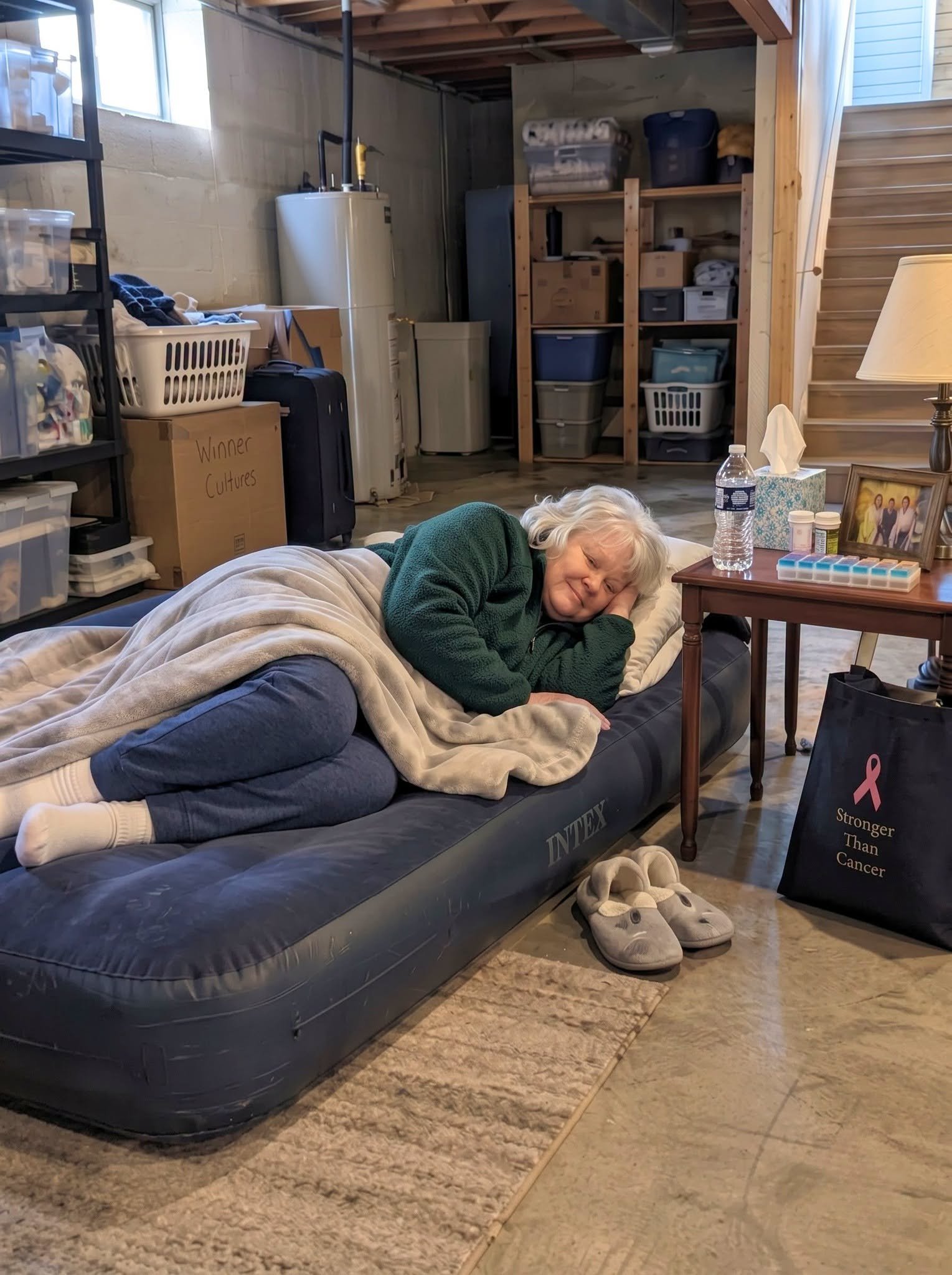
And in the middle of the floor lay a thin air mattress.
My seventy-year-old mother was asleep on it.
Three weeks into chemotherapy.
Her medications were lined up beside her on the floor.
For several seconds, I couldn’t move.
The sight of her there was bad enough.
But what made me truly furious were the details.
I had chosen the first-floor room because everything in it made her illness slightly easier.
The bathroom was only a few steps away because sometimes nausea gave her almost no warning.
The bed was high enough for her to stand without struggling.
The window gave her sunlight and a view of the garden on days when she barely had enough strength to leave the room.
Down here, she had none of that.
If she needed the bathroom, she had to climb the stairs.
If she needed to stand, she had to push herself up from nearly floor level.
If she became dizzy during the night, she was alone in a basement surrounded by storage boxes.
Gabriel hadn’t simply moved her from one room to another.
He had taken away every accommodation that made living through chemotherapy even slightly less difficult.
I felt something inside me become very calm.
Not because I wasn’t angry.
Because I had moved beyond the kind of anger that needs to shout.
Mom stirred.
Her eyes opened.
“Sara?”
I crouched beside her.
“I’m here.”
“You’re back early.”
“Yes.”
Then she looked embarrassed.
And, exactly as I should have expected, she whispered,
“I’m sorry.”
My throat tightened.
“For what?”
“For being down here.”
I almost couldn’t answer.
“Why are you apologizing to me?”
“Gabriel said they needed the room.”
I closed my eyes for one second.
“They?”
“Danny came for the game.”
“And you agreed to sleep here?”
She gave me the same quiet look she had given me my entire life.
“I didn’t want to cause trouble.”
“You didn’t.”
“I can manage.”
That sentence almost broke me.
Because she could.
That was the tragedy.
My mother could make almost anything survivable.
Cold rooms.
Loneliness.
Pain.
Exhaustion.
An air mattress in a basement while undergoing chemotherapy.
She would survive all of it and call that proof that nobody needed to worry about her.
But surviving something did not make it acceptable.
“You’re not staying down here.”
“Sara, Gabriel—”
“I’ll deal with Gabriel.”
I helped her stand.
She had lost more weight than I wanted to admit.
Halfway up the stairs, she stopped to breathe.
“Sorry,” she said.
“Mom.”
“I’m slow.”
“You’re on chemotherapy.”
Another few steps.
“Sorry. I’m leaning on you.”
“You’re supposed to lean on me.”
By the time we reached the first floor, I could feel her trembling.
When we entered the guest room, Gabriel and Danny were still watching television.
I looked at Danny.
“Thank you for coming over. You need to leave.”
He glanced at Gabriel.
Gabriel started to speak.
I didn’t raise my voice.
“Danny. Please go.”
Something in my face must have convinced him.
He stood, grabbed his jacket, and left.
Then I looked at my husband.
“Sara—”
“Get out of this room.”
“This is my house.”
“Leave.”
He stared at me.
Then, finally, he walked out.
I helped Mom back into bed.
When I checked her medication, I discovered she had missed one of her doses.
That was the moment my anger sharpened again.
I made ginger tea and sat beside her.
After several minutes, she whispered,
“I shouldn’t have let him move me.”
I turned toward her.
“No.”
She looked surprised.
“You have cancer. You are going through chemotherapy. Managing my husband’s behavior is not your responsibility.”
“He’s your husband.”
“Yes.”
“I don’t want problems between you because of me.”
“You didn’t create this problem.”
“He said the game was important.”
I stared at her.
“The football game?”
She nodded.
“I didn’t want everyone fighting.”
“You are not the reason anyone is fighting.”
Her eyes dropped.
“I don’t know if Gabriel sees it that way.”
My chest hurt.
“I know.”
A little later, she apologized because I had come home to a messy kitchen.
Then for making me prepare tea.
Then because I had missed dinner.
Eventually, I took her hand.
“Mom.”
She looked at me.
“You don’t have to manage everything alone anymore.”
Her eyes filled.
“I’ve always managed.”
“I know.”
“It feels wrong needing this much help.”
“Why?”
She struggled to answer.
Finally, she whispered,
“It feels weak.”
I squeezed her hand.
“It isn’t weakness.”
“Then what is it?”
I thought about all the years she had taken care of me without once keeping score.
Then I said,
“It’s letting someone love you.”
She was quiet for a long time.
Finally, a faint smile appeared.
“Your father used to say I was terrible at that.”
“He was right.”
She gave me a tired little laugh.
“I’m trying.”
“I know.”
And I stayed beside her until she fell asleep.
Then I went downstairs to deal with my husband.
Part 5 — “I’m the Man of the House”
Gabriel was cleaning bottles from the kitchen counter when I walked in.
He started talking immediately.
“Sara, before you say anything, Danny called unexpectedly.”
I folded my arms.
“He wanted to watch the game.”
“I know.”
“And I didn’t know you were coming home early.”
“I know that too.”
Gabriel looked relieved, as though I had just agreed with his explanation.
“If I had known you were coming, I would have handled things differently.”
I stared at him.
“That is exactly the problem.”
His forehead creased.
“What?”
“You would have acted differently if you knew I was watching.”
“That’s not what I meant.”
“It’s exactly what you meant.”
“Sara—”
“You took my seventy-year-old mother, who is undergoing chemotherapy, out of the room I prepared specifically for her medical needs and put her on an air mattress in the basement so you and your brother could watch football.”
“She said she was fine.”
“My mother says she’s fine when she can barely stand.”
“She didn’t complain.”
“Gabriel, my mother has spent seventy years avoiding complaints.”
I stepped closer.
“She would probably apologize if someone left her sleeping outside. Her silence does not mean you treated her well.”
His jaw tightened.
Then he returned to the sentence he apparently believed ended arguments.
“I’m the man of the house.”
This time, hearing it didn’t make me angry.
It made everything clear.
“You are my husband.”
He said nothing.
“You are not ‘the man of the house’ in the way you’re using those words.”
“Sara—”
“We bought this house together.”
“I know.”
“We both pay for it.”
“I know.”
“We both own it.”
“I said I know.”
“Then why did you tell me it was yours?”
His face hardened again.
“I do a lot for this family.”
“So do I.”
“I work constantly.”
“So do I.”
“She is your mother.”
“Yes.”
I held his gaze.
“Exactly.”
He looked away.
“I needed the room.”
“For football.”
“Danny came over.”
“For football.”
He stopped.
There was nowhere productive for that argument to go.
So I told him what would happen next.
“Mom stays in the guest room for as long as she needs treatment.”
He remained silent.
“That bathroom remains available to her. Nobody moves her belongings. Nobody asks her to relocate because someone wants the television. If you and Danny want to watch a game, use the living room.”
“All right.”
“And if you move her again, I will respond very differently.”
He looked at me sharply.
“What is that supposed to mean?”
“I haven’t decided yet.”
“That sounds like a threat.”
“It isn’t. It’s information.”
“You’re being dramatic.”
I almost laughed.
“You moved a chemotherapy patient to the basement for a football game.”
That ended the conversation.
But it did not solve the problem.
Because lying awake that night, I understood something.
The air mattress wasn’t the real issue.
The football wasn’t the real issue either.
The real issue was that Gabriel genuinely believed that when his preference collided with someone else’s need, his preference carried more weight simply because the house was somehow more his than ours.
And I wanted to make sure he understood exactly how wrong he was.
Part 6 — The Dinner He Didn’t Expect
The next morning, I called my closest friend, Judith.
We had known each other for fifteen years.
She listened without interrupting while I told her everything.
When I finished, she said,
“What are you going to do?”
“I need to make a point Gabriel cannot turn into another argument.”
“What point?”
“He keeps saying the house belongs to him.”
“Yes.”
“He keeps using ‘man of the house’ as though that gives him final authority.”
Judith went quiet.
Then she asked,
“So how are you going to answer him?”
“I’m inviting someone to dinner.”
“Who?”
I told her.
There was a pause.
Then Judith laughed softly.
“Oh, Sara.”
“What?”
“That is incredibly elegant.”
My next phone call was to Patricia Greene.
Patricia was the real-estate attorney who had handled the purchase of our home nine years earlier.
She had sat across the table when Gabriel and I signed the closing papers.
More importantly, she knew exactly whose names were on the deed.
I explained what had happened.
Patricia was silent for a moment.
“Well,” she finally said, “that is unusual.”
“I know.”
“The ownership issue itself is not unusual.”
“I know that too.”
“You really want me to come to dinner?”
“Yes.”
“To explain your deed to your husband?”
“He seems to need a refresher.”
“I’ll be there at seven.”
After hanging up, I gathered financial records from the previous nine years.
Mortgage payments.
Household expenses.
Income.
Repairs.
Insurance.
Scheduling.
Administrative work.
The thousands of invisible tasks that keep a shared life functioning but rarely appear in anyone’s speech about who “provides.”
I had always been organized.
Gabriel occasionally teased me about keeping too much paperwork.
For once, I was grateful for every file.
I did not want another screaming match.
If I argued with Gabriel alone, the conversation could become about my anger.
My tone.
My mother.
One bad football game.
I wanted something harder to reshape.
Facts.
A deed is not emotional.
A title record does not care who claims to be “the man of the house.”
That afternoon, Mom sat beside the kitchen counter while I cooked.
She was having what we had started calling a “reasonable day.”
Not good.
Not normal.
Reasonable.
She had enough energy to sit by the window and criticize the weeds in my garden.
I considered that progress.
“What are you making?” she asked.
“Gabriel’s favorite.”
Her eyebrows lifted.
“You’re feeding him after last night?”
“I’m feeding several people.”
She narrowed her eyes.
“Who?”
“Judith and Patricia.”
“Patricia who?”
“Greene.”
Mom remembered immediately.
“The lawyer?”
“Yes.”
She stared at me.
“What are you doing?”
“Explaining the house.”
“Sara…”
“You’re eating with us.”
“I could stay in my room.”
“No.”
“Maybe it would be easier.”
I put down the knife in my hand.
“Mom, this is part of the problem.”
She looked confused.
“You keep offering to disappear so other people don’t have to feel uncomfortable.”
Her eyes dropped.
“You’re sitting at the table.”
After a moment, she nodded.
“All right.”
Gabriel came home around six.
The moment he saw the table set for five, he stopped.
“We’re having people over?”
“Yes.”
“Who?”
“Judith and Patricia Greene.”
His expression changed.
“The attorney from our closing?”
“Yes.”
“Why?”
“We need to discuss something.”
“What?”
“The house.”
For once, Gabriel had nothing to say.
Judith arrived first.
She immediately sat with Mom and began asking about the garden as though she had been invited for an ordinary dinner.
Patricia arrived at seven carrying a briefcase.
Gabriel recognized her instantly.
“Patricia.”
“Gabriel. It’s been a while.”
“Nine years.”
“Almost exactly.”
He glanced at the briefcase.
“What brings you here?”
Patricia smiled politely.
“Sara asked me to help clarify something.”
His eyes moved toward me.
I gestured toward the dining room.
“Let’s eat first.”
Dinner was almost surreal.
Gabriel could be charming when he wanted to be.
That had always been part of the difficulty.
People imagine controlling behavior comes wrapped in cruelty every day.
Sometimes it doesn’t.
Sometimes it comes from a man who remembers your favorite wine, makes your friends laugh, fixes the leaking faucet without being asked, and then quietly assumes his judgment should carry more weight than yours.
Mom ate more that evening than she had in several days.
Judith kept conversation flowing.
After dessert, Patricia wiped her hands, opened her briefcase, and placed a document on the table.
Gabriel looked down.
“What is that?”
“The deed.”
“I know what a deed looks like.”
Patricia nodded pleasantly.
“I know. I prepared this one.”
She turned the document toward him.
“Would you read the ownership section?”
Gabriel’s eyes moved across the page.
His face tightened.
Patricia said, “When you and Sara purchased this property nine years ago, ownership was recorded under both names.”
“Yes.”
“Equally.”
“Yes.”
I looked at him.
“You told me it was your house.”
He exhaled.
“Sara.”
“You said you were the man of the house and therefore your decision overruled mine.”
“I was angry.”
“You said it twice.”
“I didn’t mean it literally.”
Patricia spoke calmly.
“Legally, neither spouse has unilateral authority over jointly owned property simply because one spouse is male.”
Gabriel leaned back.
“So this entire dinner is because Helen spent one night downstairs?”
“One night was enough,” I said.
Patricia continued.
“Sara invited Helen to use a designated guest room in a house Sara co-owns. Changing that arrangement without discussing it with Sara was not solely your decision to make.”
Gabriel folded his arms.
“Helen is a guest.”
Patricia’s expression did not change.
“Yes.”
Then she added,
“Sara isn’t.”
Silence.
For the first time since I had come home from Seattle, Gabriel seemed to understand that there was nowhere to hide inside the phrase my house.
Then Patricia removed another set of papers.
“What’s that?” he asked.
“A financial analysis.”
He looked at me.
The records summarized our contributions over nine years.
Mortgage payments.
Income.
Expenses.
Household administration.
Scheduling.
Maintenance.
Logistics.
And an estimate of what it would cost to replace the unpaid work required to keep our household operating.
Gabriel looked at the total.
“That isn’t how marriage works.”
Patricia nodded.
“Normally, no. But those numbers can become relevant when someone starts discussing sole ownership, contribution, or division of a marital estate.”
Gabriel froze.
“Division?”
I let the silence sit for one second.
Then I said,
“I haven’t filed for divorce.”
His shoulders lowered slightly.
“Then why is she talking about division?”
“Because you need to understand what you were saying when you called this your house.”
He stared at me.
I placed my hand on the table.
“This house is ours.”
Not his.
Not mine.
Ours.
Such a small word.
But somehow, after nine years of marriage, it needed to be said out loud.

Part 7 — The Person My Mother Became at the Table
Gabriel looked down at the deed.
Then at me.
“I made a mistake.”
“Yes.”
“I handled the situation badly.”
“Yes.”
“Can we discuss this without an attorney sitting here?”
Patricia immediately stood.
“Of course.”
Judith followed her into the kitchen.
Mom began to rise.
I stopped her.
“Mom, stay.”
Her eyes widened.
“Sara.”
“He owes you this conversation too.”
Slowly, she sat back down.
Gabriel looked at her.
“Helen.”
My mother immediately did what she always did.
“It’s all right.”
Gabriel shook his head.
“No.”
Something in his voice had changed.
For the first time, there was no explanation waiting behind the apology.
“No, it isn’t.”
Mom watched him.
Gabriel swallowed.
“I’m sorry.”
She nodded.
“I didn’t think about what I was doing.”
“I know.”
“I thought about what I wanted.”
He paused.
“And not what you needed.”
Mom’s answer was simple.
“Yes.”
Gabriel looked ashamed.
“I don’t think I realized how difficult treatment has been for you.”
Mom tilted her head.
“You probably would have if you had paid attention.”
I almost turned toward her in surprise.
There was no anger in her voice.
No cruelty.
Just truth.
Gabriel lowered his eyes.
“You’re right.”
Mom folded her hands in her lap.
Then she said something I will probably remember for the rest of my life.
“Sara chose a good man.”
Gabriel looked up.
“I believe that man is still here.”
She paused.
“But another version of you was running this house while she was gone.”
He stared at her.
Mom continued.
“You treated what you wanted like it mattered more because you wanted it.”
Gabriel nodded slowly.
“Yes.”
“Don’t do that again.”
That was all.
No speech.
No threat.
No revenge.
Just four quiet words from a woman who had spent most of her life apologizing for taking up space.
Don’t do that again.
Gabriel swallowed.
“I won’t.”
Then he said,
“I’m sorry, Helen.”
Mom nodded.
“I know.”
I looked at her.
And for the first time since her diagnosis, I saw something I had been too frightened to notice before.
Mom was changing too.
She had spent weeks apologizing for water.
Medicine.
Meals.
Transportation.
A comfortable bed.
But sitting at that table, she did not rush to forgive Gabriel simply because his discomfort made her uncomfortable.
She allowed him to apologize.
She allowed herself to be the person who had been wronged.
She told him plainly what needed to change.
And she did it without becoming someone else.
She was still gentle.
Still quiet.
Still my mother.
Maybe taking up space didn’t always require becoming louder.
Sometimes it simply meant refusing to disappear so someone else could remain comfortable.
Mom looked toward the kitchen.
“Now,” she said, “why don’t we ask Patricia back in here and finish this conversation like adults?”
I almost laughed.
Part 8 — What Changed After That Night
Patricia and Judith returned.
We talked for another hour.
There was no dramatic divorce filing.
No sudden contract.
No ultimatum requiring Gabriel to leave the house that night.
What we created instead were boundaries.
Clear ones.
Mom would remain in the first-floor guest room throughout treatment.
Her medical needs would come before convenience.
Neither Gabriel nor I would make unilateral decisions about shared spaces.
And “man of the house” would never again be used as shorthand for unequal authority.
Gabriel did not enjoy every part of the discussion.
I didn’t expect him to.
But he listened.
And gradually, I think he understood that the confrontation had never truly been about football.
The game was merely the moment that exposed something much larger.
For years, Gabriel had carried an assumption that his preferences were the default setting of our household.
When he wanted something, everyone else adjusted.
Usually the adjustment was small enough that I didn’t notice.
A restaurant.
A holiday plan.
The way money was spent.
What furniture we bought.
Whose schedule changed.
None of those things alone seemed worth a major argument.
But those little accommodations had formed a pattern.
And while I thought we were compromising, Gabriel had slowly learned that if he pushed long enough, other people would usually move.
Until one night he moved the wrong person.
My sick mother.
Onto an air mattress.
In a basement.
The deed wasn’t revenge.
The financial records weren’t punishment.
Patricia wasn’t there to humiliate him.
I had simply placed facts beside the story Gabriel had been telling himself.
He said the house belonged to him.
The deed said otherwise.
He said he was the primary person holding our life together.
The records showed something more complicated.
He said being “the man of the house” gave him authority.
Our marriage had never agreed to that.
One word remained after all the arguing.
Ours.
Two people had bought that house.
Two people had maintained it.
Two people had contributed financially and practically.
And both mattered.
Later that evening, I walked Mom back to the guest room.
Her room.
The one across from the bathroom.
The one with the chair by the garden window.
She stopped in the doorway.
“Sara?”
“Yes?”
“You were always going to be okay.”
I smiled.
“What does that mean?”
She leaned against the frame.
“When you were little, you hated being told something that wasn’t true.”
“That sounds normal.”
“No.”
She smiled.
“Most children eventually got tired of arguing.”
“And I didn’t?”
“You wanted evidence.”
I laughed softly.
“That sounds exhausting.”
“It was.”
Then her smile faded into something gentler.
“You always found the truth eventually.”
I looked at her.
“So do you.”
“Not like you.”
“You told Gabriel exactly what you thought tonight.”
She shrugged.
“That was easy.”
“Mom, you spent three weeks apologizing every time I brought you tea.”
“That’s different.”
“How?”
She considered it.
Then she said,
“What you did tonight took you nine years.”
I stopped smiling.
Because I understood exactly what she meant.
For nine years, I had noticed pieces of the pattern.
And for nine years, I had found explanations because explanations were easier than conflict.
Gabriel was tired.
Gabriel cared strongly about things.
Gabriel had a demanding job.
Gabriel was traditional.
Gabriel didn’t mean it that way.
Maybe the issue had never been whether Gabriel was a good or bad man.
Maybe the issue was whether our marriage allowed both of us to remain fully visible inside it.
“Goodnight, Mom.”
She climbed into bed.
“Goodnight, sweetheart.”
I turned off the lamp.
The next morning, she would probably sit beside the window while I worked in the garden.
She would tell me I was cutting something wrong.
Maybe she would apologize afterward.
Maybe one day she wouldn’t.
That was enough for me.
I didn’t need some miraculous transformation in which my mother woke up one morning completely free of seventy years of conditioning.
I only wanted her to learn, slowly, that needing people did not make her a burden.
One meal at a time.
One ride at a time.
One room at a time.
One unapologetic opinion at a time.
Part 9 — Ours
When I returned to the kitchen, Gabriel was washing dishes.
For a while, neither of us spoke.
I picked up a towel and began drying the plates he handed me.
Finally, I said,
“I’m not your opponent.”
He kept his eyes on the sink.
“I know.”
“I’m your wife.”
“I know.”
Water ran over his hands.
Then he turned off the faucet.
“I think I forgot what that meant.”
I waited.
He shook his head quickly.
“Not that I forgot you were my wife.”
“Then what?”
He leaned against the counter.
“I forgot what it means to live with a wife instead of living in a house where everybody somehow organizes themselves around me.”
The words were uncomfortable.
They were also the closest he had come to identifying the real problem.
“Yes,” I said.
He nodded.
“I’m sorry.”
“I know.”
After a moment, he looked toward the dining room.
“Patricia is terrifyingly effective.”
I almost smiled.
“Yes.”
“Did she call you?”
“No.”
“You called her?”
“Yes.”
“When?”
“Yesterday morning.”
His eyebrows lifted.
“You organized all of that in one day?”
“I already had the records.”
That surprised him.
“Why?”
I folded the dish towel.
“Because nine years of contributing to something deserves a record.”
“Even when you weren’t expecting to use it?”
“Especially then.”
He gave me a tired smile.
“That is extremely like you.”
“I know.”
“I meant it as a compliment.”
“I know.”
He handed me the final plate.
I dried it and returned it to the cabinet.
Then we stood quietly beside each other.
Outside the kitchen window, the backyard had disappeared into darkness.
I couldn’t see the flowers.
I couldn’t see the chair in Mom’s room from where I stood.
But I knew what morning would look like.
Mom would wake up in a real bed.
She would take her medicine.
She would sit beside the window.
I would probably go outside and work in the garden.
At some point, she would tap on the glass and tell me I was trimming something incorrectly.
Gabriel might make coffee.
Life would continue.
Not because what happened had been forgotten.
Not because one dinner had magically repaired every unequal habit in nine years of marriage.
But because something important had finally been named.
The house was not his.
It was not mine.
The life inside it was not supposed to orbit one person’s comfort.
It belonged to both of us.
And while my mother stayed there, the guest room belonged to her in the only way that really mattered: because we had promised her safety, dignity, and care.
That night, I understood something else too.
My mother and I had been learning opposite versions of the same lesson.
She was learning that love sometimes means allowing yourself to be cared for.
I was learning that love does not require making yourself smaller to preserve peace.
Both lessons were about taking up space.
Neither required shouting.
Sometimes dignity is simply sleeping in the bed you were promised.
Sometimes equality is one name beside another on a deed.
Sometimes love is a daughter saying, Lean on me.
And sometimes marriage is saved—or at least given a chance to become better—when one person finally stops saying mine and remembers the word that should have been there all along.