

At 5:42 on a Tuesday afternoon, my husband looked me in the eye from the middle of our $18,000 backyard pool, his hands still wet from touching another woman, and said four words that ended our marriage more completely than the affair itself.
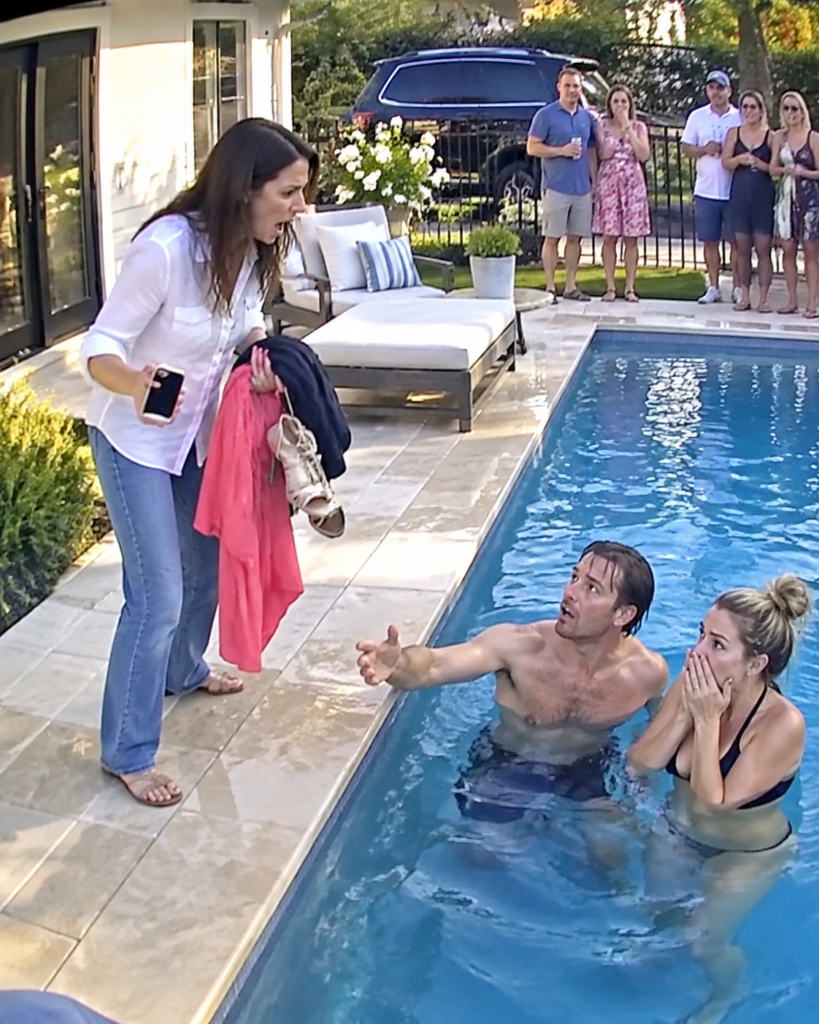
“Don’t make a scene.”
The woman beside him was Vanessa Cole.
My neighbor.
My occasional coffee companion.
And, for the previous three Tuesdays, the woman who had knocked on my kitchen door asking to borrow sugar.
I was thirty-eight years old then. I worked as a financial controller for a healthcare company outside Charlotte, North Carolina, and I had spent eleven years believing I knew the man I married.
Caleb Mercer was forty, handsome in the kind of effortless suburban way that aged well in photographs—brown hair, easy smile, expensive sunglasses, a handshake that made strangers trust him before they knew anything about him.
That afternoon, his charm couldn’t save him.
I had left work early and arrived home at 4:56 p.m. carrying a brown paper grocery bag against my hip.
I remember the smallest things.
The carton of eggs shifting when I opened the side gate.
The heat rising from the patio stones.
The basil beside the grill releasing its sharp green smell in the sun.
The neighbor’s dog barking twice and then stopping.
I remember an avocado rolling loose when I put the groceries down.
And I remember the water.
Not laughter.
Not voices.
Just the steady slap of blue pool water against tile.
Then Caleb saw me.
His hands left Vanessa’s waist so quickly the water jumped around them.
“Marissa.”
He said my name like a man watching a match fall toward gasoline.
Vanessa sank lower.
Her dark hair was wet against her shoulders. Her red lipstick looked absurdly perfect.
I recognized the color.
She had left the same shade on one of my coffee mugs the previous Tuesday.
“Can I steal some sugar?” she’d asked that day, smiling from my kitchen doorway.
“Again?” I’d joked.
She laughed.
I laughed.
That memory would bother me for months.
Not because I had been foolish.
Because I had been kind.
There is a particular humiliation in realizing that your hospitality became someone else’s access code.
I had told Vanessa when I worked late.
I had told her Caleb worked from home most Tuesdays.
I had told her where we kept pool towels.
I had even given her the side-gate code because once she’d needed to return a casserole dish while I was away.
Caleb cleared his throat.
“Don’t make a scene.”
That was the moment my heart stopped breaking and started paying attention.
Because he wasn’t apologizing.
He wasn’t ashamed.
He was managing me.
Already building tomorrow’s version of what had happened.
Marissa screamed.
Marissa went crazy.
Marissa embarrassed us.
Marissa overreacted.
I looked toward the patio furniture.
Caleb’s linen pants were folded over one chair. His shirt lay beside them. His belt rested on the stone.
Vanessa’s sundress was draped over another chair.
Her sandals.
Her phone.
Her black bikini top.
Caleb’s keys.
Her phone screen showed three missed calls from ETHAN.
Her husband.
I picked up their belongings one by one.
“Marissa,” Caleb warned.
Vanessa’s voice trembled.
“Please. We can explain.”
I glanced at the trail of wet footprints leading from my kitchen to the pool.
“You already did.”
Caleb gripped the tile.
His wedding ring flashed beneath the water.
“For God’s sake. Don’t be dramatic.”
That sentence saved me.
If he had apologized, maybe I would have cried.
If he had begged, maybe I would have listened.
Instead, something inside me went cold and clear.
Six months earlier, a package had disappeared from our front porch.
Caleb had told me I was overreacting when I spent $2,700 on a security system afterward.
It included a front doorbell camera, driveway camera, side-gate camera, pool camera, emergency alarm, cloud backup, and community patrol notification.
“This is Ridge Hollow,” Caleb had laughed. “We have a garden club, not organized crime.”
I installed it anyway.
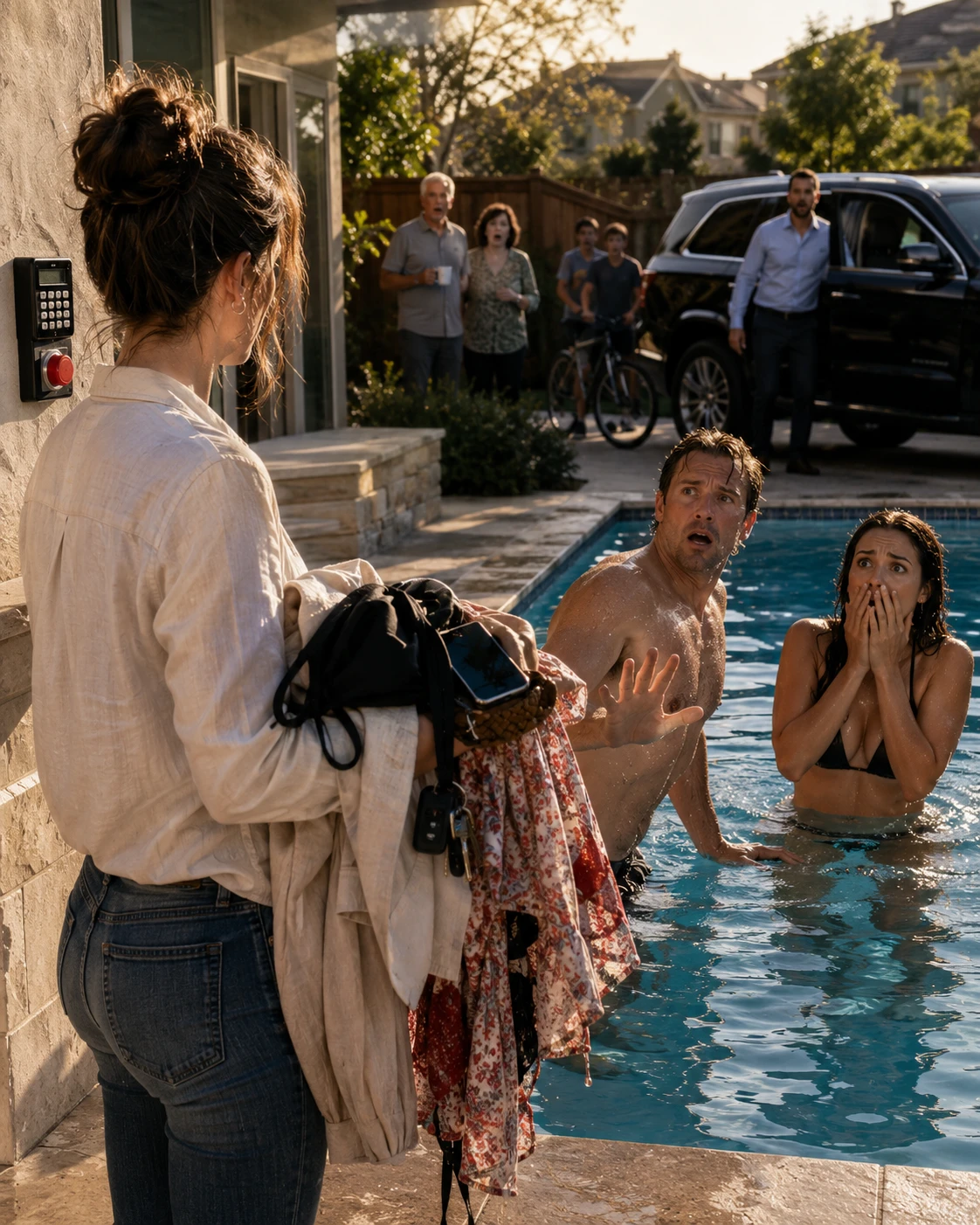
Now I stood beside the emergency panel, their clothes over my arm, and placed my thumb over the red button.
Caleb’s face changed.
“Marissa.”
I looked at him.
“No.”
I pressed it.
The siren exploded.
Dogs barked.
Garage doors rose.
Mrs. Palmer appeared at her fence wearing muddy gardening gloves.
Two teenagers stopped their bikes.
Mr. Denning walked onto his porch holding coffee.
A delivery driver froze beside his van.
Caleb shouted, “TURN IT OFF!”
“Why?” I shouted back. “You brought this five feet from my kitchen.”
My phone buzzed.
EMERGENCY ALERT CONFIRMED. PATROL NOTIFIED.
Then the Ridge Hollow neighborhood app showed the alarm.
214 RIDGE HOLLOW LANE — 5:42 P.M.
Address.
Timestamp.
Documentation.
Things Caleb couldn’t edit afterward.
I reached into his pants pocket and found the key fob to his three-month-old truck.
Sixty-four thousand dollars.
The same truck he’d bought shortly after telling me we needed to reduce restaurant spending and cancel one of our streaming subscriptions because we had to “be smarter with money.”
I held it up.
“This is the last thing of yours going into my pool.”
“Marissa, don’t.”
I dropped it.
The key vanished into the deep end.
Then tires scraped against the curb out front.
A black SUV stopped crooked beside our mailbox.
Vanessa stared toward the gate.
Her phone buzzed again.
ETHAN — 4 MISSED CALLS.
The driver’s door opened.
“Oh God,” Vanessa whispered.
Ethan entered the backyard moments later.
He was thirty-nine, dark-haired, neatly bearded, still dressed from work in a pale blue button-down shirt with the sleeves rolled to his elbows.
He carried a white overnight envelope.
He looked at Vanessa only once.
Then he stared at Caleb.
“Tell her.”
Caleb frowned.
“What are you talking about?”
“The loan.”
Everything changed.
Vanessa whispered, “Ethan, please.”
A Ridge Hollow patrol officer reached our yard and silenced the alarm.
The sudden quiet was almost violent.
Water dripped from Caleb’s arms.
A sprinkler clicked somewhere beyond the fence.
Ethan held the envelope toward me.
“Marissa, did you authorize a home-equity line three weeks ago?”
I stared at him.
“No.”
“How much?” I asked.
“Two hundred forty thousand.”
My stomach dropped.
“Against this house?”
“Yes.”
Caleb immediately said, “This is nonsense.”
Ethan ignored him.
“My wife notarized it.”
Vanessa covered her mouth.
I turned toward her.
She was crying now.
Not embarrassed tears.
Fear.
I looked down at the phone still in my hand.
A notification appeared across the screen.
FIRST PIEDMONT BANK — TRANSFER AUTHORIZATION PENDING.
Numbers and memories began colliding inside my head.
Caleb’s truck.
His sudden obsession with cutting household spending.
The folders he had asked me to pull from my office.
Our tax returns.
A copy of my driver’s license.
My mother’s estate paperwork.
The argument we’d had when I’d asked why he needed them.
“Insurance review,” he’d said.
I had believed him.
Because he was my husband.
Ethan removed a photocopy from the envelope.
“Is this your signature?”
It looked like mine.
Almost.
Eleven years earlier, when my mother died, I had received part of her life insurance and used most of it toward the down payment on our house.
That money had always made Caleb strangely defensive.
He hated when anyone mentioned that the house had been possible because of my mother’s money.
“It’s our house,” he’d always say.
I had agreed.
Apparently, he had developed a more ambitious definition of “ours.”
I examined the document.
My signature curved slightly upward at the end.
The forged one curled down.
“No,” I said.
Vanessa closed her eyes.
Beside my fake signature was her notary stamp.
The patrol officer’s posture changed.
He pulled out his phone and asked dispatch to send a county deputy.
Caleb finally climbed from the pool with a towel wrapped around his waist.
“This isn’t what it looks like.”
Ethan laughed.
“You really need a new sentence.”
He pointed at the receiving account printed on the document.
BLUE HERON HOLDINGS LLC.
I had never heard of it.
Vanessa had.
“You said that was ours,” she told Caleb.
Caleb went still.
Ethan looked at her.
“No, Vanessa. It isn’t.”
Her head snapped toward him.
“What?”
“I checked.”
Ethan’s voice was flat.
“You’re not listed as an owner.”
Caleb stepped forward.
“Everybody needs to calm down.”
I almost smiled.
That was always Caleb’s solution when other people discovered something he wanted hidden.
Calm down.
Don’t overreact.
Don’t make a scene.
Ethan handed me another page.
Blue Heron Holdings had been registered four months earlier.
Caleb was the sole member.
The mailing address was a rented mailbox fifteen miles away.
Vanessa looked genuinely stunned.
“You told me my name was on it.”
Caleb said nothing.
I understood then that Vanessa had betrayed Ethan and me.
But Caleb had betrayed Vanessa too.
The affair was real.
So was the financial scheme.
And apparently, Caleb had never intended to share the money with his mistress.
The deputy arrived seventeen minutes later.
By then Mrs. Palmer had mercifully gone inside, although I knew Ridge Hollow would survive on that afternoon’s gossip until Christmas.
I gave Caleb his clothes.
Not because he deserved dignity.
Because I wanted mine.
“Get dressed,” I said.
He took them without meeting my eyes.
The deputy separated us.
I explained the forged loan documents.
Ethan explained how he’d discovered them.
That afternoon he had worked from home after a dental appointment. A courier delivered an envelope addressed to Vanessa from First Piedmont.
He thought nothing of it.
Then another bank called the house.
The caller asked to verify a transfer connected to Blue Heron Holdings.
Ethan worked in compliance for an insurance company. Financial paperwork was not mysterious to him.
Vanessa had been acting strangely for weeks.
So he checked the shared office.
He found copies of my tax returns.
My driver’s license.
A property appraisal.
And text messages printed from Caleb’s number discussing “Tuesday windows.”
Ethan called Vanessa repeatedly.
She didn’t answer.
Then he checked her location.
My house.
He drove over.
“I thought I was coming here because my wife was cheating,” he told me quietly.
He glanced at the forged documents.
“Turns out that was the smaller problem.”
That night Caleb slept in a hotel.
I changed the side-gate code before midnight.
At 8:03 the next morning, I called an attorney.
By noon I had also called First Piedmont’s fraud department, the county recorder’s office, our primary bank, all three credit bureaus, and a forensic accountant named Rachel Sloan.
Caleb left twenty-three messages.
I answered none.
Vanessa sent one.
I’m sorry.
I deleted it.
Then she sent another.
You need to check your security footage from Tuesdays.
That one I saved.
The security company preserved thirty days of recordings.
There were no cameras inside the house. I’d always thought that would feel invasive.
But the side-gate camera told enough of the story.
Every Tuesday, Vanessa entered around 2:30.
Sometimes she carried nothing.
Sometimes she carried a leather document pouch.
The first week, she left at 4:11 carrying a thick manila envelope.
The second Tuesday, Caleb walked her to the gate and kissed her.
The third Tuesday—the coffee day I remembered—she arrived earlier.
At 1:54.
She left at 3:20.
That afternoon, after she had gone, Caleb came outside holding something.
He looked directly toward the camera.
Then stepped backward until he was outside its clearest view.
A paper shredder bag appeared in the trash that evening.
Rachel, the forensic accountant, found the rest.
For four months Caleb had been applying for credit using household financial information.
He created Blue Heron Holdings as an “investment company.”
He applied for the home-equity line using my identity.
He planned to pull $240,000 from the equity in our house.
He had also opened two smaller lines of credit.
One had helped cover the down payment on his truck.
The other paid personal expenses I had never seen.
Hotel rooms.
Restaurants.
A jewelry store.
Vanessa.
I sat in Rachel’s office looking at the spreadsheet.
There were dates.
Amounts.
Merchant names.
Numbers have always comforted me because numbers don’t care whether you are ready.
They simply tell the truth.
Rachel tapped one transaction.
“Eighteen thousand six hundred.”
I stared.
“What is that?”
“Initial transfer into Blue Heron.”
“From where?”
“One of the unauthorized credit lines.”
The number bothered me.
Eighteen thousand.
Then I realized why.
Our pool had cost eighteen thousand dollars.
For years Caleb had called it “my ridiculous pool.”
He told friends I had insisted on it.
But the amount sitting in Blue Heron’s account was almost identical.
Even his lies had symmetry.
The investigation widened.
Vanessa eventually hired an attorney and agreed to cooperate.
She admitted notarizing documents she knew I had not signed in front of her.
She admitted the affair.
She admitted Caleb had promised they would leave their marriages after the home-equity money arrived.
“He told me you were already planning to divorce him,” she said during a recorded meeting.
I stared at her across the conference table.
“You were in my kitchen.”
She looked down.
“I know.”
“You drank coffee with me.”
“I know.”
“You asked about my job.”
Tears filled her eyes.
“I know.”
“Then don’t tell me what Caleb told you. You knew enough.”
She nodded.
That was the only apology from Vanessa I ever believed.
Not because it repaired anything.
Because she finally stopped trying to make herself innocent.
Caleb did not cooperate.
He insisted I had verbally authorized the loans.
Then he said Vanessa had handled everything.
Then he claimed Ethan had fabricated documents out of jealousy.
Then he claimed our marriage had been “effectively over” for months.
His story changed every time new evidence appeared.
The cloud footage did not.
Neither did the bank logs.
Neither did Vanessa’s notary records.
Neither did the digital application tied to an IP address inside our house.
Three months later, I sat across from Caleb during divorce mediation.
He looked thinner.
Older.
The effortless smile was gone.
“I never wanted to hurt you,” he said during a break.
I looked at him for several seconds.
“You forged my name.”
“I was trying to build something for us.”
“With Vanessa?”
His jaw tightened.
“That wasn’t supposed to happen.”
I laughed.
It was the first time I had laughed about any of it.
Not because it was funny.
Because the sentence was so perfectly Caleb.
Nothing was ever something he had chosen.
Things simply happened around him.
Affairs happened.
Loans happened.
Forged signatures happened.
Women became unreasonable.
Money disappeared.
He was always standing in the center of the wreckage explaining that no one understood his intentions.
“You know what bothered me most?” I asked.
He looked up.
“The pool?”
“No.”
“The loan?”
“No.”
“Vanessa?”
I shook my head.
“The first thing you said.”
He frowned.
“At the pool.”
Recognition crossed his face.
I repeated it.
“Don’t make a scene.”
Caleb leaned back.
“I was panicking.”
“No. You were confident.”
His expression changed.
“You thought you still got to decide how I reacted to what you did.”
He didn’t answer.
The divorce took seven months.
The fraudulent credit lines were frozen.
The home-equity draw never completed.
Caleb surrendered the truck as part of the financial settlement.
Blue Heron’s assets were seized during the fraud investigation.
Vanessa lost her notary commission and later her job.
She and Ethan divorced too.
I saw Ethan only twice after that afternoon.
The last time was outside the county courthouse.
He gave me a small nod.
“Doing okay?”
“Getting there.”
“Me too.”
Then we walked in opposite directions.
There was no romance between us.
No convenient ending where the two betrayed spouses fell into each other’s arms.
Real life didn’t owe us symmetry.
It owed us the chance to leave.
By the following spring, the house legally belonged to me.
I considered selling.
For months, I hated the backyard.
I hated the pool most.
Every time sunlight hit the water, I saw Caleb’s face.
Vanessa’s red lipstick.
The clothes folded over my arm.
Eventually I invited my sister Lauren and her two daughters over.
The girls cannonballed into the deep end.
Water went everywhere.
Lauren handed me lemonade.
“You know,” she said, “you could fill it in.”
I watched my nieces shriek with laughter.
“No.”
“You sure?”
I smiled.
“I’m done letting Caleb decide what things mean.”
That summer, I planted more basil.
I replaced the patio chairs.
I painted the kitchen.
I changed every lock.
Life became quiet.
Not perfect.
Quiet.
Then, almost a year after the alarm, Rachel called me.
“I found something.”
The criminal case against Caleb was approaching its final stage, and prosecutors had requested a complete timeline of his financial activity.
Rachel had been reviewing older correspondence.
“How old?” I asked.
“Six months before Blue Heron was formed.”
My hands went cold.
That was roughly when the package disappeared.
The package that had caused me to install the security system.
Rachel emailed me a scanned shipping record.
I opened it.
FIRST PIEDMONT BANK.
My address.
Signature required.
The delivery date was the same day I had reported the package missing.
“What was inside?” I asked.
Rachel was quiet.
“A preliminary home-equity application.”
My throat tightened.
“What?”
“Caleb had started testing the process months earlier.”
I stared at the screen.
“He stole the package?”
“There’s more.”
The original delivery image showed the envelope sitting beside our front door at 1:08 p.m.
At 1:17, according to Caleb’s phone-location records, he arrived home.
At 1:23, the package disappeared.
Caleb had told me he didn’t get home until after five.
I remembered standing on the porch that evening.
“I swear it was delivered,” I’d said.
Caleb had shrugged.
“Maybe somebody grabbed it.”
I remembered his smile when I said I was ordering cameras.
Not approval.
Not amusement.
Something else.
Nervousness.
“He stole it,” I whispered.
Rachel replied, “It looks that way.”
For several seconds, I couldn’t speak.
Then I began laughing.
Rachel sounded concerned.
“Marissa?”
“I’m okay.”
But I couldn’t stop.
Because suddenly the entire story had folded in on itself.
Caleb had stolen the package to hide the first evidence of his fraud.
That theft made me afraid someone was targeting our house.
That fear made me install cameras.
Caleb mocked me for spending $2,700.
He called the system paranoid.
He called it overkill.
But months later, those cameras documented Vanessa’s Tuesday visits.
The emergency button preserved the timestamp.
The cloud records supported the investigation.
The system he never wanted existed because of the crime he committed to keep his scheme secret.
The betrayal had created its own witness.
Weeks later, Caleb pleaded guilty to financial charges related to the fraudulent accounts.
I did not attend sentencing.
I had already heard everything I needed.
On the first Tuesday after the case finally ended, I left work early.
I stopped at the grocery store.
Eggs.
Bread.
Coffee.
Basil.
And, without thinking, a bag of sugar.
When I got home, sunlight lay across the patio almost exactly as it had that afternoon.
5:42 came and went.
No alarm sounded.
No SUV stopped outside.
No neighbor appeared at my gate.
I carried the groceries into the kitchen.
The sugar went into the cabinet.
Then I stepped outside and sat beside the pool.
For months I had believed pressing that red button was the moment I took my life back.
It wasn’t.
The real moment had happened six months earlier, when I stood on my porch staring at an empty spot where a package should have been and decided I wanted proof the next time someone crossed my property.
I thought I was protecting my house from a stranger.
I had been protecting myself from my husband.
And the final irony was almost too perfect.
Caleb had told me not to make a scene.
So I hadn’t.
I made evidence instead.