
Part 1: The Empty Partner
My mother-in-law told a roomful of parents that I had kept my daughter’s father away while my daughter tied a yellow ribbon around an empty chair.
“Children deserve both parents,” Denise said, looking directly at me. “Whatever happened between the adults.”
I had spent eighteen months trying to get Owen to answer that child’s calls. Beside me, June stopped pulling the ribbon through its knot.
“Was Daddy trying to come?” she asked.
The other parents suddenly found things to do with their phones. I knelt beside my daughter before answering, because I wanted her to see my face rather than the expression I was struggling to keep off it.
“I never told Daddy he couldn’t see you.”
Denise touched my shoulder. “This isn’t the place, Leah.”
She had chosen the place. I had to remind myself that June hadn’t.
I was thirty-five, worked in payroll for a plumbing company in Dayton, and had become very good at finishing difficult conversations after bedtime. That afternoon, I still had June’s unfinished school lunch in my bag because I had left work early to bring it to rehearsal.
The school’s spring performance included a short dance with a trusted grown-up. June could have chosen me, her grandmother, or Ms. Carter, who had offered to learn the partner steps herself.
June had chosen a chair.
“Just for practice,” she had explained when the teacher asked. “Until we know.”
Each child had received a yellow ribbon to loop loosely around a partner’s wrist during the final turn. June had brought hers home every afternoon, practiced with me, then tucked it into her backpack as though it were an invitation that might expire.
“We know now,” I told her. “I’m your partner unless you decide you want someone else.”
“Okay,” she said, and untied the chair.
She didn’t ask me to take the ribbon.
* * *
Eighteen months earlier, Owen had left after telling me he needed a few weeks away from our marriage. June had been six, still young enough to think a suitcase meant somebody ought to pack snacks.
I helped her put crackers in his coat pocket. Then I asked him where he would be staying.
“With people from work,” he said. “Please don’t turn this into a whole thing.”
He answered messages at first. There were promises about Saturday visits, followed by canceled shifts, a borrowed car that wouldn’t start, a room where children supposedly weren’t allowed.
After the third cancellation, I stopped telling June about plans until they were certain. None became certain.
I filed for separation, gave the attorney the addresses I had, and learned how slowly ordinary paperwork moved when someone changed jobs and stopped collecting mail. There was no dramatic disappearance, only a growing stack of unanswered requests.
Denise said she heard from him occasionally. She said he was safe.
She also watched June after school three afternoons a week, which meant I accepted information in small, unsatisfying portions because I was afraid of losing the help attached to it.
That was my part in the arrangement. I had called it keeping the peace.
* * *
After rehearsal, June asked whether she could quit the partner dance and stay in the group number.
“Of course,” I said too quickly.
She stared at the ribbon in her lap. “Would everybody have to move?”
“Ms. Carter can work that out.”
“I don’t want everybody moving because of me.”
At home, she put her ballet slippers beside the trash instead of in her dance bag. I moved them back without saying anything, then realized I was already doing it again—deciding what her silence meant.
“Do you want to quit,” I asked, “or do you want people to stop talking about Daddy?”
“The second one.”
I sat on the kitchen floor beside her.
“I should have asked.”
She picked at a loose thread on her sock. “Grandma said he misses me.”
“He might. But missing someone and showing up are different things.”
“Can you ask him one more time?”
I wanted to tell her that I had asked enough. Instead, I told her I could send one message, but she would not have to wait by a door for the answer.
* * *
That evening, Denise called to ask why June had seemed upset.
“Because you told her I might be the reason her father stayed away.”
“I never said those words.”
“Then you can correct the words you did say.”
She sighed. “Owen said you wanted everything through lawyers. A man can hear that as being told to stay away.”
“A father can also read the sentence after it. The one asking him to call his daughter.”
For the first time, Denise had nothing ready.
I opened the old email thread after June fell asleep. There were invitations to birthdays, school information, and short messages asking whether he could manage a ten-minute call.
I sent one more.
Leah: June’s performance is Saturday at 2 p.m. She asked me to invite you. Do not surprise her. If you want to attend, answer by Wednesday, and we will discuss it with her teacher first.
I expected another empty space beneath my message.
His reply arrived before I shut the laptop.
Owen: I want to come. But before you let me, you need to know what really happened to our savings.
Part 2: What The Silence Cost
I read his message twice, then checked that June’s bedroom door was closed before I called him.
Owen answered with my name, softly, as if we had spoken yesterday.
“You have ten minutes,” I said. “Start with why your mother thinks I kept you away.”
He didn’t answer immediately.
“Because I let her.”
I put my hand flat against the counter. I had prepared for an argument, not that.
“Did you tell her that?”
“I said things were complicated. That you were angry. When she said you needed time, I didn’t correct her.”
“You let her watch me work Saturdays and tell me to be more understanding.”
“Yes.”
The simplicity of his answer made me angrier. He had possessed the words all along.
I asked about the savings. He asked whether we could meet without June.
“Not because I want another chance to explain it better,” he said. “Because I have records, and you should see them.”
We agreed on a public library meeting room the following afternoon. I told him the performance invitation remained undecided.
“And don’t call her tonight,” I added. “She doesn’t need a promise while we’re still figuring out what you can actually do.”
“All right.”
I stayed by the counter after the call ended. Then I wrote down everything he had said, because hearing his voice had already started rearranging my memory of it.
* * *
The next morning, I asked Denise to correct her statement to June before picking her up from school.
“I won’t tell her her father doesn’t care,” she said.
“Neither will I. You can tell her I didn’t stop him.”
“You’re making me choose sides.”
“I’m asking you not to give a child an explanation you never checked.”
Denise said perhaps I should find someone else for afternoons if I no longer trusted her.
For a moment, I nearly apologized. My workday ended more than an hour after June’s school day, and my supervisor had already accommodated enough last-minute changes.
Then I looked at the dance bag by the door.
“For this week, I will,” I said.
The school had room in its after-school program. Three afternoons cost $180, money I had set aside for a brake repair that could not be postponed much longer.
I enrolled June, rearranged the repair appointment, and ate lunch at my desk to make up the time I would lose meeting Owen.
It wasn’t a triumphant morning. I spent most of it checking my bank balance.
* * *
Owen arrived at the library before me. He stood when I entered, then seemed unsure whether to offer a hand or a hug.
I sat down.
He looked older, but not in any way that answered my questions. He placed a folder between us and kept his hands on his side of the table.
“Before I left, I told you the equipment deposit for the repair business had fallen through,” he said.
I remembered. We had lost $4,800 from our joint savings, and he had described it as a supplier dispute. I had spent evenings helping him search for the company online.
“You said somebody cheated you.”
“I lied.”
He pushed a bank statement toward me. I recognized our old account number and the withdrawals I had asked about until asking became another argument.
“Were you paying for somewhere else to live?” I asked.
“Not with that money.”
I thought of another relationship, another household. He shook his head before I finished asking.
“There wasn’t anyone else.”
“Then stop making me guess.”
He opened his mouth, closed it, and looked toward the glass wall.
I started putting my phone in my bag.
“Leah, wait.”
“You had eighteen months to prepare a sentence.”
That made him look back at me.
“You’re right.”
He turned another page in the folder. There were transaction histories, an intake receipt from a counseling practice, and a handwritten list of debts.
“I’m not asking you to take responsibility for any of this,” he said.
“You already left me responsible for what was missing.”
He lowered his eyes.
* * *
Before he explained, I asked about the present. He had rented the same room for seven months and worked at a warehouse for six. He could provide an address for the separation paperwork and arrange support through proper channels.
“Six months of wages,” I said. “And no birthday card.”
“I kept thinking I needed to come back with enough money to make it right.”
“June wasn’t checking your balance.”
He rubbed his palms against his knees.
“I know that now.”
I didn’t tell him knowing was a beginning. I was tired of doing the encouraging work in conversations about what he had done.
Instead, I asked whether he had told Denise about this meeting.
“She called after you spoke this morning. She said she would smooth things over at the performance.”
“What did you say?”
“That she couldn’t keep blaming you.”
“And did you tell her why?”
“Not yet.”
I stood.
“Then you don’t get to walk into that school while she’s still telling people I locked you out.”
He put a finger on the statement, stopping short of touching my hand.
“I’ll tell her,” he said. “But you need to hear it first.”
He slid the page across the last few inches of table.
The transactions weren’t payments to an equipment supplier.
There had never been a business deposit at all.
Part 3: The Borrowed Microphone
“I gambled it,” Owen said.
The words were quiet enough that the woman outside the meeting room kept shelving books.
He explained that betting on games had become betting on almost anything he could find on his phone. He had tried to win back losses, borrowed money to cover them, and invented the equipment story when our savings disappeared.
“When I left, I told myself I was keeping the mess away from you.”
“You left the missing money with me.”
“Yes.”
“And your daughter.”
He nodded.
He had continued gambling after leaving. Eventually, a debt he could no longer conceal from himself had led him to counseling and a support group.
He showed me the dates. They established when he had sought help, not whether I could trust him now.
“I don’t need your private session notes,” I said. “I need honest finances, a reliable address, and promises small enough for you to keep.”
“I can do that.”
“You can start doing that. Those aren’t the same sentence.”
He accepted the correction.
The records explained the late-night phone checking, the urgent errands during games, and why he had always needed just another week before discussing the supposed supplier. They did not turn his absence into a necessity.
“Why answer now?” I asked.
“Because you gave me a deadline. And because my counselor asked what I was waiting to have that would make this conversation painless.”
“What did you tell her?”
“Enough money.”
“And?”
“There wasn’t an amount.”
* * *
That evening, I spoke to June before contacting the school.
“Daddy answered,” I said. “He would like to watch your performance. You don’t have to dance with him, hug him, or decide anything about another visit.”
Her first question wasn’t whether he was coming home.
“Will he be there when we get there?”
I swallowed.
“If he comes, he has to arrive early. You won’t be waiting onstage.”
“Can you still be my partner?”
“Yes.”
She thought about it, then asked whether he could watch rehearsal first. I explained that the last rehearsal was already over.
“Then maybe just the warm-up.”
It was a more careful answer than I would have chosen for her. That was why I needed to hear it.
Ms. Carter agreed to a brief arrival plan. Owen would check in with the office, meet us in the gym with me present, and remain a spectator unless June requested otherwise.
“No surprise entrances,” she said.
“No speeches,” I added.
Owen agreed to both by email.
* * *
On Thursday, Denise came to my house carrying a casserole I hadn’t asked for.
“He told me,” she said.
I didn’t invite her in immediately.
“All of it?”
“About the gambling. And the messages.”
She held the dish a little higher, as though I might have forgotten it was hot.
“I didn’t know, Leah.”
“You knew I said I had asked him to come. You chose not to believe that part.”
She looked past me toward June’s room.
“Can I speak to her?”
I asked June rather than answering for her. She came into the hallway but stayed beside me.
Denise put the casserole on the floor.
“Your mom didn’t stop your dad from seeing you,” she said. “I was wrong to make you think that.”
June leaned against my hip.
“Then why didn’t he?”
“That’s something he needs to answer,” I said.
Denise nodded, although I could see how much she wanted to soften it.
It was the first useful thing she had done all week.

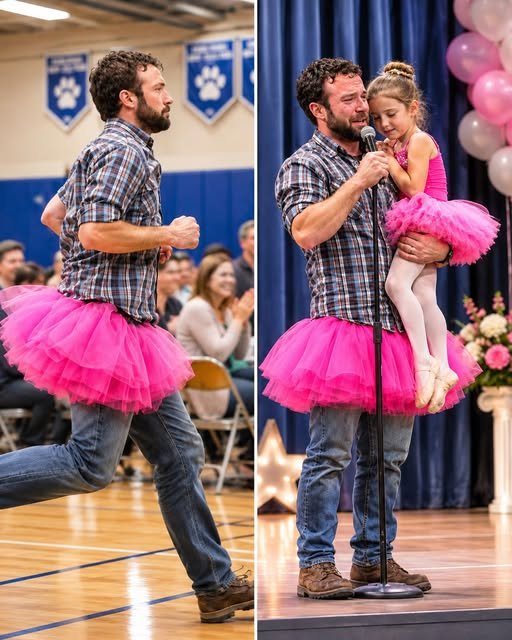
On Saturday, Owen was waiting at the school office before we arrived. He wore a green shirt and held a bag containing the adult practice tutu Ms. Carter had loaned him after June’s tentative request.
June stopped when she saw him.
“Hi, Junebug,” he said, then glanced at me. “Is that still okay to call you?”
She shrugged.
“June is okay.”
“Hi, June.”
He stayed where he was until she walked closer.
“You missed when I lost my front teeth,” she told him.
“I did.”
“Both of them.”
“I’m sorry.”
She inspected his bag. “You brought the skirt?”
He opened it without making a joke. She looked back at me.
“Could he do the last turn? You could do the rest.”
I checked with Ms. Carter. There was room beside the stage for a quiet handoff, and June had practiced that turn with half the adults at rehearsal.
“Only if you want,” I told her.
She nodded, then handed me the yellow ribbon to hold until it was time.
The dance went unevenly, like most elementary-school dances. I missed a step, June corrected me under her breath, and Owen nearly turned the wrong direction when she brought him in.
She laughed once. It was enough.
Nobody had to call it a reunion.
* * *
Afterward, at the gym reception, I went to collect June’s coat while she showed Owen the paper stars her class had made.
When I returned, Denise was speaking to two parents from rehearsal.
“I’m just grateful Leah finally let this happen,” she said.
One parent glanced at me. Denise saw her look and stopped.
I set the coat down.
Before I could speak, Owen walked toward Ms. Carter, who was gathering the sound equipment. He pointed to the microphone and asked her something.
My body reacted before my thoughts caught up.
“Owen.”
He turned. June stood several feet behind him, holding the ribbon.
“I won’t tell them about the gambling,” he said quietly. “But I can’t leave that standing.”
Ms. Carter kept her hand on the microphone.
“Twenty seconds,” she said. “And nothing the children shouldn’t have to carry.”
Owen looked at me, waiting.
I looked at the parents who had heard Denise, then gave one small nod.
He took the microphone.
For the first time that afternoon, June stopped watching her father and watched me instead.
Part 4: The Other End
“Before everyone leaves,” Owen said, “I need to correct something some of you heard.”
A few conversations continued until he spoke my name.
“Leah did not keep me away from June. She asked me to call. She invited me to things. I failed to answer, and I let my mother believe otherwise.”
Denise reached for the back of a chair.
“That was my choice,” he said. “Please don’t make Leah or June explain it for me.”
He handed the microphone back before Ms. Carter needed to ask.
There was no applause. One parent set down her cup and came over to say she was sorry she had assumed anything. Another turned toward Denise and asked whether they could speak outside.
Denise shook her head, then reconsidered.
“Yes,” she said. “I need to correct something.”
I watched her walk toward the doors with the same woman who had stood beside the empty chair at rehearsal.
Owen came back to us without reaching for June.
“Was that okay?” he asked me.
“It needed saying. It didn’t need a microphone until today.”
“I know.”
June held up the ribbon.
“Can we go somewhere quiet?”
* * *
Ms. Carter let us use the small room beside the gym, leaving the door open. June sat next to me while Owen pulled a chair around so she would not have to look across a desk.
“Why didn’t you answer?” she asked.
He took a breath.
“I was having a serious problem with gambling. That means I kept spending money trying to win more money, even when it was hurting us. I needed help to stop.”
“Like games?”
“Some games have betting. It’s something adults can get into trouble with. It was never your job to notice or fix it.”
She wound the ribbon around her fingers.
“Did you not have a phone?”
“I had a phone.”
I was grateful he didn’t look toward me for an easier answer.
“I felt ashamed,” he said. “I kept putting off calling. That was wrong, and it wasn’t because of anything you did.”
“Mom said you could call.”
“She did. Lots of times.”
June pulled the ribbon straight again.
“I don’t want you to promise tomorrow.”
His face changed.
“Okay.”
“Because then I think about tomorrow all night.”
I put my hand beside hers, not over it.
“We can make a plan with a counselor,” I said. “And you get to say how it feels.”
She considered that.
“Could we start with the library? You don’t have to talk the whole time there.”
Owen smiled a little.
“The library would be good.”
* * *
That night, after June fell asleep, I opened the folder Owen had given me. Along with the statements was a signed account of the $4,800 he had taken.
I sent it to my attorney rather than trying to turn the kitchen table into a courtroom.
Over the following weeks, we established support through the separation process and a separate proposed repayment of $200 a month toward the savings. Twenty-four payments would replace the principal, not erase the missed bills or make me grateful.
The first payment arrived on the agreed date.
I checked it, recorded it, and used part of it for the brakes.
Owen provided the information needed to assess a gradual contact plan. His counseling was his responsibility; I asked only for information relevant to June’s safety and the arrangements we were making.
“Does doing this mean we might get back together?” he asked during one planning call.
“No. It means you’re doing what a parent needs to do.”
He was quiet, then said he understood.
I didn’t promise him that understanding would earn anything else.
* * *
Denise asked to resume the afternoons with June. I said not yet.
“I apologized,” she said.
“And I heard you. We still need a different arrangement for a while.”
She started to argue about the cost, then stopped.
The next day, she sent me screenshots of messages correcting what she had told the parents she knew. She also offered to reimburse the $180 I had spent after our argument.
I accepted the reimbursement. I did not change the childcare plan.
A week later, she came over for dinner and asked June about her science project instead of asking whether she had spoken to her father.
When June left the table, Denise said, “I thought defending my son meant finding another explanation.”
“You can love him without giving him my innocence.”
She folded her napkin.
“I’m learning that.”
We finished dinner. It was not forgiveness, but it was a conversation we could finish without someone threatening to leave.
* * *
Six weeks after the performance, Owen had attended every scheduled library visit. Once, when a work shift changed, he notified me early enough that June heard one clear plan instead of a cancellation.
There were still difficult afternoons. June sometimes became quiet afterward, and once she asked to leave early.
Owen said goodbye without asking her to make him feel better.
I noticed that more than the early arrivals.
At the next visit, June took the yellow ribbon from her backpack. I had assumed she had forgotten it there.
She tied one end loosely around the handle of the chair beside her.
Owen watched without speaking.
“This is so it doesn’t get lost,” she said. “Not because I’m saving the chair.”
“Understood.”
She handed him a book about a family building a treehouse and told him he had to do the squirrel voice.
“How does a squirrel sound?” he asked.
“Confused. You’ll be good at it.”
I laughed before I could help it. Owen did too, and June looked pleased with herself rather than responsible for either of us.
When the hour ended, she untied the ribbon and checked the calendar on my phone. The next visit was already there, with a place and a time.
Then she held the loose end toward her father.
“Next Saturday,” she said, “can we try the turn without the chair?”
What would someone need to do consistently before you trusted them with a second chance?