
PART 1 — THE WOMAN IN MY FOYER
“Take her upstairs and help her bathe.”
For several seconds, I genuinely believed I had misunderstood my husband.
I stared at Adrian, then at the elderly woman standing beside him in the middle of our polished marble foyer.
“Excuse me?”
“You heard me, Elena,” he said quietly. “The bath is already running. Please help her get cleaned up.”
I looked at him as if he had lost his mind.
My name is Elena Whitmore. I was thirty-six years old, and I had been married to Adrian for fifteen years.
My husband had built one of the largest commercial construction companies in Chicago. We lived in a house with more bathrooms than two people could ever need, employed a cook, a housekeeper, a gardener, and a driver, and had spent years enjoying a life I once believed I had earned simply because I had been fortunate enough to marry a hardworking man.
Adrian was generous to a fault.
At least, that was how I used to describe it.
He donated to shelters, funded school programs, paid employees’ medical bills when insurance fell short, and occasionally became obsessed with some new charitable cause.
That week, it was a downtown meal center.
“I’m tired of signing checks,” he had told me over breakfast. “I want to actually meet the people we claim to be helping.”
I had rolled my eyes.
“You work sixty hours a week already.”
“One afternoon serving meals isn’t going to destroy the company.”
I took a sip of coffee.
“Just don’t come home acting like you can rescue every person sleeping at a bus station.”
The expression on his face should have embarrassed me.
It didn’t.
Not then.
That afternoon, I returned from lunch with two friends and immediately knew something was wrong.
Adrian was home early.
And he wasn’t alone.
Beside him stood a woman who appeared to be in her late fifties or early sixties.
Her gray hair hung in tangled clumps around her face. Her coat was torn at one sleeve and stained with years of dirt. Her shoes were held together with tape. There was grime beneath her fingernails, soot-dark patches along her neck, and a smell so overpowering that I instinctively raised my hand toward my nose.
The woman noticed.
Her eyes dropped to the floor.
“What is going on?” I asked.
Adrian’s jaw tightened.
“This is Maggie.”
The woman gave me a nervous little nod.
“Hello.”
Her voice surprised me.
It was soft.
Educated, even.
Not at all what I had expected.
I looked back at Adrian.
“Why is she here?”
“She needs somewhere safe to stay.”
I laughed once, certain he couldn’t be serious.
“There are shelters for that.”
“She has been living around the bus terminal and nearby streets for years.”
“And?”
“And I invited her here.”
My stomach dropped.
“To our house?”
“Yes.”
I lowered my voice.
“Adrian, we don’t know this woman.”
“She doesn’t even know herself.”
That stopped me.
Maggie shifted uncomfortably.
“I’m sorry,” she murmured. “I told him I didn’t want to inconvenience anyone.”
I looked at her, confused.
Adrian explained.
She had no identification.
No family contacts.
No known address.
She believed she had been homeless for nearly twenty years, but huge pieces of her life were missing from her memory.
She remembered waking in a clinic after being discovered unconscious near a highway many years earlier.
Before that?
Nothing.
Not her last name.
Not where she had grown up.
Not whether she had children.
Not even whether “Maggie” was really her name.
Someone at a shelter had started calling her that years ago, and eventually she stopped correcting them.
“I’m going to help her get medical care,” Adrian said. “Then we’ll see whether we can locate any records or family.”
“That’s wonderful,” I replied stiffly. “But why does she have to stay here?”
Maggie immediately stepped toward the front door.
“I can go.”
Adrian stopped her.
“No.”
Then he turned to me.
“Elena, please take her upstairs.”
I stared at him.
“We have staff.”
“I know.”
“So let someone whose job includes cleaning help her.”
His eyes hardened.
“She is not something to clean.”
The words landed harder than I expected.
I folded my arms.
“That isn’t what I meant.”
“Isn’t it?”
I felt my cheeks burning.
Adrian lowered his voice.
“You told me this morning that people living on the streets simply needed to make better choices. Spend twenty minutes helping one person instead of judging thousands of them.”
I hated him for saying it.
Mostly because some part of me knew I deserved it.
I turned sharply toward Maggie.
“Come with me.”
She followed me upstairs without saying a word.
Inside our bathroom, I opened a large trash bag and pointed toward it.
“You can put your clothes in there.”
She hesitated.
“Could they be washed?”
I looked at the torn coat.
“They’re beyond saving.”
A flicker of hurt crossed her face.
Again, I noticed it.
Again, I ignored it.
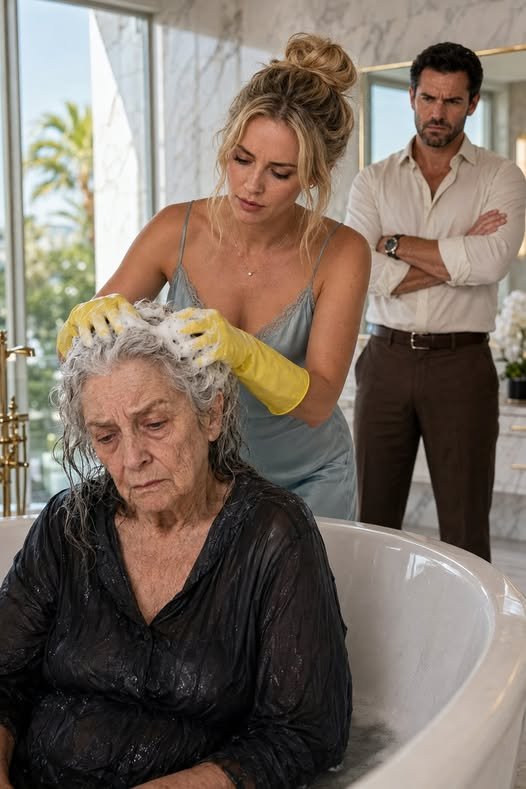
She slowly removed her layers of clothing and stepped into the warm bath.
Within moments, the water clouded with dirt.
I pulled a pair of thick rubber gloves from beneath the sink.
Maggie watched me put them on.
“You don’t have to do this,” she said.
“I’d rather make sure everything gets properly cleaned.”
It was a cruel answer.
I knew that even as I said it.
But arrogance has a strange way of convincing us that cruelty is simply honesty.
I picked up a sponge.
Then I began washing the stranger my husband had brought home.
Neither of us knew that within minutes, my entire life would split into a before and an after.

PART 2 — THE MARK BENEATH THE DIRT
I started with Maggie’s right shoulder.
Years of grime slowly disappeared beneath the warm water.
Then I saw it.
I stopped moving.
Just below her shoulder was a tiny birthmark shaped like a crescent moon.
The sponge slipped from my fingers.
“Elena?”
I couldn’t answer.
My hands began trembling.
“Turn around.”
She looked frightened.
“Did I do something?”
“Please.”
She turned toward me.
I grabbed a clean cloth and gently wiped her face.
Once.
Twice.
Again.
I stared at the woman beneath the dirt.
Her skin was lined by hardship. Her cheeks were thinner than I remembered. Her hair was gray instead of dark brown.
Twenty years had changed almost everything.
Almost.
My heart began pounding so violently that I could hear it.
I stumbled away from the bathtub and crossed to the cabinet beside my vanity.
At the very back of one drawer was a small velvet pouch.
Inside it was a gold locket.
I had carried that locket through childhood, college, marriage, and every home I had ever lived in.
I opened it.
The photograph inside had faded with age.
A young woman smiled at the camera, one arm wrapped around a ten-year-old girl.
Me.
I walked back toward the bathtub.
Maggie stared at the picture.
“What is that?”
I could barely breathe.
“My mother.”
She looked from the photograph to me.
Then back again.
“My mother had a mark on her shoulder,” I whispered. “Exactly like yours.”
Maggie’s face went pale.
I leaned closer.
She had another small scar beneath her chin.
I remembered that scar.
I remembered touching it as a child while sitting on my mother’s lap.
My knees nearly gave way.
“Your name isn’t Maggie.”
Her lips parted.
I began to cry.
“Your name is Margaret Hayes.”
She looked terrified.
“And I think…”
My voice broke completely.
“I think you’re my mother.”
The bathroom became utterly silent.
I waited for recognition.
For tears.
For her to reach for me.
For some miracle.
Instead, Margaret stared at the photograph in her hands.
Then she whispered the words that shattered me.
“I’m sorry.”
She looked into my eyes.
“I don’t remember you.”
I covered my mouth as a sob escaped.
For twenty years, I had believed my mother was dead.
Now she was sitting three feet away from me.
Alive.
And somehow that almost hurt more.
Because I had found her.
But she had not found me.
PART 3 — THE MOTHER WHO COULDN’T REMEMBER ME
My mother disappeared when I was ten.
Everyone told me she had died in the fire that destroyed our house.
No body had ever been formally identified, but the building had burned almost completely to the ground.
By morning, there was barely anything left.
My aunt took me in.
Eventually, the adults around me stopped discussing the possibility that my mother might have survived.
So did I.
Or at least I pretended to.
Twenty-six years later, she was sitting downstairs in one of Adrian’s bathrobes.
I marched into the living room and faced my husband.
“You knew.”
Adrian stood.
“Elena—”
“You knew who she was!”
“No.”
“You brought her here specifically because you thought she might be my mother.”
He hesitated.
That was enough.
I struck his chest with both hands.
“You should have told me!”
“I wasn’t sure.”
“How could you not tell me?”
“Because what if I had been wrong?”
I froze.
His voice softened.
“She was approximately the right age. Then I noticed a scar across her left wrist.”
I knew the scar he meant.
My mother had badly burned her wrist on an oven tray when I was little.
I had told Adrian the story years earlier.
“I thought about the stories you told me,” he continued. “The fire. Your mother never being found. I started wondering.”
My anger collapsed.
“You brought her here so I could see her.”
“Yes.”
He pulled me into his arms.
“I couldn’t tell you I might have found your mother and then discover I was wrong.”
I cried against his chest until I had nothing left.
The following morning, Adrian arranged an appointment with a neurologist.
My mother underwent scans, blood tests, cognitive assessments, and hours of interviews.
The eventual explanation was complicated.
She appeared to have survived significant physical trauma years earlier, followed by prolonged psychological trauma.
Her memory loss was real.
The doctor warned us against pushing her.
“Memory is not a locked cabinet you can simply pry open,” she explained. “Sometimes emotional pressure makes retrieval more difficult. Familiar sounds, scents, places, and routines may help, but you cannot force recognition.”
So I tried everything.
I made cinnamon rolls using my mother’s old recipe.
She ate one and smiled.
“Very good.”
Nothing.
I played the jazz records she used to dance to while cleaning our kitchen.
She tapped her fingers against her knee.
Nothing.
I found old photographs of relatives.
Nothing.
I took her past my childhood elementary school.
Nothing.
Every blank expression chipped away at the hope inside me.
She was kind to me.
That almost made it worse.
She thanked me for meals.
She offered to help fold laundry.
She apologized whenever she thought she was being inconvenient.
But she treated me like a generous stranger.
Not like her daughter.
One afternoon, I discovered her standing before a photograph in our living room.
She pointed at the man beside a younger version of herself.
“Who is he?”
I felt my throat close.
“My father.”
“Your father?”
I nodded.
“David.”
She studied his face.
“Was he my husband?”
“Yes.”
She smiled sadly.
“He looks kind.”
“He was.”
“Where is he now?”
I quickly turned the photograph facedown.
My mother noticed.
“Elena?”
“Not today.”
She touched my arm.
“What happened to him?”
I stepped away.
“There are some things I’m not ready to talk about.”
Because there was another secret buried inside me.
One I had carried since childhood.
I believed I had caused my father’s death.

PART 4 — THE MEMORY THAT CAME BACK
Several weeks after my mother arrived, I took her to the neighborhood where we had once lived.
Our old house was gone.
The property had been redeveloped years earlier. A pharmacy stood where our kitchen had once been.
Margaret looked around.
“I’m sorry.”
“You don’t remember?”
She shook her head.
“No.”
I tried to smile.
“It’s okay.”
It wasn’t.
We walked toward a small park several blocks away.
I was pointing out where an ice cream shop had once stood when a horn exploded behind us.
I turned.
A pickup truck had jumped the curb.
Everything happened in seconds.
Someone screamed.
Tires shrieked.
I froze.
My body simply stopped responding.
But my mother moved.
She threw herself toward me and shoved me with both hands.
I hit the pavement.
The truck roared past us and slammed into a utility pole.
For several seconds, there was only ringing in my ears.
Then I heard crying.
My mother was on her knees.
Her hands were pressed to her temples.
“Mom!”
I crawled toward her.
She looked at me.
Something had changed in her eyes.
“Elena…”
Then she whispered a name I had not heard in decades.
“Leni.”
I stopped breathing.
Only two people had ever called me Leni.
My father.
And my mother.
“Say that again.”
Her face crumpled.
“Oh, my baby.”
She grabbed me.
“Leni.”
I began sobbing.
She clung to me as memories crashed back into her.
Streetlights.
A crosswalk.
My father shouting.
My small hand slipping from his.
A speeding vehicle.
My mother standing across the road.
Then she pulled back and held my face between her palms.
“Your father’s death was not your fault.”
I stared at her.
She remembered.
Not everything.
But she remembered that day.
I had been ten.
My father had picked me up from school.
My mother had been waiting outside a grocery store across a busy avenue.
The pedestrian signal changed.
Excited to reach her, I started running.
A driver entered the intersection too quickly.
My father saw the danger before I did.
He pushed me aside.
I struck the curb and lost consciousness.
My father was killed.
For most of my life, I had believed one terrible thought:
If I hadn’t run, he would still be alive.
My mother shook her head.
“You were a child.”
“But I ran into the street.”
“And your father saved you.”
“Because of me, he—”
“No.”
Her voice became firm.
“Because he loved you.”
I began crying again.
“He would be heartbroken to know you turned his final act of love into a punishment you carried for the rest of your life.”
Something inside me broke open.
For the first time since I was ten, I allowed myself to believe that maybe my father hadn’t died because I was bad.
Maybe he had died because he was a father who saw his daughter in danger and acted without hesitation.
My mother pulled me close.
Then I asked the question that had haunted me for twenty-six years.
“What happened after Dad died?”
She closed her eyes.
Slowly, the rest began returning.
After my father’s death, Margaret had struggled terribly.
But she continued working.
Continued paying bills.
Continued raising me.
Then came the night of the fire.
I had been staying with my aunt.
My mother was supposed to work late at a bakery but returned home earlier than expected.
She smelled smoke before she reached the front door.
Instead of staying outside, she went inside because she remembered a metal document box containing photographs, birth certificates, insurance papers, and almost everything we had left of my father.
While she was inside, there was an explosion in the kitchen.
She was thrown against a wall.
Disoriented and injured, she crawled through a broken rear window.
Then she began walking.
She didn’t know where.
Shock, smoke inhalation, head trauma, and fear blurred everything.
Eventually, she collapsed.
A passing driver found her and brought her to a small clinic outside the city.
She had no identification.
When she woke, she couldn’t remember her name.
In the months afterward, she drifted between shelters and temporary jobs.
People moved her from place to place.
Records were lost.
Promises were made and forgotten.
Years passed.
She eventually stopped believing anyone was searching for her.
But somehow, she had returned to Chicago.
“I didn’t know why,” she whispered. “I just kept feeling that I needed to be here.”
I squeezed her hand.
“Maybe some part of you remembered me.”
She smiled through tears.
“Maybe a mother’s heart remembers what the mind forgets.”
PART 5 — THE WOMAN WHO SAVED MY MOTHER
My mother’s memories returned gradually after that day.
Not all at once.
Sometimes she remembered tiny things.
She remembered that I refused to eat peas.
She remembered sewing a button shaped like a strawberry onto my favorite red sweater.
She remembered singing to me during thunderstorms.
She remembered saving coins in a coffee tin because I wanted roller skates.
Every memory felt like receiving another piece of my childhood back.
And with each piece, I became more ashamed of who I had been before she entered our home.
Weeks earlier, I had looked at a homeless woman and seen inconvenience.
Odor.
Dirt.
Danger.
I had never wondered whose mother she might be.
Whose sister.
Whose daughter.
Whose missing person.
I had certainly never imagined she could be mine.
One Saturday morning, I told Adrian I wanted to go with him to the meal center.
I didn’t wear jewelry.
I didn’t invite anyone to photograph us.
I didn’t post about it.
I tied on an apron and served soup.
A woman with tangled hair approached my station.
Her coat was badly worn.
Months earlier, I might have recoiled.
Instead, I looked into her eyes.
“Would you like some extra bread?”
She looked surprised.
“If there’s enough.”
“There’s enough.”
I placed two pieces on her tray.
“Thank you.”
Two ordinary words.
But they stayed with me all day.
That evening, my mother told us about someone named Ruth.
“Who is Ruth?” I asked.
“A friend.”
During the final years of my mother’s life on the street, Ruth had worked nights cleaning the downtown bus terminal.
She had very little herself.
Still, she slipped my mother leftover sandwiches.
She let her sit in a warm maintenance room during especially cold nights.
She brought coffee.
Most importantly, she treated her like a person.
It was Ruth who encouraged my mother to visit the meal center on the day Adrian was volunteering.
“If she hadn’t insisted,” my mother said, “I would never have gone.”
Adrian leaned back in his chair.
“Then I think we should meet Ruth.”
The next afternoon, the three of us went to the bus terminal.
My mother spotted her near the far end of the building.
An older woman with silver-streaked hair was pushing a cleaning cart.
“Ruth!”
The woman turned.
She stared at my mother.
Confusion crossed her face.
Then shock.
“Maggie?”
My mother laughed.
“Apparently my name is Margaret.”
Ruth dropped the cloth she was holding.
“My goodness!”
They embraced.
Ruth began crying almost immediately.
“I thought you disappeared! I kept asking around. Nobody knew where you went.”
“I found my family.”
Ruth stepped back.
“You found them?”
My mother pointed toward me.
“My daughter.”
Ruth looked at me.
Then at Adrian.
Recognition crossed her face.
“You’re the man from the meal center.”
Adrian smiled.
“I am.”
Ruth wiped her eyes.
“Well, I’ll be.”
My husband offered his hand.
“Thank you for looking after Margaret.”
Ruth waved him away.
“Oh, I didn’t do anything.”
My mother laughed.
“You gave me half your lunch when half was all you had.”
“That’s what people do.”
“No,” my mother replied softly. “It’s what good people do.”
Adrian had asked a few questions about Ruth before we went to see her.
He learned that she had once worked as a seamstress.
She dreamed of running a tiny alteration shop but had never been able to afford commercial equipment or rent.
So Adrian offered her something better than an envelope of cash.
He helped lease a small storefront.
He purchased two professional sewing machines.
Through one of his business contacts, he arranged for her to bid on alteration work for several local school uniform suppliers.
He also helped her move into a clean apartment close to the shop.
When Ruth saw the storefront, she covered her mouth.
“No.”
Adrian smiled.
“Yes.”
“I can’t take this.”
My mother stepped beside her.
“You gave me warmth when you had almost none to spare.”
Ruth shook her head.
“It was just coffee. Just food.”
“It was dignity.”
My mother took both her hands.
“That was worth more than you knew.”
Ruth cried.
So did I.
Because I finally understood something that wealth had hidden from me for years.
Sometimes the person who changes a life isn’t the one who arrives with millions of dollars.
Sometimes it’s the woman who shares half a sandwich.

PART 6 — WHAT MY MOTHER REALLY WANTED
After finding my mother, I tried to compensate for twenty lost years in every foolish way imaginable.
I bought clothes.
She returned half of them.
I offered jewelry.
She refused it.
I suggested a vacation in Europe.
She asked whether we could visit the lake instead.
One morning, I sat across from her at breakfast.
“Mom, please. Let me spoil you.”
She stirred her coffee.
“I don’t need to be spoiled.”
“You spent twenty years with nothing.”
“And now I have you.”
“That isn’t enough.”
She looked up.
“It is to me.”
I fell silent.
She reached across the table and squeezed my hand.
“Elena, I lost years. You cannot buy years back.”
My eyes filled.
“So what do you want?”
“Breakfast.”
I blinked.
“What?”
“Breakfast with my daughter.”
She smiled.
“Sunday dinners. Stories. I want to hear about your first day of high school. Your college graduation. How Adrian proposed. What made you laugh when you were twenty. What made you cry when you were thirty.”
Her smile faded slightly.
“I don’t want expensive replacements for the years I missed. I want whatever time we still have.”
That conversation changed me more than anything money ever could.
Adrian and I eventually helped establish a nonprofit program focused on people who had fallen through gaps in the system.
Its mission was simple:
Help people recover identification.
Reconnect them with relatives when possible.
Provide access to medical and psychological care.
Help them find stable housing and employment.
We discovered that losing identification can trap someone in a terrible cycle.
Without an address, obtaining documents becomes difficult.
Without identification, securing work or housing becomes harder.
Without stability, medical conditions worsen.
People disappear into cracks most of us never notice.
Every time I walked through our office and saw a family reunited, I thought about the day my mother stood in my foyer while I covered my nose.
That memory still hurt.
I hoped it always would.
Not because I wanted to punish myself.
But because I never wanted to become that woman again.
PART 7 — WHERE WE BOTH CAME HOME
One year after my mother’s memories began returning, we returned to the street where she had pushed me out of the truck’s path.
We stood beside the curb.
Traffic moved steadily past us.
My mother took my hand.
“This is the place.”
“The place you nearly gave me a heart attack?”
She laughed.
“The place I woke up.”
I looked at her.
“You almost lost me.”
“No.”
She shook her head.
“This is where I found you.”
We stood quietly for a moment.
So much of our story had been shaped by people saving one another.
My father saved me as a child.
My mother saved me years later.
Ruth protected my mother during cold nights when she had nowhere else to go.
Adrian noticed a scar no one else had bothered to examine closely.
And somehow all those small pieces led us home.
My mother squeezed my hand.
“Leni?”
“Yes?”
“Do you remember the first bath you gave me?”
I groaned.
“Mom.”
She started laughing.
“You wore gloves!”
“I have apologized for that at least two hundred times.”
“You looked like you were handling hazardous waste.”
“Please stop.”
She laughed harder.
Adrian, who was waiting beside the car, called out, “What are you two talking about?”
My mother grinned.
“Your wife!”
“Oh no.”
“She was terrified to touch me.”
I covered my face.
“Mom!”
My mother walked toward Adrian, still laughing.
“She had no idea the filthy stranger in her bathtub was the woman who changed her diapers.”
Adrian laughed so loudly that I threatened to make both of them walk home.
But beneath my embarrassment was something else.
Gratitude.
There had been a time when hearing about those first hours with my mother filled me with shame.
Now, they reminded me how much a person could change.
That afternoon, when Margaret Hayes first stepped into my home, I thought she needed charity.
I was wrong.
She needed dignity.
She needed patience.
She needed someone to look beyond the clothes she wore and the years written across her face.
Most of all, she needed someone to believe that her story had not ended simply because society had stopped asking who she was.
And perhaps I needed rescuing too.
Not from poverty.
Not from homelessness.
But from the comfortable certainty that hardship only happened to people who had made bad choices.
My mother taught me that a life can unravel faster than most of us want to imagine.
One accident.
One illness.
One loss.
One night.
Sometimes that is all it takes.
So now, whenever I pass someone sitting alone at a station or sleeping beneath a worn coat on a park bench, I remind myself of Margaret Hayes.
Someone once loved that person.
Someone may still be searching for them.
They have a name.
A birthday.
Memories.
Maybe children.
Maybe regrets.
Maybe dreams they stopped talking about because nobody was listening anymore.
You can never know an entire human life by looking at one difficult chapter.
My mother spent two decades believing she was simply “Maggie,” a woman with no history and nowhere to belong.
But underneath the grime, the scars, and the lost memories was Margaret Hayes—
my father’s wife,
Ruth’s friend,
and my mother.
All Adrian had done was open our front door.
All Ruth had done was share her food.
All I had done was finally look closely enough to recognize her.
Sometimes, changing someone’s life does not begin with a grand gesture.
Sometimes it begins with a bowl of soup.
A cup of coffee.
An open door.
A warm bath.
Or simply the decision to look at another human being and ask:
Who were you before the world stopped seeing you?
And sometimes, against every impossible odd, that is enough to help someone find their way home.