
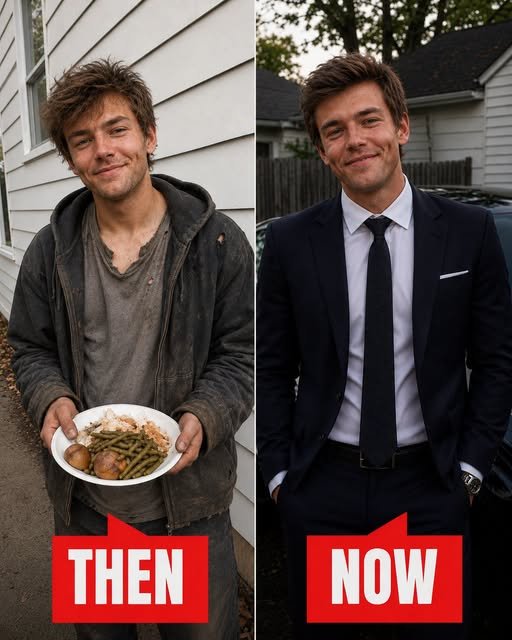
Part 1 — The Boy Behind Our House
I was eight years old when I first noticed the boy living beyond the end of our street.
His name was Luke.
He couldn’t have been much older than seventeen, although at the time he seemed like a grown man to me. He slept near the old dumping ground behind our neighborhood, beneath a crooked sheet of rusted metal that barely protected him from the rain.
His clothes were always dusty. His face looked too thin. And whenever someone approached, his eyes carried the guarded expression of a person who had learned not to expect kindness.
My father had died only a few months before Luke appeared.
His death had left our little family with more than grief.
It had left bills.
Unpaid repairs.
An almost-empty refrigerator.
And a mother who had to stand in the kitchen every evening deciding how to turn a handful of ingredients into dinner.
There were nights when Mom watered down soup so it would stretch another day.
There were mornings when she said she wasn’t hungry, even though I later understood she was simply making sure I had enough to eat.
Yet somehow, no matter how little food we had, she always found something for Luke.
Every afternoon, she would prepare a plate, cover it carefully with foil, and carry it toward the dumping ground.
Sometimes she gave him chicken while I ate vegetable soup.
Sometimes she brought him sandwiches while she herself went without lunch.
I would watch through the kitchen window as Luke accepted each plate with both hands.
He always thanked her.
Not casually.
Not the way a child says thank you because he’s been taught to.
He thanked her as though that plate of food meant the world.
But I didn’t understand any of that then.
All I understood was that my father was gone, money was tight, and my mother seemed determined to take care of someone else’s child.
Then came the apple pie.
Mom still baked one occasionally because she knew it was my favorite.
That Saturday afternoon, I walked into the kitchen and saw a fresh pie resting in her hands. The warm glass dish had fogged slightly beneath its cover.
For the first time in days, I smiled.
“Is that for tonight?”
Mom stopped.
The hesitation on her face told me the answer before she spoke.
“It’s for Luke,” she said gently. “There’s soup on the stove for us.”
My smile disappeared.
I stared at the pie.
Then at her.
Something that had been building inside me for months finally broke loose.
“Why does he always get the good food?” I shouted. “We’re the ones who barely have anything!”
Mom’s expression changed so quickly that I became frightened.
She wasn’t merely disappointed.
She was furious.
“Do not speak about Luke that way again,” she said. “Do you understand me?”
Tears burned my eyes.
“But I’m your daughter.”
Her face softened for half a second, but she still carried the pie toward the door.
“I know exactly who you are.”
Then she left.
I stood alone in the kitchen, staring at the closed door.
At eight years old, I reached the only conclusion that made sense to me.
Luke had taken something that belonged to me.
My mother’s attention.
Her sympathy.
Maybe even a piece of her love.
And from that day forward, I hated him.
Luke never gave me much reason to.
Whenever I passed him on my way home from school, he sometimes lifted a hand in greeting.
I never waved back.
Once, he carved a tiny bird from a piece of wood and offered it to me.
I looked at it, then deliberately let it fall near his feet.
His face tightened, but he didn’t get angry.
“You don’t have to like me,” he said quietly. “Just be careful crossing the road. Your mom worries about you.”
I walked away without answering.
His concern only irritated me more.
To me, everything Luke did felt like another attempt to work his way deeper into our family.
No one had ever properly explained who he was.
I only knew he had no home, no parents that I could see, and no steady job.
And Mom refused to tell me why helping him seemed so important.
Eventually, Luke disappeared.
Sometime before I finished high school, the little shelter beside the dumping ground became empty.
When I asked Mom where he had gone, she simply said he was doing better.
That was all.
By then, I had already learned how to stop asking.
And the moment I graduated, I left home.
Part 2 — My Mother’s Final Promise
I moved three hours away.
At first, I called Mom every week.
Then every month.
Then mostly on birthdays and holidays.
Eventually, our conversations became something we did out of obligation rather than closeness.
There was never one dramatic argument that separated us.
That would have been easier.
Instead, we drifted apart quietly.
A missed phone call here.
A holiday spent elsewhere.
A message answered two days late.
Distance became habit.
Eleven years passed.
Then one afternoon, while I was at work, my phone rang.
The woman on the other end introduced herself as a hospital nurse.
“Are you Evelyn Hart’s daughter?”
My stomach dropped.
“Yes.”
“Your mother suffered a severe stroke. Her condition is critical. You should come as soon as you can.”
I don’t remember leaving work.
I barely remember the drive.
What I remember is entering Mom’s hospital room and seeing her surrounded by machines.
She looked impossibly small beneath the white blankets.
This woman who had once seemed strong enough to survive anything could barely lift her fingers.
I sat beside her and took her hand.
“I’m sorry,” I whispered.
For all the years.
For all the silence.
For every call I hadn’t made.
For every time I convinced myself there would always be another chance.
Her fingers tightened faintly around mine.
“I’m here now,” I told her. “I’ll take care of everything. The house. The bills. Whatever you need.”
Her lips moved.
No sound came at first.
I leaned closer.
“Mom?”
She tried again.
This time I heard her.
“Don’t abandon Luke.”
I froze.
Of all the things she could have said.
Of all the people she could have mentioned.
Luke.
Even then.
Even while dying.
A flash of that eight-year-old girl’s jealousy returned so quickly that it embarrassed me.
Luke wasn’t there.
I was.
I had driven three hours.
I was holding her hand.
Yet somehow, she was still worried about him.
“Promise me,” she breathed.
My throat tightened.
“I promise.”
The words came out bitterly, but I said them.
Mom’s eyes closed.
Before sunset, she was gone.
After the funeral, that promise followed me everywhere.
I resented it.
I told myself I would fulfill it quickly and be done.
So one afternoon, I cooked a pot of beef stew, packed some bread beside it, and drove back toward my childhood neighborhood.
I expected to search the old dumping ground.
Maybe I would ask a few neighbors if Luke still came around.
I imagined handing him the food, telling him Mom had died, and walking away with my promise technically fulfilled.
But when I reached Mom’s house, I found a black SUV parked outside.
A man stood beside it.
He wore an expensive dark coat. His hair was neatly cut, and there wasn’t a trace of the thin, frightened teenager I remembered.
Still, something about his eyes stopped me.
He stared at me as though he had been waiting for hours.
Then he noticed the pot in my hands.
His eyes filled with tears.
“I wasn’t sure you’d come,” he said.
I studied his face.
And suddenly I saw him.
Not the man.
The boy beneath him.
“Luke?”
A small smile appeared.
“You brought food.”
I glanced down at the inexpensive plastic container in my hands and suddenly felt foolish.
“What happened to you?”
He gave a quiet laugh.
“What do you mean?”
“Look at you. The car. The clothes. Mom talked about you as though you still needed someone taking care of you.”
Luke’s smile disappeared.
He looked toward the house.
“Your mother never told you everything.”
A cold feeling moved through me.
“What didn’t she tell me?”
Instead of answering, Luke opened the SUV.
From inside, he removed an old metal box.
It was dented at the corners and scratched with age.
He set it carefully on the hood of the car.
Then he looked at me.
“Your father’s death wasn’t the beginning of the connection between our families.”

Part 3 — What My Parents Never Told Me
Luke told me about his mother.
Her name was Nina.
Years before I ever knew Luke existed, she had worked cleaning offices at the factory where my father was employed.
When Luke was sixteen, Nina became seriously ill.
She began missing shifts.
Then she lost her job.
Before long, they fell behind on rent and were evicted from their apartment.
That was when my father stepped in.
Quietly.
Without telling anyone.
He paid for several weeks in a motel.
He delivered groceries.
He helped Luke fill out applications for vocational programs and encouraged him not to give up on school.
I stared at Luke.
“My father did all that?”
Luke nodded.
“He never wanted anyone talking about it.”
That sounded exactly like Dad.
Or at least the version of him I barely remembered.
After Dad died, Nina’s health deteriorated.
Luke quit school to care for her.
A few months later, she died too.
By the time I saw Luke sleeping near the dump, he was seventeen years old.
No mother.
No father.
No home.
No stable income.
The recycling yard nearby occasionally paid him cash to separate scrap metal, but the work came and went.
The local shelters were often full.
And Luke had nowhere else to go.
Mom knew everything.
She fed him because Dad had cared about him.
Because she knew my father would have done the same.
Even when our cupboards were nearly bare.
Even when feeding Luke meant Mom quietly ate less herself.
I looked away.
A memory of that apple pie returned.
For the first time, I saw the scene differently.
Not as my mother choosing Luke over me.
But as a grieving widow trying to continue something my father had begun.
Still, one question remained.
“That explains the food,” I said. “It doesn’t explain why you said Mom was keeping a secret.”
Luke put his palm on the dented metal box.
“Your father gave this to me before he died.”
My heart began pounding.
Luke reached into his wallet and removed a tiny key.
The lock clicked.
He lifted the lid.
Inside were cassette tapes.
Dozens of them.
Each had been labeled in my father’s handwriting.
For Your Eighteenth Birthday.
For the Day You Graduate.
When You Feel Like No One Understands You.
Your Wedding Day.
Your First Big Failure.
When You Become a Parent.
I couldn’t move.
“What is this?”
Luke’s voice softened.
“Your father knew he might not be around to see those days.”
My knees weakened.
I gripped the edge of the SUV.
“He recorded these for me?”
Luke nodded.
Before Dad died, he’d prepared messages for the milestones he expected to miss.
Birthdays.
Marriage.
Heartbreak.
Career failures.
Parenthood.
The ordinary moments when a daughter might need her father’s voice.
And Dad had trusted Luke with the box.
Luke’s instructions had been simple.
Give it to me when I turned eighteen.
I looked at him in disbelief.
“I was twenty-nine when Mom died.”
“I know.”
“You were supposed to give me these eleven years ago.”
“I know.”
His answer came without excuse.
Then he told me what happened.
As my eighteenth birthday approached, Luke returned to the house with the box.
Mom stopped him.
At some point, she had listened to one of the recordings.
Hearing Dad’s voice again had shattered her.
She believed the tapes would do the same to me.
She convinced herself that instead of helping me heal, they would keep me trapped in the past.
So she begged Luke to wait.
One year.
Then another.
Then another.
“Every year I asked her,” Luke said. “Every year she told me you weren’t ready.”
Anger rose inside me.
“After I turned eighteen, that wasn’t her decision anymore.”
“No.”
“And it wasn’t yours.”
“No.”
I looked straight at him.
“You stole eleven years from me.”
Luke didn’t defend himself.
“I did.”
The simplicity of his answer surprised me.
“I can tell you why I listened to her,” he continued. “But explaining it doesn’t make it right.”
Mom had fed him when he was starving.
She had helped him attend night school.
She had treated him like family after he lost everyone else.
At first, Luke’s gratitude made him loyal.
Then loyalty turned into obedience.
And eventually, obedience became fear.
He was terrified that going against Mom would mean betraying the woman who had saved his life.
“But I should have given them to you,” he said. “You deserved to decide for yourself.”
I looked at his SUV again.
“And somewhere along the way you became wealthy?”
This time, he smiled slightly.
“The dump taught me more than you might think.”
Working at the recycling yard taught Luke how materials were priced, sorted, transported, and sold.
After finishing night school, he borrowed a truck.
Then bought one.
Then another.
Over the years, the small hauling business became a regional recycling and materials company.
Luke hadn’t lived near Mom for a long time.
He only returned regularly after her health began declining.
Quietly.
Always quietly.
Because she still didn’t want me to know.
“Why weren’t you at the hospital?” I asked.
Luke looked down.
“I was.”
I stared at him.
“The night before you arrived.”
Mom had sent him away after learning I was coming.
She wanted her last hours with me free of the secret she had carried for so long.
“Then why did she mention you?” I demanded. “Why make you her last concern?”
Luke was silent for several seconds.
Then he said something that made the entire promise suddenly make sense.
“Because she knew you’d return to this house after the funeral. And she knew you might refuse to speak to me.”
He looked at the box between us.
“Making you promise not to abandon me was the only way she knew to bring us face to face.”
Part 4 — My Father’s Voice
I carried the metal box into Mom’s house.
The place smelled exactly the way I remembered.
Dust.
Old wood.
A faint trace of the lavender cleaner Mom had used for decades.
The apple-shaped clock still hung on the kitchen wall.
Its second hand moved steadily, as though nothing important had ever changed there.
Luke set the stew on the counter.
Then he turned toward the door.
“You should listen to the recordings alone.”
I picked up the tape marked Eighteenth Birthday.
“No.”
Luke stopped.
I looked at him.
“You waited eleven years. You can stay for one.”
We found Dad’s old cassette player buried inside a cabinet.
Luke carefully cleaned it while I stood nearby, barely breathing.
Then he inserted the tape.
The machine clicked.
Static filled the kitchen.
And suddenly, after more than two decades, I heard my father’s voice.
“Happy eighteenth birthday, peanut.”
I covered my mouth.
My knees almost gave way.
His voice was older than my memory of him and yet instantly familiar.
Warm.
Playful.
Alive.
“I hope you’re taller than I was,” he continued. “Though your mother probably still insists you’ll always be her little girl.”
A broken laugh escaped me.
Across the table, Luke lowered his eyes.
Dad talked about the day I was born.
How terrified he had been the first time a nurse placed me in his arms.
How he had stood beside my crib at night simply to make sure I was still breathing.
He told me he hoped I would travel.
Make mistakes.
Love people bravely.
Change careers if I wanted.
Start over when necessary.
Then his voice grew more serious.
“Your mother may hold on too tightly after I’m gone. Try to be patient with her. But don’t disappear completely.”
I closed my eyes.
Eleven lost years pressed down on me.
Then Dad said something I never expected.
“And don’t be angry with your mother for feeding that boy who has nowhere safe to go.”
My eyes opened.
Luke looked up.
Dad had known.
He had known Mom would keep helping Luke.
He had known I might misunderstand.
“Families get through difficult seasons because people share whatever they have,” Dad said. “Sometimes you discover that even a small portion can still be enough when people stop counting who deserved the larger piece.”
I bent forward until my forehead nearly touched the table.
For most of my life, I had protected the memory of that apple pie as proof that I had been loved less.
Now it seemed painfully different.
I had been a grieving little girl.
Confused.
Lonely.
Jealous.
And no adult had explained enough.
“He knew I’d resent you,” I whispered.
Luke nodded.
“He worried you might.”
I wiped my eyes.
“But that doesn’t excuse what you and Mom did with these tapes.”
“No,” Luke said. “It doesn’t.”
And strangely, that was the first moment I began believing him.
He never demanded forgiveness.
He never told me my anger was unfair.
He simply accepted that love, gratitude, fear, and good intentions had still led to a terrible decision.
We listened to recordings until after midnight.
There was no hidden fortune.
No shocking family secret.
No dramatic confession.
Just my dad.
His terrible jokes.
His worries about money.
His thoughts about marriage.
Advice about work.
Stories from my childhood.
Things he loved about Mom.
Things he hoped I would remember.
The box didn’t contain treasure in the way people usually mean it.
It contained something far more precious.
Time.
Time I should have had eleven years earlier.

Part 5 — Learning to Forgive Without Forgetting
Luke returned several evenings later.
Then again the following week.
I never formally invited him into my life.
It simply happened one cassette at a time.
Some nights we listened to Dad.
Other nights Luke told me stories about my parents from before grief had changed our house.
He remembered Mom singing while she paid bills.
Dad destroying pancakes on Sunday mornings.
The two of them arguing in whispers because they thought I was asleep.
Then apologizing to each other before bedtime.
Luke had witnessed fragments of my parents I had either forgotten or never seen.
And slowly, he returned those memories to me.
I gave him something too.
The truth.
“I hated you,” I told him one evening.
Luke nodded.
“I know.”
“No, you don’t understand. I really hated you.”
He waited.
“Every time Mom carried food outside, I thought she was choosing you instead of me. Every plate felt like proof that you mattered more.”
Luke stared at his hands.
Then he said quietly, “I knew you were angry. But you were eight years old. Your father had just died. Nobody explained what was happening.”
There was no accusation in his voice.
That made it harder.
Because forgiveness would have been simpler if someone had been entirely cruel.
But no one had been.
Mom had loved me.
She had also made a terrible choice.
Luke had cared about me.
He had also kept something important from me.
Dad had tried to prepare us all for life without him, but even he couldn’t control what happened afterward.
Healing didn’t arrive in one dramatic moment.
Some evenings Luke and I laughed.
On others, I became so angry that I asked him to leave before we finished a tape.
He always left.
And when I was ready, I called him again.
He always came back.
That was how trust returned.
Not through one perfect apology.
Through consistency.
Through respecting boundaries.
Through showing up without demanding anything.
Months later, I had every cassette professionally digitized.
I saved copies in three separate places because the idea of losing Dad’s voice a second time terrified me.
Most of the messages remained private.
But several recordings were less personal—Dad talking about parenting, community, grief, generosity, and helping neighbors without expecting recognition.
I donated copies of those to our town’s oral-history project.
His voice, which had been hidden inside a metal box for years, became part of something larger.
And I began noticing changes in myself.
I started calling my own children more often.
Distance had become something I inherited from Mom without realizing it.
I had convinced myself that love could remain strong even when rarely expressed.
Perhaps it could.
But I no longer wanted to test that theory.
So I called.
I visited.
I listened.
I said things while there was still time to say them.
I also began making recordings for my children.
Not because I expected anything bad to happen.
I hoped to have decades ahead of me.
But Dad’s tapes taught me that there are things worth preserving while life is still ordinary.
So I recorded recipes.
Birthdays.
Stories from when they were babies.
Encouragement for bad days.
Advice they had heard a hundred times.
Memories they would probably roll their eyes at now and treasure later.
I wasn’t preparing to leave them.
I was learning how to stay.
Part 6 — The Apple Pie
One year after Mom’s death, Luke came to my house for dinner.
He arrived with flowers and the same awkward expression he had once worn while handing me that carved wooden bird.
By then, we had listened to almost every cassette.
Only one remained.
I had deliberately saved it.
After dinner, I brought an apple pie to the table.
Luke stared at it.
“Seriously?”
I smiled.
“Don’t get sentimental.”
“I’m trying not to.”
I placed the final cassette into the player.
Static whispered from the speakers.
Then Dad’s voice filled the room.
The message wasn’t long.
He talked about family.
About kindness.
About how people often remember arguments longer than they remember the circumstances that caused them.
Then, near the end, he laughed.
“If Luke happens to be there when you hear this, give him the bigger piece of pie. That boy never eats enough.”
Luke slowly turned toward me.
For a moment, neither of us spoke.
I looked down at the apple pie.
Suddenly I was eight years old again.
Standing in Mom’s kitchen.
Watching her carry something I loved toward a boy I believed had stolen her from me.
For years, that pie had represented everything I thought I had lost.
My mother’s attention.
My father’s absence.
A childhood that never felt fair.
But sitting across from Luke, I finally understood something.
There had never been only one slice of love.
Mom feeding him hadn’t meant there was less love left for me.
Dad helping his mother hadn’t made our family less important.
And my childhood anger hadn’t made me selfish or cruel.
I had simply been a little girl trying to understand grief without being given the whole story.
Luke watched me pick up the knife.
“So?” he asked carefully.
“So what?”
“Apparently your father left very specific instructions.”
I looked at him.
Then I cut the pie straight down the middle.
Two equal pieces.
I placed one in front of Luke.
He raised an eyebrow.
“Your dad said I should get the bigger one.”
“I’ve already lost eleven years,” I said. “I’m not losing dessert too.”
Luke laughed.
And for the first time, the memory of that childhood kitchen didn’t hurt.
I lifted my fork.
He lifted his.
Then I looked at the boy my mother had once fed, the man my father had trusted, and the complicated friend I had finally allowed myself to know.
“I think we’ve both waited long enough,” I said.
And this time, when we shared the pie, neither of us had to wonder who was loved more.