
PART 2
The front door opened with the calm confidence of someone who had been given a key long before tonight.
My mother turned so quickly the pearls at her throat clicked against each other. Ray stepped away from my shoulder. Tyler lowered his phone for the first time since I’d walked in.
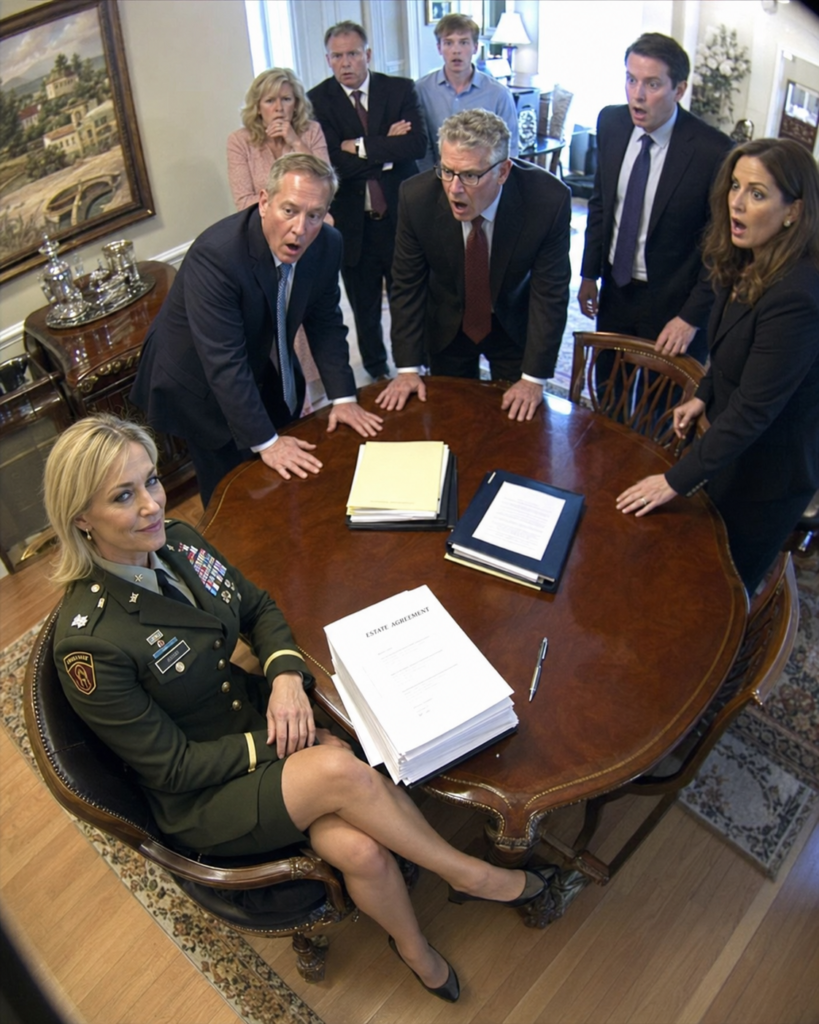
In the doorway stood Nora Singh, my private estate attorney, wearing a dark coat over a navy suit and carrying a leather folder pressed against her side. Behind her was a tall, silver-haired man I recognized from my father’s bank, Samuel Greer, the senior trust officer my father had chosen years earlier. He held a sealed document pouch in one hand and looked as if nothing in this house could surprise him.
“Good evening,” Nora said.
Brian Whitaker’s expression changed just enough for me to know he understood the room had shifted. Not collapsed. Not yet. But shifted.
My mother stared at Nora as if an uninvited guest had walked into her kitchen and opened the refrigerator.
“Claire,” she said, her voice tight, “what is this?”
“I told you,” I replied. “I didn’t come alone.”
Nora walked to my side but did not sit. Samuel remained near the entryway, patient and watchful.
Brian recovered first. “This is a private family discussion.”
“No,” Nora said evenly. “This is an attempted negotiation involving a protected trust asset. My client has representation.”
The woman with the laptop stopped typing.
My mother’s eyes moved between us, searching for a crack, some familiar weakness she could press. When she found none, she gave a small laugh.
“Claire, this is ridiculous. We’re your family.”
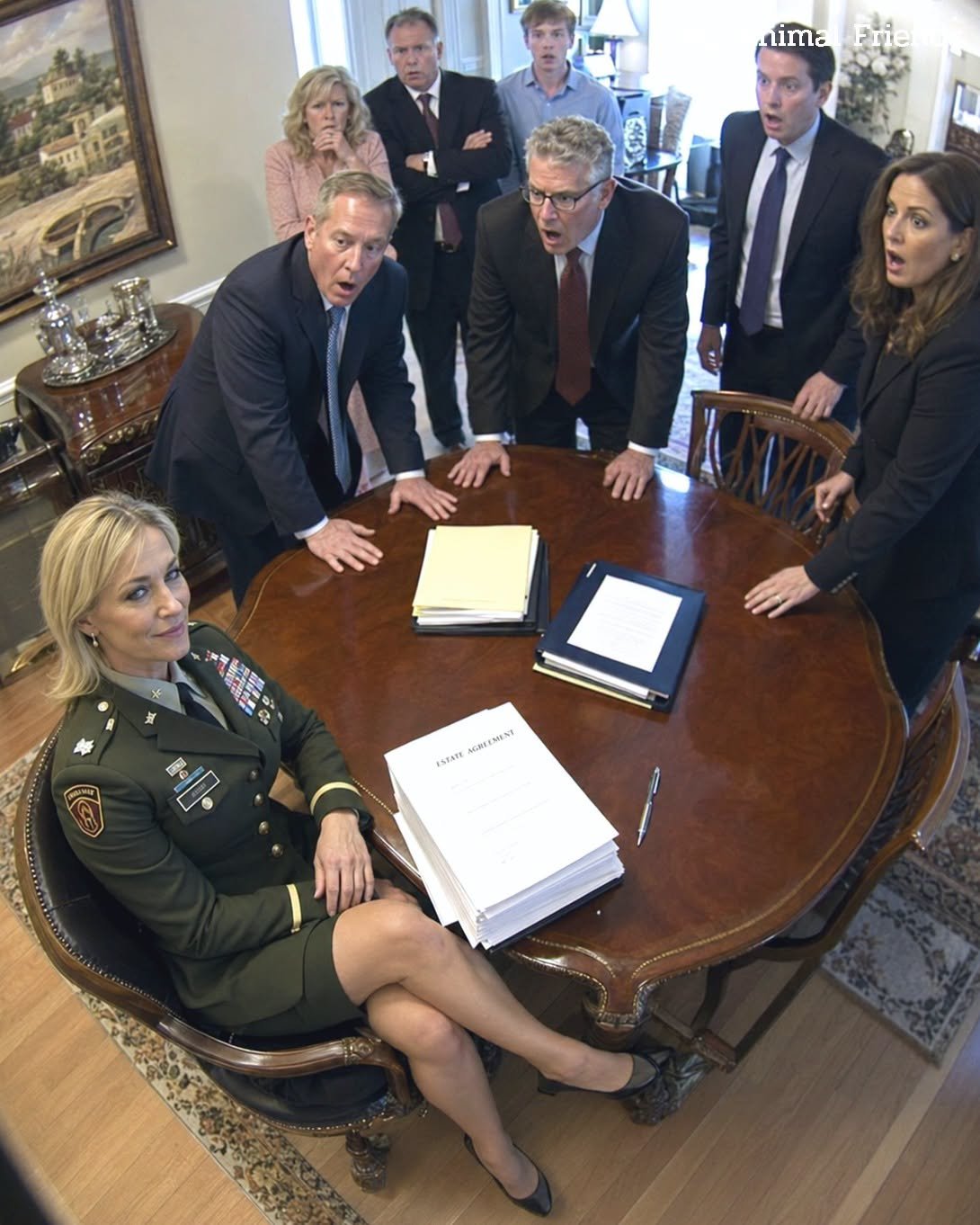
I looked at her then, really looked. The soft sweater she had chosen, the carefully lowered voice, the framed family photographs placed along the dining room sideboard like witnesses. In one picture, Tyler stood between my mother and Ray at a beach house I had never been invited to. In another, my father sat at this same table years ago, smiling faintly while my mother leaned toward him with one hand on his shoulder.
The photograph had been taken before their divorce.
Before the quiet years.
Before my father learned to speak to me without watching the doorway.
“You invited me here to pressure me into signing legal documents without my attorney present,” I said.
“Pressure?” Tyler snapped. “You walked in acting like you own the place.”
“I own nothing in this house.”
“You own everything that matters.”
The words landed harder than he intended. For a moment, the room went still.
Nora placed her folder on the table. “Mr. Whitaker, before anyone says anything else, I need to make something very clear. Colonel Parker will not sign the assignment. She will not enter mediation under threat. And she will not discuss trust assets in a room where five attorneys have been gathered for intimidation.”
My mother blinked at the word Colonel.
Tyler’s gaze jerked back to me.
Ray frowned. “Colonel?”
I kept my face still. There it was, finally. The first piece of my life they had never bothered to learn.
Brian, however, was focused on Nora. “Your client’s title is irrelevant.”
“Her title isn’t the issue,” Nora replied. “Your conduct may be.”
One of the younger attorneys leaned forward. “Careful.”
Nora smiled without warmth. “Always.”
Samuel Greer stepped closer to the dining room. “Diane, perhaps you should let counsel speak privately.”
My mother turned on him. “You knew about this?”
“I know what Lawrence Parker instructed me to know.”
At the sound of my father’s name, the air changed again. My mother’s mouth tightened. Tyler looked away.
I missed my father so suddenly that I had to press my fingers against my palm to steady myself. Grief was strange that way. It did not arrive politely. It rose from nowhere, caught you by the throat, and reminded you that even a room full of lawyers could not distract you from an empty chair.
Dad’s chair was at the far end of the table.
No one had sat in it tonight.
For that, at least, I was grateful.
Brian closed the folder he had been using. “Ms. Singh, we have concerns about the trust’s formation and Mr. Parker’s capacity during his final months.”
“My client anticipated that,” Nora said.
My mother’s eyes narrowed.
Nora opened her folder and removed several papers, each tabbed and organized. “We have physician statements, prior estate planning notes, video confirmation from the signing ceremony, and correspondence from Mr. Parker to Mr. Greer confirming his intentions over a period of six years.”
“Six years?” Tyler said.
Samuel looked at him kindly, which somehow made it worse. “Your stepfather reviewed his plans regularly.”
“He wasn’t my stepfather,” Tyler muttered.
“No,” Samuel said. “He wasn’t.”
My mother’s face flushed. “Samuel, that is unnecessary.”
“It is accurate.”
For the first time, I saw something like embarrassment cross Tyler’s face. It softened him for half a second, reminding me that he, too, had grown up inside versions of stories he had not written. Then he lifted his chin again, pride returning like armor.
“Fine,” he said. “Maybe Lawrence didn’t owe me anything. But Mom was married to him for twenty years.”
“Twelve,” I said.
“What?”
“They were married for twelve years before the divorce. You keep saying twenty because she met Ray during year thirteen and no one likes correcting you.”
Ray’s eyes cut toward me.
Tyler stared at my mother. “Is that true?”
“Dates don’t matter,” Diane said quickly. “What matters is what this family needs now.”
“Dates matter in probate,” Nora said.
Brian held up a hand. “Let’s not turn this into a debate about history. The question is whether Ms. Parker understands the cost of refusing a reasonable settlement.”
“I understand it,” I said.
“Do you?” he asked. “Litigation is expensive. Time consuming. Public.”
The word public was placed gently, but I heard the hook inside it.
Nora did too. “Is that a threat to disclose private family matters?”
“Of course not.”
“Good. Then we can keep this simple.”
She slid a single page across the table toward Brian.
He glanced down. His expression barely changed, but the attorney beside him leaned over and went very still.
My mother noticed. “What is it?”
“A notice,” Brian said quietly.
“A notice of preservation,” Nora corrected. “All communications regarding the Parker trust, including messages among counsel, Diane, Raymond, and Tyler, must be preserved. That includes texts, drafts, emails, voicemail, handwritten notes, and recordings.”
Tyler’s face drained slightly. It was subtle, but I saw it.
So did Nora.
My mother gave a brittle laugh. “Recordings? Claire, have you been recording us?”
“Maryland is a two-party consent state,” Brian said sharply.
“I know,” I said.
His eyes narrowed.
I opened my purse and removed a small stack of printed call logs. “Which is why I didn’t record in Maryland without consent. But many of your calls came when I was in Virginia, Texas, and Colorado. I asked permission in the first call after the funeral. Mom said, ‘Record whatever you want if it makes you feel important.’”
My mother’s lips parted.
I turned one page around and tapped the transcript excerpt Nora had highlighted.
Her own words stared up from the paper.
Record whatever you want.
Ray rubbed a hand over his mouth.
Tyler whispered, “Mom.”
She lifted her chin. “I was grieving.”
“So was I,” I said.
The quiet after that was not victory. It was worse. It was the sound of people realizing grief had not made us kinder to one another. It had only stripped away the manners that used to hide what we wanted.
Nora gathered the papers back with graceful efficiency. “We are not here to humiliate anyone. Colonel Parker came because Diane asked for a family meeting. But this is not a family meeting. This is a legal maneuver. So here is our position. The trust stands. Any challenge will be answered. Any intimidation will be documented. Any attempt to force an assignment will be reported to the appropriate authorities.”
Brian’s tone cooled. “That is a serious accusation.”
“It is a serious evening.”
Samuel finally set the sealed pouch on the table.
My mother stared at it. “What is that?”
“A letter,” Samuel said. “Lawrence left it with me three months ago. He instructed me to deliver it if Diane attempted to compel Claire to surrender her interest.”
My heart gave a hard, painful beat.
I had known Dad made preparations. I had not known about a letter.
My mother reached for it, but Samuel placed his hand flat over the pouch.
“It is addressed to Claire.”
Her eyes flashed. “I was his wife.”
“No,” Samuel said quietly. “You were not.”
The words should have felt satisfying. They didn’t. They felt like a door closing on a room none of us could enter again.
Samuel handed me the pouch.
For a second, I couldn’t open it. My fingers rested on the seal, and I was back in the hospital room with my father’s thin hand wrapped around mine. He had smelled faintly of antiseptic and peppermint tea. Even near the end, he had corrected nurses gently, thanked everyone by name, and asked me whether I was sleeping enough.
“She knows what buttons to push because she installed some of them,” he had told me.
I had tried to smile. “That’s grim, Dad.”
“It’s true.”
Now his handwriting waited in my hands.
Claire, written across the front.
Not Colonel. Not Ms. Parker. Not the child he had failed to protect early enough.
Just Claire.
Nora leaned close. “You don’t have to read it here.”
My mother said, “Yes, she does.”
That decided it.
I opened the pouch.
Inside was a cream envelope, a folded letter, and a small brass key taped to an index card. The key was old-fashioned, with a rounded bow and tiny numbers etched into the stem.
I removed the letter and unfolded it.
My father’s handwriting had always been precise, though near the end it had begun to tremble.
Claire,
If you are reading this, then I misjudged neither your mother’s determination nor your kindness. She will mistake the second for weakness. Do not let her.
I stopped. The room blurred slightly, and I blinked until the words sharpened.
I know you will want to avoid making things worse. You have always tried to stand between other people and the consequences they created. That is why I made the trust irrevocable. Not because I doubted your judgment, but because I trusted your heart too much to leave it unguarded.
My mother made a small sound, but no one spoke.
Nora stood beside me, close enough that I could feel her presence without needing to lean on it.
The assets in the trust belong to you because I chose you. Not because you were obedient. Not because you followed the path I imagined when you were young. Because you became someone I admire.
My throat tightened.
Tyler looked down at the table.
I regret many things. I regret the years when I let your mother convince me that peace was more important than truth. I regret not correcting the stories she told. I regret every birthday dinner where I allowed you to feel like a guest in your own family.
But I do not regret protecting you now.
The key opens Box 417 at Harborside Trust. Samuel knows the procedure. Inside is something I should have given you years ago. It concerns the house on Briar Lane, the summer before you left for West Point, and the reason your mother has been afraid of this trust since the day I signed it.
Do not confront her alone after you read it.
Trust Nora. Trust Samuel. Trust the instincts the Army sharpened but did not create.
I love you, kiddo.
Dad
By the time I finished reading, the dining room seemed smaller, the chandelier too bright, every breath too loud.
The house on Briar Lane.
I had not heard that address in years.
It had belonged to my father’s mother, a narrow brick home with a blue door and ivy crawling along the fence. I spent summers there when I was little, before my grandmother died and before my mother insisted the property be sold. I remembered the smell of lemon polish, old books, and rain on warm pavement. I remembered my grandmother teaching me to make biscuits. I remembered my father standing in the backyard one evening, arguing with my mother in a voice so low I could not catch the words.
The summer before West Point, I had returned from a weekend visit to find the house emptied and sold.
No one had explained why.
My mother’s face had gone pale beneath her makeup.
Ray noticed and whispered, “Diane?”
She ignored him.
Tyler looked between us. “What’s Briar Lane?”
“Nothing,” my mother said too quickly.
Samuel’s gaze moved to her. “Lawrence did not think it was nothing.”
“What is in the box?” I asked.
“I don’t know,” Samuel said. “He sealed it himself. He instructed the bank not to inventory the personal contents unless required by court order.”
Brian stood. “I advise everyone to pause. No one should speculate about unknown materials.”
Nora gave him a look. “That may be the first sensible thing said by your side tonight.”
My mother pressed both hands against the back of a dining chair. For the first time that evening, she looked older than I remembered. Not fragile. Not defeated. Just older, as if the effort of holding her version of the world together had finally become visible.
“Claire,” she said softly, “your father was sick.”
“He wrote this three months ago.”
“He was angry.”
“He sounded clear to me.”
“You don’t understand what marriage does to people.”
I folded the letter carefully. “Then explain it.”
Her eyes filled, but I could not tell whether the tears were grief, fear, or habit. “There are things parents keep from children because children can’t understand them.”
“I’m forty-two.”
“You’re still my daughter.”
The sentence might have meant something if she had said it differently. If it had carried love instead of ownership.
I put the letter back into the envelope but kept the key in my hand. It was cool against my skin.
Tyler pushed his chair back. “I want to know what this is.”
“No,” my mother said.
He stared at her. “Why not?”
“Because it has nothing to do with you.”
He laughed once, not happily. “Everything was about me ten minutes ago.”
Ray stepped forward. “Tyler, leave it.”
But Tyler was watching my mother now with the unsettled expression of a man noticing a crack in the foundation of the house he grew up in.
“You told me Lawrence cut us out because Claire manipulated him,” he said. “You told me he always favored her because she was his biological daughter. You told me he promised you he’d take care of us.”
“He did promise,” my mother said.
Samuel’s voice was gentle. “Diane, Lawrence fulfilled every obligation in the divorce agreement. More than fulfilled it.”
“That agreement was unfair.”
“You signed it with independent counsel.”
“I signed it because he made me feel like I had no choice.”
Nora looked up. “That is not supported by the record.”
My mother turned toward her. “You don’t know anything about my marriage.”
“No,” Nora said. “I know documents. And tonight, I know enough.”
Brian began gathering his papers. “I think we should adjourn.”
The word sounded almost comic after everything that had happened. Adjourn. As if we had been a committee meeting instead of a family splitting open over a polished dining table.
My mother looked at him sharply. “We’re not done.”
“I believe we are,” Brian said.
“You work for me.”
“Yes. And my advice is that we stop.”
That frightened her more than Nora’s arrival had. I saw it in the way her fingers tightened around the chair. People like my mother were used to hiring confidence. When the confidence began packing its briefcase, the room became dangerous in a quieter way.
Ray walked to her side. “Diane, maybe we should talk privately.”
She pulled her arm away. “Don’t manage me.”
His face closed.
There was a whole marriage in that tiny exchange. Not a happy one.
I picked up my purse. “I’m leaving.”
“Claire, wait.” My mother moved toward me.
Nora shifted, not dramatically, just enough to remind everyone she was there.
My mother stopped. “You can’t walk out after dropping this on us.”
“I didn’t drop anything. Dad did.”
“That letter is poison.”
“No,” I said. “It’s a map.”
Her face changed.
Only for a heartbeat.
But I saw it.
So did Samuel.
I turned toward the hallway, and for one strange second, memory overlaid the present. I saw myself at seventeen, standing in this same entryway with a duffel bag at my feet while my mother told me I was choosing strangers over family. I remembered my father waiting in the car outside, hands gripping the wheel, saying nothing until we reached the highway.
Then he had looked over and said, “You are allowed to leave places where love feels like a debt.”
I had not understood then.
I understood now.
Outside, the night air felt cold and clean. Nora followed me down the front steps while Samuel locked the pouch’s empty clasp and placed it in his briefcase. Through the front window, I could see the others still inside, figures moving behind glass, no sound reaching us.
“Are you all right?” Nora asked.
“No.”
She nodded. “That’s a fair answer.”
I looked at the brass key in my palm. “How soon can we go to Harborside Trust?”
“Tomorrow morning.”
“Good.”
Samuel joined us beside the SUV. “Colonel Parker, I should tell you something.”
The formality steadied me. “Go ahead.”
“Your father visited Box 417 twice in his final month. The second time, he asked whether the bank’s viewing room had cameras.”
I frowned. “Why?”
“I told him there were security cameras in the corridor, not inside the private rooms. He seemed relieved.”
Nora and I exchanged a glance.
Samuel continued, “He also asked me to witness him placing a second sealed envelope inside. He said the first envelope explained the past. The second would explain what to do next.”
A faint pressure built behind my ribs.
“What did he mean?” I asked.
“I don’t know.”
Behind us, the front door opened.
Tyler stepped out alone, his jacket unbuttoned, his expression stripped of its earlier arrogance. He stopped halfway down the path, as if unsure whether he had the right to come closer.
“Claire.”
Nora’s posture sharpened.
“It’s okay,” I said, though I wasn’t sure it was.
Tyler shoved his hands into his pockets. For a moment, he looked younger, like the boy who used to trail behind me at family gatherings pretending not to care whether I included him.
“I didn’t know about the lawyers until yesterday,” he said.
I waited.
“I mean, I knew Mom wanted you to sign something. I didn’t know it was going to be like that.”
“Did you read the assignment?”
He looked away. “Part of it.”
“That means yes.”
His mouth tightened. “I thought you’d negotiate. I thought everyone did that with estates.”
“Five attorneys at a dining room table isn’t negotiation.”
“I know that now.”
The porch light hummed above him. Inside, my mother’s silhouette moved past the curtains, then disappeared again.
Tyler lowered his voice. “When he was sick, Lawrence called me.”
That caught me off guard.
“When?”
“Two weeks before he died. I didn’t answer.” He swallowed. “I was mad. Mom had been saying he was rewriting things to punish us. I thought he was calling to make himself feel better.”
I did not know what to say.
Tyler’s eyes shone, but he did not let the tears fall. “He left a voicemail.”
My fingers tightened around the key. “What did it say?”
“I deleted it.”
The words came out rough.
Nora looked at him carefully. “Deleted voicemails can sometimes be recovered depending on the carrier and timing.”
“I tried,” he said. “It’s gone.”
“Why are you telling me now?” I asked.
“Because he said one thing before I deleted it. I only listened to the first few seconds.” Tyler looked toward the house, then back at me. “He said, ‘Tyler, someday you’re going to learn that the story your mother told you about Claire isn’t the worst lie.’”
The night seemed to still around us.
Nora’s expression did not change, but I felt her attention sharpen.
“What lie?” I asked.
Tyler shook his head. “I don’t know. That’s where I stopped it.”
For a moment, anger rose in me, hot and useless. Then I saw his face and realized he had been punishing himself long before he walked outside.
“Come to Harborside tomorrow,” I said.
Nora turned toward me. “Claire—”
“He deserves to know what story he’s in.”
Tyler looked stunned. “You mean that?”
“I don’t know what’s in that box. But if it concerns all of us, I won’t do what Mom did. I won’t build a life out of half-truths.”
He nodded once, too moved to speak.
From inside the house came the sharp sound of raised voices. Ray’s, then my mother’s. The words were muffled, but their shape was familiar. Denial. Blame. Fear dressed as anger.
Samuel checked his watch. “I’ll arrange access for nine.”
Nora walked me to my SUV. “You realize tomorrow may complicate everything.”
“It already is.”
“That’s not what I mean.”
I paused with my hand on the door.
She studied me with the careful concern of someone paid to protect my interests but human enough to worry about my heart. “Your father did not leave that letter to win an estate dispute. He left it because he believed something hidden needed to surface.”
I looked back at the house.
My mother stood behind the front window now, watching us. For once, she was not performing sadness, outrage, or control. She looked afraid.
The next morning, Harborside Trust smelled of marble floors, old paper, and expensive silence.
Tyler arrived ten minutes late, wearing the same suit from the night before. He looked as if he had not slept. Nora came with me. Samuel met us in the lobby and led us past a reception desk, through two locked doors, and down a narrow corridor lined with private viewing rooms.
No one spoke much.
At Box 417, Samuel inserted his master key. I inserted mine. The lock turned with a soft metallic click that sounded louder than it should have.
Inside the box were three items.
A brown accordion folder.
A second sealed envelope.
And a small velvet pouch.
Nora photographed everything before I touched it.
The accordion folder was labeled Briar Lane.
Inside were property records, bank statements, handwritten notes, and a yellowing photograph of my grandmother standing in front of the blue door, one hand raised against the sun.
Beneath the photograph was a document I recognized only by its title.
Deed of Transfer.
I read the first page once.
Then again.
My grandmother had not left the Briar Lane house to my father.
She had left it to me.
I was seventeen when she died. My father had been named custodian until I turned twenty-one. The house had been sold six months later.
Tyler leaned over the table. “How could they sell a house that belonged to you?”
Nora’s face had gone very still. “That is an excellent question.”
My hands felt cold. “Dad knew?”
Samuel answered softly. “I don’t believe he knew at the time.”
The next papers explained why.
There were copies of letters, forged signatures, and a notarized consent form carrying my name in handwriting that did not look remotely like mine.
I remembered that summer now in flashes. My mother placing papers in front of me while I packed for West Point. Her saying they were insurance forms. Her tapping the signature line with one polished nail.
Just sign, Claire. Your father already checked them.
I had trusted her.
Nora turned another page, then stopped.
“What?” I asked.
She lifted a bank statement.
The proceeds from the sale of Briar Lane had been deposited into an account controlled by my mother.
Three weeks later, a large transfer had gone to a company I had never heard of.
Raymer Holdings LLC.
Tyler stared. “Raymer?”
Ray went by Ray. Raymond Miller.
Raymer.
A cold thread moved through me.
Tyler whispered, “That’s my dad’s old company.”
None of us spoke.
With careful hands, I opened the second sealed envelope.
Inside was one page in my father’s handwriting.
Claire,
I found the Briar Lane documents too late to fix the damage quietly. I planned to confront Diane after your deployment ended, but then I became ill. The trust was not just an inheritance. It was restitution.
There is more. The velvet pouch contains your grandmother’s locket. Open it only after you read the last document in the folder.
I picked up the velvet pouch. Inside was a small gold locket, warm from my hand almost immediately, engraved with initials I knew.
E.P.
Eleanor Parker.
My grandmother.
The clasp resisted, then opened.
Inside was not a photograph.
It was a folded strip of paper, thin as a secret.
On it, in my grandmother’s handwriting, were eight words:
Diane knows Tyler is Lawrence’s son. Tell Claire gently.
Part 3
For a long moment, no one in the viewing room moved.
The sentence lay between us on that narrow strip of paper, small enough to hide inside a locket, large enough to rearrange every year of my life.
Diane knows Tyler is Lawrence’s son. Tell Claire gently.
Tyler was standing beside me, close enough that I could hear his breathing change.
At first it was quiet.
Then uneven.
Then almost nothing at all.
He reached for the edge of the table as if the floor had shifted beneath him.
“No,” he whispered.
Nora did not touch the note. Samuel did not speak. Even the bank’s fluorescent light seemed to hum more softly, as though the room itself understood that some truths needed space before they could become real.
I stared at the handwriting.
My grandmother’s handwriting.
Eleanor Parker had written thank-you notes for birthday gifts, grocery lists on blue stationery, recipes in careful cursive. She had written my name on envelopes with little loops in the C. I knew the shape of her letters. I knew the slant of her words.
This was hers.
“Claire,” Tyler said, but my name broke in his mouth.
I looked at him.
His face had gone pale, the anger and certainty of the night before stripped away. He looked younger than I had ever seen him. Younger than thirty-five. Younger than the boy who used to trail behind me at family gatherings, pretending he didn’t care whether I noticed him.
“My father is Ray,” he said.
The words came out like a rule he had been repeating his entire life.
Nora’s voice was gentle. “Tyler, we don’t know yet what evidence supports this note.”
He turned toward her quickly. “Then it might not be true.”
“It might require verification,” she said. “That is different.”
He looked back at the paper as if it might change if he stared hard enough.
Samuel folded his hands in front of him. “Lawrence believed it was true.”
The sound of my father’s name broke something in me.
Dad.
Not Tyler’s stepfather.
Not a man who had simply tolerated my half-brother at holiday dinners.
His father.
Maybe.
My father.
Maybe ours.
I sat down slowly in one of the viewing room chairs. Its leather was cool and stiff beneath me. Across the table, Tyler remained standing, one hand braced on the polished wood, the other hanging at his side.
I remembered all the years I had resented him.
Not loudly. Not dramatically. Resentment in our family had been quieter than that. It lived in small omissions. In my mother saying, “Tyler needs more support right now.” In Ray saying, “Claire is independent; she’ll be fine.” In my father looking uncomfortable whenever Tyler asked him for advice.
Had Dad known?
The letter said he found the Briar Lane documents too late.
But did he know about Tyler?
I reached for the accordion folder again, moving carefully, as if the papers could bruise. Nora watched without stopping me.
There had to be something else. My father would not have left us with eight impossible words and no path forward.
Beneath the property records and bank statements was a thinner folder labeled Personal Correspondence. Inside were copies of letters my grandmother had written to my father during the year after I left for West Point.
The first few were ordinary. She asked about his work, about my training, about whether I had learned to polish boots without ruining the leather. Then, halfway through the folder, her tone changed.
Lawrence,
I know Diane has told you that I am imagining things. I am not. I saw the hospital bracelet. I saw the paperwork before she took it from the kitchen drawer. Tyler’s blood type is not what she said. I am not accusing anyone lightly, but there is a reason she panics every time anyone mentions medical records.
You must speak with her. You must ask directly.
Please do not let pride make you cruel to the boy. Whatever Diane has done, Tyler is innocent.
My hands tightened on the page.
Tyler had moved behind me. I could feel him reading over my shoulder, but he did not ask me to stop.
The next letter was shorter.
Lawrence,
You asked me not to interfere. I will respect that only because I love you. But silence is not the same as peace. One day Claire will suffer for what everyone refuses to say aloud. One day Tyler will too.
Your mother
The last letter had no date.
Lawrence,
I am leaving the locket for Claire because she listens even when adults assume she does not. If I am wrong, let the secret die with me. If I am right, do not punish the children for the sins of frightened grown-ups.
There it was again.
Children.
Not child.
Children.
Tyler stepped away abruptly and walked to the far corner of the viewing room. He pressed both hands against the wall and bowed his head.
I looked at Nora.
“What happens now?” I asked.
Her professional composure softened, just slightly. “Now we slow down. We verify documents. We determine whether there are medical records, birth records, correspondence, anything that supports or contradicts what your grandmother believed. And we do not confront Diane without a plan.”
Tyler laughed once. It was a sound with no humor in it. “A plan. My whole life might be a lie, and we need a plan.”
“Yes,” Nora said. “Especially then.”
He turned. His eyes were wet, but his voice was steady in that dangerous way people get when they are trying not to fall apart. “Do you know what he said to me the last time I saw him?”
I shook my head.
“It was at the hospital. Mom made me go. I didn’t want to because I thought he was only seeing us out of guilt. He asked me to sit down. Just sit. And I stood there by the door like some stubborn kid.” Tyler swallowed. “He said, ‘You have his jaw.’”
“Whose jaw?” I asked softly.
“I thought he meant Ray. I told him I didn’t want to talk about Ray.” Tyler wiped his face quickly with the heel of his hand. “He looked so tired. He said, ‘No, that’s not what I meant.’ Then Mom walked in with coffee, and he stopped talking.”
The silence after that felt heavy with all the conversations that had almost happened.
I thought of my father trapped in a hospital bed with secrets pressing on his chest harder than illness. I thought of him trying, again and again, to find the right door into the truth, only for someone to close it.
And I thought of Tyler, standing by that door, too wounded by the story he had been given to hear the one my father was trying to tell.
Samuel cleared his throat quietly. “There is one more item in the safe deposit box.”
He reached inside and removed a small digital recorder sealed in a clear evidence sleeve. A label was taped to the front.
For Claire and Tyler.
My heart thudded.
Tyler stared at it.
Nora raised one hand. “Before playing that, I need to advise you both. This could affect legal claims, inheritance rights, and family relationships. You may want separate counsel.”
Tyler looked at me. “Do you want that?”
I should have said yes.
A careful person would have.
A colonel would have separated personal feelings from strategy, secured the evidence, and waited until every party had representation.
But I was also a daughter holding my grandmother’s locket. And Tyler was standing across from me, suddenly not an adversary, not an entitled half-brother, not my mother’s favorite weapon, but a man who might have been denied the same father I was grieving.
“No,” I said. “Not for this.”
Nora studied me, then nodded once. “I’ll remain present as a witness.”
Samuel brought over a small player from the bank’s office. His hands were steady as he inserted the recorder and pressed play.
For a second, there was only static.
Then my father’s voice filled the room.
Weak. Raspy. Unmistakably his.
“Claire. Tyler. If you are hearing this together, then either I have managed to do one thing right, or the truth has forced you into the same room. I hope it is the first.”
Tyler covered his mouth with one hand.
I closed my eyes.
Dad breathed audibly on the recording, then continued.
“I am sorry. That is too small a sentence for what I owe both of you, but it is the only honest place to begin. Claire, I failed you by letting Diane make you feel replaceable in your own family. Tyler, I failed you by being near enough to matter and too afraid to claim what I suspected.”
A chair creaked in the background of the recording.
“I did not know for certain when you were a child. Eleanor suspected. I ignored her because believing her would have meant admitting how much of my marriage had been built on fear. Later, when I tried to ask Diane directly, she denied it. She said Ray was your father. She said I was cruel for even wondering.”
Tyler made a sound like a breath catching on glass.
“I should have done more,” my father said. “I told myself that pushing would hurt you. That staying quiet kept peace. But peace built on silence becomes another kind of harm.”
The recorder clicked faintly.
“Two months before my diagnosis, I found copies of medical forms in an old Briar Lane storage trunk. Diane must have missed them when the house was cleared. I had testing done privately using a sample Tyler left at a family dinner years ago. I am ashamed to admit that. I had no right to do it without his consent. But I was desperate to know whether my mother had been right.”
Tyler looked sharply at Nora. “Can he do that?”
Nora’s expression tightened. “Legally complicated. Emotionally, I imagine even more so.”
The recording continued.
“The result showed a biological relationship consistent with father and son.”
The room seemed to tilt.
Tyler sat down hard.
My fingers closed around the locket until its edge pressed into my palm.
A biological relationship consistent with father and son.
Not a possibility.
Not a suspicion.
A result.
My brother.
Not half. Not maybe. Not someone standing just outside the circle.
My brother.
Dad’s voice softened.
“Tyler, I wanted to tell you myself. I tried. Your mother was afraid. I was afraid too. I let that fear win for too long. You deserved better from both of us. Whatever you feel toward me now, you have a right to it.”
Tyler bent forward, elbows on knees, both hands covering his face.
“Claire,” the recording said, “I know this will complicate everything. You may wonder why I left the trust only to you if Tyler is my son. The answer is not because I loved him less. It is because the trust began as repayment for Briar Lane. Your grandmother’s house was yours. Diane took that from you. I used the trust to restore what had been stolen and what I failed to protect.”
I opened my eyes.
“But there is a second account,” Dad said.
Nora straightened.
Samuel’s eyebrows lifted slightly.
“It is not large compared with Claire’s trust, but it is enough to begin repairing what I can. Samuel has instructions. Tyler, if you choose to accept it, the account is yours. Not as charity. Not as consolation. As acknowledgment.”
Tyler lowered his hands slowly.
“I also left a letter for Ray. He may have been told a lie too. Do not assume every wound came from the same hand.”
That sentence passed through the room like a door opening somewhere far away.
Ray.
I had spent years thinking of him as my mother’s accomplice. Cold, silent, watchful Ray. The man who had stood near my shoulder while lawyers waited with documents. The man whose old company had received money from the sale of my grandmother’s house.
But what had he known?
And when?
Dad coughed on the recording, then resumed.
“There is one more matter. Diane did not act alone in the Briar Lane sale. The notary was real. The signature was not. Someone helped her. I did not have time to prove who. I suspected the answer would be in the old family storage unit on Route 9, the one registered under Eleanor’s name. Claire, the key is not with this recording. Diane has it, unless she moved it.”
Nora and Samuel exchanged another look.
My father’s voice grew thinner.
“I am tired now. More tired than I want either of you to hear. So I will end with this. Do not let my mistakes decide who you become to each other. You are not responsible for the cowardice of adults who chose silence. You are only responsible for what you do after truth arrives.”
A long pause followed.
Then, so quietly I almost missed it, he said, “I love you both.”
The recording ended.
No one moved for several seconds.
Then Tyler stood so suddenly his chair scraped against the floor. He turned away from us, shoulders shaking once, twice, before he mastered himself.
I wanted to say something.
I had led soldiers through crisis. I had briefed rooms where one wrong word could shift policy. I had sat across from officials who measured emotion as weakness and spoken with a steady voice.
But in that bank room, with my father’s last message still hanging in the air, I did not know how to speak to my brother.
So I did the only thing that felt true.
I walked around the table and stood beside him.
Tyler looked at me, eyes red, face open in a way I had never seen.
“I hated you,” he said.
The words were quiet.
I nodded. “I know.”
“I thought you thought you were better than me.”
“Sometimes I did.”
He blinked, surprised by the honesty.
I let out a shaky breath. “Not because you were less. Because I was hurt. Because Mom made everything feel like a competition, and I got tired of losing without knowing the rules.”
Tyler looked down.
“She told me you didn’t want me around,” he said. “When I was little. She said you resented me because your dad paid attention to me.”
“I thought he paid attention to you because she made him.”
“Maybe both were true.”
Maybe they were.
Families were not court cases. Truth did not always arrive cleanly labeled. Sometimes two painful things stood side by side, neither canceling the other.
Tyler looked at the recorder. “He loved me.”
“Yes,” I said.
His face twisted, and this time he did not hide the tears. “And I wasted it.”
“No,” I said. “You were lied to.”
“So were you.”
“Yes.”
That was the first bridge between us.
Not forgiveness. Not yet.
But recognition.
Nora quietly gathered the documents and made copies with Samuel’s help. The practical sounds helped anchor the room: paper sliding, scanner humming, folders closing. Evidence being preserved. History being handled carefully at last.
An hour later, we stood outside Harborside Trust beneath a bright, cold sky.
Tyler looked exhausted. The kind of exhausted that comes after a life has been taken apart and set back down in pieces.
“What are you going to do now?” I asked.
He gave a humorless laugh. “I was going to ask you that.”
“I’m going to find the storage unit.”
“Mom won’t give you the key.”
“I know.”
“She’ll deny everything.”
“I know that too.”
He glanced toward the street, where traffic moved like ordinary life had no idea ours had been overturned. “I should be angry at her.”
“You are.”
“I mean more angry.” His jaw tightened. “But I keep thinking about her face last night. She was scared, Claire. Not just caught. Scared.”
That had stayed with me too.
“I saw it,” I said.
“What if Dad was right about Ray? What if he didn’t know?”
“Then he deserves the truth.”
Tyler rubbed both hands over his face. “And if he did?”
“Then he deserves the truth anyway.”
Nora approached with two sealed folders. “I recommend no unsupervised confrontation today.”
Tyler almost smiled. “You mean don’t storm into my mother’s house demanding answers?”
“That is precisely what I mean.”
I looked at her. “We need the storage unit key.”
“We need records first. Storage facility ownership, access history, payment records. If the unit is still active, there will be a trail.”
Samuel, who had been speaking on the phone near the curb, walked back toward us. “There may be a faster way.”
Nora lifted an eyebrow.
“Lawrence gave me authorization to release certain administrative details if the recording was played.” Samuel adjusted his glasses. “The storage unit payments continued until two months ago. They were made annually by cashier’s check.”
“From Diane?” I asked.
“No. From Ray Miller.”
Tyler went very still.
Ray.
Again.
The thread returned, colder now.
“Why would Ray keep paying for my grandmother’s storage unit?” I asked.
Samuel’s face was grave. “That is one of the questions Lawrence wanted answered.”
Tyler’s phone rang.
He looked at the screen and froze.
“Mom?” I asked.
He shook his head slowly. “Ray.”
None of us spoke.
The phone rang again.
Nora said, “You don’t have to answer.”
Tyler stared at the screen. His thumb hovered, then lowered.
“I do.”
He put the call on speaker.
Ray’s voice came through rough and low. “Tyler. Where are you?”
Tyler looked at me. “With Claire.”
A silence followed.
Then Ray exhaled. “Good.”
That one word changed the air.
Tyler frowned. “Good?”
“I need both of you to listen. Diane left the house this morning.”
My spine straightened. “Where did she go?”
“I don’t know. She took an old key ring from the desk and a box from the attic.”
Nora’s eyes sharpened.
Ray continued, voice strained. “I should have told the truth years ago. I thought keeping quiet protected everyone. It didn’t.”
Tyler’s face tightened. “What truth?”
Ray did not answer immediately.
When he did, his voice cracked.
“I knew Lawrence was your father.”
Tyler closed his eyes.
I looked away, giving him the small privacy of not being watched while another foundation broke.
Ray said, “Diane told me before we married. She said Lawrence knew and wanted nothing to do with you. She said if I loved her, I would raise you as mine and never ask questions.”
Tyler’s hand trembled around the phone. “Was any of that true?”
“I don’t know anymore,” Ray said. “I wanted it to be. I loved you, Tyler. That part was real.”
Tyler swallowed hard.
Ray continued, “But there’s more. The Briar Lane money—the transfer to my company—I didn’t know where it came from until later. Diane said it was part of the divorce settlement. I used it to keep the business alive. When I found out it had come from the house, I confronted her. She said Claire had signed the papers.”
“I was seventeen,” I said.
Ray’s voice softened. “I know that now.”
“Why didn’t you come forward?”
“Because by the time I understood, the money was gone, the house was gone, and Diane told me if I tried to expose it, Tyler would be the one hurt most. She said Lawrence would claim him out of spite and destroy our family.”
I felt Tyler flinch beside me.
Nora spoke clearly. “Mr. Miller, where is Diane now?”
“I think she’s going to the storage unit.”
“Why?” I asked.
Ray’s answer came after a long, frightened pause.
“Because your father wasn’t the only one who left something there.”
The call ended before anyone could ask another question.
For once, Nora did not tell us to wait.
Within fifteen minutes, we were in my SUV, following the address Samuel had obtained from an old trust file. Tyler sat in the passenger seat, silent, the recorder sealed in Nora’s bag behind us. Nora made calls from the back seat, her voice calm and efficient. Samuel remained at the bank to secure the original documents.
The storage facility sat off Route 9 behind a row of winter-bare trees, its metal buildings arranged in long beige corridors under a pale afternoon sun. A faded sign read BAYLOCK STORAGE. The gate attendant, a gray-haired woman named Marcy, looked alarmed when Nora introduced herself and requested access records.
“We can’t just let people into units,” Marcy said.
“We understand,” Nora replied. “We’re not asking you to violate policy. We are asking whether a woman named Diane Parker or Diane Miller accessed a unit today.”
Marcy hesitated.
Then she looked past Nora at me.
“You’re Claire?” she asked.
I felt the question settle strangely. “Yes.”
Her expression changed. “I was told you might come one day.”
“By whom?”
“An older man. Years ago. Kind eyes. Walked with a cane.”
My father had never used a cane.
“My father?” I asked.
Marcy shook her head. “No. A woman.”
My breath caught.
“My grandmother?”
“She said her name was Eleanor.” Marcy opened a drawer and removed a sealed envelope, yellowed with age. “She paid me twenty dollars to keep this in the office file. Said if a Claire Parker ever came asking about Unit C-18, I should give it to her.”
Nora took the envelope first, examined it, then handed it to me.
On the front, in my grandmother’s handwriting, was my name.
Claire.
Inside was a single photograph.
Not of Briar Lane.
Not of my grandmother.
It showed my mother, much younger, standing outside a hospital entrance with a newborn bundled in her arms. My father stood beside her, one hand resting gently on the baby’s blanket.
On the back, someone had written:
Tyler’s first day home. Lawrence promised he would wait until Diane was ready.
Tyler stared at the photograph.
His hand rose slowly, touching the image without taking it from me.
“He was there,” he whispered.
I had no answer.
Marcy looked uncomfortable. “The woman who came this morning was upset. She had a key. She went to C-18 about forty minutes ago.”
“Is she still there?” Nora asked.
“I don’t think so. She left in a hurry. But she dropped something near the gate.” Marcy reached beneath the counter and placed a small object on the desk.
It was a brass key tag, scratched and old.
C-18.
We walked to the unit together.
The corridor smelled of dust, metal, and cold concrete. My footsteps echoed. Tyler walked beside me, shoulder nearly brushing mine. Not behind me. Not against me.
Beside me.
Unit C-18 stood halfway down the row.
The padlock was open.
Nora pulled the door upward.
Inside were stacked boxes, old furniture wrapped in sheets, framed paintings, and a cedar chest I remembered from my grandmother’s bedroom.
But the center of the unit had been disturbed.
Boxes had been opened. Papers scattered. A trail of old photographs lay across the floor like fallen leaves.
On top of the cedar chest sat a white envelope.
Fresh.
Modern.
Addressed in my mother’s handwriting.
To Claire and Tyler.
I did not reach for it at first.
Neither did Tyler.
Nora put on gloves, opened it carefully, and unfolded the letter inside.
Her eyes moved across the first lines.
Then she looked at me, and the expression on her face made my pulse slow.
“What is it?” I asked.
She handed me the letter.
My mother’s handwriting rushed across the page in uneven strokes.
Claire, Tyler—
If you are reading this, then Lawrence found more than I thought, and I am out of time. I did many things I cannot defend, but the first lie was not mine.
Ask Samuel Greer why your grandmother changed her will three days before she died.
Ask him what he witnessed at Briar Lane.
And ask him why Lawrence was never told that Claire was not the only child Eleanor left a house to.
Tyler looked at me.
I looked at him.
Then Nora’s phone rang.
She answered, listened for three seconds, and went completely still.
“Claire,” she said quietly, “Samuel Greer has disappeared.”
👉 Follow the page and turn on notifications so you won’t miss the next chapter. The story continues in the next post.