
Part One: Six Weeks
When my mother-in-law, Diane, sold her house, she asked if she could stay with us for six weeks while her new condo was being finished.
I said yes before Mark had even finished explaining. Six weeks was nothing. I bought her a nicer pillow than the one on our own bed, cleared out the hall closet so she’d have room for her coats, and taped a little calendar to the inside of our bedroom door so I could cross off the days. Not because I was counting down. Just because I like knowing where I stand.
Two afternoons a week, Diane watched our four-year-old, Noah, while I worked. The first Tuesday, I spent the entire drive home worrying that he’d been clinging to the window, waiting for me.
Instead, I walked in to find every cushion in the house arranged into a zoo across the living room floor. Diane was on her hands and knees in the middle of it, barking.
“I’m a walrus,” she informed me.
“The walrus needs a lawyer,” Noah said gravely.
“The walrus already has one,” Diane said. “She’s a pelican.”
Noah collapsed against her shoulder, laughing so hard he got the hiccups.
I set my work bag down as quietly as I could. He hadn’t even noticed I was home. A small, selfish part of me stung at that. A bigger part of me thought, Okay. This is going to be good for him.
That lasted until day three.
I came into the kitchen that evening and found Diane standing at the open fridge, eating potato salad straight from the container. She took a bite, licked the spoon clean, and plunged it right back into the bowl.
“Diane,” I said, trying to keep it light. “Could you use a separate spoon for that? We’re all eating it.”
She laughed like I’d told a joke. “Oh, honey. You’d think I’d dipped it in poison. We’re family, aren’t we?”
I let it go. I told myself it was one bowl.
But then it was the pasta sauce, tasted from the wooden spoon and stirred right back in. Then the mashed potatoes. Then, one afternoon, I watched her take a bite of Noah’s yogurt with his own spoon, lick it, and hand it back to him.
“Please don’t put your mouth on his food,” I said. “I’m asking you, really.”
She patted my arm. “You’re a germaphobe, sweetheart. He’s fine.”
Mark would sometimes look up from his coffee and say, “Mom, just grab a clean spoon.” She’d wave a hand at him, and he’d go back to his phone, satisfied that he’d said something.
I kept waiting for him to notice she never actually listened.
When I reached for a bowl she’d been eating from to throw it out, Diane would sigh, loudly, the way you sigh at a toddler. And I’d feel my face go hot, embarrassed to be making a scene in front of Noah again over something everyone else seemed to think was nothing.
So I adapted. I started serving Noah’s plate before anything reached the table. If I stepped away from the stove, I checked the pot when I came back. I was guarding my own kitchen, quietly, like it was a job.
And every night I crossed off another day on the calendar.
Part Two: The Soup
Then Diane caught a cold.
For two days she coughed into her hand, blew her nose into tissues she left on the arm of the couch, and insisted it was “just a little sniffle.”
On the second night, I made chicken soup. Noah had been sniffling too, and I wanted him to have something warm before bed. When Diane wandered in, I pointed to the ladle and the stack of clean bowls beside the pot.
“That’s for Noah’s dinner,” I said. “If you want some, please ladle it into a bowl first.”
“I heard you,” she said.
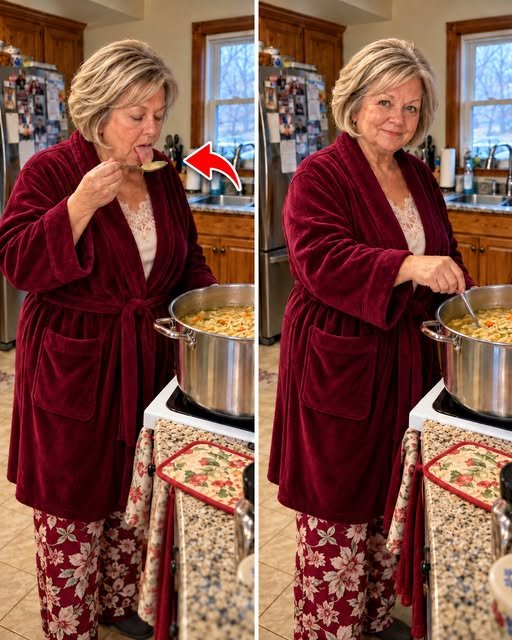
I went to start the bath. Ten minutes later, I came back to the kitchen to find her standing over the stove with the big serving spoon in her mouth. She pulled it out, dipped it back into the pot, and stirred.
“Diane!”
She jumped, then scowled. “For God’s sake, stop screaming.”
“You’re sick.” My voice cracked on the word. “That’s Noah’s dinner. I asked you not ten minutes ago.”
“Kids need germs,” she said, setting the spoon on the counter. “That’s how they build an immune system. You can’t wrap him in plastic.”
That was when Mark walked in. He looked at the spoon. Then at the pot. Then at his mother.
“Mom,” he said slowly, “you really think Claire’s being ridiculous?”
“Completely.”
“And there’s nothing wrong with what you just did?”
“Nothing at all.”
He was quiet for a second. Then he just said, “Okay.”
That was it. Okay. I poured the soup down the drain, made Noah a grilled cheese, and didn’t say a word to Mark for the rest of the evening.
But when we were in bed and the lights were almost off, he rolled toward me.
“Don’t worry,” he whispered. “I know how to stop this. Be in the kitchen tomorrow morning.”
I wanted to ask what he meant. I wanted to ask why it had taken two weeks and a sick woman’s spoon in our son’s soup for him to decide to stop anything.
Instead, I let him turn out the light. I was tired. And some part of me just wanted to believe that tomorrow, I wouldn’t have to make the same request one more time.
Part Three: The Breakfast Tray
The next morning, Diane was already at the kitchen table with her tea when Mark came in carrying a breakfast tray. He’d found the silver dome we got as a wedding present and never used. It was polished so bright I could see the window reflected in it.
“What’s all this?” Diane asked, sitting up.
“Thought I’d take care of my mom for once,” he said, and set it down in front of her.
She beamed at him. Then she lifted the lid.
The smile slid right off her face.
The toast sagged in the middle, its crust crumpled around a dark, soggy patch. The sausages had a wet sheen to them, and one was flattened at the end, like it had been chewed and given up on. The eggs glistened in a way that eggs simply should not.
“Noah and I sucked on every piece,” Mark said pleasantly. “We’re family, Mom. Right?”
My stomach rolled. I pictured myself coming downstairs ten minutes earlier and absentmindedly picking up a slice of that toast, and I suddenly wanted the lid back on.
Diane shoved her chair back so hard it scraped across the tile.
“How the hell could you do this to me? I’m your mother!”
“You said being family made it okay,” Mark said. “Does that only work when it’s our food?”
“I tasted a spoon,” she sputtered. “You deliberately ruined an entire breakfast!”
“You need to respect the food in this house, Mom. That’s a condition of staying here.”
I’ll admit it: for one second, I felt something warm rise in my chest. He’d done it. Clumsily, grossly, but he’d done it. He’d stood up for me.
Then Diane snapped, “Then why did you tell me to rent out my condo?”
The warmth went cold.
“What?” I straightened up from the counter. “Mark. What does she mean?”
He reached over and put the lid back on the tray. Suddenly he couldn’t quite look at me.
“Claire, let me explain,” he said. “The condo was ready two weeks ago. Mom wanted to stay. I told her she could rent it out.”
I set my coffee down very carefully, because my hand wasn’t steady.
“You told her she could stay here? Without asking me?”
“I thought we’d all get used to it,” he said. “And then we could talk about making it permanent.”
I thought of the calendar on the back of our bedroom door. Every night I’d crossed off another day, and every night he’d been lying right there watching me do it. I thought of my winter coats, still stacked on the chair in our room, because there’d been no point finding a new home for them for only six weeks.
“Last week,” I said. “When I told you I was struggling, and you asked me to be patient. Did you know then?”
He looked down at the tray.
“Yes.”
Diane folded her arms, vindicated. “My son promised me a home. And you’ve turned the whole thing hostile.”
I looked at the silver dome. A minute ago, I’d been ready to thank him.
“So what was this supposed to fix?” I asked.
“The food thing,” he said. “I thought if Mom understood, you’d be more comfortable. She’s great with Noah. You wouldn’t have to rush around for childcare, and she’d have family close. I thought it would work for everyone.”
“And if I still didn’t want to live with her?”
“We hadn’t gotten that far.”
“You’d already told her to rent out her home, Mark. That’s not something you can just take back.”
He pulled out a chair and gestured to it. “Can’t we at least try? With some proper rules?”
I stayed where I was, against the counter. Sitting down felt too much like starting the conversation he’d planned to have after the decision was already made.
“I agreed to six weeks,” I said.
“Her condo has a tenant now.”
“Then why didn’t you ask me before that happened?”
Diane stood up. “Don’t talk as if I barged in here. He asked me to stay.”
“I believe you,” I said, and I did. “But he couldn’t agree for both of us.”
She turned to Mark, waiting for him to correct me. He rubbed his forehead.
“Could you just give us a little more time?” he asked me.
“Until when?”
He didn’t answer.
And that was the moment I understood what that six-week date had been holding up. Every time I’d swallowed a complaint, every time I’d checked a pot or quietly scraped a plate, I’d told myself, It’s temporary. Without that date, I could see myself months from now, still guarding the stove, still being told we’d talk about it when things settled down.
“I’ll honor the six weeks,” I said. “But I need us to figure out what happens after that.”
Diane’s voice went sharp. “I watch Noah twice a week. Does that count for nothing?”
I thought of the cushions all over the living room. Noah laughing so hard he got the hiccups.
“It counts,” I said. “I’m grateful. I mean that.”
“Then maybe you should think about what you’re giving up.”
“I can be grateful without agreeing to live together forever.”
“Fine.” Her chin came up. “Then I won’t babysit anymore.”
Part Four: Who Bends
My next shift was Tuesday, noon to six. Then Thursday, same hours. I reached for my phone, already running through names in my head. My sister. The neighbor with the twins. Anyone.
“Could you move your hours around for a little while?” Mark asked.
I stopped with my thumb over the screen.
He was the one who’d made the promise. Diane was the one who’d pulled her help. And somehow the first solution on the table was for me to change my work.
“What can you change?” I asked.
He blinked, like the question had genuinely never occurred to him. “I work those hours too.”
“I know. That’s why we need to figure it out together.”
He was quiet for a long moment.
“Okay,” he finally said. “I’ll ask about switching to the early shift.”
It wasn’t a plan yet. But I put my phone face-down on the table instead of calling my manager, and that felt like something.
Diane left the room without another word. Her chair stayed pushed back beside the untouched tray.
When it was just the two of us, I asked the question that had been bothering me since he lifted that lid.
“You really got Noah involved in this?”
“He helped with the toast,” Mark admitted. “I did the rest. Nobody was ever going to eat it.”
“He’s four. Please don’t use him to get back at your mother.”
He nodded. “I shouldn’t have.”
He carried the tray to the trash and scraped it clean. I watched him do it and realized I’d only ever wanted him to back up one simple request. Now I had to find out something much bigger: whether he could accept a decision he didn’t like.
That night, after Noah was asleep, I opened the website for a daycare two streets over. I’d toured it last spring, before Diane ever asked to stay, and decided we didn’t need it yet.
I filled in the inquiry form. Tuesday and Thursday, noon to six. Then I got to the fees and stopped.
Diane had never charged us a cent. This would come straight out of our savings.
From down the hall, I heard Noah, who apparently wasn’t asleep at all, begging Grandma for “one more walrus.” She did the voice. He giggled.
I could close the laptop. Ask Mark for another month. Give everyone time.
But what would actually be different a month from now?
I typed in Noah’s name. My hands hovered over the start date for a long time. He hadn’t asked for any of this. I pictured him at pickup, looking past me for his grandmother.
I hit submit.
The director called the next morning. There was a spot, but pickup was at five-thirty sharp. I booked a visit before my shift and wrote the time on a sticky note for Mark.
He read it twice.
“I’d have to leave work earlier,” he said.
“Can you?”
“My supervisor said I could switch on those two days. I’d have to start at six.”
I thought about the five a.m. alarm, the fee, Noah learning a whole new routine. None of it was what I’d pictured the day I bought Diane that pillow.
“Are you willing to do that?” I asked.
He nodded. Slowly, but he nodded. “Yes.”
When I got home from the daycare tour, Noah met me at the door with a cushion under each arm and his lower lip pushed out.
“Grandma says the zoo is closing.”
I knelt down and helped him carry the cushions back to the couch. I could set up visits. Sunday lunches. Phone calls. What I couldn’t promise him was that nothing would change.
“We’ll build it again,” I told him. “I promise.”
Part Five: The Apartment
On Friday, Mark slid his laptop across the kitchen table. On the screen was a furnished apartment, available at the end of Diane’s six weeks, on a short lease.
Beside it, on a notepad, he’d written out the deposit and first month’s rent, right next to the daycare fees.
“She says she doesn’t want another temporary place,” he said.
“Have you told her this is an option?”
“I told her we’d look at it together.”
I studied the numbers. Between helping her move and paying for daycare, the weekend away we’d been saving for since spring was gone. I’d been looking forward to that trip for months. Just the two of us. I had never imagined spending that money to get our own home back.
Mark tapped the screen. “Could she maybe stay until her tenant moves out?”
“Do you know when that is?”
“No.”
“Then that’s the same question again, Mark.”
He set the pen down.
“She’s going to say I promised.”
“Then are you going to tell her what you told me? That you assumed I’d get used to it before you ever asked me?”
He looked toward the hallway, toward the guest room.
“I’ll talk to her.”
On Saturday, my sister took Noah to the park, and Mark asked his mother to join us in the kitchen.
Diane barely glanced at the listing.
“I don’t need that. I have a home. Here.”
“We agreed on six weeks,” I said. “This place is available the day those six weeks end.”
She ignored me and looked at her son. “Are you really going to make me leave?”
Mark took a breath. I waited for him to turn to me. To give me that look, the one that meant Can you just manage a little longer?
“Mom,” he said. “I told you that you could stay.”
Diane nodded. “Exactly.”
“And I shouldn’t have done that without asking Claire.”
She stared at him. “So now I have to pay for your mistake?”
“I’ll cover the deposit and the first month,” he said. “I’ll help you move. But I can’t keep the promise I made about all of us living here.”
The kitchen went very quiet.
Then Diane tried one last door. “I’ll keep watching Noah if you let me stay. Same as before. You won’t need daycare at all.”
I looked down at the notepad, the daycare fee written right beside the rent. In my head I could still hear Noah asking if the zoo was really closing.
Mark didn’t answer right away.
The silence made me turn and look at him. I could almost feel the question forming, the Claire, maybe we should think about it. I pressed my lips together so I wouldn’t fill the silence for him. This one had to be his.
He met my eyes. Then he turned back to his mother.
“No, Mom. We’ve arranged the early shifts. I’m doing the pickups.”
Diane’s voice rose. “You’re spending all that money because she can’t share a kitchen? I rented out my condo because you told me to!”
“I know,” he said quietly. “That’s why I’m paying for the apartment. But it doesn’t make Claire responsible for what I promised.”
Diane turned on me, her eyes hard. “And you have nothing to say?”
“I’d like you and Noah to keep spending time together,” I said. “I just don’t want us to keep living together.”
The second the words were out, I wanted to soften them. Add an I’m sorry, or a for now, or something. Diane’s mouth went tight, and I let the sentence stand exactly as it was.
Mark slid the listing toward her again.
“Will you come see it with me?”
She picked up the paper and looked at it for a long time.
“I’m not happy about this,” she said.
Neither of us tried to turn that into a yes.
Part Six: The Last Spoonful
She went to see the apartment with Mark that afternoon, and she signed the lease.
During the weeks that were left, I took Noah for his daycare visits, and Mark started setting his alarm for five. Diane kept her suitcases packed in the corner of the guest room, like she wanted us to see them every time we walked past.
On the last morning of the six weeks, Noah wrapped both arms around her legs at the front door.
“Can the pelican come visit?”
Diane crouched down beside him, and for a moment her face softened into the grandmother on the living room floor.
“Of course she can,” she said.
I held Noah’s hand and helped him wave while Mark carried her bags to the car.
That evening, Mark found me on the couch.
“I’m sorry,” he said. “I thought if it all worked out, you wouldn’t mind that I hadn’t asked.”
“I might still have said no.”
“I know.”
“You needed to let me.”
He sat down beside me, careful to leave a little space between us.
“Thank you for handling the move,” I said. “I mean it. But I’m still hurt that you let me cross off days on that calendar for something you’d already decided wasn’t going to happen.”
He nodded. He didn’t argue. And he didn’t ask if we were okay now, which was the first thing in weeks that made me think we might be.
Over the next couple of weeks, we figured out the new mornings and the new pickups. When Diane called asking about Sunday, Mark came and found me before he answered her. We settled on lunch.
One evening, Noah came into the kitchen with glue and glitter up to his wrists from a craft project. I turned off the burner, left the soup on the stove, and walked him to the bathroom to scrub up.
When we came back, Mark had already ladled the soup into three bowls.
He slid mine across the table.
I picked up my spoon and started to eat.
I didn’t check the pot.
What This Story Taught Me
A boundary isn’t a boundary if someone else gets to quietly erase the end date. Sometimes the hardest part of standing up for yourself isn’t facing the person who crossed the line. It’s discovering who promised them they could.
Love doesn’t mean saying yes to everything, and gratitude doesn’t mean giving up your home. You can appreciate what someone gives you and still say no to what they want.
And trust, once it’s been spent, comes back the same way it left: one small, ordinary moment at a time. Sometimes it looks like a bowl of soup you don’t have to guard.