
The Call That Shook Me
For twelve years, my mother lived in the same room at the back of her little white house.
Her name was Margaret, but everyone called her Miss Maggie. She was eighty-one years old, small as a bird, with silver hair that curled around her temples and eyes that still noticed everything. After a stroke left her bedridden, the doctors said she would never walk again. They were right about that. But they were wrong about one thing.
They thought her life would become quiet.
My mother had never been quiet a day in her life.
She still gave opinions about my clothes, corrected the weather reporter on TV, remembered every neighbor’s birthday, and somehow knew when I was lying about being “fine.”
Because I worked full-time at a dental office, I couldn’t be with her every hour. That was where Brenda came in.
Brenda had been Mom’s caregiver for years. She was a soft-spoken woman from our church, the kind who wore floral blouses and kept peppermint candies in her purse. She made Mom’s meals, helped with bathing, changed linens, and read devotionals out loud in the afternoon.
I trusted her.
So when Brenda called me two months ago, sobbing so hard I could barely understand her, my stomach dropped.
“Your mother kicked me out,” she cried. “She told me not to come back.”
“What?” I nearly dropped my phone. “That doesn’t make sense.”
“She’s already found my replacement,” Brenda said, her voice trembling. “But trust me, Anna… you’re better off not knowing who he is.”
He?
I left work without even asking permission.
All the way to Mom’s house, my hands shook on the steering wheel. I imagined some scammer, some stranger, someone taking advantage of a lonely old woman who couldn’t even get out of bed.
But nothing prepared me for what I saw when I opened her bedroom door.
The Man Beside Her Bed
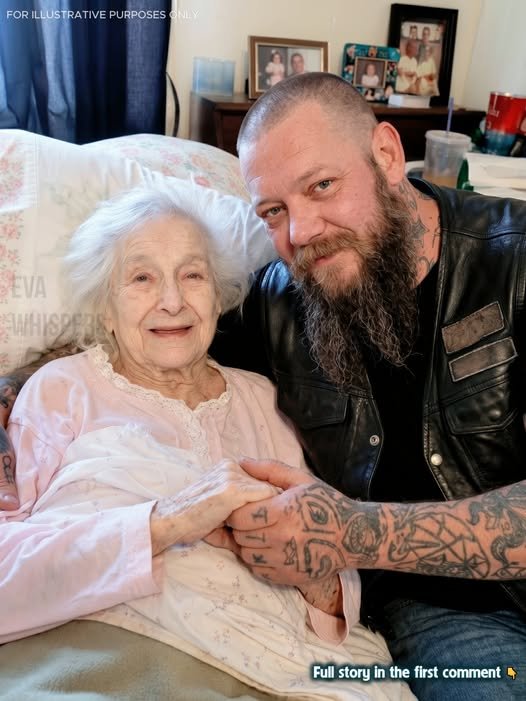
A huge man sat beside my mother’s bed, holding a spoonful of chicken soup.
He wore a black leather vest over a gray shirt. His beard reached his chest. Tattoos crawled up his neck, over both hands, and disappeared under his sleeves. A silver chain hung from his belt. His boots looked like they could crush stones.
And my mother?
She was smiling at him like he had hung the moon.
“Just one more spoonful, Miss Margaret,” he said gently.
Mom opened her mouth obediently.
I stood frozen in the doorway.
“Mom,” I said slowly. “Can I talk to you? Alone?”
The man didn’t look offended. He didn’t even look surprised.
He set the bowl down, wiped Mom’s chin with a napkin, and stood.
“I’ll be in the garden, Miss Margaret.”
“Thank you, Louis,” Mom said warmly.
Louis.
The second he left, I shut the door and turned to her.
“Have you lost your mind?”
Mom’s smile faded.
“Anna.”
“No, Mom. Don’t ‘Anna’ me. You fired Brenda? Brenda? The woman who has cared for you for years? And replaced her with some biker you barely know?”
My mother’s eyes hardened in that familiar way. Even bedridden, she could still make me feel twelve years old.
“He is staying,” she said. “No matter what. I want Louis to be the one taking care of me.”
“Why?”
Her lips pressed together.
“Because I trust him.”
“You trust him? Mom, you don’t even know him.”
Her eyes moved toward the window, where Louis stood in the garden pulling weeds with his giant tattooed hands.
“Oh,” she whispered. “I know him better than you think.”

The House Changed
I didn’t like it.
That is the honest truth.
For the first week, I came by every day expecting to find something wrong. Missing jewelry. Dirty sheets. Unwashed dishes. My mother neglected. My fears proven right.
Instead, the house was cleaner than it had been in years.
The curtains were open. Fresh flowers sat on the dresser. Mom’s hair was brushed and pinned neatly. Her meals looked homemade, not reheated. The medicine chart was updated in careful handwriting.
Louis didn’t just care for her body. He cared for her spirit.
He wheeled her bed closer to the window so she could watch the birds. He found her old records and played the songs she used to dance to with my father. He read mystery novels to her in a deep, rumbling voice that somehow made every sentence sound important.
And Mom blossomed.
She laughed more. Ate better. Asked for lipstick. Once, I walked in and found her wearing a blue scarf I hadn’t seen since I was a teenager.
“Louis found it in the hall closet,” she said, touching it like treasure. “Your father always liked this one.”
I wanted to hate him.
But it was hard to hate a man who knew exactly how much cinnamon Mom liked in her oatmeal.
Still, something wasn’t right.
Every time I entered the room, their conversations stopped.
Once, I heard Mom say, “You have his eyes.”
Then I stepped inside, and silence fell.
Another day, I caught Louis holding an old photo album. When he saw me, he closed it quickly.
“What were you looking at?” I asked.
“Memories,” Mom answered before he could.
Her voice was soft, but final.
I began to feel like a visitor in my own mother’s life.
The Attack
Everything changed on a rainy Thursday morning.
I was at work when Louis called.
“Anna,” he said. His voice was steady, but I heard fear under it. “Your mother’s having trouble breathing. I called an ambulance.”
By the time I reached the hospital, Mom was already in a bed, pale and exhausted, with tubes and monitors around her.
The doctor told me it was a serious episode connected to her long-term condition. He said Louis had acted quickly. He said calling emergency services when he did may have prevented something worse.
But I couldn’t hear that part.
All I saw was Louis sitting beside her bed, holding her hand like he belonged there.
Like he was family.
I hated how natural it looked.
He stayed through the tests. Stayed through the night. Refused coffee until a nurse forced a cup into his hand. When Mom stirred, he leaned close and whispered, “I’m here, Miss Margaret. You rest.”
My chest burned.
I was her daughter.
I was the one who had filled out hospital forms, paid bills, answered midnight calls, held her hand after the stroke. I had earned my place beside that bed.
Who was he to sit there as if he had loved her all his life?
When Mom finally fell asleep, I stepped into the hallway.
“Louis,” I said.
He looked up.
“I want you to quit.”
His face didn’t change.
“I’ll pay you three times whatever she’s paying you,” I continued. “You’ve done enough. I’ll find someone else.”
He looked at me for a long moment.
Then he stood, silently, and walked away.
“Louis,” I called.
He didn’t stop until we were outside the hospital, under the gray morning sky.
Rain tapped against the covered entrance.
He turned around, and for the first time since I’d met him, he looked tired.
“It’s time you learned the truth,” he said. “She asked me to stay silent… but I can’t anymore.”
My heart dropped.
“What did she hide?”
The Truth in His Pocket
Louis reached into the inside pocket of his vest and pulled out a folded envelope, worn soft at the edges.
“She wrote this to me forty-six years ago,” he said.
I stared at it.
“My mother?”
He nodded.
“My name is Louis Carter. But that wasn’t the name I was born with.”
The hospital noise behind us seemed to fade.
Louis looked down at the envelope like it weighed more than stone.
“Your mother had a son before she married your father.”
The words didn’t make sense at first.
I almost laughed because they sounded impossible.
“No,” I whispered.
“She was seventeen,” Louis said. “Her parents sent her away to stay with an aunt. Back then, girls didn’t get many choices. She gave birth to a boy, held him for less than an hour, and then he was taken for adoption.”
My legs weakened.
“I was that boy.”
The world tilted.
Louis continued quietly.
“I didn’t know her name until a few years ago. My adoptive parents were good people, but after they passed, I started searching. It took time. Records were sealed. Names had changed. Finally, I found the truth.”
I gripped the cold metal railing.
“When did Mom find out?”
“Six months ago.”
Six months.
My mother had known for six months that she had another child.
A son.
My brother.
“And she didn’t tell me?”
“She wanted to,” Louis said. “Every day, she wanted to. But she was afraid.”
“Afraid of what?”
“Losing you.”
That broke something in me.
Louis’s voice softened.
“She thought you would feel betrayed. She thought you’d think she had lied to you your whole life. She kept saying, ‘Anna has carried enough. I can’t put another burden on her.’”
I wanted to be angry. I wanted to hold on to my hurt because it was easier than feeling everything else.
But then Louis handed me the letter.
My hands trembled as I opened it.
The handwriting was unmistakably Mom’s, though younger, rounder.
“My dearest baby boy,” it began.
I could barely read through the tears.
She had written about his tiny hands. About how sorry she was. About how she hoped he would grow up safe, loved, and strong. About how she would think of him every birthday.
At the bottom, she had written:
“If life is kind, maybe one day you will find me. If you do, please know this first: I never stopped loving you.”
I pressed the letter to my chest.
My knees gave out right there.
Louis caught my arm before I hit the ground.
Brenda’s Fear
Later, when I could breathe again, I asked about Brenda.
“Why did Mom fire her?”
Louis sighed.
“Brenda walked in during one of our visits. Your mother had just told me she wanted me to help care for her. Brenda got upset. She said it wasn’t proper. Said a man who looked like me had no business caring for an elderly church woman.”
I winced.
“She called you dangerous?”
“She called me worse,” he said, but without anger. “Your mother defended me. Brenda threatened to call you and tell you everything before Margaret was ready. That’s when your mother asked her to leave.”
I thought of Brenda’s warning.
You’re better off not knowing who he is.
She had not been protecting me from Louis.
She had been protecting the version of my mother she understood.
The neat version. The church version. The version without pain, secrets, or impossible choices.
But people are never that simple.
Especially mothers.

The Conversation I Almost Missed
When we returned to Mom’s room, she was awake.
The moment she saw my face, tears filled her eyes.
“You know,” she whispered.
I walked to her bed.
For a second, I was a little girl again, wanting answers, wanting comfort, wanting my mother to make everything make sense.
“Why didn’t you tell me?” I asked.
Her mouth trembled.
“Because you were my miracle after losing him,” she said. “And I was terrified that if you knew, you would look at me differently.”
I sat beside her.
“I do look at you differently.”
She closed her eyes as if I had struck her.
I took her hand.
“I see more of you now.”
Her eyes opened.
“I see a girl who was scared. A mother who was forced to say goodbye. A woman who carried grief quietly for sixty-four years and still managed to love me with everything she had.”
A sob broke from her.
“I should have told you.”
“Yes,” I said gently. “You should have.”
Louis stood near the door, his big hands folded in front of him, looking like a boy waiting to be accepted.
I turned to him.
“And you should have told me too.”
He nodded.
“I know.”
“But I understand why you didn’t.”
Mom looked between us, tears slipping into her silver hair.
“I wanted both my children in one room before I left this world,” she whispered. “Just once. I wanted to see it.”
I leaned over and kissed her forehead.
“Then you’re going to see it more than once.”
My Brother in the Garden
Mom came home three days later.
This time, I didn’t glare when Louis carried her bag inside. I didn’t tense when he adjusted her pillows. I didn’t feel replaced when he sat beside her bed.
I watched him differently.
I noticed how careful he was with her hands. How he listened when she spoke. How his eyes softened every time she smiled.
One afternoon, I found him in the garden planting lavender.
“Mom hates lavender,” I said.
He looked startled.
“She told me she loved it.”
“She says that to be polite.”
For a moment, we stared at each other.
Then Louis laughed.
It was a deep, surprised laugh, and somehow I laughed too.
We dug up the lavender and planted roses instead.
Little by little, the silence between us changed.
He told me about his life. About his adoptive parents, his years working as a mechanic, his motorcycle club that delivered food to elderly people on weekends. I learned that the tattoos on his hands were not symbols of trouble, but memories. One for his adoptive mother. One for his late wife. One for every child his club had helped through charity rides.
And I told him about Mom.
How she burned toast every Christmas morning. How she cried during old musicals. How she once chased a raccoon off the porch with a broom while wearing bedroom slippers.
Louis listened like a man gathering pieces of a family he had been denied.
The Birthday Dinner
Two months after the hospital, Mom turned eighty-two.
For the first time in years, she asked for a birthday dinner.
Nothing fancy. Just soup, cake, flowers, and “both my children,” as she put it.
Louis arrived wearing a clean button-down shirt under his leather vest. I brought a chocolate cake from the bakery downtown. Mom wore her blue scarf and insisted on lipstick.
Before we cut the cake, she asked Louis to open the top drawer of her nightstand.
Inside was a small velvet box.
He brought it to her, confused.
Mom opened it with trembling fingers and took out a tiny silver bracelet.
“My parents removed this from your wrist the day they took you away,” she said. “I kept it hidden all these years.”
Louis’s face crumpled.
On the bracelet, in faded engraving, was one word:
Samuel.
“That was your first name,” Mom whispered. “But Louis is the name life gave you. And I love both.”
He bowed his head over her hands.
For a moment, none of us spoke.
Then Mom looked at me.
“Anna, I don’t expect you to forgive the silence all at once.”
“I already forgave the love behind it,” I said. “The rest will take time.”
She nodded, crying and smiling at the same time.
Louis reached for my hand across the bed.
I took it.
His hand was rough, tattooed, and warm.
My brother’s hand.
What I Know Now
Mom is still bedridden.
She still has hard days. There are still medications, appointments, and nights when fear sits heavy in the room.
But the house is no longer just a place of waiting.
It is full of music again. Full of stories. Full of a deep voice reading mystery novels and my mother interrupting to say, “No, no, he’s obviously the guilty one.”
Brenda eventually wrote a letter of apology. Mom accepted it. Louis did too. He said everyone deserves room to learn.
That is the kind of man he is.
The kind I almost threw away because I judged him by his vest, his beard, his tattoos, and my own fear.
I used to think family was simple. People either belonged or they didn’t. Truth was either told or hidden. Love was either clean or broken.
Now I know better.
Sometimes love carries secrets because it is afraid.
Sometimes strangers are not strangers at all.
And sometimes an eighty-one-year-old bedridden woman knows exactly what she is doing when she fires the sweet church lady and hires the heavily tattooed biker.
Because she isn’t choosing a caregiver.
She is choosing the son she lost.
And giving her daughter the brother she never knew she needed.