
Part 1: The Door That Stayed Closed
The first thing I remember clearly from that night wasn’t the fire itself. It was six-year-old Mason coughing in the backseat while the yellow fire department report kept sliding across my lap, its incident number making the destruction of our home feel official before I had even begun to understand what had happened.
My hair and coat smelled like smoke. Four-year-old Ellie was wrapped in a fleece blanket beside her brother, and less than an hour earlier, both children had been standing barefoot on the sidewalk while firefighters poured water into what used to be our kitchen.
At 1:18 a.m., part of the roof collapsed. Mason tried to run toward the house because his favorite dinosaur was still inside, but I grabbed him around the waist before he could move more than a few steps.
A firefighter eventually recovered the toy. Its little green tail had warped from the heat, but Mason held it against his chest as though saving that dinosaur meant some small piece of his old life had survived.
My husband Ryan was working a night shift at the hospital. His relief hadn’t arrived yet, so although he desperately wanted to leave, he couldn’t immediately get to us.
“I’m leaving as soon as my relief gets here.”
After calling our insurance company and the Red Cross, I finally drove to my parents’ house. It was 2:07 in the morning when I pulled into their familiar driveway and saw the porch light glowing.
For one foolish second, that light gave me hope.
I carried Ellie to the porch while Mason followed with his damaged dinosaur. When the front door opened, however, my mother left only a narrow gap between us.
“Oh, Claire. What happened?”
“Our house burned. Please. We just need a place to sleep.”
My father appeared behind her in his robe.
“Is everyone alive?”
“Yes.”
“Then calm down.”
Mason coughed behind me.
My mother glanced toward the stairs, where their perfectly prepared guest room sat empty. Then she explained that my sister Vanessa and her husband Brad were arriving the next morning.
“We can’t have the children coughing all over the guest room.”
I thought I had misunderstood her.
“My children just watched their home burn.”
My father sighed.
“Vanessa has been planning this visit for weeks. She already has enough stress with the baby shower.”
Vanessa was seven months pregnant, married to a dentist, and living in a five-bedroom house. My parents had always protected her from inconvenience while expecting me to be practical, resilient, and understanding.
That night was no different.
“So we can’t stay one night?”
“There’s a motel near the highway,” my father said.
“My wallet burned.”
My mother’s expression tightened.
“Claire, don’t make this ugly.”
I wanted to show her the soot on Ellie’s pajamas and put Mason’s melted dinosaur into her hands. Instead, I looked at my frightened children and forced myself to remain calm.
“Okay.”
My mother visibly relaxed.
That hurt more than the refusal.
I took Mason and Ellie back to the minivan and parked beneath a streetlight along the curb. The children tried to sleep while I kept the heater low because I was afraid we would run out of gas.
Then, at 3:11 a.m., my parents’ front door opened.
For one hopeful second, I thought my father had changed his mind. Instead, he reached for the switch beside the door.
The porch light went dark.
I sat behind the wheel staring at the house where I had grown up, finally understanding that my parents had chosen an empty guest room over their smoke-covered grandchildren.
But at 5:42 that morning, another car pulled into their driveway.
A small elderly woman stepped out wearing her church coat over her pajamas, gray hair badly tucked beneath a scarf.
My grandmother Margaret had arrived.
She looked at my children sleeping inside the minivan, then at the dark porch and the fire department report on my lap.
Her expression changed immediately.
And without asking me a single question, Grandma turned toward my parents’ front door and started walking …
Part 2: The Woman Who Saw Everything
Grandma Margaret crossed the driveway without hesitation. She was small and still wearing her church coat over her pajamas, with her gray hair awkwardly tucked beneath a scarf, but I had never known anyone who needed size or volume to make herself heard.
My father opened the door wearing the same irritated expression he had shown me hours earlier. Grandma looked at him, then at the dark porch and finally toward the minivan where Mason and Ellie were sleeping.
“You turned off the porch light on two babies who smelled like smoke.”
My father opened his mouth but couldn’t find an answer. Mom appeared behind him, pulling her robe tighter as her eyes moved from Grandma to me.
“Mom, it’s not what it looks like.”
“It is exactly what it looks like.”
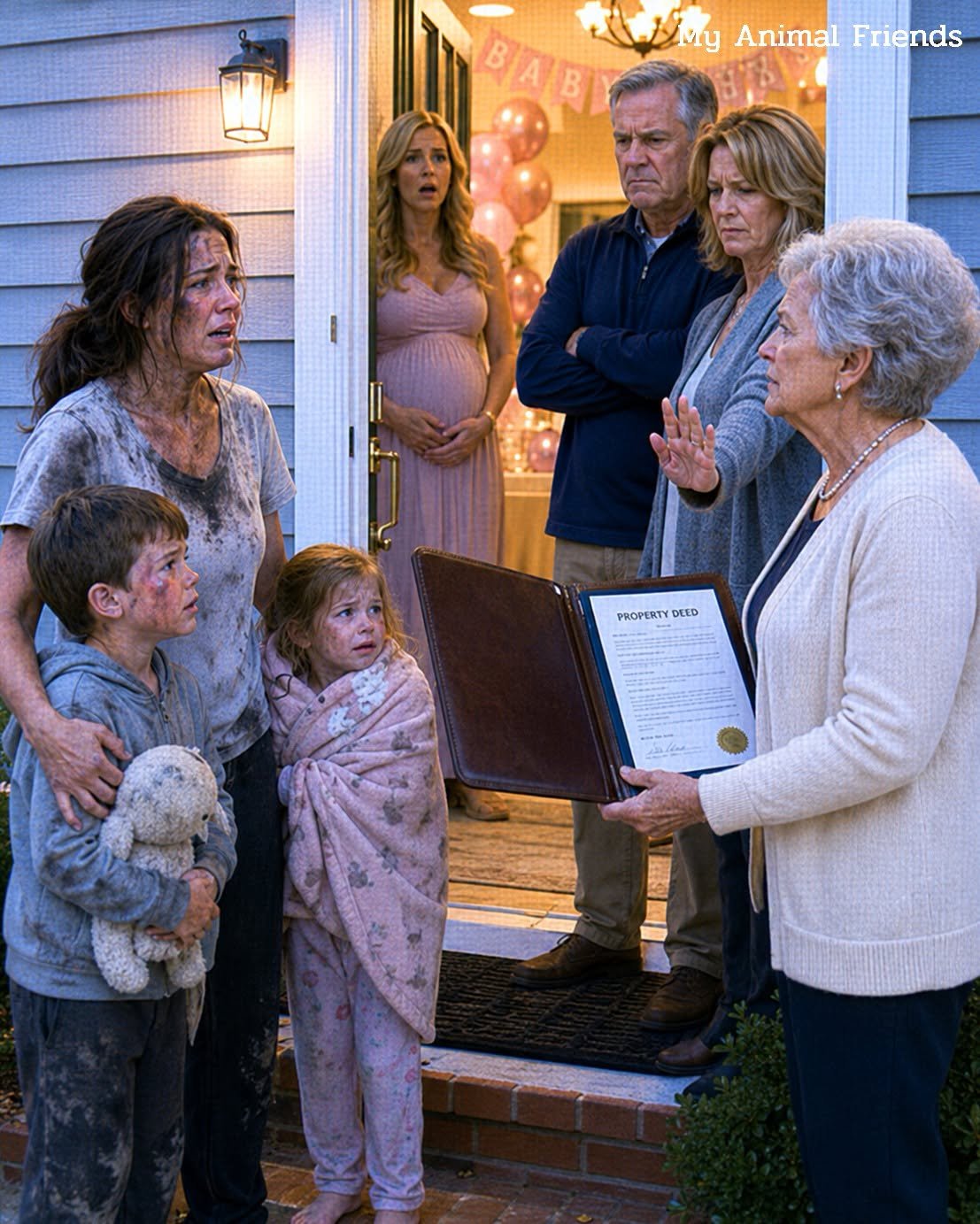
Grandma opened the leather folder she had carried from her car. Inside were old emergency contact forms, family medical information, phone numbers, and a document she had created after Mason was born.
Years earlier, Grandma had asked every adult in the family to write down where the children could be taken during an emergency. My parents had listed their address first and signed beneath a sentence stating that family did not leave children without shelter, something that had seemed so obvious at the time that I barely remembered the document existed.
“This is yours.”
My father recognized his own handwriting and looked away. Instead of admitting what they had done, however, he immediately tried to distinguish that old promise from what had happened that night.
“It was a different situation.”
“The situation was children needing a bed.”
Mom stepped in and explained that Vanessa was pregnant and they had only been trying to keep everything calm for her upcoming visit. Grandma listened without interrupting, but her expression hardened when Mom mentioned the baby shower.
“Your daughter’s house was burning while you were protecting a baby shower.”
Nobody answered. Grandma closed the folder, turned toward me, and gave me the first uncomplicated instruction anyone had offered since the fire began.
“Get in your car. Follow me.”
My knees nearly gave out from relief. After hours of calling insurance companies, emergency services, shelters, and finally my own parents, someone had stopped asking me to justify why two exhausted children deserved somewhere warm to sleep.
Dad stepped onto the porch and objected that Grandma couldn’t simply take us away and make him and Mom look like villains. Grandma didn’t argue with him or soften what had happened.
“You did that without help.”
Twelve minutes later, I followed Grandma to her small ranch house as the sky began turning pale. Her porch light was already on when we arrived, and unlike my parents’ door, hers was unlocked before I even reached it.
Grandma didn’t waste time discussing sleeping arrangements or whether our arrival was convenient. She pulled towels and clean shirts from the closets, found crackers, applesauce, cough drops, and water for the children, then ordered me to sit down because I was still moving as though stopping would cause everything to collapse.
Mason soon fell asleep on the couch with his damaged dinosaur tucked against him. Ellie curled into Grandma’s recliner beneath an old quilt, while I plugged in my nearly dead phone and finally saw Ryan calling.
He arrived around sunrise after leaving the hospital. Ryan went directly to the children, held Mason when he woke, and only afterward sat with me while I explained what had happened at my parents’ house.
I told him about the guest room they had refused to let the children use, their concern about Vanessa’s pregnancy, and the motel my father suggested even after I told him my wallet had burned. Finally, I told Ryan that Dad had come outside at 3:11 and switched off the porch light while his grandchildren were sleeping in the minivan.
Ryan didn’t shout or threaten anyone. He simply sat at Grandma’s kitchen table with both hands resting flat against the worn wood, staring silently ahead for so long that his quiet anger frightened me more than yelling would have.
By 7:00, I was speaking with the Red Cross, and soon afterward Ryan was back on the phone with our insurance company. A firefighter later confirmed that our kitchen was destroyed and smoke damage had spread through most of the house, which meant we wouldn’t be returning home anytime soon.
I wrote down every number and instruction while keeping my voice calm because Mason and Ellie were nearby. Only after everything had been documented did I walk into Grandma’s laundry room, press a towel against my face, and finally allow myself to cry.
Grandma found me there but never told me to calm down or remind me that everyone had survived. She simply stood beside me, folding clean washcloths one after another until I could breathe normally again.
That was when I understood what love looked like when there was nothing comfortable or pretty about it. It wasn’t promises about family always being there, but someone standing beside you while your life had been reduced to smoke, insurance numbers, exhausted children, and paperwork.
Around midmorning, Mom called, but I let the phone ring until it stopped. A minute later, a message appeared on the screen.
“Please call me. Your father is upset.”
I stared at those words because even after everything that had happened, the person Mom was worried about wasn’t Mason, Ellie, Ryan, or me. It was still my father.
Grandma read the message and placed my phone facedown on the table.
“Not today.”
I thought ignoring them would buy us at least one quiet day. But before that afternoon was over, my parents would appear at Grandma’s front door carrying groceries, excuses, and a very different version of what had happened.
Fortunately, Grandma had already begun making sure the truth couldn’t be rewritten …
Part 3: A Record That Couldn’t Be Rewritten
Later that morning, Vanessa called me. I didn’t answer because I had no energy left to hear another explanation about her pregnancy, the baby shower, or why everyone had supposedly been under too much pressure to think clearly.
Vanessa left a voicemail instead, and when I eventually listened, her voice sounded much smaller than I expected. She said she had only just learned what had happened, that she hadn’t known Mason and Ellie had been left outside, and that her baby shower had never mattered more than giving my children somewhere safe to sleep.
I listened to the message once and saved it without responding. There would be time later to decide what kind of sister Vanessa wanted to be when our parents were no longer arranging everything around her comfort, but that morning belonged to Mason and Ellie.
Grandma found Mason a clean sweatshirt that hung almost to his knees and gave Ellie fuzzy socks decorated with snowflakes. Ryan went to the store for toothbrushes, underwear, children’s medicine, and pajamas, while I finally took a shower and watched gray water disappear down the drain.
Even after washing my hair twice, I could still smell smoke. When I returned to the kitchen, I noticed Grandma had placed her leather folder in the center of the table and added several new documents to it.
The yellow fire department report was now inside, along with the old emergency contact sheet my parents had signed. Grandma had also written down exactly what she had witnessed when she arrived at 5:42 that morning.
“At dawn, I found my great-grandchildren sleeping in a van outside a closed family door.”
My throat tightened as I read the sentence. Grandma tapped the paper once, making it clear that she wasn’t creating ammunition for some future family war.
“Not for revenge. For memory.”
I understood immediately. My family had always been remarkably skilled at reshaping uncomfortable events once enough time had passed, turning deliberate choices into misunderstandings and hurtful behavior into something everyone was expected to forgive because nobody had supposedly meant any harm.
Within weeks, Mom might claim she had panicked, while Dad could insist he had offered us a perfectly reasonable motel. Someone would mention Vanessa’s pregnancy, someone else would say I had been emotional after the fire, and eventually the story might become so softened that leaving two children in a freezing minivan sounded like an unfortunate communication problem.
Grandma’s folder wouldn’t allow that to happen. It contained the fire report, my parents’ old written promise, and the testimony of the woman who had personally found Mason and Ellie sleeping outside their grandparents’ house.
By afternoon, my parents arrived at Grandma’s home. They brought two grocery bags and, bizarrely, a package of diapers that didn’t fit either of my children, along with the nervous expressions of people more interested in repairing a family conflict than confronting why it had happened.
Grandma met them at the front door and didn’t invite them inside. I stood several feet behind her, exhausted but clearheaded enough to realize I didn’t owe anyone immediate forgiveness simply because they had shown up carrying groceries.
Mom began crying while Dad looked past us toward the living room, where Mason and Ellie were watching cartoons beneath a quilt. For once, I resisted the instinct I had spent my entire life developing, the one that told me to smooth over uncomfortable moments so everyone else could feel better.
Dad said they had been tired. Mom explained that they had been worried about germs because Vanessa was pregnant, and both insisted they had never intended for Mason and Ellie to spend the night in the car.
Grandma listened without interrupting, then turned toward me. She didn’t answer for me because this time, the decision belonged entirely to me.
I could feel the familiar pressure to be reasonable and accept their explanation. Then Mason coughed from the couch, Ellie moved closer to Ryan, and I remembered the relief on Mom’s face when I had finally stopped asking for shelter.
Most of all, I remembered the sound of the porch light switching off.
“No.”
Mom blinked at me. I stepped forward, surprised by how little effort the word required after years of believing that keeping peace was my responsibility.
“You can leave the bags. You can go home. We’ll talk another day.”
Dad’s expression hardened, but before he could argue, Grandma quietly lifted the leather folder. She didn’t open it or threaten him with what was inside, because simply seeing it was enough to remind everyone that this time, the facts had been preserved.
My parents left the grocery bags on the porch and walked back to their car. Nobody chased them, apologized for making them uncomfortable, or called them back.
As I watched them drive away, I realized the fire had destroyed our kitchen and left us without a home. But something else had burned away that night too.
For the first time in my life, I was no longer willing to confuse being easy to ignore with being strong …

Part 4: The Meaning of an Open Door
That night, Mason slept in Grandma’s spare room with his damaged dinosaur resting on the pillow beside him. Ellie slept on a cot near Ryan and me, keeping one small hand wrapped around the edge of my sleeve as though she needed physical proof that I wasn’t going anywhere.
The house still carried the faint smell of smoke because our clothes and belongings had brought it inside with us. But underneath it were the ordinary smells of chicken soup, freshly washed towels, and the lemon soap Grandma kept beside her kitchen sink, and after the night we had survived, those simple things felt strangely reassuring.
Before I turned off the lamp, Mason studied his warped dinosaur and decided it looked as though it had survived a volcano. Ryan told him that probably made it the bravest dinosaur he owned, which finally earned the first small smile I had seen from him since the fire.
Ellie was quiet for a moment before looking toward the doorway.
“Is Grandma’s house our home now?”
Ryan and I exchanged a glance because neither of us knew how to answer without promising something we couldn’t guarantee. Grandma, who had been standing in the doorway, answered before either of us had to.
“For tonight.”
It was exactly the answer we needed. Nobody could tell us how long insurance would take, when repairs would begin, or where we would be living next month, but Grandma had given the children something more immediate: a safe place for that night.
Over the following weeks, our damaged house became a maze of tarps, contractors, insurance forms, estimates, and phone calls. The kitchen was beyond saving, smoke damage had reached most of the house, and every conversation seemed to end with another document we needed to complete or another decision we weren’t emotionally prepared to make.
Ryan and I focused on rebuilding stability for Mason and Ellie while Grandma continued treating our presence as completely ordinary. She never reminded us that we were guests or acted as though our emergency had disrupted her life, and the contrast with my parents became impossible to ignore.
My relationship with Mom and Dad changed as well. We eventually spoke again, but I stopped accepting explanations that required me to pretend their choices had been less painful than they really were.
They continued insisting that they had been exhausted and worried about Vanessa’s pregnancy. They reminded me that Dad had suggested a motel and said they never expected us to remain in the minivan, but none of those explanations answered the question that mattered.
They had known two frightened children needed shelter, and they had still closed the door.
Whenever someone tried to soften the story, I remembered Grandma’s leather folder. She had preserved the fire department report, the emergency sheet my parents had signed years earlier, and her own written account of finding Mason and Ellie sleeping outside at 5:42 that morning.
The folder wasn’t about punishing anyone. It prevented the truth from gradually shrinking until everyone could comfortably pretend nothing serious had happened.
Vanessa’s voicemail stayed on my phone for a long time. Eventually, we talked, and I learned that she genuinely hadn’t known our parents had refused to let us stay because of her visit.
That didn’t erase the history between us, and it didn’t suddenly make us close. But for the first time, I began separating Vanessa’s choices from the way our parents had spent years arranging the family around her, and I realized those weren’t always the same thing.
The biggest change happened inside me. For years, I had believed being strong meant requiring less, forgiving quickly, and making myself convenient whenever somebody else needed more attention.
After the fire, I understood how dangerous that lesson had become. Mason and Ellie were watching me, and I didn’t want them growing up believing love had to be earned by becoming the person who never needed anything.
One evening, Mason asked whether we would visit Grandma after our own house was repaired. The question surprised me because he apparently thought our staying there was connected only to the fire.
“Of course we will.”
“Even when our house is fixed?”
“Especially then.”
He seemed satisfied and returned to playing with his dinosaur. I watched him for a moment and realized Grandma had given my children something that night beyond blankets and somewhere to sleep.
She had shown them what family was supposed to do when helping was inconvenient.
The fire had taken our kitchen, damaged nearly everything we owned, and forced us into months of uncertainty. Yet when I thought back to that night, the image that stayed with me wasn’t always the flames.
Sometimes it was my father reaching for the porch switch and turning off the light.
And sometimes it was Grandma arriving hours later with her own house keys already in her hand.
One door had taught me exactly where I stood in my parents’ family.
The other was about to teach Mason and Ellie an entirely different definition of home …
Part 5: Family Opened the Door
In the weeks that followed, rebuilding our house became a slow process of insurance calls, contractor visits, estimates, and paperwork. Mason and Ellie gradually returned to their routines, but I noticed that both children had become unusually attentive to small signs of security, especially unlocked doors, porch lights, and knowing exactly where Ryan and I were.
Grandma never treated those fears as dramatic or inconvenient. She simply kept the hallway light on when Mason asked, left her bedroom door open at night, and made sure Ellie knew where everyone would be sleeping before bedtime.
My parents, meanwhile, tried several times to repair what had happened. Their apologies always came with explanations about exhaustion, Vanessa’s pregnancy, germs, and the assumption that I would find a motel, but I no longer helped them turn those explanations into excuses.
I didn’t cut them out of our lives entirely. I simply stopped doing the emotional work that had allowed them to favor Vanessa while expecting me to absorb every disappointment quietly.
Whenever Mom suggested that perhaps I remembered that night more harshly because I had been frightened after the fire, Grandma’s leather folder ended the discussion. The fire department report, the emergency contact sheet, and her written account remained exactly as they had been that morning.
“At dawn, I found my great-grandchildren sleeping in a van outside a closed family door.”
Grandma had been right when she said the record wasn’t about revenge. It was about refusing to let time transform a deliberate decision into an innocent misunderstanding.
Eventually, Vanessa and I spoke as well. She apologized for the role her visit had played, but I told her the decision hadn’t actually been hers because our parents had made it before she even knew we were standing outside.
For once, Vanessa didn’t defend them. She admitted that our parents had spent years protecting her from discomfort while assuming I could handle anything, and hearing her acknowledge that mattered more than any apology she could have offered for that particular night.
Months passed before our house was ready for us again. The repaired kitchen looked unfamiliar at first, and Mason remained suspicious of the smoke detectors until Ryan showed him exactly how every one worked.
Ellie wanted a night-light in her new bedroom, so we bought one shaped like a little house. Every evening, she checked that it was glowing before climbing into bed, and neither Ryan nor I ever told her she was old enough to sleep without it.
We continued visiting Grandma even after we no longer needed her spare room. Mason brought his warped dinosaur every time, and Grandma eventually cleared a permanent place for it on a shelf whenever he wasn’t carrying it around.
One afternoon, I found the leather folder on Grandma’s kitchen table again. The yellow fire department report was still inside beside the old emergency form, and seeing them together reminded me how completely that one night had changed my understanding of family.
For most of my life, I had believed family loyalty meant being forgiving, accommodating, and willing to overlook hurtful behavior. Grandma taught me that loyalty could also mean refusing to lie about what someone had done, especially when children were the ones who paid the price.
My parents had spent years teaching me that strength meant needing less. I wanted Mason and Ellie to learn something different: that asking for help wasn’t weakness, that love wasn’t measured by how convenient you were, and that a person who truly cared about you didn’t require you to earn shelter during an emergency.
The fire eventually became something the children could talk about without fear. Mason started telling people his dinosaur had “survived a volcano,” while Ellie mostly remembered Grandma’s fuzzy snowflake socks and the quilt she slept under that first morning.
I remembered something else.
I remembered sitting inside the minivan at 3:11 in the morning and watching my father switch off the porch light. For years, I had made excuses for my parents because accepting the truth seemed harder than continuing to hope they would eventually treat me the way they treated Vanessa.
That small click ended the argument inside me.
Grandma arriving two and a half hours later gave me something to replace it with. She had shown up wearing a church coat over pajamas, carrying house keys in one hand and a leather folder in the other, and she hadn’t asked whether helping us would interfere with her plans.
She had simply opened her door.
Years later, when Mason and Ellie asked what family was supposed to mean, I never gave them a complicated answer. I told them about the night their house burned and two different porch lights taught me everything I needed to know.
Family wasn’t necessarily the people whose address appeared beside yours on old forms or the people who shared your last name. It was the person who saw frightened, smoke-stained children standing outside in the cold and never wondered whether letting them inside would be convenient.
Because when everything else had burned away, Grandma had reduced family to one rule simple enough for my children to understand.
Family opened the door.