
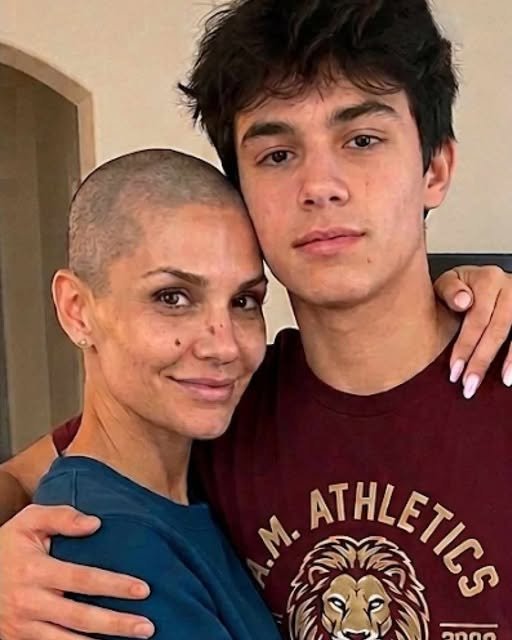
My SIL gave up the long hair she’d cherished her entire life so our son could go to prom looking like every other kid. We thought it was an unbelievable sacrifice. Then she removed her knitted hat and told us the real reason she had cut it all off.
Three months earlier, our family had still been pretending everything was fine.
My husband, Eliot, had lost his warehouse supervisor job shortly before Christmas. The company had closed one of its locations with almost no warning, and nearly sixty employees were sent home with cardboard boxes and promises about severance checks.
At first, Eliot treated unemployment like a temporary inconvenience.
He woke at six every morning, showered, shaved, and sat at the kitchen table with his laptop open. He rewrote his résumé so many times that I could recite it from memory. He applied for management positions, delivery jobs, office work, and anything else that offered health insurance.
Every interview ended the same way.
“They said they’ll call next week.”
Next week always passed quietly.
By February, we were behind on the electric bill. We stopped eating out, canceled everything that was not necessary, and learned exactly how long a tank of gas could last if we planned every trip.
Our seventeen-year-old son, Corbin, noticed more than we wanted him to.
He never complained when I stopped buying his favorite cereal. He said nothing when Eliot explained that we would have to postpone fixing his old car. He quietly canceled a school trip and told us he had never wanted to go anyway.
Then he started working two jobs.
Three evenings a week, he bagged groceries at a neighborhood market. On Saturdays and Sundays, he cleaned theaters after the final movie ended.
Some nights, he came home smelling like popcorn and cleaning spray. He would place his tips in an old coffee tin, eat whatever I had saved for him, and begin his homework close to midnight.
I hated watching him carry so much.
“You’re still a kid,” I told him one evening.
He was sitting at the table with a calculator, several pay stubs, and a notebook.
“I’m almost eighteen.”
“That isn’t the same thing.”
“I’m not doing anything dangerous, Mom.”
“That’s not what I mean.”
He covered the notebook with his hand.
I gently pulled it toward me.
He had written down the price of a prom ticket, dinner, photographs, and a suit. Beside each amount, he had listed how many shifts he would need to work.
At the bottom of the page, he had written:
ONE NORMAL NIGHT.
I looked at him.
“What does that mean?”
His face reddened.
“It’s stupid.”
“Tell me.”
Corbin stared at the table.
“Everyone else talks about prom like it’s simple. They’ll rent limos, buy clothes, go out to dinner, and take pictures with their parents.”
He swallowed.
“I just want one night when nobody can look at me and know we’re struggling.”
My heart broke because he had never asked for anything extravagant.
He did not want designer shoes or a luxury car. He wanted to stand beside his classmates without feeling as though our financial problems were written across his clothes.
A few weeks earlier, he had shown me a midnight-blue suit on his phone. It had a fitted jacket, a simple black lapel, and trousers that would need only minor alterations.
“It’s probably too expensive,” he had said quickly. “I was just looking.”
The price was more than we had left after paying the mortgage.
I searched rental shops, discount websites, and secondhand stores. Corbin came with me to three thrift shops one Saturday.
At the last store, he tried on a gray jacket that was two sizes too large. The shoulders hung several inches beyond his own, and the sleeves covered most of his hands.
He looked at himself in the mirror.
“I could make this work.”
I stepped behind him and folded the sleeves inward.
“You look like you borrowed it from a much larger businessman.”
He smiled, but his eyes did not.
“It’s better than nothing.”
We left without buying it.
A week later, Eliot brought home an old formal jacket that belonged to his cousin. It was black, shiny at the elbows, and smelled faintly of mothballs.
Corbin put it on without a word.
Eliot tried to adjust the collar, but the jacket swallowed our son’s narrow frame.
“I can get it altered,” Eliot said.
“With what money?” Corbin asked gently.
My husband’s hands dropped.
Corbin immediately regretted the question.
“I didn’t mean it like that, Dad.”
“No. You’re right.”
“It’s fine. Really.”
Corbin removed the jacket and hung it carefully over the back of a chair.
“I’m still going to prom. Nobody will care what I wear.”
But that night, I passed his room and heard him tell a friend he might skip the photographs.
He said it casually.
I heard the shame beneath it.
Eliot’s younger sister, Sabine, usually visited us on Sundays.
She was thirty-six, lived alone, and worked from home designing book covers. She had no children of her own, but she loved Corbin as though he were partly hers.
She had attended every school concert, remembered every birthday, and once drove through a snowstorm to bring him a poster board for a project he had forgotten until ten o’clock at night.
The first thing most people noticed about Sabine was her hair.
It was dark brown, thick, and naturally wavy. When she wore it loose, it reached well below her waist. She had been growing it since childhood, trimming only the ends.
Once, she measured it for Corbin after he insisted it was long enough to use as a rope.
Twenty-eight inches.
She treated it with more care than I gave most of my furniture. She used special oils, slept with it braided, and refused to let anyone near it with harsh chemicals.
Corbin enjoyed teasing her.
“If there’s ever a zombie attack, Aunt Sabine, your hair is going to get you caught.”
She would gather it over one shoulder.
“Then I’ll sacrifice myself while you escape.”
We always laughed.
Looking back, I wish those words had not been so close to the truth.
Sabine learned about the prom suit during a Sunday dinner.
Corbin had fallen asleep on the sofa before dessert. His work shoes were still on, and there were dark circles beneath his eyes.
Sabine watched him for a moment.
“He looks exhausted.”
“He’s working too much,” I admitted.
“For college?”
“For prom.”
I told her about the suit, the old jacket, and the notebook.
Sabine did not say much. She simply asked to see the photograph of the midnight-blue suit.
I showed her.
“It would look good on him,” she said.
“He knows we can’t afford it.”
Sabine handed back my phone.
“He shouldn’t have to carry all of this.”
“None of us should.”
She reached across the table and squeezed my hand.
Her fingers felt cold.
I assumed it was because the house was chilly.
During the following two weeks, Sabine missed both Sunday dinners.
The first time, she said she had a deadline.
The second time, she claimed she had caught a cold and did not want to bring it into our home.
When I called, she sounded tired.
I asked whether she needed anything.
“No,” she said. “I’m handling it.”
That answer should have troubled me more than it did.
Prom was nine days away when Sabine walked into our house carrying a long velvet garment bag.
It was warm outside, yet she wore a loose sweater and a knitted gray hat pulled low over her ears.
I was folding laundry in the living room. Eliot was fixing a broken drawer in the kitchen.
“Why are you dressed for winter?” I asked.
Sabine smiled.
“My head gets cold.”
I assumed she had cut her hair into a shorter style and felt nervous about showing us. It never occurred to me that all of it might be gone.
She laid the garment bag across the sofa.
“Where’s Corbin?”
“At work.”
“Good. I wanted to get here before him.”
Eliot entered carrying a screwdriver.
“What did you buy?”
“Nothing for you.”
He smiled.
“That sounds about right.”
Sabine sat down slowly.
For the first time, I noticed how pale she looked.
Before I could ask, the front door opened.
Corbin came inside wearing his grocery store uniform. He looked at Sabine, then at the garment bag.
“What’s that?”
She stood and held it out to him.
“Open it.”
He unzipped the bag.
The midnight-blue suit appeared beneath the velvet.
For several seconds, Corbin did not move.
Then he touched the sleeve as though it might disappear.
“This is the one.”
“I know,” Sabine said.
His eyes filled.
“Aunt Sabine, this costs too much.”
“It’s already paid for.”
“I can’t accept it.”
“You can, and you will.”
Eliot looked from the suit to his sister.
“How did you pay for that?”
Sabine’s smile faded.
“Don’t be angry.”
Those four words changed the room.
She raised both hands to the knitted hat.
I suddenly did not want her to remove it.
“Sabine,” I said. “What happened?”
She slowly pulled it upward.
There was no short haircut beneath it.
Her head was completely bare.
The dark waves she had carried all her life were gone. Not cut to her shoulders. Not cropped around her ears.
Gone.
Corbin let go of the garment bag.
Eliot stared at his sister as though he no longer understood what he was seeing.
“What did you do?” he whispered.
Sabine folded the hat in her hands.
“I sold my hair to a wigmaker.”
“All of it?”
“It was easier that way.”
“Easier?”
Eliot’s voice rose.
“You spent your entire life growing that hair.”
“I know.”
“You loved it.”
“I did.”
“And you sold it for a prom suit?”
Tears appeared in his eyes.
“Sabine, he would never have asked you to do that.”
“He didn’t.”
“You should have come to us.”
“And said what? That I had money for the exact thing he needed?”
“You didn’t have money. You sold part of yourself.”
Corbin quickly zipped the bag closed.
“I’m not wearing it.”
Sabine turned toward him.
“Yes, you are.”
“No.”
His face twisted.
“I don’t want a suit that cost you your hair.”
“It grows back.”
“That doesn’t make this okay.”
He pushed the garment bag toward her.
“Please return it.”
Sabine did not take it.
Instead, she stepped toward Eliot and placed her hands over his.
His fingers were shaking.
“I did not cut my hair because of prom,” she said quietly.
Eliot stopped breathing.
Sabine looked at each of us before continuing.
“I start chemotherapy on Monday.”
The room seemed to tilt beneath me.
Corbin’s face went blank.
Eliot stared at his sister.
“What did you say?”
“I have breast cancer.”
“No.”
“The doctors found it last month.”
“No,” Eliot repeated, louder this time. “You would have told me.”
“I’m telling you now.”
“You’ve known for a month?”
“Three weeks.”
“And you went to appointments alone?”
Sabine looked down.
“I needed time.”
“For what?”
“To be myself before I became everyone’s sick sister.”
Eliot turned away and pressed both hands against the kitchen counter.
I could see his shoulders moving.
Sabine continued because stopping would have made it harder.
“The doctor said the treatment would almost certainly make my hair fall out. I kept imagining it coming loose in the shower or finding pieces of it on my pillow.”
Her voice shook.
“I know hair is not the worst thing cancer can take. I know that. But it was mine, and I loved it.”
She touched the bare side of her head.
“I did not want to wait for the disease to decide when I would lose it.”
Corbin began to cry.
“So I chose,” Sabine said. “I cut it before treatment could take it from me. The wigmaker paid well because it had never been dyed or damaged.”
She glanced at the garment bag.
“If something I was going to lose could give Corbin one good night, I wanted it to.”
Corbin crossed the room and wrapped his arms around her.
“I’m sorry,” he sobbed.
Sabine held him tightly.
“You did nothing wrong.”
“I didn’t know.”
“You weren’t supposed to know yet.”
“I would rather wear the old jacket.”
“I wouldn’t.”
He pulled back.
“How can I go dancing while you’re going through this?”
“Because my illness is not allowed to take your prom too.”
She wiped his cheek.
“I am going to lose things over the next few months. My energy. My appetite. Maybe more of my pride than I’d like.”
A small smile touched her mouth.
“But I refuse to let cancer turn every happy moment in this family into something we feel guilty about.”
Eliot came back into the room.
“You should have told us.”
“I was afraid.”
“So are we.”
“I didn’t want to become a burden.”
He took her face gently between his hands.
“You are my sister. Loving you is not a burden.”
That was when Sabine finally broke.
She leaned into him and cried with a sound I had never heard from her before.
We stood around her in the living room while the midnight-blue suit remained on the sofa.
For the next hour, Sabine told us everything: the lump she had found, the scans, the biopsy, the treatment schedule, and the appointments she had attended alone.
She admitted she was terrified.
We admitted we were too.
But once the fear belonged to all of us, it no longer seemed large enough to fill the entire room.
Prom night arrived three weeks after Sabine’s first treatment.
Corbin stood in front of the hallway mirror wearing the midnight-blue suit. It fit as though it had been made for him.
Sabine sat on the sofa beneath a soft blanket. Treatment had left her tired and pale, but she insisted on coming over to see him before he left.
When Corbin walked into the room, her whole face brightened.
For a moment, she lifted her hand as though she meant to sweep her long hair over one shoulder.
Then she remembered.
Corbin noticed.
He knelt in front of her.
“You look beautiful, Aunt Sabine.”
She smiled.
“So do you.”
He laughed through sudden tears.
“I don’t look beautiful.”
“Fine. You look painfully handsome.”
He kissed her cheek.
“I’m wearing this because of you.”
“No,” she said. “You’re wearing it because you worked two jobs and refused to give up.”
He stood and adjusted his jacket.
“I’ll still think about you every time I see it.”
“Then think about me telling you not to come home early.”
Corbin smiled.
“You want me to stay out late?”
“I sold twenty-eight inches of hair for that suit. You had better dance in it.”
When he left, his shoulders were straight.
He did not look like a boy trying to hide what his family could not afford.
He looked like he belonged exactly where he was going.
Sabine watched through the window until his car disappeared.
Then she rested her head against Eliot’s shoulder.
The suit had never truly been about prom.
It was about Sabine choosing what cancer would not be allowed to take from her.
It was about Corbin learning that accepting love did not mean he had caused the sacrifice behind it.
And it was about the rest of us finally understanding that Sabine had not given away the most precious part of herself.
She had trusted us with it.