
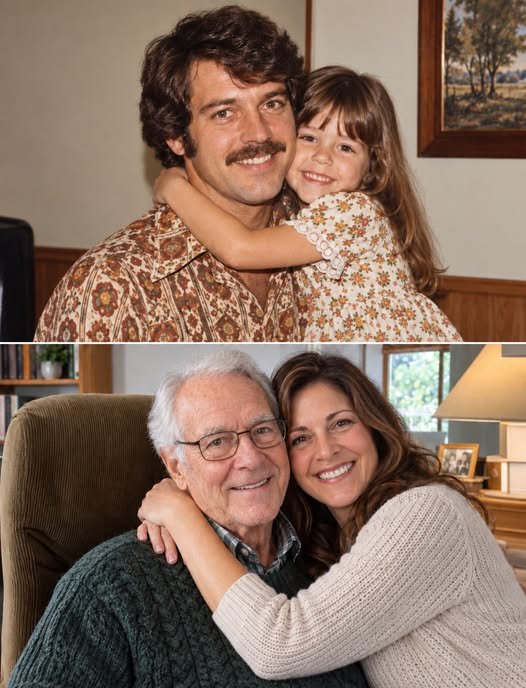
Part 1 — The Only Father I Had Ever Known
There is something strange about standing at a funeral while people tell you how much someone loved you.
They squeeze your hand. They hug you longer than usual. They lower their voices, as though grief has turned you into something delicate.
And all you can think is:
I already knew he loved me.
Five days earlier, I had lost my stepfather, Michael, to pancreatic cancer.
He was seventy-eight.
The disease moved frighteningly fast. One year he was still complaining about the neighbor parking too close to his mailbox and insisting he could repair anything with the right wrench. The next, I was sitting beside his bed, counting the seconds between his breaths.
Then he was simply gone.
At the funeral, I stood beside his urn and stared at the photograph we had chosen for the memorial table.
Michael was squinting into the sunlight, a streak of grease across one cheek and an amused half-smile on his face.
It had always been one of my favorite pictures of him.
Now I hated it.
A photograph could capture his face, but it couldn’t show the way he cleared his throat before giving advice. It couldn’t imitate the ridiculous songs he made up while fixing things in the garage. It couldn’t tell me, Don’t forget to check your oil, Clover, or remind me that I was stronger than I thought.
“You meant everything to him,” a woman whispered as she held my hand.
“Thank you,” I managed.
I had been saying those words all afternoon.
Thank you.
Thank you for coming.
Thank you for remembering him.
Thank you for caring.
But inside, all I wanted to do was turn toward the picture and ask him how he could possibly have left me.
“You weren’t supposed to go yet,” I whispered when no one was close enough to hear. “What am I supposed to do without you?”
Michael had entered my life when I was two years old.
He married my mother, Carina, not long afterward in a small ceremony that I couldn’t remember.
In fact, I couldn’t remember a life before Michael at all.
One of my earliest memories was of sitting high on his shoulders at a county fair, one fist wrapped around the string of a red balloon while my other hand was tangled in his hair.
I remembered laughing.
I remembered him pretending I was pulling too hard.
I remembered feeling completely safe.
My mother died when I was four.
That fact had followed me through my entire life like a sentence I had learned before I was old enough to understand it.
My mother died when I was four.
Afterward, Michael stayed.
He packed my lunches.
He learned how to braid my hair badly enough that I eventually begged him to stop.
He helped with school projects, waited outside fitting rooms while I tried on prom dresses, taught me to drive, and threatened every boyfriend I ever brought home with the same sentence:
“She knows how to change a tire. Make sure you know how to treat her.”
He wasn’t my biological father.
But that distinction had never mattered inside our house.
When Michael became ill, I moved back home without giving it a second thought.
I cooked his meals when he could eat.
I drove him to appointments.
I sat with him through the long nights when the pain medication stopped helping and conversation became too exhausting.
I never thought of it as repayment.
You don’t repay someone for being your father.
You simply stay.
Just as he had stayed for me.
Part 2 — The Stranger at the Funeral
After the service, everyone returned to the house.
People gathered in small groups, speaking quietly over plates of food no one seemed hungry enough to finish.
The house was full, yet somehow it felt emptier than it ever had before.
Michael was everywhere.
In the scuffed corner of the hallway where he had once carried in a cabinet that was too wide.
In the old recliner nobody else dared sit in.
In the faint combination of wood polish, aftershave, motor oil, and the lavender soap he had always insisted he didn’t use.
I stood near the hallway table holding a glass of lemonade I had forgotten to drink when Aunt Sammie came beside me.
She wrapped both arms around me.
“You shouldn’t be here alone tonight,” she said gently. “Come stay with me for a while.”
I stiffened almost without meaning to.
“This is my home.”
Her smile remained fixed.
“Of course it is. We can talk about it later, sweetheart.”
Aunt Sammie was my mother’s sister.
She had never disappeared from my life completely, but she had never been part of our everyday world either.
Birthdays.
Christmas cards.
Occasional phone calls.
Visits where everything felt just a little too polite.
Before I could answer her, I heard someone behind me.
“Clover?”
I turned.
An older man stood several feet away.
He was probably in his late sixties. Deep lines crossed his face, and his tie was pulled so tightly around his neck that I wondered if someone else had dressed him for the funeral.
He held a paper cup in both hands.
Something about him seemed nervous.
“Yes?”
“I’m Frank.”
I waited for the name to mean something.
It didn’t.
“I’m sorry,” I said. “Did you work with my dad?”
His eyes changed when I called Michael that.
My dad.
Not my stepdad.
He nodded slowly.
“I knew Michael for a very long time.”
“I don’t think we’ve ever met.”
“No,” he said. “You weren’t supposed to.”
I stared at him.
“What does that mean?”
Frank looked around the room as if checking whether anyone was close enough to listen.
Then he stepped nearer.
I caught the faint smell of peppermint beneath the scent of engine grease clinging to his jacket.
His voice dropped.
“If you ever want to know what really happened around the time your mother died, look in the bottom drawer of Michael’s workbench in the garage.”
For several seconds, I couldn’t understand what he had said.
“What?”
“The bottom drawer.”
My heart began beating harder.
“What are you talking about?”
Frank’s face tightened.
“I made your father a promise. This was part of it.”
“Who are you?”
He reached into his jacket and handed me a business card.
Then he looked at me with an expression I couldn’t read.
“I’m sorry, kid. I wish both your parents could be here to explain it themselves.”
And before I could stop him, he walked away.
Within seconds, he had disappeared into the crowd.
I stood there gripping the card.
One sentence repeated inside my head.
Look in the bottom drawer.

Part 3 — What Michael Had Hidden
I waited until everyone had left.
The house finally became silent sometime after dark.
I didn’t turn on many lights.
For some reason, darkness felt easier.
Maybe because with the rooms dim, I could almost imagine Michael was asleep somewhere instead of gone forever.
I carried Frank’s business card into the garage.
The moment I opened the door, the smell hit me.
Oil.
Dust.
Cedar.
Metal.
Michael.
His tools were still arranged exactly as he had left them. Screwdrivers lined the wall. Jars of screws sat on the shelf. A faded shop rag hung from the edge of the workbench.
For a moment, I couldn’t move.
Then I saw the drawers.
The bottom one was larger than the rest.
I crouched and pulled.
Nothing happened.
I pulled harder.
The drawer resisted, then opened with a low wooden groan.
Inside lay a sealed envelope.
My name was written across the front in Michael’s unmistakable handwriting.
CLOVER.
My knees weakened.
Beneath the envelope was a manila folder stuffed with documents.
I sat down directly on the cold concrete floor.
My hands trembled as I opened the envelope.
The first words nearly broke me.
Clover,
If you’re reading this, Frank kept his promise.
I covered my mouth.
Michael knew.
He had planned this.
I forced myself to keep reading.
He explained that he had asked Frank never to tell me anything while he was still alive. He didn’t want me carrying the weight of the past when there was no reason for me to.
Then came the sentence that changed everything I believed I knew.
I never lied to you, kiddo. But I didn’t tell you the whole story.
Michael wrote that my mother’s death had indeed been caused by a car accident.
That part was true.
What I had never known was where she had been going.
She had been driving to meet Michael.
They were supposed to finalize guardianship paperwork that would make his role in my life official.
But there had been another problem.
Aunt Sammie.
According to Michael, she had threatened to challenge him for custody.
She believed that because he wasn’t related to me by blood, he had no right to raise me.
My mother had been terrified.
She didn’t want a courtroom fight.
She didn’t want to risk losing me.
Michael had told her to wait.
To calm down.
To give everyone time.
But my mother had gotten into the car anyway.
She never reached him.
I stopped reading.
The garage blurred around me.
For my entire life, my mother’s accident had existed as a tragedy without details.
Suddenly it had a destination.
A reason.
A fear attached to it.
I lowered my eyes to the page again.
Michael blamed himself.
He wrote that he should have stopped her from leaving that day.
After her death, Aunt Sammie apparently hadn’t backed down.
She sent letters.
She contacted attorneys.
She argued that Michael had no biological claim to me.
But Michael had something she didn’t know about.
Documents.
Letters.
And most importantly, words written by my mother herself.
If anything happens, don’t let them take her.
My vision filled with tears.
Michael’s letter continued.
He told me he had fought to keep me not because he felt entitled to me, but because my mother had trusted him.
Because he loved me.
Because he couldn’t bear the thought of allowing me to become the object of an ugly family battle when I was already grieving a mother I was barely old enough to remember.
He wrote:
You were never a case file to me.
You were my daughter.
I pressed my fist against my mouth and cried.
Not quietly.
Not gracefully.
I cried the way I hadn’t allowed myself to cry at his funeral.
Because suddenly I understood that Michael hadn’t simply raised me.
He had protected my childhood from a truth he believed would hurt me.
All those years, I had believed our little family had simply continued after tragedy.
I had never known he had fought for it.
At the bottom of the letter came one final warning.
He told me to be careful with Aunt Sammie.
She wasn’t, he wrote, always the person she wanted others to believe she was.
Then he signed the letter the way he had signed birthday cards, school forms, and little notes left beside my breakfast for decades.
Love always,
Dad.
Not Michael.
Not your stepfather.
Dad.
Part 4 — My Mother’s Words
I opened the manila folder next.
Inside were guardianship papers bearing both Michael’s name and my mother’s.
There were legal documents and correspondence.
Then I found Aunt Sammie’s letters.
Her handwriting looked exactly as I remembered from birthday cards.
But the words weren’t warm.
They were formal.
Sharp.
She described Michael as unstable.
She questioned his ability to provide a “proper structure.”
She repeatedly emphasized that he had no biological connection to me.
I read the letters twice.
The second time, anger replaced shock.
Michael had taken care of me every day.
He had already been there when I woke up crying for my mother.
He had already been the person who made my breakfast, carried me when I fell asleep, and stayed beside me through nightmares.
Yet to Sammie, he was apparently still just “a man with no relation to the child.”
At the bottom of the folder, I found one torn journal page.
My mother’s handwriting covered it.
I recognized it immediately from the few cards and recipes of hers Michael had saved for me.
There were only a handful of words I needed to read.
If anything happens, don’t let them take her.
I held the page against my chest.
For years, I had wondered what my mother might have wanted for me.
Now I knew.
She had chosen Michael too.
He hadn’t stolen a place in my life.
She had trusted him with it.
And when she died, he spent the rest of his life honoring that trust.

Part 5 — The Will
The following morning, Aunt Sammie called before the reading of Michael’s will.
“I thought we could arrive together,” she said. “Family should sit together on a day like this.”
I stared at Michael’s letter lying on the kitchen table.
“You never really sat with us before.”
Silence.
Then she gave a small laugh.
“Oh, Clover. That was so long ago.”
Maybe for her.
Not anymore for me.
She continued carefully.
“Your mother and I had a complicated relationship. And Michael… well, I understand that you cared very much about him.”
Something inside me hardened.
“Cared about him?”
“That’s not what I meant.”
“I loved him, Aunt Sammie. He was my father. He was everything to me.”
Another pause.
“I only want today to go peacefully.”
“So do I.”
When she arrived at the attorney’s office, she looked perfectly composed.
Pearls.
Soft pink lipstick.
Blonde hair pinned neatly into a bun.
She greeted the attorney by name and shook his hand as though she had been there many times before.
Then she kissed my cheek.
Her rose-scented hand cream lingered on my skin afterward.
During the reading, she occasionally pressed a tissue beneath one eye, particularly when someone glanced toward her.
I said nothing.
I waited.
When the attorney finished and asked whether there were any questions, I stood.
“I’d like to say something.”
Every face turned toward me.
Aunt Sammie’s expression changed first.
“Clover?”
I looked directly at her.
“For most of my life, I thought Mom’s death was the only tragedy our family went through.”
She slowly lowered the tissue.
“But now I know there was another fight happening too.”
The room became completely still.
“I found the letters.”
Color disappeared from her face.
“What letters?”
“Yours.”
She stared at me.
I continued.
“You tried to take me away from Michael after Mom died.”
“Clover, you don’t understand—”
“I understand enough.”
A cousin sitting farther down the table looked between us.
“Sammie… what is she talking about?”
The attorney cleared his throat.
“For clarity,” he said, “Michael did retain correspondence regarding a proposed custody challenge.”
Aunt Sammie leaned forward.
“I was trying to protect you.”
“From what?”
She opened her mouth.
Nothing came out.
“From the man who packed my lunches? From the man who sat beside my bed when I was sick? From the man who raised me every day after my mother died?”
“You were a child.”
“Exactly.”
My voice cracked, but I didn’t stop.
“I was a four-year-old who had just lost her mother. And you wanted to take away the only parent I had left because you thought blood made you more entitled to me than love made him.”
“Clover—”
“No.”
For the first time in my life, I didn’t care whether I sounded rude.
“Michael never owed me anything. He didn’t have to stay. He didn’t have to fight. He didn’t have to spend the rest of his life raising somebody else’s biological child.”
My throat tightened.
“But he did.”
I swallowed.
“He wasn’t handed the right to be my father. He earned that place every single day.”
Aunt Sammie looked down at the table.
I thought of Michael’s handwriting.
You were my daughter.
Then I said the thing I had been thinking since opening that drawer.
“I don’t know why you came here expecting anything from him.”
Her eyes lifted sharply.
“Did you think he left you something?”
I touched Michael’s letter inside my bag.
“He did.”
The room waited.
“He left the truth.”
Part 6 — The Things He Kept
That evening, I went through one of the boxes Michael had kept in the hall closet.
Written across the top in black marker were the words:
CLOVER’S ART PROJECTS
I almost laughed.
The box contained decades of evidence that Michael had never thrown away anything I made.
Construction-paper flowers.
Crayon drawings.
A lopsided clay bowl.
A paper-mâché volcano.
And at the bottom, a macaroni bracelet I had made in second grade.
I remembered giving it to him.
I had painted some of the pasta yellow and threaded it onto cheap elastic string.
To seven-year-old me, it was magnificent.
Michael had looked at it as though I had handed him a Rolex.
“This is premium jewelry,” he had announced.
Then he wore it for the entire day.
Even to the grocery store.
I picked up the bracelet.
The string had weakened with age, and much of the paint had chipped away.
Still, I carefully stretched it over my hand.
It barely fit.
The elastic pressed into my wrist.
I smiled through my tears.
“Still works, Dad.”
Beneath the paper-mâché volcano, I discovered an old Polaroid.
In it, I was missing one front tooth and sitting on Michael’s lap.
He was wearing his favorite flannel shirt.
The ugly one.
The shirt I stole whenever I was sick because it smelled like him.
I suddenly remembered exactly where it was.
Still hanging on the back of his bedroom door.
I went upstairs, took it down, and slipped my arms into it.
It hung loosely around me.
For one impossible second, it felt almost like being held.
Then I walked outside and sat on the porch steps.
The night was cool and quiet.
I pulled my knees against my chest.
The macaroni bracelet dug into my wrist beneath the flannel sleeve.
The Polaroid rested in one hand.
Frank’s business card sat in the other.
Finally, I took out my phone.
I typed:
Thank you for keeping your promise. I understand everything much better now. And I finally understand just how loved I was.
I sent it.
Frank never replied.
Somehow, I hadn’t expected him to.
Frank seemed like the sort of man who didn’t need to explain himself after doing what he had promised.
He simply showed up when the moment came.

Part 7 — The Story I Choose to Keep
I stayed on the porch for a long time.
Eventually, I looked up at the dark sky.
“Hey, Dad.”
The word came naturally.
It always had.
“They tried to tell a different story about us, didn’t they?”
I imagined Michael beside me.
Probably grumbling that I was sitting outside without proper shoes.
Probably telling me that truth didn’t need defending as loudly as people thought.
Probably pretending not to cry.
I looked down at the Polaroid.
All my life, I thought I understood why Michael had stayed.
He loved my mother.
Then she died.
And because he was a good man, he raised me.
But the truth was larger than that.
He had been given choices.
He could have walked away.
He could have surrendered when lawyers became involved.
He could have decided that losing his wife was already more grief than one person should have to carry.
Instead, he chose me.
Again.
And again.
And again.
Through childhood tantrums.
School plays.
Teenage arguments.
College.
Heartbreak.
Adulthood.
And finally, through his own illness.
When I went back inside, I placed Michael’s letter in the middle of the kitchen table.
Not hidden in the garage.
Not locked inside a drawer.
No more secrets.
“You didn’t just raise me,” I whispered.
The house gave no answer.
But for the first time since his death, the silence didn’t feel completely empty.
“You chose me.”
My bag was already packed beside the staircase.
The next morning, I planned to begin the paperwork to restore Michael’s name on my birth certificate. I had already called the clerk’s office to ask what I needed to do.
Some people might have called it unnecessary.
After all, a document couldn’t change the decades we had shared.
But it wasn’t about proving that Michael had been my father.
He had already proven that.
It was about making the paper finally reflect the truth of my life.
Blood hadn’t taught me to ride a bike.
Blood hadn’t stayed awake when I had a fever.
Blood hadn’t stood outside my school auditorium with a bouquet after my first performance.
Blood hadn’t taught me how to change a tire, balance a checkbook, recognize a bad apology, or walk away from someone who didn’t value me.
Michael had.
He never called himself extraordinary.
He never told me how hard he had fought to keep me.
He never demanded gratitude.
He simply loved me so steadily that I grew up believing being chosen was normal.
Maybe that was his greatest gift.
He had taken one of the most painful chapters of my childhood and carried the ugliest parts himself so that I could grow up without feeling unwanted, contested, or temporary.
He kept my mother’s promise.
And somewhere along the way, he created one of his own.
That no matter what anyone called him—stepfather, guardian, unrelated man—he would be my dad for as long as I needed one.
Now he was gone.
But the promise wasn’t.
Neither was the love.
I touched the worn macaroni bracelet around my wrist and looked at his letter one last time.
For years, other people had tried to decide what our relationship was allowed to mean.
Now I knew better.
Michael hadn’t inherited the role of father.
He hadn’t been entitled to it.
He had chosen it.
He had lived it.
And he had earned it.
So now I get to choose too.
I choose the man who stayed.
I choose the father who protected me without ever making me feel like I needed protecting.
I choose the truth my mother trusted him to carry.
And I choose to tell our story the way it was always meant to be told:
Michael wasn’t the man who raised someone else’s daughter.
He was my dad.
And I was his.