
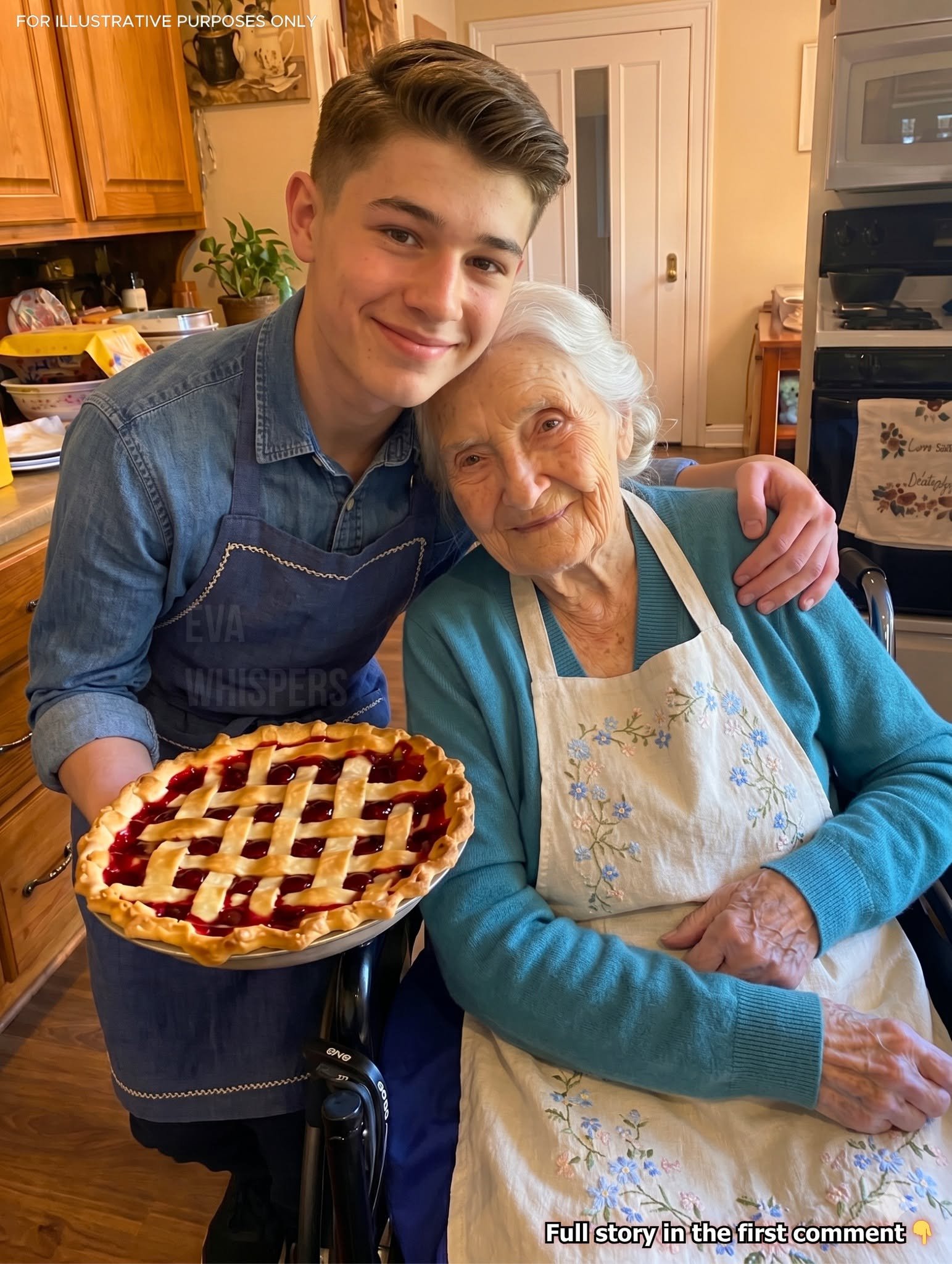
For years, I worried that my son was too kind for the world we lived in. I never imagined that one quiet friendship would force an entire room of strangers to confront what they had overlooked.
A Neighbor Everyone Forgot
The street where I raised my son, Joe, was the kind of place where everyone waved, but nobody really looked.
We had modest houses, trimmed lawns, and, at the end of the block, Mrs. Whitaker’s big white colonial home sat like a museum nobody visited.
I’d lived next door to her for almost 11 years, and ever since my husband passed away, it had been just my boy and me. In all that time, my rich neighbor had been cordial but private: a wave from the porch, a few words about the weather at the mailbox, a plate of cookies left on my step at Christmas with a note signed only “E.W.” Nothing more, nothing less.
Mrs. Whitaker’s sons, Richard and Daniel, came only on holidays.
They spent 15 minutes, tops, visiting. They’d park in her driveway, leave the engine running, kiss her on the cheek, check their watches, and be gone before the porch light blinked on.
The Mailbox in the Rain
One afternoon, the rain came down in sheets. Looking through my kitchen window, I spotted a familiar gray hoodie crouched beside Mrs. Whitaker’s mailbox.
“Honey, are you here again?” I called, pulling my jacket over my head as I crossed the wet grass.
Joe glanced up.
His hair was plastered to his forehead, and his sneakers were sinking into the mud. With one hand, he held the mailbox steady while twisting a screwdriver into the rotted post.
“It was tilting,” Joe said. “The mail carrier almost dropped a package yesterday.”
“Mrs. Whitaker didn’t ask,” I told him.
He wiped a streak of mud from his cheek with the back of his wrist.
“That’s why I’m doing it.”
I stood there for a moment.
Joe was 17 years old, soaked through in a downpour, fixing a stranger’s mailbox simply because nobody else would.
Behind us, the front door creaked open. Mrs. Whitaker stepped onto her porch wearing a blue cardigan, both hands wrapped around the railing.
“Sweetheart, you’ll catch your death,” she called. Her voice carried that papery shake. “Come in, both of you. I’ll make cocoa.”
Joe grinned without looking up.
“Almost done, ma’am.”
She watched him for a moment longer than seemed natural, her eyes softening in a way I couldn’t quite place.

Cocoa and Memories
When Joe finished, we followed Mrs. Whitaker inside.
“Look at you,” she murmured as she let us in. “You’ve grown so much. I remember when you were small.”
I smiled politely. Joe had lived next door his entire life. Of course she remembered him growing up. I didn’t think much of it.
Then she turned to me with the softest, most exhausted smile.
“My boys used to fix things for me when they were small.”
I wasn’t sure how to respond, so I simply nodded.
“Richard called last week,” Mrs. Whitaker added, almost to herself. “Said he’d come by Sunday if his schedule allowed.”
The way she said “if” landed heavily in my chest.
At the kitchen table, she handed us mugs of cocoa and talked about her late husband, her garden, and a recipe she kept meaning to write down for me.
Joe listened the way he always listened—as though every word mattered.
By the time we left, the rain had become a mist.
As we walked home, Joe shoved his hands into his hoodie pockets.
“You don’t have to go over there, you know,” I said carefully.
He shrugged.
“She’s old and by herself, Mom. She needs help.”
“I know.”
“So somebody should be there.”
I watched him climb our porch steps, leaving wet footprints on the welcome mat.
Something tightened in my throat.
My son was seeing something the rest of the world kept overlooking—something even her own children couldn’t be bothered to notice.
And somewhere deep inside, I had a quiet, uneasy feeling that one day, that kindness would cost us.
Becoming Family
The seasons changed, and Joe’s visits became routine.
In winter, he shoveled Mrs. Whitaker’s walkway before school.
He changed light bulbs on her porch.
When her hands trembled too much to hold the newspaper, he sat beside her and read it aloud, even the sports scores.
I started bringing soup every Sunday.
She would wrap both hands around the bowl as though it were something sacred, and her eyes would shine in a way that always tightened my throat.
“You spoil me, Sarah,” she said one evening.
“It’s just chicken and rice.”
“You know it’s more than that.”
Over time, we grew close.
That year, we spent Easter at her dining table. Thanksgiving too.
By Christmas, Mrs. Whitaker had hung a stocking for Joe beside the two she’d displayed for more than twenty years.
“I’m so happy I finally have a family,” she told us with a smile.
Joe ducked his head because boys his age never know quite what to do with words like that.
Richard’s Visit
One Saturday in early spring, Richard’s black sedan pulled into his mother’s driveway.
He stayed exactly eleven minutes.
I counted.
Joe was inside helping Mrs. Whitaker sort old photographs, and I didn’t want him caught in the middle of anything uncomfortable.
When Richard came outside, he noticed me on my porch and crossed the lawn.
We’d only encountered each other twice before—brief nods at the mailbox and once near Thanksgiving.
Nothing memorable.
“You’re the neighbor,” he said.
“Sarah. We’ve met. Twice.”
“Right.”
His eyes moved toward my house and then back again.
“My mother mentions you and your boy a lot lately.”
“My son cares about her.”
“I’m sure he does.” Richard smiled without warmth. “Hang-ons always do.”
Then he got into his car and drove away.
I stood there for a long time before going inside.
The Loss
A month later, Mrs. Whitaker died in her sleep.
The mailman was the one who told me.
He stopped his truck, rolled down the window, and said, “Hey, did you hear about the lady at the end of the block?”
I knew before he finished.
Joe took it harder than I expected.
He didn’t cry in front of me.
Instead, he disappeared into his room.
When he finally came downstairs for dinner, his eyes were red and he avoided looking at me.
“She was old, baby,” I said.
“I know.”
“You made her last year better. You know that, right?”
“I just liked her, Mom, that’s all.”

The Invitation
Nine days later, a cream-colored envelope arrived.
My name was typed neatly across the front.
Inside was a letter from Mr. Bennett, attorney at law, inviting Sarah and Joseph to attend the final reading of Mrs. Whitaker’s will.
“Mom?” Joe asked from the doorway. “What is it?”
I held up the letter.
“Do we have to go?” he asked.
“I don’t know if we have to,” I replied. “But Mrs. Whitaker wanted us there. So we’ll go.”
I folded the letter slowly, wondering what business we had entering a room full of strangers who already resented us.
The lawyer’s office smelled of old paper and lemon polish.
Joe sat beside me, shifting nervously. His dusty sneakers left faint smudges of grass on the carpet. Earlier that morning, he’d mowed our lawn before changing into the only button-up shirt he owned.
Across the table sat Richard and Daniel.
Their wives, Vanessa and Pamela, sat beside them, clutching their purses like shields.
All four stared at us.
Vanessa’s eyes swept over us.
“Why is the neighbor’s kid here?” she muttered aloud.
“Probably looking for a handout,” Daniel retorted.
The family laughed.
Joe lowered his head.
I squeezed his shoulder.
Mr. Bennett adjusted his glasses.
“Shall we begin?”
He opened a leather folder and began reading.
“To my children, who waited for my death more patiently than they ever waited at my door, I leave exactly $1 each.”
The room froze.
Even the air conditioner suddenly seemed too loud.
Pamela gasped.
A chair scraped sharply against the floor.
Richard’s face turned a blotchy red.
“This is a joke,” he snapped. “She wasn’t in her right mind!”
“She was, sir,” Mr. Bennett replied evenly. “I’ll get to that.”
But Richard was already pointing at us.
“You! You did this! You sent your kid over there with his little chores and his little soup, and you wormed your way into a sick old woman’s head!”
“Richard,” I said quietly. “That isn’t true.”
Vanessa stood.
“Isn’t it? A widow with no money and a teenage son who suddenly can’t stay off our mother’s porch? Don’t insult us!”
Joe’s hands clenched into fists.
He wasn’t angry.
He was ashamed.
He hated being judged that way.
“We never asked her for anything,” I said.
“You didn’t have to ask,” Vanessa hissed. “You groomed her. You used your son to do it!”
My throat tightened.
For a moment, I nearly stood up and left.
I nearly grabbed Joe’s wrist and walked out forever.
Because maybe they were right.
Maybe the world really did work that way.
Maybe kindness was just a long road leading to humiliation.
Then I looked at my son.
He wasn’t watching them.
He was watching me.
Waiting to see what I would do.
Waiting to learn, the way children always do.
So I stayed.
“Mr. Bennett,” I said. “Please continue.”
The lawyer gave me a slight nod.
Then he removed a cream-colored envelope from the folder.
The Last Envelope
Mr. Bennett looked directly at Joe and smiled.
“And for the boy, Mrs. Whitaker left separate instructions.”
The room fell silent.
Joe glanced at me.
I nodded.
Carefully, he opened the envelope and unfolded a handwritten page.
The handwriting was shaky but neat.
As he read, I watched his expression change.
His eyebrows drew together.
His lips parted.
“Mom,” he whispered, “I forgot all about this. I never even told you.”
“Tell me what, honey?”
He turned the page so I could read.
“Dear Joe, You don’t remember me, but I’ve known you a long time. Nine years ago, you found my wallet on the corner of our street. You were maybe seven years old. You walked all the way to my porch and left a note in green crayon. It said, ‘I think this is yours.’ There was $300 inside. You didn’t take a dime.”
My breath caught.
I continued reading aloud.
“I’ve watched you from my window ever since, my dearest boy. I wanted to see if that little boy stayed the same. He did.”
Richard had fallen silent.
Vanessa stared at the envelope.
And suddenly I understood.
Mrs. Whitaker had never been thanking us for fixing a mailbox.
She had been thanking him for being the same honest little boy all those years later.
Mr. Bennett continued reading.
“To Joe, I leave a trust fund for his college education. To his mother, Sarah, a modest sum, in gratitude for raising the kind of son this world forgets to make. The house will be donated to a local senior outreach program.”
Richard jumped to his feet.
“This is insane! We’ll contest every word of it!”
Mr. Bennett remained calm.
“Mrs. Whitaker recorded video testimony with two witnesses and her physician. Her mind was sound. You’re welcome to try.”
Walking Away
Afterward, Vanessa cornered me in the hallway.
Her voice was low and sharp.
“You think you’ve won something? You’re nothing but a leech in a cardigan!”
I stopped.
This time, I wasn’t afraid.
“Mrs. Whitaker wasn’t lonely because she had no family,” I said. “She was lonely because you forgot she was one.”
Then I took Joe’s hand and walked out into the afternoon sunlight.
What Kindness Really Means
Weeks later, I stood at the gate of the senior outreach program now operating out of Mrs. Whitaker’s former house.
Inside, Joe sat beside an elderly woman with trembling hands, reading the newspaper aloud.
She sat in the same worn armchair where Mrs. Whitaker used to cradle her soup as if it were sacred.
Joe looked up through the window and waved.
I waved back.
And for the first time in years, something inside me settled.
For so long, I had worried that raising a kind boy in a hard world meant teaching him how to lose.
I believed goodness might be a luxury people like us couldn’t afford.
I was wrong.
Joe stepped onto the porch—the same porch where, years earlier, a little boy had returned a lost wallet with a green-crayon note.
He smiled at me.
And at last, I understood that quiet kindness—the kind nobody asks for—is often the kind that changes the world.