
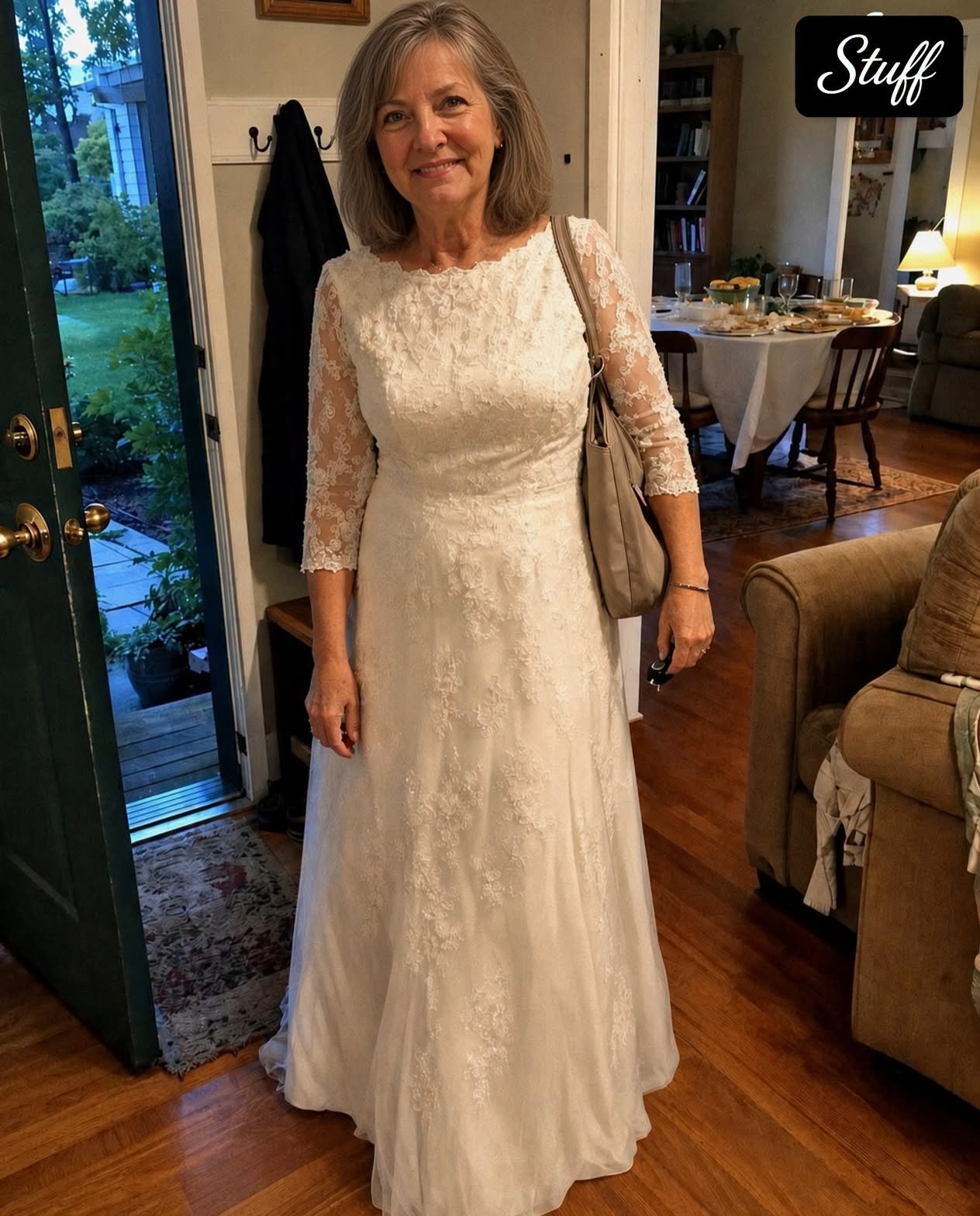
Ever since Dad died, I had been watching Mom closely, hoping each small sign of happiness meant she was beginning to heal. But that evening, she showed me just how little I understood about what she was carrying.
The good silverware now came out on Saturdays. That was the rule Brandon and I had made without ever really saying it out loud. If Mom was coming, we used the good silverware, the cloth napkins, and the wine glasses my aunt gave us for our wedding.
I lined up the forks and tried to remember which side the knife went on. Fifteen years of marriage, and I still had to think about it.
“I know you’re doing it wrong again,” Brandon called from the kitchen.
“I’m not.”
That was the rule Brandon and I had made.
“Blade faces the plate, Carol. Every time.”
“Then you set the table.”
“I’m making the chicken. You want the chicken, or you want a lecture on cutlery?”
I laughed, and it surprised me a little. Six weeks ago, I couldn’t have imagined laughing like that.
***
Six weeks ago, we buried my father.
Dad, John, and Mom, Jane, had been married for 47 years.
I couldn’t have imagined laughing like that.
They had built almost their entire lives together, and had one of those marriages where he’d hand her a cup of tea before she realized she wanted one. When he died, Mom folded in on herself like a paper bag.
Watching her suddenly face a world without Dad by her side was heartbreaking.
The first two weeks were the worst.
Mom folded in on herself like a paper bag.
Mom stopped answering the phone. She let her friends’ casseroles pile up in the fridge untouched. My aunt told me she found her sitting in Dad’s recliner one afternoon, holding one of his old flannel shirts, not crying, just holding it.
I visited her several times a week, but I still hated the thought of her sitting alone in that quiet house.
So Brandon and I started the Saturday dinners.
I visited her several times a week.
***
“She’s coming, right?” Brandon asked, poking his head around the doorway. He was wearing the apron my niece made him, the one that said: “BRANDON’S COOKING NOW.”
“She said she was.”
“Do you think she’ll bring another loaf?”
“Please don’t encourage her.”
“I ate two slices of that lemon thing last week.”
“She’s coming, right?”
“Brandon, it was burnt.”
“It had character.”
I rolled my eyes at him, and he winked and disappeared back into the kitchen.
The lemon loaf had honestly been a small miracle. At first, Mom barely spoke during dinner. She’d sit with us, pick at her food, and leave early. But slowly, things began to change.
“It had character.”
Three weeks in, Mom had shown up on our porch holding a foil-wrapped rectangle and looking almost sheepish. She’d said she wanted to try again.
After that, the Saturdays got easier. Mom stayed for dessert. She’d ask about our week: Brandon’s work, my garden, and whether we’d finally fixed the leaky faucet. She also started laughing at my husband’s jokes again.
Little by little, my mom came back into the room with us.
She’d said she wanted to try again.
I was getting her back. That’s what I kept telling myself.
Although, if I were honest, something had felt a little off during the last two visits.
Mom had been cheerful. Not the quiet, careful cheer of someone practicing it, but something brighter, almost busy. She’d asked me strange questions, too, while sitting at the dinner table.
That’s what I kept telling myself.
“Do you think your father would want me to keep doing things? Not just sitting?”
“Of course, Mom.”
“Even things that might seem strange to other people?”
“Like what?”
Mom had only patted my hand. “Nothing, sweetheart. I’m just thinking out loud.”
And then, last week, she’d mentioned a name I hadn’t heard in years. Henry. She’d said Henry, her old friend, had driven her to an appointment, and when I asked what appointment, she’d changed the subject to Brandon’s chicken.
“I’m just thinking out loud.”
I didn’t pry. I told myself she was healing, and it looked different for everyone.
***
I was finishing setting the table, and I hadn’t lit the candles yet.
Then I heard the front door open.
“Mom, we’re in the dining room!” I called out, balancing three plates on my hip.
The front door clicked shut, and I heard the familiar shuffle of Mom’s shoes on the hardwood.
Then I heard the front door open.
Then she stepped through the archway, and I nearly dropped everything I was holding!
Mom was wearing a wedding dress!
Not a nice blouse or one of the church outfits she’d been rotating through. A full ivory floor-length wedding dress! Her own, from what I could tell, taken out of whatever box it had been sleeping in for four decades.
Behind me, I heard Brandon come out of the kitchen.
Mom was wearing a wedding dress!
My husband stood there, mouth agape.
“Jane?” he said very carefully.
I couldn’t get my mouth to work as I stared. My father had been in the ground less than two months, and now Mom was standing in my dining room dressed like a bride. She was smiling at me as if this were a perfectly normal Saturday!
“Mom.” My voice came out thinner than I wanted. “What is going on?”
She didn’t answer.
I couldn’t get my mouth to work.
Mom just walked over, gently pried the plates out of my hands, and set them down on the table as if she were keeping me from breaking them.
“Sit down for a second, sweetheart.”
“I don’t want to sit down. Mom, look at yourself. Look at what you’re wearing!”
“I know what I’m wearing.”
“Then explain it.”
She looked directly at me and reached for my hand instead. Hers was cool and steady. Mine wasn’t.
“I don’t want to sit down.”
“I need you to come with me,” Mom said.
“Come with you where?”
“I’ll tell you on the way.”
“No. No, that isn’t how this works.” I could feel my voice rising. “You show up at my house in a wedding dress, and I just get in the car? Is there… is there someone waiting for you? Is this Henry? Mom, is this about Henry?”
She blinked at me.
“Come with you where?”
“Henry is a neighbor, Carol. He’s 78 and has a bad hip. That’s all.”
“Then who?”
“Carol.” Her thumb moved across my knuckles the way it had when I was small. “I can’t explain this at the table. I need you to see it. Please.”
Brandon was still standing in the doorway. I looked at him, half hoping he’d say something sensible, half hoping he’d tell my mother to go home and change.
Instead, he picked up his car keys.
“Henry is a neighbor.”
“I’ll keep dinner warm,” my husband said quietly.
“Brandon.”
“Carol, whatever this is, you’re going to want to know.”
“You’re taking her side?”
“There aren’t any sides yet.”
I hated that he was right. I hated how calm both of them were being while I felt like the floor had tilted 20 degrees.
“You’re taking her side?”
Mom squeezed my hand once, then let go and moved toward the front door like a woman on a schedule. Her train floated along my hallway rug. I stood there for a second longer, breathing, then grabbed my coat off the hook and followed her because what else was I going to do?
***
When she reached the car, she paused.
“Would you help me with the skirt? I can’t do the door.”
“Mom.”
“Please.”
Her train floated along my hallway rug.
I gathered the fabric in both arms. There was so much of it. I remembered the photo on the mantel at their old house, the one of her at 22, and I felt my throat tighten.
“You don’t get to do this to him,” I said in a low voice.
“I’m not doing anything to him.”
“He’s been gone six weeks.”
“I know exactly how long he’s been gone, Carol.”
“You don’t get to do this to him.”
Mom got into the passenger seat. I closed her door for her because the dress wouldn’t let her reach.
Brandon came to the driver’s window and touched my shoulder.
“Call me if you need me,” he said.
I nodded because I didn’t trust my voice.
I put the car in reverse and drove out of my own driveway with absolutely no idea where I was going.
“Call me if you need me.”
***
The car smelled of Mom’s perfume, the same one she’d worn to every family Christmas I could remember. Only now it was mixed with the faint scent of dry-cleaned lace.
I gripped the steering wheel hard enough to feel my ring press into my fingers.
“Mom, please. Just tell me where we’re going.”
“You’ll see when we get there,” she replied, directing me.
“That isn’t an answer.”
I gripped the steering wheel hard.
She stared straight ahead, hands folded neatly in her lap over the white fabric. Calm. Too calm.
“Is it a man?”
Her mouth twitched, but she didn’t turn.
“Is it Henry? You mentioned him. You said he drove you somewhere and wouldn’t tell me why.”
“Henry’s just a neighbor, Carol. I told you that.”
“Is it a man?”
“Then who?”
“Your father asked me to do this.”
I nearly stopped the car in the middle of the road!
“Dad is gone, Mom. He can’t ask you anything anymore. You buried him. I buried him. I watched you cry so hard at that funeral I thought you’d break in half.”
“I know all that; I was there.”
“Then how can you sit there in that dress? Weeks. It’s been weeks.”
“Your father asked me to do this.”
Mom finally looked at me, and her eyes weren’t wild or lost or love-struck. They were just tired, steady, and something else I couldn’t name.
“You have to see it, sweetheart. If I try to explain in this car, you won’t come.”
“I’m already in the car.”
“Your body is. Your heart isn’t.”
I hated when she was right about things like that.
We drove for a few more minutes in silence.
“If I try to explain in this car, you won’t come.”
I quietly ran through every worst-case scenario I could invent. A courthouse. Some widowed man’s living room. A grief group where people paired off like animals on an ark.
“What am I supposed to tell the family, Mom? What am I supposed to tell Aunt Diane?”
“Nothing yet.”
“Nothing yet? So there is something.”
“There’s a promise. That’s what there is.”
“What am I supposed to tell the family?”
Then she told me to turn the corner, and I understood nothing and everything at once.
We didn’t pull up to a chapel. We didn’t pull up to some stranger’s house.
We pulled up to the little care home. The one with the blue shutters and the wooden bird feeder by the entrance. The place where my father had spent the last month of his life.
I put the car in park and just sat there.
I understood nothing and everything at once.
“Mom. Why are we here?”
“Come inside.”
“Did you meet someone here? Is that what this is? Some man you saw in the hallway when you were sitting with Dad?”
She unbuckled her seatbelt with the patience of a saint being interviewed by a very rude reporter.
“Carol. Come inside.”
I followed her in because I didn’t know what else to do.
“Why are we here?”
***
Two nurses looked up from the front desk and smiled at my mother as if they’d been expecting her, which somehow made everything worse.
“She’s ready for you,” one of them said softly. “David’s already back there with her.”
“She?” I whispered.
Mom took my hand and led me down the hallway I already knew too well.
“She’s ready for you.”
We walked past the room where Dad had died. Past the little kitchenette where I’d made him tea he couldn’t drink, and toward the sunroom at the end.
I braced myself for a man.
There wasn’t one, not the kind I’d been dreading. There was a small circle of plastic chairs, a few of the staff I recognized, and a middle-aged man I didn’t know but understood at once must be the David mentioned at the front desk.
I braced myself for a man.
He was standing behind an elderly woman in a wheelchair, one hand resting protectively on the back of it. He was her son. Anyone could see it in the way they resembled each other.
She was wearing a cream-colored blouse and a single strand of pearls, and someone had pinned a small spray of baby’s breath into her thin white hair.
No groom. No suitor. No scandal.
Just a woman who looked like she’d been waiting her whole life for something.
She was wearing a cream-colored blouse.
My mother squeezed my hand again.
“Carol, this is Marguerite.”
Marguerite lifted her chin and looked at me the way old women look at people they’ve already decided to like.
“Hello, dear.”
“Hello,” I managed.
I turned to my mother. My throat felt strange.
“Mom. What is this?”
“This is Marguerite.”
My mom didn’t answer me. She stepped forward, still holding my hand, and gently placed her other hand on Marguerite’s shoulder. The old woman reached up and covered it with her own.
Then Mom turned to face me fully, and the expression on her face wasn’t that of a woman betraying anyone.
It was the expression of a woman keeping a vow.
The old woman reached up.
“This is the daughter I told you about,” she said to Marguerite. Then, to me, quieter, “Carol, this is the woman your father wanted me to keep a promise to.”
The sunroom became very still.
Everything I thought I understood about the last few weeks began, quietly, to come apart.
Mom’s eyes filled as she finally spoke.
The sunroom became very still.
“If you recall, your father shared his hospice room with a man named Timothy. Timothy and Marguerite were engaged for 52 years. They kept putting the wedding off because of finances, and then it was too late.”
Marguerite nodded from her wheelchair, hands folded neatly in her lap.
“Timothy passed three days before your father did,” Jane went on. “Dad made me promise. On what would’ve been their anniversary, I’d wear my dress and stand beside Marguerite. So she’d finally have the moment they never got.”
I couldn’t speak.
They kept putting the wedding off.
Marguerite looked up at me with a small, dry smile.
“Your father was very bossy for a dying man.”
Mom laughed through her tears, and something in my resolve softened.
“Mom, I thought…”
“I know what you thought, sweetheart. That’s why I couldn’t tell you. You would’ve tried to control things.”
Mom laughed through her tears.
Mom smoothed her skirt and stepped to Marguerite’s side, one hand resting lightly on the wheelchair’s arm. The staff started a soft song from a small speaker. I moved in close on my widowed mom’s other side.
Two women in white stood honoring one man who couldn’t be there.
The suddenly cheerful Saturdays. The questions about what Dad would’ve wanted. Henry, the neighbor who drove her. I assumed it must have been to the fitting. All of it clicked into place.
The staff started a soft song.
“Mom,” I whispered, “he didn’t leave you anything ordinary, did he?”
“No. He left me one last crazy but meaningful thing to do.”
***
Brandon had kept dinner warm. Mom sat at our table, still in the dress, her hair a little wild, and told us how Dad had barked orders from a hospice bed like a general.
Brandon had kept dinner warm.
“Bossy,” she said, laughing. “Right to the end.”
I looked at her, really analysed her, and understood. She hadn’t come back to herself despite losing Dad. She’d come back because of one final kindness he’d asked of her.
“Same time next Saturday?” Brandon asked.
I reached for my mother’s hand.
“Same time. Always,” she replied.