
Part 1: The Towels on the Table
On the night my twin daughters turned eighteen, they placed two faded beach towels on our kitchen table and asked me not to hate them.
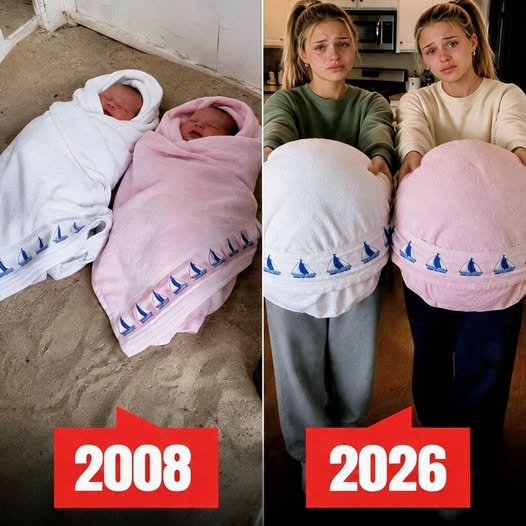
One towel had once been white. The other had been soft pink. Time had dulled their colors, but the tiny blue sailboats embroidered along their edges were still visible.
I knew those towels better than I knew almost anything in my house.
Eighteen years earlier, I had found two newborn baby girls wrapped inside them in an abandoned beach changing cubicle.
Those babies had become my daughters, Chloe and Sadie.
As I stared at the towels, Chloe reached across the table and took my hand.
“Dad,” she whispered, “we’ve been keeping something from you.”
Sadie stood beside her with tears gathering in her eyes.
“We didn’t want to tell you until we knew the whole truth.”
My chest tightened.
“What truth?”
Neither of them answered immediately.
Instead, Chloe slowly unfolded the white towel. Her fingers found a small opening along the thick bottom seam.
She reached inside and pulled out something wrapped in a yellowed piece of paper.
When she placed it on the table, a silver heart-shaped locket slipped free and landed with a quiet metallic sound.
My breath stopped.
There was a tiny scratch across the front and a small letter B engraved on the back.
I had given that locket to my fiancée, Rebecca Lane, three weeks before she died.
I hadn’t seen it in eighteen years.
With shaking fingers, I opened it.
Inside was a photograph of Rebecca and me standing on a beach, our arms around each other, laughing into the wind.
On the back, written in Rebecca’s unmistakable handwriting, were nine words:
When you’re afraid, find Daniel. He will keep you safe.
Daniel was my name.
And suddenly, the night I found my daughters no longer felt like an accident.
Part 2: The Life I Thought I Had Lost
Eighteen years earlier, I was twenty-nine and preparing to become a husband and a father.
Rebecca—Becca to everyone who loved her—was thirty-six weeks pregnant.
We had painted our daughter’s nursery pale yellow because Becca said pink was too predictable. She had chosen white curtains with tiny embroidered stars and spent an entire afternoon arranging stuffed animals on a shelf.
I complained that no baby needed eleven stuffed rabbits.
Becca kissed my cheek and told me I knew nothing about babies.
She was right.
I knew nothing about the tiny socks folded inside the dresser or the different types of bottles lined up beside the sink. I had spent weeks pretending I understood car seats while secretly reading the instruction manual every night.
But I knew I loved Becca.
And I already loved our daughter.
We had decided to name her Lucy.
Then, on a rainy Tuesday afternoon, a delivery truck lost control on a wet highway.
Becca’s car was caught in the collision.
By the time I reached the hospital, everything that had once seemed permanent was gone.
Becca was gone.
Lucy was gone.
The doctors spoke gently, but I barely heard them. I remember signing papers without understanding what they said. I remember Becca’s mother collapsing into my arms. I remember returning home and standing in the pale-yellow nursery with one hand gripping the empty crib.
For several weeks, I moved through life without truly living it.
I stopped answering my phone.
I stopped opening the curtains.
Food spoiled in my refrigerator because I rarely remembered to eat.
My best friend, Mark Ellison, tried to help, but grief had turned me into someone who pushed everyone away.
Finally, one Friday morning, he walked into my house using the spare key I had forgotten he owned.
He looked at the unopened mail, the dark rooms, and the untouched plates people had left on my porch.
Then he went upstairs, packed some of my clothes into a duffel bag, and carried it outside.
“What are you doing?” I demanded.
“Saving what’s left of my best friend.”
“I’m not going anywhere.”
“Yes, you are.”
“Mark—”
“If I leave you alone in this house another day, you’re going to disappear into this grief.”
I was too exhausted to argue.
He drove us three states away to Cape Haven, North Carolina, a quiet coastal town Becca had loved.
I had been there with her once.
I didn’t know then that she had another connection to that place—one she had never had the chance to explain.

Part 3: The Cry Behind the Curtain
Mark and I arrived at Cape Haven in the early afternoon.
We rented a small motel room across from the beach. Mark suggested fishing, kayaking, and half a dozen other activities.
I refused all of them.
Eventually, he stopped trying to force conversation and simply walked beside me along the shoreline.
We spent hours in silence.
The wind was cool, and the beach was nearly empty. A storm had passed earlier that morning, leaving the sky streaked with gray and gold.
As the sun began to sink, Mark returned to the motel to get our jackets.
I kept walking.
Near the far end of the boardwalk stood a row of old wooden changing cubicles. Most of the curtains had been tied back, and sand had collected in the corners.
I almost walked past them.
Then I heard a faint sound.
At first, I thought it was a gull.
Then it came again.
A baby crying.
I froze.
A second cry answered from inside the cubicle.
My heart began pounding.
I pulled the curtain aside.
Two newborn girls lay together in a shallow laundry basket on the sand.
One was wrapped in a white towel. The other was wrapped in a pink one. Both towels had tiny blue sailboats embroidered along their edges.
The girls were red-faced and trembling, their little hands opening and closing in the cool air.
There was no adult nearby.
No diaper bag.
No note that I could see.
Nothing except the babies.
I shouted for help, but the beach remained silent.
The baby in the white towel cried harder. Without thinking, I lifted her into my arms.
The instant her tiny body rested against my chest, something inside me cracked open.
For weeks, I had felt nothing but emptiness.
Now I felt fear.
Urgency.
Responsibility.
And, beneath all of it, a fragile spark of love.
“Someone’s coming,” I promised her. “You’re not alone.”
Mark returned moments later and stopped so suddenly that he nearly dropped the jackets.
“Daniel?”
“Call 911.”
He stared at the second baby.
“Where did they come from?”
“I don’t know.”
Emergency workers arrived quickly. Police searched the beach, nearby roads, parking lots, and motels.
No mother was found.
The babies were taken to the hospital, where doctors estimated they were less than a day old.
I rode behind the ambulance with Mark.
I told myself I only wanted to make sure they were safe.
But the next morning, I returned to the hospital.
And the morning after that.
And every morning for the next three weeks.
Part 4: Becoming Their Father
A social worker named Elena Alvarez was assigned to the case.
She was patient but direct.
“The police are still investigating,” she explained. “The girls will eventually be placed with a foster family.”
The idea of them leaving unsettled me more than I could explain.
I had already started calling the quieter baby Chloe because she calmed whenever I hummed. The other baby, Sadie, had an impressive set of lungs and kicked every blanket away from her feet.
Their names were not official, but the nurses began using them too.
One afternoon, Ms. Alvarez found me asleep in a hospital chair with Chloe on my chest and Sadie curled in the crook of my arm.
She waited until I woke before asking, “Have you thought about becoming a foster parent?”
I stared at her.
“I’m a single man who can barely cook.”
“That wasn’t my question.”
“I just lost my fiancée and our baby.”
“I know.”
“I don’t know if I’m ready.”
“No one ever feels completely ready.”
The police searched for the birth mother for weeks. They shared descriptions of the towels, checked hospitals and clinics, and contacted agencies throughout the region.
No one came forward.
No missing pregnant woman matched the circumstances.
Eventually, Chloe and Sadie entered temporary foster care.
I began the licensing process the next day.
It was not quick or easy. My house had to be inspected. I attended parenting classes. I submitted financial records, references, medical forms, and background checks.
There were moments when I wondered whether the officials looked at me and saw only a grieving man trying to replace the family he had lost.
Maybe part of me wondered the same thing.
Then I held Chloe while she fought a fever.
I watched Sadie smile at me for the first time.
I realized they were not replacing anyone.
They were completely themselves.
Fourteen months after finding them on the beach, I stood in a small courtroom while a judge signed the adoption papers.
“Do you understand that this is a lifelong commitment?” she asked.
“Yes, Your Honor.”
“Do you accept responsibility for these children in every way?”
I looked at the twins in their matching yellow dresses.
“With my whole heart.”
The judge smiled.
“Then congratulations, Mr. Hart. You are officially their father.”
Mark cried louder than either baby.

Part 5: Eighteen Years of Ordinary Miracles
Raising twin daughters alone was the hardest and best thing I ever did.
I worked as an electrician during the day and repaired appliances on weekends. Money was often tight, especially when the girls were young.
There were no expensive vacations.
Most summers, we camped near a lake or visited Mark’s family farm.
Our furniture rarely matched.
Our Christmas gifts were practical.
But the house was full of laughter.
Chloe grew into a thoughtful girl who read books at the dinner table and apologized to furniture after bumping into it. Sadie was fearless, funny, and capable of turning any quiet moment into an adventure.
When they were five, they covered the dog in washable paint because they wanted him to look like a tiger.
When they were nine, they opened a lemonade stand and donated their profits to the local animal shelter.
When they were thirteen, they decided I needed a “more modern appearance” and replaced half my closet with shirts Mark later described as deeply unfortunate.
They knew they were adopted from the beginning.
I never wanted their story to feel like a secret.
On every birthday, I told them about the beach, the basket, and the blue sailboat towels.
I told them that somewhere in the world was a woman who had given them life and, for reasons we might never understand, had been unable to raise them.
I never called her selfish.
I never told the girls she did not love them.
The truth was that I didn’t know.
“She may have been frightened,” I would say. “She may have believed leaving you where someone could find you was the only way to keep you safe.”
I kept the towels inside a cedar chest in my bedroom.
They were not evidence to me.
They were the first pieces of my daughters’ history.
When Chloe and Sadie turned seventeen, they asked to use the towels for a school project about family identity.
I gave them the chest without hesitation.
That was when everything changed.
Part 6: The Secret in the Seam
Back at the kitchen table on their eighteenth birthday, Chloe slid the yellowed paper toward me.
“There was a hidden pocket inside the white towel’s hem,” she explained. “The stitching looked slightly different. We found it while taking pictures for the project.”
Sadie placed her hand over mine.
“Inside were the locket and this.”
The paper had been folded around the necklace and sealed inside a thin waterproof sleeve.
I opened it carefully.
The writing was faded but readable.
My name is Hannah Pierce.
I am the girls’ mother. I am sorry.
Rebecca Lane helped me when I had nowhere to go. She gave me this necklace and told me that if I was ever afraid, I should find Daniel Hart. She said he was the safest person she knew.
I tried. I truly tried. But Rebecca was gone, and I was terrified. I left the girls where someone would find them and called for help.
Please tell Daniel that Rebecca believed he could save people, even when he did not believe it himself.
Please tell my daughters that leaving them was not the same as not loving them.
I read the final sentence three times.
My vision blurred.
Rebecca had known their mother.
The locket had belonged to her.
And somehow, the daughters I had found during the darkest week of my life had been connected to the woman I had lost.
“Where did you get the rest of the story?” I asked.
Chloe and Sadie exchanged nervous glances.
“That’s what we’ve been hiding,” Chloe admitted.
“We found Hannah,” Sadie said.
I slowly lifted my head.
“She’s alive?”
They nodded.
“And you met her?”
“Once,” Chloe answered. “Three weeks ago.”
The room seemed to tilt beneath me.
“You met your biological mother without telling me?”
Sadie’s face crumpled.
“We were afraid.”
“Of me?”
“Of hurting you,” she whispered. “We didn’t know whether she was telling the truth. We didn’t want to bring her into your life until we were certain.”
Chloe pulled a folder from beneath the pink towel. Inside were copies of public records, a DNA report, photographs, and a handwritten letter addressed to me.
They had spent months searching.
Hannah had submitted her DNA to a genealogy service several years earlier, leaving her profile visible in case her daughters ever looked for her after turning eighteen.
The twins had received the results two days before their birthday.
The match was conclusive.
Hannah Pierce was their biological mother.
But that was not the truth that frightened them most.

Part 7: What Rebecca Had Done
Hannah had been nineteen when she met Rebecca.
She had escaped a controlling relationship and arrived at a women’s outreach center in Cape Haven with no money, no family support, and nowhere safe to stay.
Rebecca had been volunteering there during a temporary work assignment.
At the time, Rebecca was newly pregnant with Lucy.
She helped Hannah complete housing applications, drove her to medical appointments, and sat beside her during meetings with an adoption counselor.
Hannah told the twins that Rebecca never treated her like a problem that needed fixing.
“She made me feel like I was still a person,” Hannah had said.
A week before Rebecca returned home, Hannah panicked and disappeared from the shelter.
Rebecca searched for her but could not find her.
Before leaving Cape Haven, she gave the center director her silver locket.
Inside was the photograph of us.
On the back, Rebecca wrote the message telling Hannah to find me if she was afraid.
Rebecca had planned to tell me about Hannah.
She never got the chance.
After the crash, the center director eventually located Hannah and gave her the locket. She also told her that Rebecca and her unborn daughter had died.
Hannah was overwhelmed with grief and guilt.
She believed she had already caused Rebecca too much worry.
When she gave birth to the twins several weeks later, she panicked again.
She had no stable home, and the girls’ biological father had begun trying to locate her.
Hannah wrapped the babies in towels donated to the shelter, placed the locket and letter inside the hidden seam, and brought them to the changing cubicle near the staffed boardwalk.
Then she called 911 from a public phone.
She remained nearby long enough to see someone approach the cubicle.
That person was me.
Hannah recognized me from the photograph inside the locket.
“She watched you pick us up,” Chloe said. “She said you held us like you had known us forever.”
“Why didn’t she come forward?”
“She was ashamed,” Sadie answered. “And she was still afraid. By the time she was safe enough to think clearly, we were in the adoption process. She believed appearing would take us away from the person Rebecca trusted.”
I looked at my daughters.
“Did she know I adopted you?”
“Yes.”
“How?”
“Years later, she found an old newspaper article about the adoption. She kept it.”
Chloe pulled a plastic sleeve from the folder.
Inside was a faded clipping from the Cape Haven Gazette.
The photograph showed me leaving the courthouse with two toddler girls in my arms.
The headline read:
Man Who Found Abandoned Twins Becomes Their Father.
Across the bottom, Hannah had written:
They are safe. Rebecca was right.
Part 8: The Fear Beneath the Truth
I stood and walked to the window.
For eighteen years, I had imagined my daughters’ birth mother as a faceless figure disappearing into the night.
Now she had a name.
A history.
A connection to Rebecca.
I was angry that Chloe and Sadie had met her without me.
But beneath that anger was something more vulnerable.
Fear.
“What happens now?” I asked.
Chloe came to stand beside me.
“Nothing changes unless we all agree.”
“You found your real mother.”
Sadie rose so quickly that her chair scraped across the floor.
“No.”
I turned toward her.
“You found the woman who gave birth to you.”
“That doesn’t make you less real,” she said firmly. “You were there for every fever, every school play, every heartbreak, every ordinary Tuesday. You’re the person who stayed.”
Chloe’s eyes filled with tears.
“We wanted to know where we came from. But we already know who our father is.”
Something inside me softened.
I had always believed love meant holding on tightly enough that nothing could be taken from you.
My daughters had taught me something different.
Love could also mean opening the door without fearing that someone would leave through it.
I picked up the letter addressed to me.
Hannah’s handwriting was neat and careful.
Daniel,
I am not asking to be called their mother. You earned every meaning of that word long before I learned how to forgive myself.
Rebecca believed you were safe. She was more right than either of us understood.
You did not simply raise Chloe and Sadie. You gave them the childhood I prayed they would have.
I will respect whatever boundaries you choose. I only want the chance to thank you.
Hannah
At the bottom was a phone number.
I stared at it for a long time.
Then I looked at my daughters.
“Call her.”

Part 9: Returning to Cape Haven
We met Hannah two weeks later at the same beach where I had found the twins.
Mark came with us.
When I told him the truth about Rebecca and the locket, he cried in my driveway for ten minutes before claiming there was sand in his eye.
Hannah stood near the boardwalk wearing a blue sweater and holding an old photograph against her chest.
She was thirty-seven now.
Chloe had her eyes.
Sadie had her smile.
For several seconds, none of us spoke.
Then Hannah looked at me.
“I have imagined this moment for eighteen years,” she said. “None of the words ever sounded good enough.”
“You could start with the truth.”
So she did.
She told me everything again, this time without records or DNA reports between us.
She did not excuse her choices.
She did not ask me to forget the fear and confusion she had caused.
She simply told me who she had been, how lost she had felt, and how hard she had worked to become someone her daughters would not be ashamed to meet.
After leaving Cape Haven, Hannah had completed high school through an adult education program. She later became a social worker specializing in helping young parents find safe housing.
“I couldn’t change what I had done,” she said. “But I could help other frightened girls make better choices.”
Then she handed me the photograph she had been holding.
It showed Rebecca standing outside the Cape Haven outreach center with one arm around Hannah’s shoulders.
Rebecca was smiling directly at the camera.
On the back, she had written:
No life is saved by one person alone. We carry one another.
My knees nearly gave way.
For eighteen years, I had believed Rebecca’s final chapter ended on that rainy highway.
It hadn’t.
Her kindness had continued through Hannah.
Through Chloe and Sadie.
Through me.
Hannah looked toward the twins.
“When I saw you lift Chloe from that basket, I knew who you were,” she said. “I wanted to run toward you. But I was afraid you would look at me and see only the person who had failed them.”
I swallowed hard.
“I might have.”
She nodded.
“I know.”
“But I also know what fear can do to a person.”
Tears slipped down her cheeks.
“I am so sorry.”
I looked at Chloe and Sadie standing together near the water.
“You gave them life,” I said. “They gave mine back to me.”
Hannah covered her mouth as she cried.
I didn’t tell her everything was forgiven that day.
Some emotions take time.
But I invited her to walk with us.
That was the beginning.
Part 10: The Blue Sailboat Promise
Hannah did not suddenly become another parent.
She became part of our lives slowly and respectfully.
At first, there were occasional phone calls.
Then lunches.
Later, Chloe and Sadie visited the community center where Hannah worked.
I watched them learn pieces of themselves they had never known. Chloe discovered that Hannah also apologized to furniture after bumping into it. Sadie learned that her love of old music came from a grandfather she would eventually meet.
None of it erased me.
It added to them.
The following spring, Chloe and Sadie graduated from high school.
Mark sat beside me in the front row, cheering so loudly that three people turned around to glare at him.
Hannah sat on my other side.
When the twins crossed the stage, all three of us stood.
After graduation, Chloe announced that she wanted to study child psychology.
Sadie planned to become a family-law attorney so children in foster care would have someone fighting for them.
Together, they created a small scholarship through Hannah’s community center.
They called it the Blue Sailboat Fund.
It helps young parents, foster children, and adoptees access counseling, emergency housing, and educational support.
The original white and pink towels now hang inside a glass frame in our home.
The locket rests between them.
Below it is Rebecca’s message:
When you’re afraid, find Daniel. He will keep you safe.
For years, I believed I had found two abandoned babies by coincidence.
Now I understand that life is rarely that simple.
Rebecca helped Hannah.
Hannah gave Chloe and Sadie life.
Chloe and Sadie rescued me from a grief I had believed would never end.
And somehow, across loss, fear, and eighteen years of unanswered questions, we carried one another.
My daughters once told me they owed me the truth.
But they never owed me anything.
Being their father was not a sacrifice.
It was the greatest privilege of my life.
On their eighteenth birthday, those old towels revealed where our family story had begun.
But they also reminded us of something more important:
A family is not defined only by blood, birth certificates, or the mistakes people make when they are afraid.
Sometimes, a family begins with two crying babies, a grieving stranger, and a pair of towels embroidered with tiny blue sailboats.
And sometimes, the people we believe we rescued are the ones who quietly save us.