
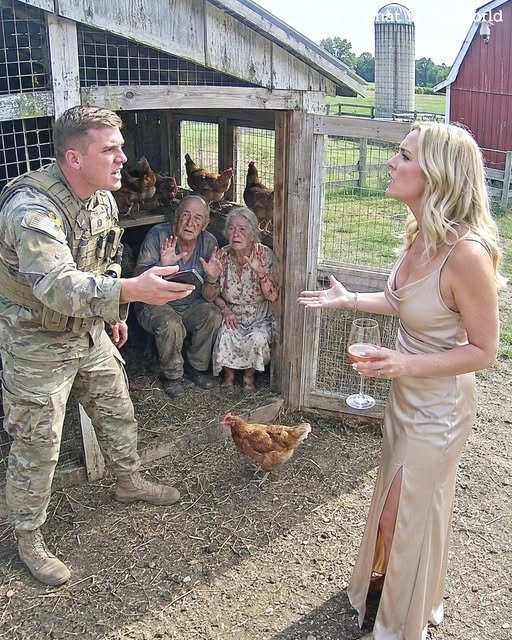
I knelt beside my mother and carefully slipped one arm around her shoulders. She flinched at first, then recognized my touch and leaned against me.
That instinctive fear—my own mother recoiling from a gentle hand—nearly broke something inside me.
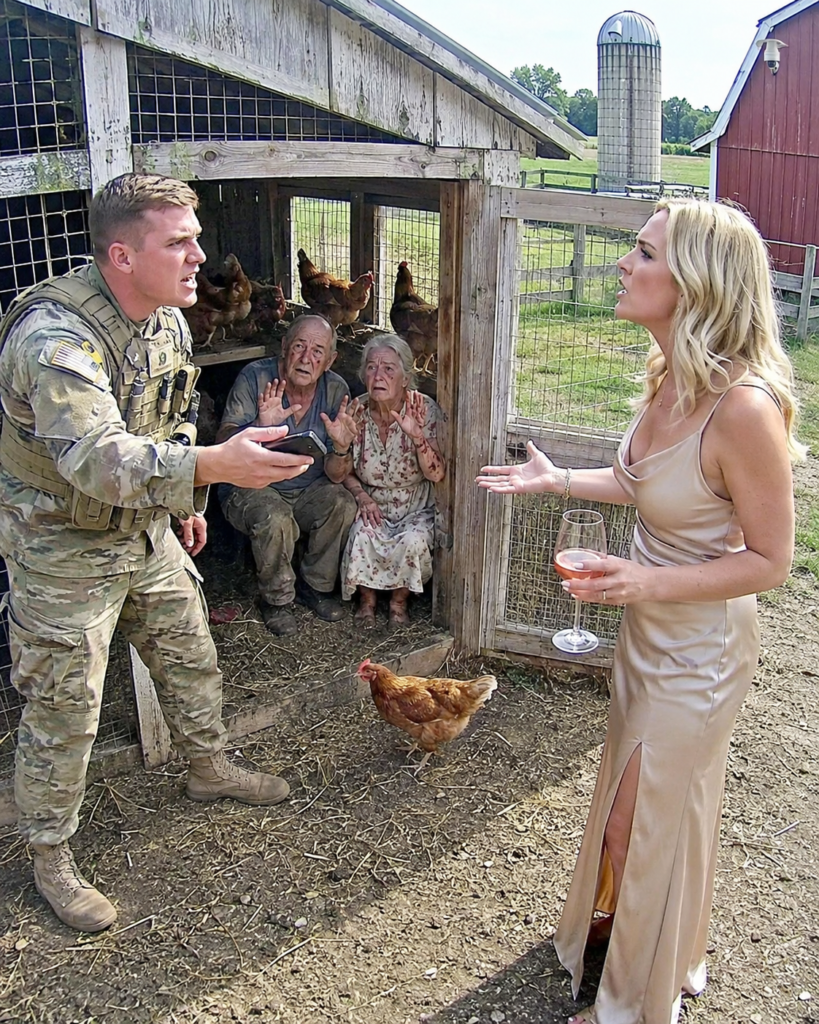
“I’m taking them to the hospital,” I said.
Claire stepped down from the porch.
“You can’t just come home and start making accusations.”
I looked at her.
“I haven’t made an accusation.”
“You called the camera a backup transmitter.”
“I said everything was recorded.”
Her gaze shifted toward the strangers on the porch.
There were five of them. Two men and three women, all dressed as though they had come for an afternoon gathering. One woman held a plate of food. Another was slowly lowering her phone, her smile gone.
None of them looked at Claire now.
They were looking at the chicken coop.
At the chain on the ground.
At my parents.
Claire seemed to understand what they were seeing.
“They’ve had several falls,” she said quickly. “I’ve been trying to care for them alone. Daniel’s father gets confused and aggressive. His mother wanders. I locked the coop because there are tools and chemicals in the barn, and I was afraid they’d hurt themselves.”
My father let out a dry, painful laugh.
Claire turned sharply.
“You see?” she said. “He thinks this is funny.”
I rose carefully.
My mother gripped my sleeve.
“Daniel,” she whispered. “Please don’t argue with her.”
I looked down at her.
The woman who had once stood in the doorway during thunderstorms to convince me there was nothing in the dark was now begging me not to anger my own wife.
“I’m not going to argue,” I said.
Claire’s shoulders relaxed slightly.
Then I took out my phone and called emergency services.
Her face hardened.
“Put that away.”
I gave the dispatcher the address.
Claire crossed the yard quickly.
“Daniel, listen to me.”
I stepped between her and the coop.
She stopped.
I did not raise my voice. I did not threaten her. I simply stood there, watching her as the dispatcher asked whether the injured people were conscious.
“Yes,” I said. “Both conscious. Both elderly. They have visible injuries, and they appear severely dehydrated.”
Claire lowered her voice.
“You don’t understand what’s been happening here.”
“Then you’ll have a chance to explain it.”
“To whom?”
“The paramedics. The police. Whoever needs to hear it.”
For the first time, she looked less angry than desperate.
“You think a few blurry recordings will prove anything?”
I ended the call.
“I didn’t say they were blurry.”
The strangers on the porch began leaving without saying goodbye.
One of the men hurried toward a truck parked beside the house. Claire watched him go.
“Mark,” she called. “Don’t leave.”
He did not turn around.
Within a minute, engines started along the gravel driveway.
Claire stood alone near the porch steps, still holding the wineglass.
The house behind her looked exactly as I remembered it. White curtains moved in the open windows. My mother’s flower boxes hung beneath the kitchen sill. A wreath remained on the front door even though the season had changed months ago.
It was unsettling to see ordinary things surrounding something so wrong.
I returned to the coop.
My father tried to rise.
“Easy,” I said.
“I can walk.”
“You don’t have to.”
His jaw tightened. Even bruised and exhausted, he hated appearing weak.
“I said I can walk.”
He made it two steps before his knees folded.
I caught him under the arms.
He was lighter than I remembered.
That frightened me more than the bruises.
My father had always seemed solid, built from the same oak as the barn beams. When I was ten, he had carried me half a mile after I broke my ankle near the creek. When I was seventeen, he had stood beside my first car in the rain for hours, refusing to let me quit until the engine started.
Now I lifted him from the straw as though he were a child.
He turned his face away.
“I’m sorry,” he murmured.
“For what?”
“For you coming home to this.”
My throat tightened.
“You didn’t do this.”
He closed his good eye.
“I should have seen what she was.”
A siren sounded in the distance.
Claire set her glass down on the porch railing.
Then she went inside.
I watched the front door close behind her.
My first thought was that she might run.
My second was that there were documents inside the house she did not want anyone to see.
I looked at my parents.
My mother followed my gaze.
“She keeps papers in your study,” she whispered.
“What papers?”
“I don’t know. She made your father sign things.”
“I didn’t sign,” my father said.
My mother looked at him sadly.
“You signed something.”
His expression changed.
Only slightly.
But I noticed.
“What did you sign?” I asked.
“Nothing that matters.”
“Dad.”
“I was tired. Your mother hadn’t eaten since the morning before. Claire said she’d give us food if I signed a statement saying she had been caring for us.”
My mother shook her head.
“It was more than that.”
He stared at the dirt floor.
The sirens grew louder.
“What else was on the paper?” I asked.
“I couldn’t read it properly. She took my glasses.”
The front door opened.
Claire emerged carrying a leather folder against her chest.
She walked toward her car.
I stepped out of the coop.
“Where are you going?”
“I’m getting away from you.”
“You need to wait for the police.”
“You don’t have authority to detain me.”
She was right.
I could not physically stop her.
But before she reached the car, a blue sedan turned into the driveway, followed by an ambulance and a sheriff’s vehicle.
The sedan belonged to Mrs. Bell, our nearest neighbor.
She parked sideways across the lower driveway, unintentionally blocking Claire’s car.
Mrs. Bell climbed out before the engine stopped.
She was seventy if she was a day, wearing gardening gloves and a wide straw hat.
“I heard the sirens,” she called.
Then she saw my parents.
Her face went white.
“Evelyn?”
My mother began crying again.
Mrs. Bell crossed the yard as fast as her knees allowed.
Claire stood beside her car with the folder still pressed to her body.
“You need to move your vehicle,” she said.
Mrs. Bell did not even look at her.
The paramedics hurried past us with equipment bags and a stretcher. The deputy approached more slowly, one hand resting near his belt, taking in the chain, the coop, my parents’ injuries, and Claire’s position beside the car.
“I’m Deputy Harris,” he said. “Who made the call?”
“I did.”
“And you are?”
“Daniel Mercer. Their son.”
Claire gave a sharp laugh.
“And my husband, though he seems to have forgotten that.”
Deputy Harris looked at the folder in her hands.
“Ma’am, please set that on the hood of the car.”
“Why?”
“So we can speak without you holding anything.”
“It’s paperwork.”
“Then it can rest on the hood.”
For a moment, I thought she might refuse.
Instead, she placed the folder down carefully.
One of the paramedics called for assistance.
My father’s blood pressure was dangerously low.
Whatever questions the deputy had, they disappeared from my mind as I followed the stretcher.
My mother refused to leave my father’s side.
When the paramedics tried to place them in separate ambulances, she held his hand with surprising strength.
“No,” she said. “Not alone.”
The paramedic glanced at me.
“They can ride together if we have room, but she needs evaluation too.”
“Keep them together,” I said.
My father opened his good eye.
“Daniel, the house—”
“I’ll handle the house.”
“No.” His fingers closed around my wrist. “Listen to me.”
The urgency in his voice made me lean closer.
“There’s something under the floor in your old room.”
“What?”
But he looked past me.
Claire was watching us.
His hand loosened.
“Later,” he whispered.
The ambulance doors closed.
I stood in the driveway as it pulled away, carrying both my parents toward the county hospital.
Mrs. Bell remained near the coop, one hand over her mouth.
Deputy Harris spoke quietly into his radio.
Claire had moved several steps away from her car. She looked strangely composed again.
Almost relieved.
That worried me.
Harris approached her.
“Mrs. Mercer, I need to ask you some questions.”
“I’d prefer to speak with an attorney.”
“That’s your right.”
“Am I under arrest?”
“Not at this moment.”
“Then I’m leaving.”
“You’re free to leave on foot, but the vehicle may need to remain here while we determine who owns it and whether it contains evidence relevant to the condition of Mr. and Mrs. Mercer.”
Claire looked toward me.
The car was registered in both our names.
She knew I would not consent to her taking it.
“What exactly do you think happened?” she asked the deputy.
“That is what we’re trying to establish.”
“This is a family disagreement.”
Harris’s gaze moved toward the coop.
“A chain on the outside of a locked structure is more than a disagreement.”
Claire folded her arms.
“They were not imprisoned.”
Mrs. Bell finally spoke.
“I saw Evelyn at that window.”
Everyone turned to her.
She pointed toward a small square opening in the rear wall of the coop.
“Three weeks ago,” she continued. “I was checking the fence line because one of my calves had gotten loose. I saw Evelyn standing there.”
My mother’s name seemed to catch in her throat.
“She told me they were cleaning it out,” Claire said.
Mrs. Bell looked at her.
“No, you told me that.”
Claire’s mouth tightened.
“You came onto private property.”
“I asked why Evelyn was in the coop. You said she was feeding chickens.”
“There used to be chickens.”
“Not for six years.”
Silence settled over the yard.
Harris turned toward Mrs. Bell.
“I’ll need a full statement.”
She nodded.
Claire looked at me again.
“You’ve already decided I’m guilty.”
“I’ve decided my parents need help.”
“They were turning you against me before you ever left.”
“My father helped pay for our wedding.”
“He controlled the money.”
“My mother gave you her grandmother’s necklace.”
“She used gifts to make me feel indebted.”
Every memory I offered seemed to pass through some private machinery inside Claire and emerge altered.
I wondered how long she had been collecting grievances.
How long she had been translating kindness into manipulation.
“Why didn’t you tell me you were struggling?” I asked.
“I did.”
“When?”
“In every call where you asked about them before you asked about me.”
Her answer was so quick that I knew she had rehearsed it, perhaps many times.
I remembered our calls overseas.
Claire telling me the house was exhausting.
Claire complaining that my father questioned every repair bill.
Claire saying my mother interfered with meals, laundry, visitors.
I had listened.
I had sympathized.
I had even told my mother to give Claire space.
The memory made me feel ill.
Perhaps that was what Claire saw in my face, because her voice softened.
“You left me here with them, Daniel.”
“They were supposed to be helping you.”
“They watched me. Judged me. Every day, in this house, I felt like a guest they were waiting to remove.”
“So you locked them in a coop?”
“I didn’t—”
She stopped.
Not because she had changed her mind.
Because Deputy Harris was listening.
The leather folder still rested on the hood of the car.
A corner of a document protruded from it.
I could see my father’s name.
Harris noticed it too.
“Ma’am, whose paperwork is that?”
“My husband’s.”
“It has his father’s name on it.”
“It concerns the property.”
“Did Mr. Mercer give you permission to take it?”
Claire hesitated.
“They’re family records.”
“That wasn’t my question.”
Her gaze hardened.
“My attorney will answer the rest.”
She turned and began walking toward the road.
“Claire,” I called.
She stopped but did not face me.
“Where is my phone?”
“In the house.”
“Why?”
“You left it here when you deployed.”
“My local phone. The one my parents used to contact me when the internet was down.”
She remained still.
“I don’t know.”
“My father said you took their phones.”
“I put them somewhere safe because they kept losing them.”
“Where?”
She turned.
For one second, I saw the woman I had married.
Not the smiling hostess on the porch.
Not the cold stranger beside the chicken coop.
The woman who used to sit barefoot on the kitchen counter, eating strawberries and laughing when I tried to cook. The woman who wrote letters during my first deployment because she said messages on a screen felt too temporary. The woman who once drove six hours through heavy rain when my mother was in the hospital.
That woman’s face was still there.
But fear had hollowed it out.
“I didn’t think it would go this far,” she said.
Then she walked down the driveway.
Deputy Harris did not stop her.
Mrs. Bell watched until Claire disappeared beyond the bend.
“What did she mean?” she asked.
I had no answer.
While Harris waited for another deputy and a search warrant, I went into the house with his permission to collect identification, medications, and clothing for my parents.
The change inside was immediate.
The kitchen looked immaculate.
Every surface gleamed. Fresh flowers stood in a vase on the table. Plates of untouched food remained from Claire’s gathering.
The pantry, however, was secured with a new padlock.
Harris photographed it before allowing me to look for a key.
We found one in a drawer beside the sink.
Inside, shelves were filled with canned goods, flour, rice, cereal, bottled water, and snacks.
Enough food for months.
On the counter beside the refrigerator sat a framed photograph from my wedding.
Claire and I were dancing.
My parents stood behind us, smiling.
Someone had turned the frame facedown.
My old study was at the end of the hall.
The room smelled of perfume and printer ink.
Stacks of documents covered the desk. Property valuations. Bank statements. Medical forms. Copies of my father’s signature repeated across sheets of scrap paper.
Harris stood in the doorway.
“Don’t touch anything yet.”
I stepped back.
On the wall above the desk, Claire had pinned a calendar.
Several dates were circled.
One was the date of my scheduled return.
Two months from now.
Another was three weeks earlier.
Beside it, she had written: FINAL SIGNATURE.
Harris photographed the calendar.
“Do you recognize the handwriting?”
“Yes.”
“Your wife’s?”
“Yes.”
A noise came from the corner.
A soft electronic chime.
My father’s phone was charging beneath a pile of magazines.
Harris put on gloves and picked it up.
The screen showed forty-three missed calls.
All from me.
The phone had been switched to silent.
My mother’s phone was in the same drawer as the pantry key.
Its screen was cracked, but it still worked.
There were no outgoing calls in nearly four months.
Several messages had been drafted but never sent.
The first was to me.
Daniel, please call when Claire is not in the room.
The second was longer.
We do not want to worry you while you are away, but things here are not right.
The third ended midway through a sentence.
Your father found papers with your—
That was all.
“Can you recover deleted messages?” I asked.
“The digital unit can,” Harris said.
He looked around the room.
“This didn’t happen overnight.”
“No.”
I thought about all the calls I had made from overseas.
All the times Claire had answered first.
All the reasons she had given when my parents were unavailable.
Your mother is sleeping.
Your father is outside.
They went to visit Mrs. Bell.
The service is bad.
Every explanation had sounded reasonable because I trusted her.
Trust, I realized, did not usually collapse all at once.
Sometimes it was dismantled quietly, memory by memory.
Harris’s radio crackled.
A second deputy had arrived.
Before they secured the room, I noticed an envelope beneath the desk.
My name was written across it in my mother’s handwriting.
“Can I take that?”
Harris examined it, photographed its position, then placed it in an evidence sleeve.
“You can read it here.”
My hands trembled as I opened it.
The letter inside was dated five months earlier.
Daniel,
I have started this letter three times and destroyed it each time because I do not know what is fair to say. Claire is unhappy. Your father believes she has been taking money from the household account, but I think there may be an explanation. She cries often when she thinks we cannot hear her. She says you are never coming home and that we have ruined your marriage.
I do not believe that, but I am frightened by the way she speaks to your father. Yesterday she threw his medication into the sink because he would not show her the property deed.
Please do not confront her while you are so far away. Call us when you can speak privately.
There is something else.
Your father has not told you the full truth about why he refuses to transfer the house.
I will explain when you come home.
Love,
Mom
I read the final lines twice.
“What truth?” Harris asked.
“I don’t know.”
But I remembered my father gripping my wrist before the ambulance doors closed.
There’s something under the floor in your old room.
My childhood bedroom was upstairs.
Harris followed me.
The hallway looked unchanged. Family photographs lined the wall. School portraits. Holidays. My father holding a fish I had caught at twelve. My mother standing beside me on graduation day.
One photograph was missing.
A pale rectangle remained where it had hung.
“The picture that was there,” I said. “It showed my father when he was young. He was standing with his brother.”
“Could your wife have moved it?”
“Maybe.”
My bedroom door was locked.
That was new.
Harris called for the other deputy.
They found the key on Claire’s ring inside the study.
When the door opened, dust moved through a stripe of afternoon light.
The room had become storage.
Boxes were stacked against the walls. Old furniture had been covered with sheets. My childhood books remained on a shelf, along with a wooden airplane my father had carved when I was eight.
I stepped toward the floorboards near the bed.
There had always been one loose plank.
As children, my cousin and I used it to hide coins and comic books.
The bed had been moved over it.
With Harris watching, I pulled the frame aside.
The plank came up with little resistance.
Underneath was a shallow compartment.
Inside lay a metal document box.
It was not locked.
Harris photographed it before opening the lid.
There was no money inside.
No jewelry.
Only papers.
The first was a deed.
The second was a birth certificate.
The third was an old photograph of two young men standing beside the barn.
My father was one of them.
The other looked almost exactly like him.
On the back, someone had written:
Thomas and Samuel Mercer, summer of 1978.
Samuel was my father’s younger brother.
He had died before I was born.
At least, that was what I had always been told.
Beneath the photograph lay a stack of letters tied with blue ribbon.
They were addressed to my mother.
The return name was Samuel Mercer.
The latest letter was dated three years after his supposed death.
I looked at Harris.
“My uncle died in 1980.”
“This letter is from 1983.”
“I can see that.”
My voice sounded far away.
Harris did not open the letters.
“These may not be relevant to the immediate investigation.”
“My father sent me up here to find them.”
“Then they may be relevant to him.”
At the bottom of the box was a sealed envelope marked:
FOR DANIEL—ONLY WHEN THE HOUSE IS AT RISK.
The handwriting belonged to my father.
Harris allowed me to open it.
Inside was a legal document and a handwritten note.
The legal document appeared to establish a family trust.
The farmhouse, barn, and surrounding land had not been owned solely by my father.
Half belonged to an entity called the Samuel Mercer Family Trust.
The listed beneficiary was someone named Anna Mercer.
I had never heard the name before.
My father’s note was brief.
Daniel,
If you are reading this, then I have failed to protect the family from a mistake I made long ago.
Do not transfer the property.
Do not sign anything Claire gives you.
And do not assume Claire came here by accident.
Ask her about Anna.
I read the final sentence again.
Ask her about Anna.
The room seemed to tilt.
Harris took the page gently from my hand and placed it with the other documents.
“Do you know an Anna?”
“No.”
“Could she be a relative?”
“I don’t know.”
A floorboard creaked in the hall.
Both deputies turned.
Mrs. Bell stood in the doorway.
She had followed us upstairs, though neither of us had heard her.
Her eyes were fixed on the photograph of my father and Samuel.
“Where did you find that?” she asked.
“Under the floor.”
She stepped closer.
Her face had lost its color again.
“Mrs. Bell,” Harris said, “do you know Anna Mercer?”
She sat down on the edge of a covered chair.
For a long moment, she said nothing.
Then she looked at me.
“Anna wasn’t a Mercer,” she said. “Not then.”
“What does that mean?”
She folded her gardening gloves in her lap.
“Your uncle Samuel was engaged to a woman named Anna Lewis. They were supposed to marry that autumn.”
“But he died.”
Mrs. Bell looked toward the window.
“That is what your family told people.”
“What actually happened?”
“I never knew for certain. Samuel disappeared. A few weeks later, your grandfather said there had been an accident out west. No funeral. No body brought home.”
“And Anna?”
“She left town soon afterward.”
I held up my father’s note.
“Why would he tell me to ask Claire about her?”
Mrs. Bell’s mouth opened, but no words came.
Then she whispered, “What was Claire’s mother’s maiden name?”
I stared at her.
“I don’t know.”
The realization embarrassed me.
Claire’s mother had died when Claire was young. She rarely spoke about her childhood, and when she did, the details changed. Sometimes she said she had grown up in Ohio. Other times it was Pennsylvania. I had assumed the inconsistency came from moving frequently.
Harris took out his notebook.
“What was Claire’s mother’s first name?”
“Anne,” I said.
Mrs. Bell closed her eyes.
“Anna sometimes called herself Anne.”
A cold uneasiness moved through me.
“That doesn’t prove anything.”
“No,” Mrs. Bell said. “It doesn’t.”
But she looked frightened.
My phone rang.
The hospital.
I answered immediately.
My father had been admitted for dehydration, malnutrition, and two cracked ribs. My mother had a fractured wrist and severe bruising, but neither injury was life-threatening.
Relief came so sharply that I had to sit down.
“They’re stable,” I said after ending the call.
Mrs. Bell reached for my hand.
“Thank heaven.”
Harris closed the metal box.
“We need to secure these documents.”
“I’m going to the hospital.”
“That’s where you should be.”
On the drive there, the farmhouse disappeared behind me in the rearview mirror.
For the first time since coming home, I allowed myself to feel the exhaustion beneath the anger.
Two years overseas had taught me to separate danger into manageable pieces.
Assess the situation.
Protect the vulnerable.
Preserve evidence.
Wait for support.
But this was not a foreign road or an unfamiliar village.
This was my family.
And every room held memories Claire had somehow entered, rearranged, and weaponized.
At the hospital, my mother was asleep.
Her wrist had been wrapped, and an intravenous line ran into her arm.
My father sat propped against several pillows.
His bruised eye was closed, but the other opened when I entered.
“You found the box,” he said.
“Yes.”
He looked toward my mother.
“Keep your voice down.”
I pulled a chair closer.
“Who is Anna?”
His expression tightened.
“Where’s Claire?”
“Gone. The police are looking for her.”
“Did she take the folder?”
“No.”
He exhaled.
“Then we may still have time.”
“Time for what?”
He stared at the blanket covering his legs.
“When your uncle disappeared, your grandfather blamed Anna. He said Samuel had taken money and run away with her. But that wasn’t true.”
“How do you know?”
“Samuel came back once.”
The room felt suddenly smaller.
“When?”
“Years later. Late at night. He was frightened. He said he had uncovered something about the land.”
“What about it?”
“There is an old mineral lease attached to part of the property. Nothing valuable was ever found, but the rights were separated from the surface ownership. Samuel believed someone had forged documents to sell those rights.”
“Who?”
“My father.”
I leaned back.
My grandfather had been dead for twenty years.
To me, he existed mostly in photographs and in my father’s careful stories.
“Samuel threatened to expose him,” my father continued. “They argued. Samuel left again.”
“And then?”
“I never saw him after that.”
“What happened to Anna?”
“She was pregnant.”
The words settled between us.
“Anna Mercer,” I said.
My father nodded.
“She and Samuel had married privately before he disappeared. The trust was created for their child.”
“Claire?”
His gaze met mine.
“We didn’t know.”
“But you suspected.”
“Not until last year.”
He reached toward the water cup, but his hand shook too badly. I held it for him.
“Claire began asking questions about Samuel,” he said after drinking. “At first, I thought you had told her the family stories. Then she asked about the trust.”
“How would she know?”
“She said she found an old reference in the county archive.”
“And Anna was her mother?”
“I asked her. She denied it.”
“Why didn’t you tell me?”
“You were deployed.”
“That didn’t stop you from letting her live in the house.”
His face twisted with regret.
“I thought she wanted answers. Perhaps even a connection to the family. Your mother believed we could repair what the older generation had broken.”
I glanced at my mother.
Even asleep, she seemed tense.
“You trusted Claire.”
“We wanted to.”
“And when did that change?”
“When she demanded the deed.”
My father looked toward the window.
“She said the property belonged to her by blood. I told her a court could decide the trust, but I would not sign the house to her. After that, she changed.”
I thought about Claire’s words in the yard.
They watched me. Judged me.
Perhaps resentment had brought her to us.
Perhaps she had married me because of a buried family claim.
Yet the explanation felt too simple.
People did not share a life for six years as part of a single, uninterrupted deception.
At least, I did not want to believe they could.
“Did she marry me for the property?” I asked.
My father’s expression softened.
“I can’t answer that.”
“You warned me not to assume she came here by accident.”
“That was written after she asked about the trust.”
“Why phrase it that way?”
He looked at my mother again.
“Because Claire did not meet you by accident.”
I felt the words before I understood them.
“What are you talking about?”
“Your mother met her first.”
My mother stirred in the bed.
Her eyes opened.
She looked from my father to me and immediately knew what we were discussing.
“Evelyn,” my father said quietly.
“No more secrets,” I told them.
My mother turned her face away.
“Please,” I said.
She took a slow breath.
“Six months before you met Claire, she came to the house.”
My hands went still.
“She used another name,” my mother continued. “She said she was researching local history. She asked about Samuel.”
“What name?”
“Clara Lewis.”
Claire’s full name was Claire Anne Lewis before we married.
Close enough to be an alias.
Close enough to be deliberate.
“She spoke to us for nearly two hours,” my mother said. “She was polite. Sad, even. She said Anna had been her grandmother.”
“Her grandmother?”
My father frowned.
“She told me Anna was her mother.”
“She told me grandmother,” my mother said.
They looked at each other.
Another inconsistency.
Another lie.
“What happened after that?” I asked.
“She left,” my mother said. “Then months later, you introduced us to Claire. I recognized her immediately.”
“And you said nothing?”
“She pulled me aside before dinner. She said she had not told you about her family because she wanted you to love her for herself, not because of an old dispute. She begged me to give her time.”
My father’s voice sharpened.
“You never told me that.”
“I was going to.”
“When?”
“When she was ready.”
“You let our son marry her without telling him?”
My mother’s eyes filled with tears.
“She loved him.”
“Did she?”
“I believed she did.”
I stood and walked to the window.
Below us, cars moved through the hospital parking lot. Ordinary people carried bags, held doors, checked their phones.
I pressed my palm against the cool glass.
The woman I had trusted had entered my life knowing exactly who I was.
The chance meeting at a bookstore.
The coffee afterward.
The astonishment when we discovered we lived only twenty minutes apart.
All of it might have been arranged.
Yet I remembered the small, unguarded moments.
Claire falling asleep during old movies.
Claire keeping every note I had ever left in her lunch bag.
Claire shaking in my arms after a doctor told us we might never have children.
Had those moments been false too?
My phone vibrated.
A message from an unknown number.
There was no text.
Only a photograph.
Claire stood beside an older woman outside a small house.
On the back of the printed photograph, visible beneath their hands, someone had written:
ANNA AND CLAIRE—2009.
A second message arrived.
You have heard your father’s version. Before you decide what I am, ask him what happened the night Samuel disappeared.
I turned toward the hospital bed.
My father was watching me.
The bruising around his eye made his expression difficult to read.
“Who is it?” he asked.
I showed him the photograph.
All the remaining color left his face.
My mother pushed herself upright.
“What is it?”
My father did not answer.
He stared at the older woman beside Claire as though he had seen a ghost.
Then he whispered a name.
“Anna.”
“You said you didn’t know where she went,” I said.
“I didn’t.”
“She was alive in 2009.”
He closed his eye.
The phone vibrated again.
This time, the message contained a short video.
The image was dark and unsteady, recorded inside our barn only three nights earlier.
Claire stood beneath the weather vane, speaking to someone beyond the camera’s view.
Her voice was low but clear.
“Daniel will be home soon. Once he finds them, he’ll open the box.”
A man answered.
My body went cold.
I knew that voice.
I had heard it all my life.
My father gripped the hospital blanket as the man in the recording said:
“And when he reads the letters, he’ll finally understand why we needed Claire to believe the house belonged to her.”
The video ended.
I looked slowly toward my father.
He seemed smaller beneath the white hospital sheets.
Not merely injured.
Exposed.
“Dad,” I said, barely above a whisper. “Who were you talking to in the barn?”