
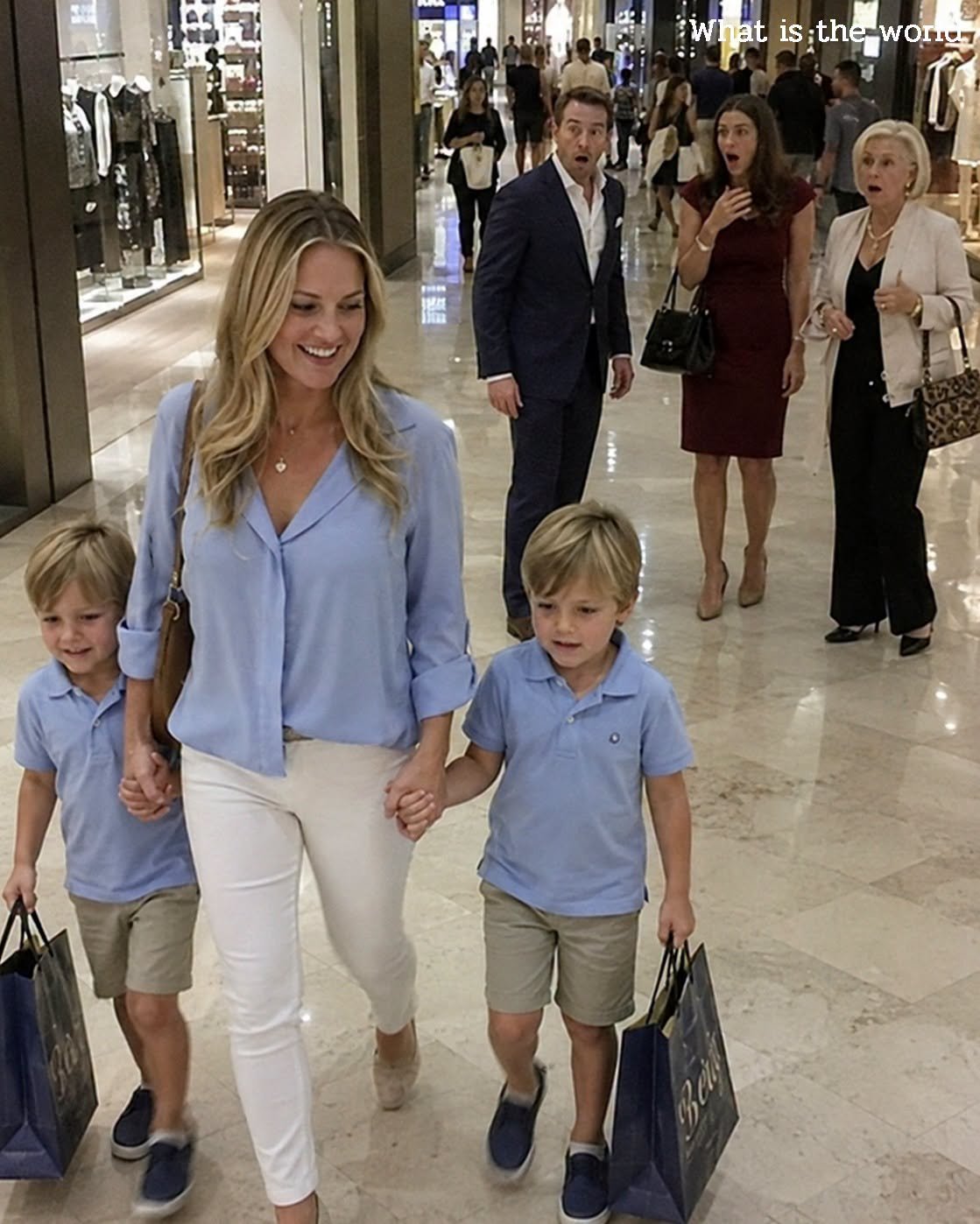
“Damien!”
His mother’s voice sliced through the air with the kind of precision that had once made entire boardrooms fall silent.
I didn’t turn around right away.
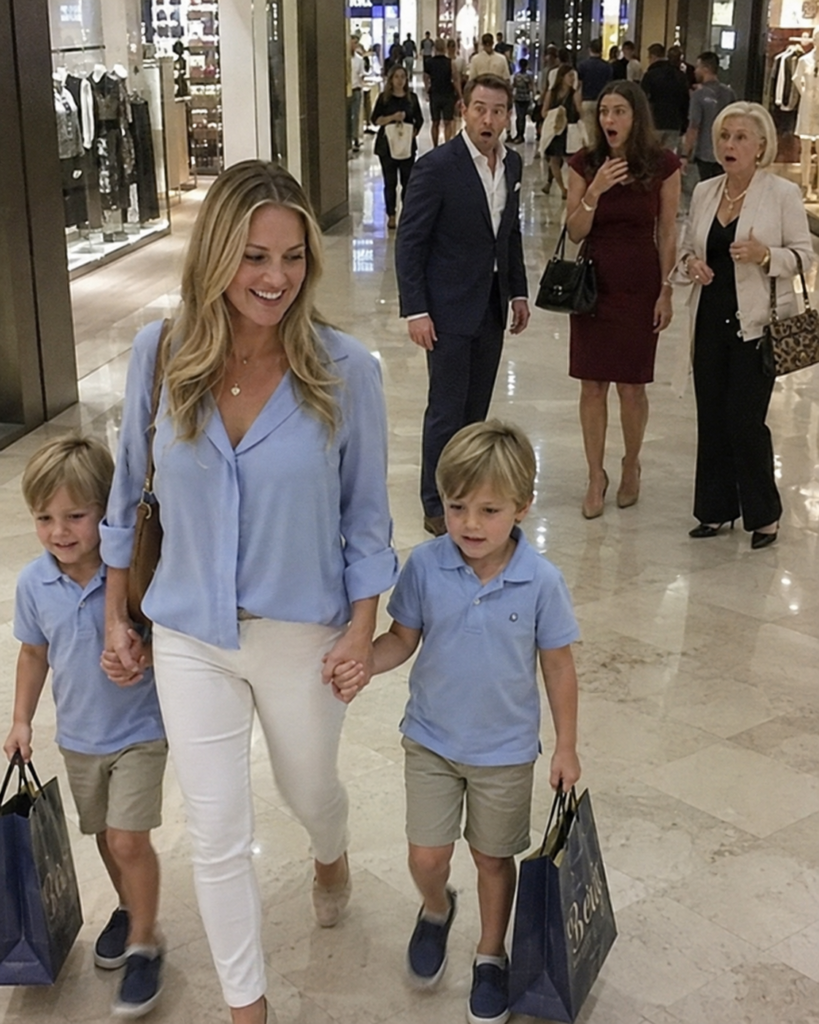
For a moment, I only stood there with my sons’ small hands in mine, feeling the warmth of their palms, the slight tug of Ethan’s restless fingers, the steady softness of Noah’s grip. Around us, Westbridge Mall kept moving. Someone laughed near the escalators. A child cried over a dropped pretzel. Music floated faintly from a clothing store, bright and cheerful, as though nothing extraordinary had happened.
But everything inside me had gone still.
Because I knew that voice.
Vivienne Mercer.
Five years had done nothing to blur the memory of her polished smile, her pearl earrings, her quiet perfume, or the cold way she had looked at my stomach as if the life growing inside me were a problem to be solved before lunch.
“Damien,” she said again, closer now. “We need to go.”
Only then did I turn.
She looked exactly as I remembered, though perhaps a little thinner, a little sharper around the edges. Her silver-blonde hair was gathered at the nape of her neck, not a strand out of place. Her cream coat probably cost more than my first car. A pair of leather gloves covered her hands, but even from several feet away, I could see the tremor in her fingers.
Her eyes met mine.
The color vanished from her face.
For one small, terrible second, Vivienne Mercer looked afraid.
Not annoyed.
Not offended.
Afraid.
Then her gaze dropped to Ethan and Noah.
The reaction was almost invisible, but I saw it. Her lips parted. Her shoulders stiffened. Her eyes moved from one boy to the other, taking in the gray eyes, the dark hair, the familiar shape of their brows.
Recognition passed across her face like a shadow.
Ethan leaned closer to me.
“Mom,” he whispered, “who is that lady?”
I swallowed.
“No one we need to talk to right now.”
Vivienne heard me. I knew she did, because something hardened in her expression.
Damien stepped toward us, ignoring the coffee still dripping from his fingers onto the polished floor.
“Mara,” he said, his voice rough. “Please.”
I looked at him then.
He wasn’t the confident man who had once walked through the world as though doors opened for him before he even reached them. That Damien Mercer had been calm, controlled, almost impossibly sure of himself. The man in front of me looked shaken down to the bones.
His eyes moved from me to the twins again.
“Are they mine?” he asked.
Noah looked up at me, his brow furrowing in confusion.
“Mom?”
There it was.
The question I had known might come one day, but never like this. Never in the middle of a crowded mall, with my children standing between me and the past I had spent years trying to survive.
Vivienne’s voice came quickly.
“Damien, this is neither the place nor the time.”
He didn’t look at her.
“Mara,” he said again.
I drew in a quiet breath. “You don’t get to ask that here.”
Pain flickered across his face. “Then where? When? You disappeared.”
A laugh rose in my throat, but it wasn’t humor. It was disbelief sharpened by years of silence.
“I disappeared?” I repeated softly. “That’s what you think happened?”
Something shifted in his expression.
Vivienne’s hand closed around his arm. “Damien.”
He finally looked at her.
And for the first time, I saw it.
Not respect.
Not obedience.
Suspicion.
“What did you do?” he asked.
The question was quiet, but Vivienne flinched as though he had shouted.
I felt the old anger stir in me, but it came differently now. Five years ago, it had been fire. It had burned through my chest, wild and consuming, because I had been young and terrified and heartbroken.
Now it was colder. Steadier.
Because I had learned how to stand while holding two children, two lunch boxes, two fevers in the night, two dreams, two futures.
I had learned that some pain does not destroy you.
It teaches you how much weight your heart can carry.
“Boys,” I said gently, kneeling in front of them, “I need you to stay with me, okay?”
Ethan’s eyes moved from Damien to Vivienne and back again.
“Did we do something wrong?” he asked.
That broke something in me.
“No,” I said immediately, cupping his face. “Never. You hear me? You did nothing wrong.”
Noah’s lower lip trembled, but he held it together the way he always tried to. My brave, quiet boy.
“Is he mad?” Noah asked.
Damien’s face crumpled.
“No,” he said quickly, dropping to one knee without thinking. “No, I’m not mad. I’m just…” His voice caught. “I’m surprised.”
Ethan studied him with open curiosity.
“You spilled your coffee,” he said.
For a heartbeat, no one spoke.
Then Damien looked down at his hand, as if noticing the mess for the first time. Coffee stained his sleeve and dripped from his knuckles. The absurdity of it almost made me laugh.
Almost.
A mall employee approached with napkins, murmuring politely. Damien took them without looking away from the boys.
Vivienne stepped closer, her voice lowered now. “Mara, perhaps we should discuss this privately.”
The sound of my name in her mouth brought back another room.
Not the conference room with Damien.
A hotel lounge two days later, rain running down the windows, my coat damp on my shoulders, Vivienne Mercer sitting across from me like a queen granting mercy.
She had ordered tea she never drank.
I had ordered nothing because my stomach had been twisting so badly I was afraid I would be sick.
“I understand you are upset,” she had said.
“No,” I replied. “You don’t.”
She slid a folder across the table.
Not an envelope.
A folder.
Inside were documents, medical contacts, legal forms, and a cashier’s check with more zeros than I had ever seen attached to my name.
“You are young, Mara. This could make your life very difficult.”
“I’m not interested.”
Her smile remained, but her eyes cooled. “You should be. Damien has responsibilities you cannot comprehend. There are expectations. Public obligations. Family obligations.”
“I’m carrying his child.”
“You are carrying a complication.”
I remember staring at her then, stunned by how easily she said it.
A complication.
That was what Ethan and Noah had been to her before they even had names.
She had leaned forward, lowering her voice.
“Take the money. Leave quietly. Build yourself a comfortable life somewhere else. Damien will not come after you.”
“Did he send you?”
For the first time, she paused.
That pause had answered more than any confession.
“He knows what needs to happen,” she said.
But she hadn’t answered the question.
Back in the mall, I looked at her and wondered how many of her lies I had built my life around.
“You’re right,” I said. “This should be private.”
Relief flashed across her face.
Then I added, “But not with you.”
Her expression tightened.
Damien stood slowly. “Mara, I need to know.”
I looked at my sons, then at the man who had missed their entire lives.
Not because of one conversation.
Not because of one mistake.
Because of a hundred decisions made by people with money, pride, fear, and secrets.
“You want the truth?” I asked.
“Yes.”
“Then come to the children’s garden near the east entrance. Ten minutes. Alone.”
Vivienne’s eyes sharpened. “Absolutely not.”
Damien turned to her. “Mother.”
She lowered her voice, but I could still hear every word. “You are emotional. This woman appears out of nowhere with two children who happen to resemble you, and you are ready to—”
“She didn’t appear out of nowhere,” he said.
Vivienne stopped.
Damien stared at her. “Did she?”
For the first time since I had known her, Vivienne Mercer had no immediate answer.
I didn’t wait to hear the next lie.
I took my sons’ hands and walked away.
Neither boy spoke at first. They moved with me past the toy store, past the fountain, past teenagers eating cinnamon pretzels from paper bags. I could feel their questions gathering, small and heavy.
At the children’s garden, a quiet indoor space filled with potted trees and benches, I found an empty seat near a large fake oak with twinkling lights woven through its branches. The twins sat beside me.
Ethan kicked his sneakers lightly against the bench.
Noah leaned against my arm.
“Mom,” he said finally, “was that our dad?”
I closed my eyes for one second.
There are moments in motherhood when the truth is not hard because you don’t know how to say it.
It is hard because you know exactly how important it is.
I turned to face them.
“He might be,” I said gently.
Ethan’s eyes widened. “Might be?”
“When I was younger, before you were born, I knew him. We cared about each other. But things happened that were very confusing and hurtful, and we were apart before I had you.”
Noah studied my face carefully.
“Did he know about us?”
The question landed softly but cut deeply.
I brushed a curl from his forehead. “I thought he did.”
Ethan frowned. “But maybe he didn’t?”
“I’m not sure anymore.”
Noah looked down at his hands.
“Does that mean he didn’t want us?”
I pulled both boys close immediately.
“No,” I said, my voice firmer than before. “Listen to me. Whatever happened between adults, whatever mistakes were made, that is not because of you. You are not something anyone gets to regret. You are the best part of my life.”
Ethan leaned into me.
Noah’s fingers curled into my sleeve.
Across the garden, I saw Damien approaching.
Alone.
His hair was damp at the temples, as though he had splashed water on his face. He had cleaned his hand, but the coffee stain remained on his cuff. For some reason, that small imperfection made him look more human than I remembered.
He stopped several feet away.
“May I sit?” he asked.
I almost said no.
But Noah was watching him.
Ethan too.
And whatever I felt, however much bitterness still lived inside me, my sons deserved more than my anger in that moment.
I nodded toward the bench across from us.
Damien sat slowly.
For several breaths, no one spoke.
Then Ethan, who had never been very patient with silence, asked, “Are you rich?”
Damien blinked.
I stared at my son.
“Ethan.”
“What?” he said. “His coat looks rich.”
Despite everything, Damien let out a quiet, stunned laugh. It was gone almost immediately, but I saw it. So did Ethan, who seemed pleased with himself.
“I suppose my family has money,” Damien said.
Noah tilted his head. “Do you like robots?”
Damien looked from one boy to the other, clearly trying to keep up with the unexpected interrogation.
“I did when I was your age.”
“What kind?” Ethan demanded.
“The kind I could take apart and rebuild.”
Ethan’s face lit up. “I do that! Mom says I’m not allowed to take apart the toaster again.”
“The toaster was plugged in,” I reminded him.
“It wasn’t on.”
“That is not the point.”
For a moment, the three of us slipped into something familiar. A rhythm. A small piece of our normal life. Damien watched it with an expression I couldn’t quite name.
Longing, maybe.
Or grief.
Then Noah asked, very softly, “Are you our father?”
The garden seemed to hold its breath.
Damien looked at me.
I didn’t rescue him.
Not this time.
He turned back to Noah, his face pale.
“I don’t know for certain,” he said carefully. “But I think there is a very good chance I am.”
Ethan looked at me. “Mom said maybe.”
Damien nodded. “Your mom is being honest.”
Something in his tone made my throat tighten.
Noah asked, “Where were you?”
There it was again.
A child’s question.
Simple.
Impossible.
Damien opened his mouth, then closed it. His gaze moved briefly to me, not asking permission exactly, but perhaps asking how much truth two five-year-olds could carry.
I answered for him.
“He and I need to talk about that,” I told the boys. “There are things we don’t understand yet.”
Ethan frowned. “Grown-up things?”
“Yes.”
“I hate grown-up things.”
“So do I sometimes.”
Noah looked at Damien again. “Are you going to leave?”
Damien’s eyes filled.
He looked completely unprepared for the question.
“I don’t want to,” he said.
That was not a promise.
I noticed.
So did Noah, though he didn’t yet know why.
I stood. “I need to take them home.”
Damien rose too quickly. “Please don’t disappear again.”
I stared at him.
Something like shame moved across his face.
“I know,” he said quietly. “I know how that sounds.”
“No,” I replied. “You don’t.”
He flinched, but he didn’t look away.
“You’re right,” he said. “I don’t. But I want to.”
The words were simple.
Too simple to undo anything.
But honest enough that I didn’t walk away immediately.
I pulled a receipt from my purse and found a pen. My hands were steady now as I wrote my number on the back.
“This is not an invitation to enter our lives,” I said, handing it to him. “It is a way to schedule a conversation. With boundaries. With a lawyer if necessary.”
He took the paper like it was something fragile.
“I understand.”
“No, Damien. I need you to really understand. They have a life. A safe one. They have school, friends, bedtime routines, favorite cereal bowls, fears, dreams, and a mother who has protected all of that without you. If you come near them, it will be carefully. Slowly. And only if it is good for them.”
His jaw tightened, but not in anger.
In pain.
“I understand,” he said again.
This time, I almost believed him.
We left him standing beneath the twinkling fake oak, holding my phone number in his hand as though it were both a gift and a sentence.
That night, after the twins fell asleep, I sat alone at the kitchen table with a cup of tea I never drank.
The apartment was quiet except for the hum of the refrigerator and the faint sound of Ethan snoring down the hall. Noah had insisted on sleeping with his stuffed fox tucked under his chin. Ethan had asked three times whether the “rich robot man” would come to breakfast.
I had answered all three times with the same careful words.
“We’ll see what happens.”
Now, in the silence, I allowed myself to shake.
Not much.
Just enough to remind me that strength is not the same thing as being unbreakable.
At 9:17 p.m., my phone lit up.
Unknown number.
I stared at it until the screen went dark.
Then it lit again.
This time, a message appeared.
It’s Damien. I know I have no right to ask for anything tonight. But I need to say this: I did not know you had the babies. I thought you ended the pregnancy and left because you wanted nothing more to do with me.
I read it once.
Then again.
My chest went cold.
Another message came before I could respond.
My mother told me she met with you. She said you accepted money and signed an agreement. She said you refused to speak to me. I believed her. I was a coward for believing her without finding you. I know that now.
I stood so quickly the chair scraped against the floor.
Accepted money?
Signed an agreement?
My hands shook as I typed.
I never accepted her money. I never signed anything.
The reply came almost immediately.
Then someone forged your signature.
I sat back down slowly.
The kitchen seemed to tilt.
Memories rushed in, jagged and incomplete. Vivienne’s folder. The cashier’s check. The legal documents I had pushed back across the table. Her calm smile. Her final words as I walked away.
“You will regret making this difficult.”
At the time, I thought it was only a threat.
Now I wondered if it had been a promise.
My phone rang.
I considered ignoring it.
Then I answered.
For a moment, neither of us spoke.
Damien’s voice came low and strained. “Mara.”
“What agreement?”
He exhaled shakily. “A settlement document. It said you accepted two million dollars in exchange for confidentiality and a complete release of parental claims involving any child or pregnancy connected to me.”
I closed my eyes.
“There was no child named in it?”
“No. It was written vaguely. My mother said it had to be, for privacy.”
“And you believed that?”
Silence.
Then, “Yes.”
The answer hurt more because he didn’t try to dress it up.
“I was angry,” he continued. “And ashamed. I had asked you to do something unforgivable, and when my mother told me you took the money, I used it as a way to hate you instead of hating myself.”
I pressed my palm to my forehead.
Five years of silence.
Five years of him thinking I had sold my children away before they existed.
Five years of me thinking he had paid to erase them.
The cruelty of it was almost elegant.
Vivienne had not merely separated us.
She had given each of us a version of the other we could survive hating.
“Why?” I whispered.
Damien’s voice changed. “Because she was afraid.”
“Of what?”
Another pause.
“My grandfather’s trust.”
I frowned. “What does that have to do with anything?”
“Everything,” he said. “My grandfather built the Mercer estate with very specific rules. He hated the way my father lived. The trust passes control to the first legitimate heir of my generation who has a child. Not a ceremonial position, not just money. Voting control.”
I tried to understand the words, but they felt unreal.
“Damien…”
“I was engaged to someone else when we met.”
“I know,” I said quietly.
That had been the first secret that wounded me. Before the pregnancy. Before the envelope. Before Vivienne.
Damien had told me the engagement was only a business arrangement, already ending, no love involved. I had wanted to believe that love could be simple if the feelings were real enough.
It never was.
“My mother had spent years arranging that marriage,” he said. “If I had a child outside of it, especially before the wedding, the trust structure would shift. My grandfather’s lawyers would have to be notified. Everything she built around the merger would collapse.”
“So she erased me.”
“She tried to.”
“No, Damien,” I said, my voice trembling. “She erased them.”
The silence on the other end of the line was heavy.
“I’m sorry,” he whispered.
I wanted to throw the phone across the room.
I wanted to weep.
I wanted to go into the boys’ room, crawl between their small beds, and hold both of them until morning.
Instead, I asked, “Why did you give me that envelope?”
He inhaled sharply. “Because I panicked.”
“That’s not an answer.”
“I know.” His voice broke slightly. “My father had just had a stroke. The board was threatening to remove me. My mother had convinced me that if news got out, everything my family controlled would implode. I told myself I was protecting everyone. I told myself it was one mistake, one impossible decision. But the truth is simpler. I was scared, and I let fear make me cruel.”
I pressed my lips together.
There were apologies that asked for forgiveness.
This did not feel like one.
It felt like a man finally reading aloud from a page he had spent years avoiding.
“I won’t ask you to forgive me,” he said. “I wouldn’t know what to do with that if you offered it.”
“Good,” I replied, because I had no forgiveness to give him. Not tonight.
But I had questions.
“What happens now?”
“I’d like to take a paternity test,” he said. “Only with your consent. Only through whatever doctor or lawyer you choose.”
“And if they’re yours?”
His answer came quietly.
“Then I start by doing whatever is best for them, not what is easiest for me.”
It was the right answer.
That made me distrust it more.
“Words are easy,” I said.
“I know.”
“My sons are not a legal problem.”
“I know.”
“They are not heirs, leverage, proof, or property.”
His voice deepened. “Mara, I know.”
“No,” I said, feeling years of exhaustion rise through me. “You don’t. You grew up with people treating family like a board game. I grew up with my mother working double shifts so I could have new shoes for school. These boys think pancakes shaped like dinosaurs are luxury. They think a perfect Saturday is the library, a park, and hot chocolate. I will not let the Mercer name turn them into pieces on a chessboard.”
“I won’t let that happen.”
I closed my eyes.
“You may not be able to stop it.”
That was when a sound came from the hallway.
A soft creak.
I turned.
Noah stood there in his blue pajamas, holding his stuffed fox by one ear.
His eyes were wide.
“Mom?” he whispered. “Are we chess pieces?”
My heart dropped.
I ended the call without saying goodbye.
“No, sweetheart.” I hurried to him and knelt. “No. You heard something you weren’t supposed to hear, and I’m sorry.”
He looked past me toward the phone on the table.
“Was that him?”
“Yes.”
“Is he sad?”
The question was so Noah that it nearly broke me. Ethan reacted to the world with motion, questions, noise. Noah absorbed it, carried it, tried to understand where everyone’s pain belonged.
“I think he is,” I said.
Noah frowned. “Did we make him sad?”
“No.” I held his shoulders gently. “Adults can be sad because of choices they made. That is not your job to fix.”
He nodded, but I could tell he only half believed me.
“Can I sleep in your bed?”
“Always.”
He climbed in beside me that night, small and warm and restless. A few minutes later, Ethan appeared too, claiming he had only come to check whether Noah was scared. Then he crawled under the blanket and fell asleep in less than a minute.
I lay awake between my sons until dawn.
By morning, Damien had sent the name of his attorney, a short apology for calling late, and a promise not to contact the boys directly without my permission.
I sent one message back.
All communication goes through me. Paternity test through my family doctor. No media. No family visits. No surprises.
He replied:
Agreed.
I stared at that word for a long time.
Agreed.
It looked so simple.
Life rarely is.
Three days later, I sat in Dr. Han’s office while Ethan built a tower of blocks and Noah asked whether cotton swabs could steal your thoughts.
“They cannot,” Dr. Han assured him solemnly.
“Good,” Noah said. “I need mine.”
Damien arrived exactly on time.
He wore no expensive coat this time, no polished armor. Just a dark sweater, jeans, and the expression of a man trying very hard not to scare two children by wanting too much too soon.
Ethan noticed him first.
“Robot man!”
Damien paused in the doorway.
Dr. Han looked amused.
I sighed. “Ethan.”
“What? We don’t know his name-name yet.”
Damien stepped inside. “Damien is fine.”
Ethan considered this. “Damien Robot Man.”
“No.”
“Mr. Damien?”
“That’s better,” I said.
Noah watched silently from beside my chair.
Damien crouched to their level, keeping a careful distance.
“Hi,” he said.
Ethan waved. Noah gave a small nod.
The test itself took less than ten minutes.
A swab inside each boy’s cheek. A swab from Damien. Forms signed. Identification checked. Chain of custody explained.
So much fear reduced to cotton, plastic tubes, and labels.
When it was over, Dr. Han told us results would take several business days.
Several days.
After five years, a few days should have seemed like nothing.
Instead, they stretched endlessly.
Damien asked if he could walk us to the car.
I almost said no.
Then Ethan asked if he could show him the tiny robot keychain attached to his backpack.
So I said yes.
In the parking lot, the autumn air smelled like wet leaves and exhaust. Ethan talked nonstop about gears, magnets, dinosaurs, and how Noah once cried because a worm was trapped on the sidewalk after rain.
“I rescued it,” Noah said defensively.
“You named it Charles,” Ethan added.
“He looked like a Charles.”
Damien listened as though each word mattered.
Maybe it did.
At the car, he stopped.
“Thank you,” he said to me.
“For what?”
“For letting me be here today.”
I buckled Ethan into his booster seat. “Don’t make me regret it.”
“I won’t try to rush this.”
I glanced at him. “Good.”
He hesitated. “There’s something else.”
Of course there was.
I closed the car door gently and turned.
“What?”
“My mother left the city.”
“When?”
“Yesterday.”
A chill moved through me. “Why?”
“She claims she needs rest. But my attorney found out she requested copies of old trust documents and contacted a private firm we’ve used before.”
“What kind of firm?”
Damien’s expression darkened. “Investigators.”
I looked toward the car, where Ethan was making faces at Noah through the window.
“She is not coming near my children.”
“I’ve already made that clear.”
I laughed softly, without humor. “You think clear means anything to her?”
“No,” he admitted. “I don’t.”
That honesty settled between us.
For the first time, we stood not exactly together, but facing the same direction.
It was a strange feeling.
Dangerous, maybe.
Because it would have been easier if Damien were still only the man who abandoned me. Easier if there were no lies, no forged signatures, no mother pulling strings behind velvet curtains. Easier if my anger had a single place to go.
But now the truth was expanding, unfolding into something larger and more complicated.
And I hated complicated.
I had built peace out of simple things.
Lunches packed the night before.
Library books returned on Fridays.
A calendar on the fridge with stickers for dentist appointments and school pajama day.
I did not want trust documents, investigators, attorneys, or the Mercer family anywhere near that peace.
“Keep her away from us,” I said.
Damien nodded. “I will.”
But I saw the uncertainty in his eyes.
He did not know if he could.
That evening, I called my best friend, Lena.
She answered on the second ring.
“Tell me you are calling because you finally bought the red boots.”
“I saw Damien.”
Silence.
Then a sharp inhale. “Where are you?”
“Home.”
“Are the boys okay?”
“Yes.”
“Are you okay?”
I looked at the cup of untouched tea in my hand.
“No.”
“I’m coming over.”
“You don’t have to.”
“I wasn’t asking.”
Twenty minutes later, Lena walked into my apartment carrying soup, bread, and the expression she wore whenever she was prepared to fight someone emotionally, legally, or with a strongly worded email.
I told her everything.
The mall.
Vivienne.
The forged agreement.
The trust.
The paternity test.
Lena listened without interrupting, which was how I knew she was furious.
When I finished, she sat back and said, “I always knew that woman was terrifying, but this is another level.”
“I don’t have proof yet.”
“You have enough to be careful.”
“I’m scared,” I admitted.
Lena’s face softened immediately.
I had not said those words often in the past five years. There had been no room for fear most days. There were bills, daycare costs, fevers, grocery lists, work deadlines, little hands reaching for me in the dark.
But fear had always been there.
A quiet passenger.
Now it had moved into the driver’s seat.
“What if he wants custody?” I asked.
“Then you get a lawyer.”
“What if his family comes after me?”
“Then you get a better lawyer.”
“What if the boys get hurt?”
Lena reached across the table and took my hand.
“Then they will have you,” she said. “And they will have me. And probably half the parents from kindergarten, because Ethan has somehow convinced everyone he is their emotional support gremlin.”
I laughed despite myself.
Lena squeezed my hand.
“Mara, listen to me. You are not the twenty-three-year-old woman sitting across from Vivienne Mercer with no backup. You are not alone now.”
I wanted to believe her.
The next morning, an envelope appeared under my apartment door.
No stamp.
No return address.
Just my name written in neat black ink.
Mara Bennett.
For several seconds, I simply stared at it.
Then I picked it up carefully and opened it over the kitchen counter.
Inside was a single photograph.
Me, leaving Dr. Han’s office with Damien and the boys.
Taken from across the street.
My stomach turned.
Behind the photograph was a note.
You should have stayed gone.
My first instinct was to pack.
Not clothes. Not toys. Just passports, birth certificates, medical records, the emergency cash hidden in a flour tin, and the boys’ favorite stuffed animals.
My second instinct was to call Damien.
I hated that.
I hated that his name rose in my mind as someone who needed to know.
But if Vivienne had people watching us, he was part of it whether I liked it or not.
He answered immediately.
“What happened?”
I looked at the photograph on the counter.
“Did you have someone follow us yesterday?”
“No.”
“No hesitation.”
“Because the answer is no. Mara, what happened?”
I sent him a photo of the note.
He called back within seconds.
“Where are you?”
“Home.”
“Are the boys there?”
“At school.”
“I’m sending security.”
“No.”
“Mara—”
“No men in suits outside my sons’ school. No strangers frightening them. No Mercer circus.”
His voice tightened. “Someone followed you.”
“I know.”
“This is serious.”
“I know that too.”
A pause.
Then he said, more carefully, “Let me help in a way you approve.”
That stopped me.
Not let me handle it.
Not you don’t understand.
Let me help in a way you approve.
I closed my eyes.
“Have your attorney contact mine.”
“You have one?”
“I will in an hour.”
“Good.”
“And Damien?”
“Yes?”
“If this came from your mother—”
“I’ll find out.”
“No,” I said. “We’ll find out. Legally. Carefully. No dramatic confrontations.”
I could almost hear him absorbing the boundary.
“All right,” he said.
That afternoon, Lena introduced me to her cousin’s former law professor, now a family attorney named Serena Vale, who spoke in calm sentences and took notes with terrifying efficiency.
Serena examined the photograph, the note, and my summary of events.
“You need documentation,” she said. “Every message, every call, every encounter. No informal agreements. No private meetings with Vivienne Mercer. No verbal arrangements with Damien without follow-up in writing.”
I nodded.
“And the children?”
“Stable,” I said. “Confused, but stable.”
“Good. We keep them that way.”
By the time I left her office, my fear had not vanished.
But it had a structure now.
A list.
Steps.
Names.
Boundaries.
Sometimes courage is not a roar.
Sometimes it is a folder with labeled copies.
The DNA results arrived four days later.
I was at work when Dr. Han called.
I stepped into the supply room, surrounded by printer paper and cleaning spray.
“Mara,” she said gently, “the results are conclusive.”
I closed my eyes.
Though I had known, my body still braced.
“Damien Mercer is the biological father of both Ethan and Noah.”
There it was.
The truth, official and undeniable.
Not a memory.
Not a resemblance.
Not a suspicion.
A fact.
I thanked her, ended the call, and stood in the supply room until my coworker knocked and asked if I was all right.
I said yes.
I was not.
That evening, Damien came to Serena’s office for the scheduled meeting. His attorney came with him, a quiet man named Aaron Pike who seemed far less interested in Mercer power than in avoiding disaster.
Serena placed the results on the table.
No one spoke for a long moment.
Damien stared at the paper.
His hand moved toward it, then stopped, as though he was afraid to touch the proof.
“They’re mine,” he whispered.
I watched his face.
Not for performance.
Not for tears.
For truth.
It came in fragments. His mouth tightening. His eyes shining. His shoulders lowering under a weight he had not known how to carry until it was placed on him.
“They were always yours,” I said.
He looked up.
The words had come out sharper than I intended, but I did not take them back.
“I know,” he said.
Serena cleared her throat gently and guided us through the practical matters. No immediate custody petition. Supervised introduction period, controlled by my consent. No overnight visits. No public announcements. No contact from extended family. Damien would contribute financially through a child support structure arranged by attorneys, not gifts, not favors, not leverage.
When Serena said the number, I almost objected.
It was far more than I needed.
Far more than I wanted.
Damien seemed to sense my discomfort.
“This is for them,” he said quietly. “Not to buy anything from you.”
I looked at him across the table.
“Money has been used as a weapon in this story before.”
His face tightened. “Not by me. Not again.”
Serena added, “Funds can be placed into education and child welfare accounts with strict terms.”
That I could accept.
Slowly.
Carefully.
By the end of the meeting, nothing was healed.
But something had begun.
A framework.
A bridge built with caution tape and legal signatures.
As we gathered our things, Damien lingered near the door.
“Mara,” he said. “May I ask one personal question?”
I almost smiled. “That has never ended well for me.”
He nodded once, accepting the hit.
Then he asked, “Are they happy?”
The question softened something I had not meant to soften.
I thought of Ethan singing nonsense songs while brushing his teeth. Noah arranging his crackers by shape before eating them. Their laughter when I pretended the laundry basket was a pirate ship. Their sleepy faces in the morning.
“Yes,” I said. “They’re happy.”
His eyes closed briefly.
“Good.”
Not I wish I’d been there.
Not I missed it.
Not I’ll make it up to them.
Just good.
For some reason, that answer stayed with me.
Two weeks passed.
Damien saw the boys twice, both times at a public park with me present.
The first visit was awkward.
Ethan arrived carrying a notebook full of questions.
“What’s your favorite dinosaur?”
“Do you know how airplanes stay up?”
“Can rich people eat cereal for dinner?”
“Do you have a house with stairs?”
Damien answered every question seriously, except the cereal one, which he admitted required further thought.
Noah stayed close to me at first, observing.
Then, near the end of the visit, Damien noticed him staring at a fallen bird’s nest beneath a tree.
“Do you want to look?” Damien asked.
Noah hesitated, then nodded.
They crouched together beside it.
Damien didn’t touch the nest. He simply pointed out the bits of twig and grass, explaining how carefully birds build, how they choose soft pieces for the inside.
Noah listened.
Then he said, “It fell.”
“Yes,” Damien replied.
“Will the birds come back?”
“Maybe not to this one.”
Noah’s face fell.
Damien looked at him, then added, “But they might build another. Somewhere safer.”
Noah considered this.
“Can we put it under the tree so no one steps on it?”
“Yes.”
Together, they moved the broken nest to the base of the trunk.
It was such a small thing.
But I saw Noah glance back at Damien afterward with something new in his eyes.
Not trust.
Not yet.
But possibility.
The second visit was easier.
Ethan brought a small plastic robot and declared that Damien was now an apprentice engineer. Damien accepted the promotion gravely. Noah brought his fox but pretended he had not brought it for comfort.
I sat on a bench with coffee growing cold in my hands and watched the three of them build a city out of sticks and pebbles.
For a dangerous moment, I saw the outline of a life that might have been.
Then my phone buzzed.
A message from Serena.
Call me when you can. We received something unusual.
I looked up.
Damien was helping Ethan balance a pebble on a twig bridge.
Noah was laughing.
The sound made my chest ache.
I called Serena after the visit, once the boys were buckled in and distracted by snacks.
“What happened?” I asked.
“I received a packet by courier,” Serena said. “No sender. It contains copies of documents related to the alleged settlement agreement.”
My hand tightened on the steering wheel.
“Forged?”
“Almost certainly. But that isn’t the unusual part.”
“What is?”
Serena paused.
“There’s a second document. A hospital intake record from the week after your meeting with Vivienne Mercer.”
I went still.
“That’s impossible. I didn’t go to a hospital that week.”
“I know,” Serena said. “This record isn’t for you.”
A cold thread slid down my spine.
“Then who is it for?”
Serena’s voice lowered.
“A woman named Claire Bennett.”
I stopped breathing.
My mother.
The parking lot blurred beyond the windshield.
“My mother died three years ago,” I said.
“I’m sorry,” Serena replied gently. “But this record suggests she was admitted under private billing arranged by Mercer Holdings.”
“That makes no sense.”
“There’s more. The admission notes mention a confidential consultation regarding guardianship, maternal next-of-kin, and two unborn male fetuses.”
The world narrowed to a single point.
Two unborn male fetuses.
My sons.
My mother had never told me.
Not once.
She had held my hand through the pregnancy. She had cried when she heard two heartbeats. She had painted clouds on the nursery wall of our tiny apartment. She had been there when Ethan was born first and Noah followed six minutes later, furious and red-faced and perfect.
She had never mentioned Vivienne.
She had never mentioned Mercer Holdings.
She had never mentioned a hospital meeting.
“Mara?” Serena asked. “Are you there?”
“Yes,” I whispered.
“I think someone tried to pressure your mother too.”
My throat closed.
Outside the car, the world continued as though my foundation had not shifted. A man loaded groceries into his trunk. A woman pushed a stroller. Leaves skittered across the pavement.
In the back seat, Ethan laughed at something Noah said.
My mother had known something.
Maybe she had protected me from it.
Maybe she had hidden it because she thought silence would keep us safe.
Or maybe there was another truth buried beneath the one I had just uncovered.
“Send me everything,” I said.
“I will. But Mara, there’s one final page I need you to prepare yourself for.”
I gripped the phone.
“What page?”
“It appears to be a handwritten note. The signature is hard to verify from the scan, but it looks like your mother’s.”
My heart pounded.
“What does it say?”
Serena was silent for a moment.
Then she read the words that changed everything.
“If Mara ever learns the truth, tell her I did not take the money for myself. I took it to keep the boys alive.”
BỎ CAPTION VÀO CUỐI BÀI
END OF PART 2 – LIKE, SHARE AND COMMENT “THE ENTIRE STORY” IF YOU WANT TO READ THE FULL STORY