
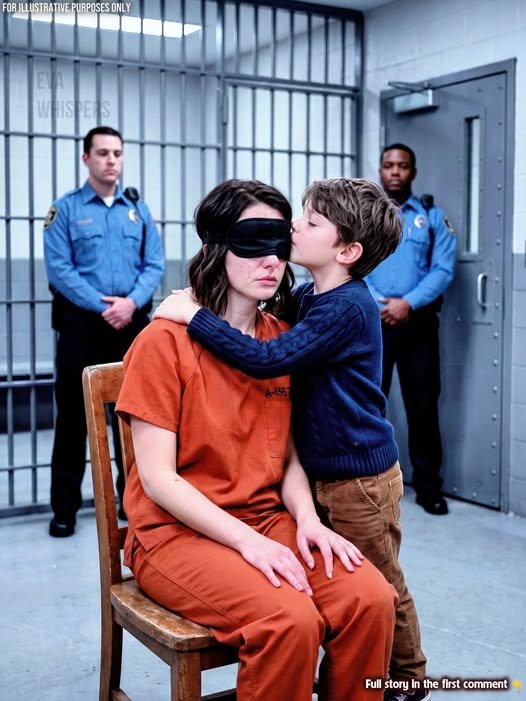
For six long years, the whole world believed my mother had murdered my father. Our relatives stopped saying her name. Neighbors lowered their voices whenever my brother and I walked past. Reporters called her cold, calculating, and heartless.
Then, minutes before her execution, my eight-year-old brother leaned close to her and whispered seven words that brought everything to a stop.
“Mom, I saw who hid the knife.”
In seconds, the secret that had destroyed our family began to crack open.
And every person in that room slowly turned toward the woman who had spent six years pretending to protect us.
The Lie Everyone Believed
“Don’t cry for me,” my mother said softly as the cuffs closed around her wrists. “Just promise me one thing. Look after Ethan.”
I was seventeen when the judge sentenced her to death for killing my father, Daniel Foster.
By then, almost everyone believed justice had been done.
The evidence seemed impossible to explain away.
My father had been found in our kitchen late one November night. He had suffered a fatal wound during what police believed was a violent argument.
The knife was discovered beneath my mother’s side of the bed.
Her fingerprints were on the handle.
Several neighbors had heard my parents arguing earlier that week. My father’s sister, Victoria, testified that my mother had once said she would “make Daniel regret everything” if he ever tried to leave her.
That sentence was repeated during the trial until it sounded less like something spoken in anger and more like a confession.
My mother insisted Victoria had twisted her words.
No one listened.
The prosecution told the jury that my mother had confronted my father over money, attacked him, cleaned herself up, and hidden the knife beneath the bed before calling for help.
Her defense attorney argued that there was no blood on her clothes and no evidence that she had cleaned the kitchen. He pointed out that the knife came from our own home, so it was hardly surprising that her fingerprints were on it.
But the story the prosecution told was simple.
People like simple stories.
A troubled marriage.
An angry wife.
A dead husband.
A knife with her fingerprints.
Nobody wanted to question the answer they had already been handed.
I never said aloud that she was guilty.
But somewhere deep inside, I wondered if she might be.
That doubt lived in my chest for years.
Everyone else condemned her loudly.
I failed her in a quieter way.
I said nothing.
Six Years of Silence
After the trial, my father’s sister became Ethan’s legal guardian.
Aunt Victoria had always seemed impressive to me. She wore tailored coats, drove an expensive black SUV, and spoke with the calm confidence of someone who expected to be believed.
She had worked beside my father at Foster Development, the construction company their parents had started.
At the funeral, she held my hand while cameras flashed outside the church.
“We’re all you have now,” she told me. “I’ll take care of you and Ethan.”
I was almost eighteen, so I moved into a small apartment after graduation and worked two jobs while attending community college.
Ethan stayed with Victoria.
She enrolled him in a private school, bought him new clothes, and made sure everyone knew how much she had sacrificed to raise her brother’s child.
Whenever Ethan had nightmares, she said they came from the trauma of losing our father and learning that our mother had killed him.
I believed her.
Or perhaps I wanted to believe her because the alternative was too complicated.
For all six years behind prison walls, my mother wrote to us.
Letter after letter arrived in pale envelopes bearing the prison’s return address.
She never begged.
She never blamed me.
She always wrote the same three things: she was innocent, she loved Ethan and me more than anything, and she would never have hurt our father.
No matter how angry they had been with each other.
No matter what Victoria claimed.
I read every letter.
I kept them tied together with a ribbon in the back of my closet.
But I never wrote back.
I told myself I didn’t know what to say.
The truth was uglier.
I was afraid that answering her would mean choosing her side. I was afraid people would look at me and see the daughter of a murderer. I was afraid she would convince me she was innocent, and then I would have to live with questions I had spent years trying to bury.
Doubt has a cruel way of getting louder.
Loud enough to drown out even the deepest love.

The Last Visit
The morning of the execution arrived before I could believe it was real.
Rain covered the highway as I drove Ethan to the prison. He sat silently beside me in a blue sweater that was much too big, the sleeves hanging past his hands.
Aunt Victoria followed in her SUV.
She had insisted on coming.
“You shouldn’t have to face this alone,” she told us.
Ethan had barely spoken all morning.
As we entered the prison, he gripped my arm so tightly that his fingers hurt.
Our mother was brought into the visitation room a little after nine.
Prison had made her thin. Silver strands ran through her dark hair. Her shoulders seemed smaller than I remembered.
But her eyes had not changed.
They were still the same gentle brown eyes that had watched over us through childhood fevers, nightmares, school plays, and scraped knees.
When she saw Ethan, she stopped walking.
Then she knelt as far as the restraints allowed.
“My sweet boy,” she whispered.
Ethan stood frozen for a moment before running into her arms.
She held him carefully, closing her eyes as if trying to memorize the feeling.
“I wish I could have watched you grow up,” she said.
“You did watch me,” he replied. “I have all your letters.”
My mother looked toward me.
I lowered my eyes.
She knew Ethan had received letters because I had passed them along. She also knew I had never answered mine.
Still, she smiled.
“You became so strong, Claire,” she said. “I’m proud of you.”
Those words nearly broke me.
I had spent six years abandoning her, and she was using her final minutes to comfort me.
“I’m sorry,” I whispered.
She shook her head.
“You were a child who lost both parents in one night. You don’t owe me an apology.”
A guard quietly announced that we had only a few minutes left.
My mother turned back to Ethan and touched his cheek.
“Listen to your sister,” she told him. “Be kind. Work hard. And remember that nothing anyone says can change how much I love you.”
Ethan did not cry.
Instead, he stared at something over our mother’s shoulder.
Aunt Victoria stood near the door, speaking quietly with a prison official. She wore a cream-colored coat and carried a leather handbag over one arm.
A small silver charm dangled from the bag’s zipper.
It was shaped like a fox.
Ethan’s face went pale.
He leaned close to our mother’s ear.
“Mom,” he whispered, “I know who put the knife under your bed.”
My mother went completely still.
The Whisper That Stopped Everything
The guard standing nearest them must have noticed the change in her expression.
“What did he say?” the guard asked.
My mother looked at Ethan.
“Tell him,” she said.
Ethan shook his head and stepped backward.
Aunt Victoria stopped talking.
“Ethan,” I said gently, “what do you know?”
His eyes remained fixed on the silver fox hanging from Victoria’s handbag.
“The fox lady,” he whispered.
Victoria’s face tightened.
“Claire, he’s frightened,” she said quickly. “This isn’t the time to encourage one of his stories.”
Ethan began trembling.
“She was in Mom’s room,” he said.
No one moved.
The guard crouched beside him.
“Who was in your mother’s room?”
Ethan lifted one shaking hand and pointed.
“Aunt Victoria.”
The room fell silent.
Victoria gave a short, shocked laugh.
“That’s ridiculous. He was two years old.”
“Almost three,” Ethan said.
She stared at him.
He pressed himself against my side.
“I got out of bed because Dad was talking loud,” he continued. “I went into the hallway. I saw Aunt Victoria come out of Mom and Dad’s room.”
His words came slowly, mixed with sobs.
“She was holding a towel. The knife was inside it. She went back into the room and put something under the bed.”
Victoria stepped forward.
“That is not what happened.”
Ethan flinched.
The guard immediately moved between them.
My brother covered his face.
“She saw me,” he cried. “She told me the fox lady would take Claire away if I talked.”
The warden, who had been observing from the back of the room, raised his hand.
“Stop all preparations,” he ordered.
Victoria’s voice rose.
“You cannot delay a lawful sentence because of a child’s nightmare!”
The warden looked directly at her.
“We can, and we will, until the appropriate authorities hear what this child has said.”
My mother’s attorney was called.
The state attorney’s office was notified.
Within minutes, an emergency motion was submitted to a judge. At 10:17 that morning—six minutes before my mother was scheduled to be taken from the visitation wing—a temporary stay was issued.
My mother was escorted away from us.
This time, however, she was not walking toward an execution chamber.
For the first time in six years, she was walking toward a chance.

The Silver Fox
Detectives separated us for questioning.
Ethan told his story three times.
The details never changed.
He remembered waking to raised voices. He had seen Victoria walk from the kitchen toward our parents’ bedroom.
She wore dark gloves and a bracelet with a silver fox charm.
After she came out of the bedroom, she noticed him standing in the hallway.
She knelt and gripped his shoulders.
“You had a bad dream,” she told him. “You didn’t see me. If you tell anyone you did, the fox lady will come back and take Claire away too.”
At two years old, Ethan had not understood death, evidence, or murder.
But he understood that he could lose me.
For years, he believed that staying silent kept me alive.
He had tried to talk about the “fox lady” several times after our father died, but Victoria told doctors it was an imaginary figure from his nightmares.
Once, when he was five, he asked me whether bad people could hide things beneath beds.
I remembered laughing nervously and checking under his mattress for monsters.
I had never asked why he wanted to know.
The silver fox charm on Victoria’s bag had brought the memory back clearly.
It had once been part of a bracelet.
Victoria claimed she had lost that bracelet before my father’s death.
But Ethan remembered it.
And now investigators had a reason to look again.
Reopening the Night
A new investigative team reviewed every item in the original case.
This time, they did not begin with the assumption that my mother was guilty.
They discovered that the towel wrapped around the knife had never been tested thoroughly. It had been dismissed as an ordinary kitchen towel belonging to our family.
Modern testing found a partial DNA profile inside one of the folded corners.
The profile belonged to Victoria.
Her attorney argued that she had visited our home often and could have touched the towel at any time.
Then investigators examined the financial records from Foster Development.
My father had discovered that more than $700,000 was missing from company accounts.
Money had been transferred through false invoices to a consulting business secretly controlled by Victoria.
Three days before he died, he had arranged a meeting with an accountant and told a colleague that he planned to confront his sister.
The colleague had mentioned this during the original investigation.
The statement had been buried in a file because detectives believed the family business had nothing to do with the killing.
Digital experts recovered deleted location information from Victoria’s old phone records.
She had testified that she spent the night at a hotel nearly forty miles away.
The records showed that her phone had connected to a tower less than a mile from our house shortly before my father died.
The final piece was found inside an old box from my father’s office.
It contained a small voice recorder.
My father often recorded business meetings so he could review them later. On the final recording, his voice sounded tired but firm.
“You took money from the company,” he said. “I gave you every chance to explain it. Tomorrow morning, I’m going to the board and the police.”
Victoria’s voice answered.
“If you do this, you’ll destroy everything.”
“No,” my father said. “You did that.”
The recording ended with the sound of a chair moving and Victoria saying, “You’ll regret choosing her over your own sister.”
By “her,” she meant my mother.
My mother had encouraged my father to report the missing money. Victoria believed that if my mother were gone, she could convince him to protect the family business.
When that failed, she decided to make my mother pay for it.
What Really Happened
Faced with the financial records, phone data, DNA evidence, Ethan’s statement, and the recording, Victoria’s story began falling apart.
She eventually admitted that she had gone to our house to stop my father from reporting her.
They argued in the kitchen.
My father refused to change his mind.
Victoria claimed she never intended to kill him. During the confrontation, she grabbed the kitchen knife to frighten him. A struggle followed, and he was fatally wounded.
Instead of calling for help immediately, she panicked.
She knew my parents had been arguing over money. She knew my mother had used the knife while preparing dinner, which explained her fingerprints.
So Victoria wrapped it in a towel, carried it upstairs, and hid it beneath my mother’s side of the bed.
Then she drove away, returned to her hotel, and waited.
When the police began questioning the family, she gave them the story they wanted.
She described my mother as jealous and unstable.
She exaggerated arguments.
She invented threats.
She sat beside Ethan during interviews and told investigators his comments about a fox lady were trauma-induced nightmares.
Later, she volunteered to raise him.
For six years, she built a reputation as the devoted aunt who had rescued two children from the woman who killed their father.
It was the perfect disguise.
Not because the evidence against my mother was perfect.
But because Victoria had made herself look like the last person anyone should suspect.

The Door Finally Opened
Three months after the execution was stopped, my mother’s conviction was vacated.
The prosecutor stood before the court and admitted that the state no longer believed she had committed the crime.
I sat beside Ethan in the front row.
When the judge ordered her immediate release, the courtroom became so quiet that I could hear my brother breathing.
A side door opened.
My mother stepped through wearing plain clothes for the first time in six years.
She paused as if she did not trust the floor beyond the doorway.
Ethan ran first.
She dropped to her knees and caught him in her arms.
Then she looked at me.
I wanted to run to her, but guilt held me in place.
She had written to me for six years.
I had given her silence.
“I should have believed you,” I said.
My voice broke before I could say anything more.
She crossed the space between us and pulled me into her arms.
“You were seventeen,” she whispered. “You were frightened, grieving, and surrounded by adults telling you what to believe.”
“I never wrote back.”
“I know.”
“I read every letter.”
“I know that too.”
I looked at her through my tears.
“How?”
“Because you kept them.”
I had brought the bundle of letters to court that morning. The ribbon was visible inside my open bag.
She touched my cheek.
“Love doesn’t disappear because fear makes us quiet,” she said.
For the first time since my father died, all three of us held one another without glass, handcuffs, guards, or cameras between us.
Learning to Be a Family Again
Freedom did not fix everything overnight.
My mother had missed birthdays, graduations, school concerts, and six years of ordinary mornings.
She did not know how to use the newest phone Ethan gave her. Crowded stores overwhelmed her. At night, she sometimes woke believing she was still inside her cell.
Ethan struggled too.
He blamed himself for waiting so long.
One evening, I found him sitting outside my mother’s bedroom.
“What if I had told someone before?” he asked. “Dad would still be gone, but Mom wouldn’t have been in prison.”
My mother heard him.
She sat beside him on the floor.
“You were a little boy,” she said. “Someone you trusted frightened you into silence. None of this was your fault.”
“But I remembered.”
“And when you were strong enough, you spoke.”
She took his hand.
“You saved my life, Ethan. But you should never have been placed in a position where saving me was your responsibility.”
We began seeing a family counselor.
We talked about my father—not only about how he died, but about how he lived.
He loved old jazz records, overcooked pancakes, and terrible jokes. He sang loudly in the car even when he did not know the words. He believed every broken object could be repaired with duct tape.
Victoria had taken enough from us.
We refused to let her take our good memories of him too.
My mother used part of the compensation she received from the state to create the Daniel Foster Family Justice Fund. It provided legal assistance and counseling to families affected by wrongful convictions.
She said she did not want revenge to become the center of her new life.
“I lost six years,” she told me. “I won’t give hatred the rest.”
Ethan placed the silver fox charm recovered from Victoria’s belongings in a sealed evidence box and never asked to see it again.
To him, it was no longer a symbol of fear.
It was proof that even a carefully hidden lie could not remain hidden forever.
The Letter I Finally Wrote
One year after my mother came home, I sat at the kitchen table and wrote her a letter.
She was only a few feet away, helping Ethan with his homework, but I needed to write it anyway.
I told her I was sorry for the years of silence.
I told her I had confused doubt with fairness and fear with wisdom.
I told her that while everyone else had taken her life apart with accusations, I had wounded her by withholding the one thing only I could give—my voice.
Then I thanked her for loving me through all of it.
When she finished reading, she folded the letter carefully.
“Why are you keeping it?” I asked.
She placed it inside the same wooden box where she now stored copies of the letters she had sent from prison.
“Because this one brought you back to me,” she said.
I thought the truth would set my mother free and erase everything that had happened.
It did not.
The truth could not return my father.
It could not give my mother back the years she had lost or take away the nightmares Ethan carried.
But the truth opened a door.
And through that door, slowly and imperfectly, we found our way back to one another.
For six years, the world believed my mother had destroyed our family.
In reality, our family had been torn apart by one carefully hidden lie.
But lies survive only while people remain afraid to speak.
My little brother had been frightened into silence when he was barely old enough to understand what he had seen.
Then, on the darkest morning of our lives, he found his voice.
Seven whispered words stopped an execution.
They exposed the person who had betrayed us.
And they gave the three of us something we thought we had lost forever.
A future.