
The call came while hospital soap still clung to my hands and the adhesive from a gauze strip stuck to my thumb.
Room 214, pediatric floor. A seven-year-old named Tyler was blinking hard while I changed the bandage on his arm, and the monitor beside him kept making that soft, steady beep that makes people believe the world still has rules. The hallway was cold under my scrub sleeves. The fluorescent lights made every face look tired.
Then my phone vibrated.
I almost let it go. Nurses get good at putting their own lives on mute. But my elderly neighbor had been admitted the night before, so I stepped into the hall and answered in the calm voice I use when everybody else is scared.
“Hello, this is Heather.”
The man on the other end sounded careful before he even said why.
“Miss Wilson, this is Craig Donovan from the bank. I’m calling about your missed mortgage payments.”
I laughed once because impossible news sometimes lands like a joke before it lands like a weapon.
“I don’t have a mortgage,” I said. “I rent a one-bedroom apartment.”
There was a pause. Not confused. Professional.
“Our records show you took out a mortgage for $623,000 in January. You are currently three months behind.”
The floor seemed to dip under my sneakers.
Then he read the address.
4872 Highland Drive.
My sister’s house.
Amanda’s Craftsman with the sunroom. Amanda’s marble counters. Amanda’s city view. Amanda’s life, polished and posted online with captions about hard work, blessings, and knowing your worth.
Eight months earlier, she had walked me through that house with a wineglass in her hand and said, “Someday you’ll have something like this too, Heather. You just need to aim higher.”
I smiled then because she was my sister.
I did not know she had already aimed at me.
Craig said the file had my Social Security number, my employment history, my signature, and income verification claiming I made $192,000 a year.
I almost dropped the phone.
I am a nurse. A good one. A tired one. The kind who picks up extra shifts, packs leftovers in plastic containers, and keeps a paper coffee cup in the cupholder because buying one from the hospital cafeteria feels reckless by Thursday.
I do not make $192,000 a year.
At 6:18 p.m., I walked into the bank branch still wearing scrubs under my jacket. Richard Peterson, the branch manager, took me into a small office and set a thick folder on the desk.
Too thick.
Loan application. Credit authorization. Closing documents. Income verification. Page after page with my name typed at the top and my name written at the bottom.
Heather Wilson.
Almost my signature.
Almost.
The H was too controlled. The W was too careful. My real signature gets loose in the middle when I am tired, and I am always tired. This one looked practiced. Copied. Rehearsed.
That was when the last little part of me hoping this was a clerical mistake went quiet.
Amanda had not borrowed my sweater, my car, or twenty dollars until payday.
She had borrowed my identity and left me with a house-sized bomb.
Richard lowered his voice as he handed me the copies. “If you did not sign these, Miss Wilson, you should contact the police.”
Police.
Family teaches you to solve family problems at family tables. Smile through it. Keep it private. Don’t embarrass your mother. Don’t make Thanksgiving weird. But a forged signature does not become less criminal because it shares your last name.
The next morning at 7:42 a.m., I pulled my credit reports at my apartment kitchen table while my laundry sat folded in a basket by the door.
My credit score had fallen to 546.
I stared at that number until the laptop blurred. I had spent my adult life paying bills on time, saying no to trips I could not afford, buying used furniture, and telling myself slow stability still counted as success.
Amanda had burned it down in less than a year.
A family secret does not always explode. Sometimes it clears its throat in a bank office and waits for you to recognize the voice.
I wanted to call her. I wanted to scream. I wanted to hear her say, “Heather, no, I would never.”
But I knew Amanda.
She could lie warmly. She could lie with her hand on your shoulder. She could lie so beautifully you ended up apologizing for making her uncomfortable.
So I gathered proof instead.
A financial adviser named Diane reviewed the mortgage packet, the credit report, and the loan copies at her desk. A small American flag stood beside a framed photo on the shelf behind her.
“This is identity theft,” she said.
Then she saw the address.
“This is your sister’s house?”
“Yes.”
Her face changed. Not legally. Humanly.
“Family fraud is emotionally complicated,” she said. “Not legally complicated. Without a police report, the banks may treat you like a participant instead of a victim.”
I hated that word.
Victim.
It made me feel like I had left a door unlocked somewhere inside my own life.
Then a handwriting expert named Marcus Bell compared the mortgage signatures against my passport, hospital paperwork, and rental agreement.
“These are forgeries,” he said.
“Are you sure?”
“Yes. Good forgeries. But forgeries.”
He pointed to pressure changes, hesitation marks, and letters copied instead of written naturally.
“Someone who knew your signature may have practiced this.”
I did not ask who.
By Friday afternoon, I had duplicates, a printed credit report, Marcus’s handwriting analysis, and the police report I filed with hands shaking so badly the officer asked if I needed water.
That night was family dinner at my parents’ house.
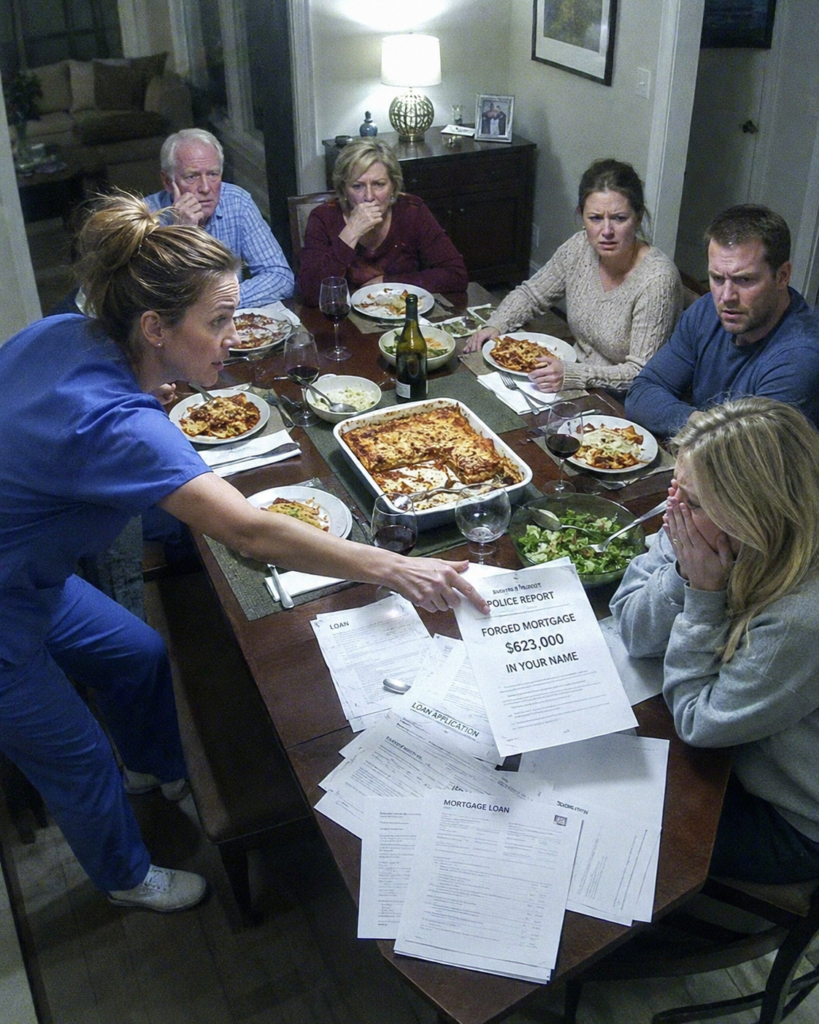
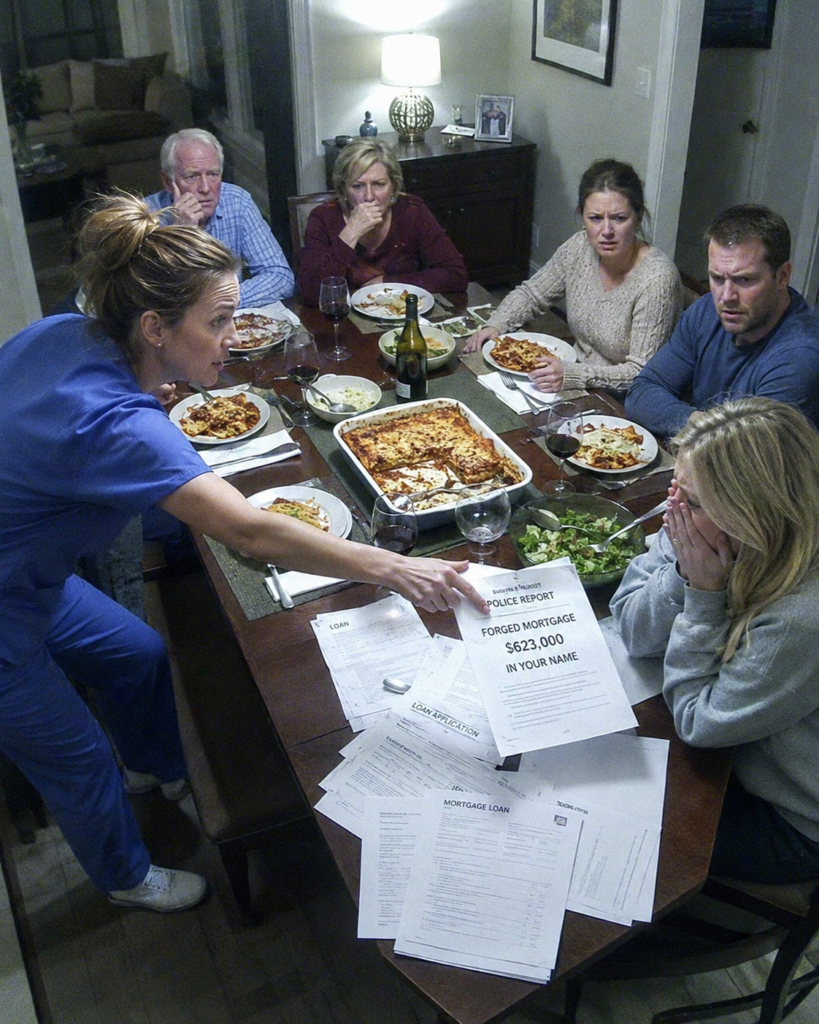
Amanda came in wearing a cream blouse and carrying chocolate mousse cake like she had not built her life on top of my ruined name. Brian carried wine. My mother fussed over lasagna. My father asked about my shift.
Everybody acted normal.
That was the cruelest part.
Normal sat at the table with us. Normal passed the salad. Normal laughed when Amanda told a story about a contractor messing up the built-in bookshelves at Highland Drive.
I sat across from her and watched her smile.
Forks scraped plates. The ceiling fan clicked once every few turns. Tomato sauce steamed between us under the dining room light. My father stared at his napkin when Amanda bragged. My mother kept refilling water glasses nobody had asked for. Brian leaned back like money trouble was always someone else’s weather.
Then Amanda lifted her glass and said, “People who play small stay small.”
I reached into my bag.
My fingers found the police report.
For one ugly second, I pictured standing up and letting every word in my throat come out at once. I pictured the glass in Amanda’s hand trembling. I pictured my mother finally seeing both of her daughters clearly.
I did not do any of that.
I did not raise my voice. I did not throw anything. I slid the folder across the table, past the lasagna, past my mother’s hand, until it stopped in front of Amanda’s plate.
The room froze.
My father’s fork stayed halfway to his mouth. My mother’s hand hovered over the salad bowl. Brian’s wineglass stopped against his lower lip. A ribbon of melted cheese stretched from the serving spoon and fell back into the pan while everyone stared at the folder like it had started breathing.
Amanda looked down.
The color left her face so fast it was like someone had pulled a plug.
Brian reached for the folder, but Amanda grabbed his wrist first.
My mother whispered, “Heather… what is this?”
And I looked at my sister and said—
Tell them what you did with my name.”
Amanda’s fingers were still clamped around Brian’s wrist, but the grip had changed. It was not protective anymore. It was panicked. Her nails pressed into his skin while the police report sat beside her plate, the top page stamped with the case number, my name, and the address she had been bragging about all night.
Brian slowly pulled his hand free.
“Amanda,” he said, softer than I expected. “Why is there a police report about our house?”
She opened her mouth. Closed it. Smiled for half a second like muscle memory had reached for the old trick and found nothing there.
My father set his fork down so carefully it barely made a sound. My mother looked from Amanda to me, and all the little family rules about keeping peace seemed to collapse right there between the lasagna pan and the water pitcher.
Then I slid out the second page I had kept tucked under the report.
Not the mortgage.
The $150,000 home equity line of credit.
Amanda saw the number before anybody else did. Her eyes moved across the page, and whatever color was left in her face disappeared. Brian stood so fast his chair scraped the floor behind him.
“You told me that was savings,” he whispered.
My mother sat down hard in the chair beside her, one hand pressed over her mouth. My father said Amanda’s name once, and for the first time in my life, it sounded less like a question than a verdict.
I placed my fingertips on the folder so my hands would stop shaking.
Then Brian looked at his wife, the woman who had been smiling over lasagna ten seconds earlier, and asked the question that made Amanda finally let go of the table edge:
“Amanda… what else did you put in her name?”
Part 2 and full ending: Type “YES” and Press “Like” so we can post the full story. Thank you!
If you don’t see it, switch to Newest/All.