
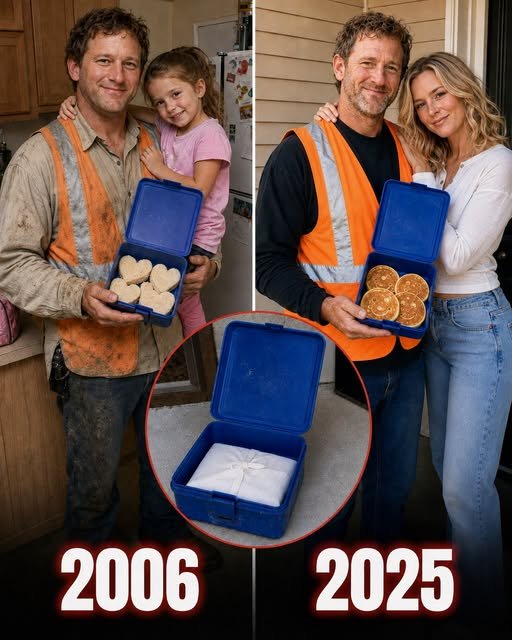
“For twenty years, he made sure I never began a day feeling forgotten. His final lunch made sure I would not face the years ahead alone.”
Part 1 – Before Sunrise
For twenty years, my father made my lunch before most of the neighborhood had turned on a single light. The only morning he failed to do it was the morning he died.
Dad had been both parents to me since I was four, when my mother, Denise, left with Richard, the wealthy man who employed her. He never tried to make me hate her. He simply folded her name away like a document too painful to keep reading. If anyone asked about her, his mouth tightened, his answer became brief, and within seconds he was talking about the weather, my homework, or anything else that could keep me from seeing the wound in his face.
His alarm sounded at 4:30 every morning. By five, he was in scuffed work boots with coffee steaming from a battered thermos, ready to spend the day framing walls and raising roofs for families he would never know. Yet before he built anything for them, he stood in our small kitchen and made something for me.
When I was little, he trimmed away every crust and used metal cutters to turn bread into hearts, stars, or lopsided animals. Apple slices became flowers. Pancakes wore crooked smiles. Later, when childish shapes would have embarrassed me, he replaced them with notes tucked under the napkin: a joke before a difficult Monday, encouragement before an exam, or four simple words – I believe in you.
I went to college, graduated, and found an office job across town. Dad still refused to surrender the ritual. Before dawn, the blue metal lunchbox appeared outside my apartment as faithfully as the morning paper. Whenever I told him I was old enough to feed myself, he would grin and say, “A paycheck doesn’t make you too grown to be loved.”
Nothing stopped him. He delivered lunch through winter storms, after punishing shifts, and even during the months when his face began to sharpen and climbing my apartment steps left him breathless.
He called his hospital visits “appointments” and hid the truth until I found several treatment bracelets under the passenger seat of his truck. I drove straight to his house, set them on the kitchen table, and demanded to know why he had shut me out.
Dad looked at the bracelets for a long moment. “I was trying to keep one part of your day untouched,” he said quietly. “I wanted your lunch to taste like home, not like a hospital waiting room.”
I cried. I argued. I begged him to let me care for him. He apologized, accepted my help with nearly everything, and remained stubborn about the lunchbox. Near the end, his fingers trembled so badly that he sometimes pinned sandwiches together with toothpicks. I would tell him to rest, and he would promise he would – soon. Somehow, soon always remained one morning beyond our reach.
Then Cal, his foreman and oldest friend, called before sunrise. He said my name once, and the silence that followed told me what his words had not yet managed to say.
“Claire, he’s gone.”
That morning, there was no lunchbox outside my door.
The funeral blurred into lilies, dark clothes, covered dishes, and people telling me how dependable Dad had been. They meant the houses he had finished, the shifts he had never missed, and the promises he had kept at work. I thanked them because they were right. But they did not know his greatest act of devotion had happened quietly in a kitchen, one sandwich at a time. He had spent two decades making certain I never started the day wondering whether I mattered.

The morning after we buried him, I woke before my alarm and walked to the front door without deciding to. Grief had taken control of my muscles; my body was repeating a habit my mind knew had ended.
I opened the door expecting the bare welcome mat I had found on the day he died.
Dad’s blue lunchbox was waiting beneath the porch light.
A streak of dried mud darkened one corner. The handle tilted slightly to the left, just as it had for years. I stared until the cold from the floor climbed through my bare feet. We had lowered my father into the ground less than twenty-four hours earlier. That box could not possibly be there, yet every dent in it belonged to him.
I carried it inside, locked the door behind me, and set it on the table. The metal latch felt icy against my shaking thumb.
There was no food inside. Instead, I found a small parcel wrapped in brown paper, a sealed envelope bearing my name, and a bus ticket for that afternoon. I pulled away the string around the parcel. A photograph slid free, and the moment I saw it, all the blood seemed to leave my face.
Dad stood beside a teenage girl in front of an apartment building. He looked frail, but his smile was unmistakably happy. The girl appeared to be sixteen or seventeen. She had my eyes, the dimple in my left cheek, and the same slight tilt of the head that appeared in every school picture Dad had ever saved.
At the bottom of the photograph, Dad had written five words: “Her name is Lily. Find her.”
My first feeling was not curiosity. It was betrayal. The photograph seemed to prove that Dad had built another life while telling me I was the center of his. Shame for that assumption came later; anger arrived first.
I called Cal. My fingers missed his name twice before I managed to press it.
“You left the lunchbox,” I said when he answered.
Cal released a long breath. “Your dad made me promise I would.”
“Who is Lily? I need the truth now.”
“She isn’t his daughter, Claire,” Cal said. “She is Denise’s daughter. Your half sister.”
The kitchen seemed to tilt. I had not heard my mother’s name spoken aloud in years except when legal paperwork forced it into the room.
Cal told me Denise had called Dad three years earlier. Richard was gone. Denise was seriously ill, and Lily was working late shifts while her grades collapsed. Dad began visiting once a week. He repaired what was broken, helped with applications, taught Lily to drive, and left meals whenever he could.
“Why would he hide that from me?” I asked.
“Because he was afraid you would think he had chosen the life Denise built after leaving you,” Cal said. “He was wrong to keep it secret, but he never stopped being afraid of hurting you.”
I looked at the ticket. “And the bus?”
“He knew you would be furious. He also knew better than to trust you behind the wheel while you were furious.”
Even from beyond the grave, Dad sounded exactly like himself. I packed the photograph and envelope into the lunchbox and boarded the bus that afternoon.

Part 3 – The Girl Above the Laundromat
The bus carried me through miles of gray streets while anger pressed against my ribs. Why had Dad protected a secret this enormous? Why had he answered a call from the woman who had abandoned us? And why, in that photograph, had he looked so peaceful beside Lily? Every explanation I invented made me feel worse.
The address led to a tired brick building above a laundromat. A girl in a school sweatshirt sat on the front steps with a backpack between her shoes. When she saw the lunchbox in my hand, she sprang up so quickly that the backpack toppled sideways.
“Where did you get that?” Her voice broke before she reached the last word.
“Are you Lily?”
She nodded, tears already gathering. “You must be Claire. He showed me your pictures.”
The ease with which she said my name unsettled me. She knew the shape of my life while I had not known she existed.
I asked whether she had attended the funeral. Lily looked toward the pavement. “I stood behind the tree, past the chairs. I didn’t know if I had the right to come closer.”
Then I remembered a thin girl alone at the edge of the cemetery. I had assumed she was the daughter of one of Dad’s coworkers.
“He promised he would be at my graduation,” Lily continued. “Then he stopped visiting. Mom finally told me he had cancer. I thought maybe he had decided I was too much trouble before he died.”
“He did not forget people,” I snapped.
Lily recoiled, and shame immediately cooled my anger. “I’m sorry,” I said. “None of this is your fault. I just don’t know where to put what I’m feeling.”
“Neither do I,” she whispered.
She told me Denise was upstairs recovering from surgery. She also told me I did not have to see her. Every part of me wanted to leave. Instead, I tightened my grip on the lunchbox and followed Lily inside.
Denise sat beneath a blanket near the window. Illness had narrowed her face and silvered her hair, but I recognized her from the one photograph Dad had kept hidden in a drawer. She looked at me as if my name were both a prayer and a punishment.
“Claire.”
I stayed near the door. “How could you ask him to help raise your second child after walking away from your first?”
Lily murmured my name, but Denise raised a hand. “Let her ask. She earned the truth years ago.”
Richard had left them long before. When Denise became seriously ill, Lily began working nights while trying to stay in school. Bills piled up. Repairs went undone. Denise said she had called Dad only after every other door had closed.
“You went back to the man you betrayed because you needed him,” I said.
She lowered her eyes. “I called him because I knew he would never make a child pay for an adult’s mistake.”
The answer hurt because it described my father perfectly.
I asked if she had apologized. Denise said she had, many times. When I asked whether Dad forgave her, she gave a small, tired nod. “He told me forgiveness could release the past without reopening the door. He helped Lily, but he never pretended that what I did to you was acceptable.”
Before I could answer, Lily asked me to come to her room. Perhaps she sensed that one more sentence might break all three of us.

Part 4 – The Letter Dad Never Got to Give Me
Lily’s room was small and carefully kept. Textbooks were stacked beside a secondhand laptop, and several of Dad’s lunch notes were pinned above the desk.
One said, “One chapter at a time. You don’t have to conquer the whole book tonight.” Another read, “A painful day is still only one day. Don’t let it write your entire future.”
The third note made me reach for the wall to steady myself: “Your sister has more courage than she realizes. So do you.”
“He talked about me?” I asked.
Lily nodded. “Constantly. I knew you hated peas, loved thunderstorms, and laughed when you were nervous. He showed me your graduation pictures so often I could probably describe the dress you wore.”
I sat on the edge of her bed. Until then, part of me had imagined a separate version of Dad in this apartment – a man who had put me aside while becoming important to someone else. The notes told a different story. Even while helping Lily, he had carried me into every room.
Lily explained that Dad had planned to introduce us after her graduation. He wanted her to be old enough to decide what kind of relationship she wanted with me without Denise directing it. He also wanted to tell me himself, face-to-face, so I could be angry with the right person.
“He thought he had more time,” she said. “The cancer moved faster than he did.”
From a desk drawer, she removed another envelope. My name crossed the front in Dad’s unsteady late-stage handwriting. I opened it with Lily sitting beside me.
“Kiddo, if you are reading this, I ran out of time. You have every right to be hurt that I kept Lily from you. I was afraid the truth would feel like I had chosen the family your mother made after she left us. I never did.”
“Helping Lily did not take anything away from you. Love is not a loaf that shrinks because another hungry person receives a slice. You were the promise that made me a father. Lily became a promise my conscience would not let me ignore. Please do not make her answer for choices adults made before she was born.”
I lowered the letter into my lap. Lily watched me without reaching for comfort or asking to be forgiven for existing. That restraint made her look much younger than she had on the steps.
“I am angry,” I admitted.
“With him?”
“Some. Mostly with Denise.” I glanced toward the living room. “But none of that anger belongs to you.”
Lily’s face folded. She began to cry soundlessly, and after a moment, I put my arm around her. It did not feel natural yet. It felt like learning the first word of a language Dad had hoped we would one day speak.
Part 5 – Learning to Share a Father
Cal arrived at the apartment the next morning carrying a small paper bag. Inside were Dad’s old wristwatch, Lily’s graduation forms, and the metal heart-shaped sandwich cutter from my childhood. A strip of paper had been tied around its handle.
“After graduation, make lunch together,” Dad had written. “Neither of you should have to eat alone.”
The watch and forms were for Lily. The cutter was for both of us. Cal admitted that Dad had trusted him with only pieces of the plan. “He wanted the important parts to come from him,” Cal said. “Leaving that lunchbox at your door was the closest I could get.”
Over the next month, Lily and I built a relationship out of ordinary errands. We found a graduation dress that made her stand taller. We practiced the route to school so Denise would not have to worry. I replaced the cracked strap on Dad’s watch, then watched Lily fasten it beneath her sleeve as carefully as if she were holding his hand.
We did not become sisters in one dramatic moment. We became sisters while comparing shoe sizes, sharing fries on the bus, and discovering that we both stirred coffee long after the sugar had dissolved. At first, every silence between us felt fragile. Gradually, silence became a place where neither of us had to perform.
A week before graduation, Lily helped me empty Dad’s house. We boxed up work gloves, receipts, old tape measures, and notebooks stained by rings from his thermos. In the kitchen, she opened a drawer and found dozens of folded notes he had prepared but never used.
Some contained awful jokes. Others reminded us to breathe, call home, or trust ourselves on difficult days. We decided not to read them all. Grief already made us hungry for any scrap of him, and consuming every message in one afternoon felt like finishing the last food in the house.
We divided the stack. Before we left, Lily slipped one note into my coat pocket. I tucked another into her backpack. Neither of us acknowledged what we had done, but for the first time, sharing Dad did not feel like having less of him.
Later that evening, Lily asked, “Did he really bring you lunch every single day?”
“Every day he could.”
She looked down. “He only came here once a week. Sometimes twice.” Guilt moved across her face, as though she had accepted something stolen from me.
I reached for her hand. “Frequency isn’t the same as love. He gave each of us what we needed. You don’t have to apologize for needing him.”
Her shoulders loosened. After a moment, she said, “His tuna sandwiches were terrible.”
I laughed so suddenly that it startled both of us. “At last – undeniable proof we had the same father figure.”
Denise and I remained more complicated. I visited her once before graduation and told her I was not ready to forgive her. I might never understand how she had left a four-year-old child behind. But I also promised I would not turn Lily into a weapon for punishing her.
Denise did not ask for more. “That is already kinder than I deserve,” she said.
It was not reconciliation. It was a boundary with a small gate in it, one I could choose to open later if healing ever made that possible.

Part 6 – Two Heart-Shaped Sandwiches
On graduation day, Denise sat in a wheelchair near the aisle, and I took the seat beside her. We spoke only when necessary. Some wounds do not vanish because the room has been decorated with flowers and hope.
When the principal announced that Lily had earned a scholarship to study civil engineering, Denise gasped. I understood the choice before Lily later explained it. Dad had spent weekends showing her why certain houses survived pressure and others failed, how a strong structure could bend without collapsing, and why a sound foundation mattered even when no one could see it.
Lily crossed the stage with Dad’s watch hidden under her gown. When her name echoed through the auditorium, I stood and applauded until my hands burned.
Beside me, Denise wept. “He should be sitting here.”
I kept my eyes on Lily. “He is part of every step that brought her across that stage.”
It was not forgiveness. But it was the first sentence I had spoken to Denise that did not come from anger.
After the ceremony, Cal drove Dad’s pickup into the school parking lot. He placed the keys in my palm and handed Lily and me two sealed notes. Then he pointed to the sandwich cutter in my bag.
“Your dad’s last instruction was very specific,” he said. “Take the truck home and make lunch together.”
Dad’s kitchen looked as though he might return at any moment. His dented thermos stood beside the sink. The bread box remained partly open. Thousands of knife strokes had faded the center of the cutting board to a lighter shade of wood.
Lily and I worked side by side. She spread mayonnaise all the way to the crust. I cut the cheese crooked. We debated whether Dad would have added pickles, then laughed when we realized neither of us could remember him ever making the same sandwich twice.
At last, I pressed the old metal cutter through the bread. It produced two imperfect hearts.
We carried the sandwiches outside and sat on the hood of Dad’s truck. The late-afternoon sun warmed the windshield behind us. Beneath each napkin was one of the envelopes Cal had given us.
We opened them at the same time.
My note said, “No one ever took your place.”
Lily’s said, “You were never a duty. You were loved.”
Without speaking, we exchanged the notes. I read the reassurance Dad had written for her; she read the one he had written for me. Somehow, holding the proof meant for the other person made its truth feel larger.
Lily leaned her head against my shoulder. This time, there was no careful distance between us. I let my cheek rest against her hair, and together we ate the first lunch Dad had asked us to make for ourselves.
The lunchbox he left after his funeral had contained no sandwich. It held an introduction, an unfinished apology, a path through my anger, and one final lesson from the man who had raised me: love does not become smaller when it is offered to someone else in need.
For twenty years, Dad made sure I never ate alone. After he was gone, he gave me someone to sit beside.