
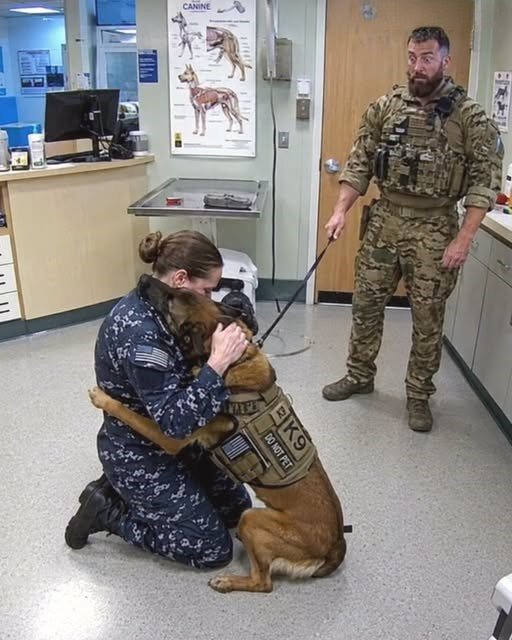
PART 2
For several seconds, no one in the clinic moved.
Ghost remained pressed against me, his body trembling with a restraint that felt more painful than panic. His ears were lowered, his breathing shallow, his amber eyes fixed on my face as if he had spent years searching for it.
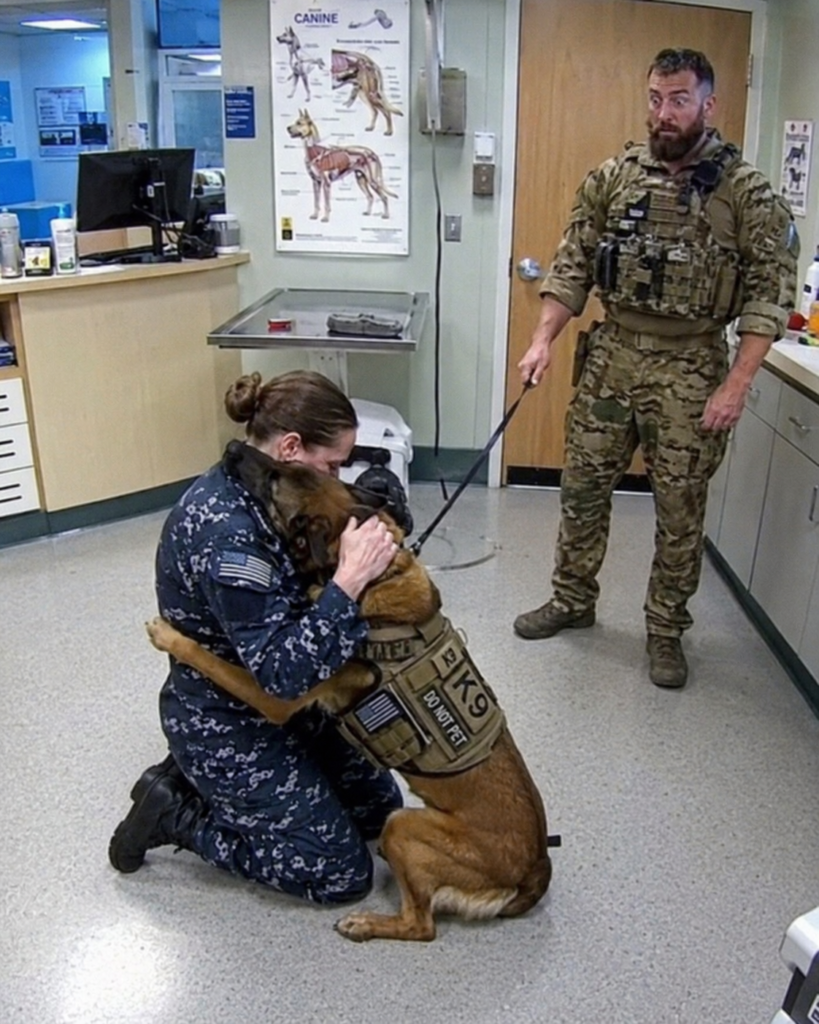
The SEAL stood three steps away, one hand still wrapped around the useless leash.
“What’s impossible?” I asked again.
He looked toward the waiting room.
Paula had risen from behind the desk. Two veterans sat rigidly beside their dogs, pretending not to listen while listening to everything. Rain tapped steadily against the windows.
The man lowered his voice.
“This dog has never responded to that command.”
“That is because you were never taught it.”
His jaw tightened. “Who taught you?”
I looked down at the tag resting against Ghost’s chest.
“Lieutenant Ethan Cross.”
Something flickered in his expression. Not surprise. Recognition.
That was enough.
“You knew him,” I said.
He did not answer.
Ghost shifted closer until his shoulder rested against my knee. I placed one hand on the side of his neck, feeling the old rhythm beneath his fur. His pulse was fast but steady.
“Paula,” I said, without taking my eyes off the handler, “close the clinic for one hour. Reschedule anything that can wait.”
She hesitated only long enough to understand that this was not a request.
“All right.”
The veterans gathered their leashes quietly. One of them, an older man with a silver Labrador, paused near me.
“You safe, Doc?”
“I am.”
He studied the SEAL, then Ghost.
“Call if that changes.”
When the door closed behind the last patient, the room seemed to shrink.
I stood slowly. Ghost rose with me.
“Exam room three,” I said.
The handler did not move.
“You wanted a refill.”
“That was an excuse.”
“I know.”
His eyes narrowed.
“You knew when I walked in?”
“No. I knew when you said his name.”
He glanced at Ghost. “He came to me as Atlas.”
The name struck another wrong note.
“Who renamed him?”
“I did.”
“Why?”
“Because I was told Ghost was a call sign, not his real designation.”
“It was both.”
The handler looked toward the hallway, as though measuring exits.
“Exam room three,” I repeated. “Or you can leave. But Ghost stays until I determine why a supposedly dead military working dog has a scarred flank, an outdated identification tag, and medication prescribed under a false name.”
For the first time, his control cracked.
“You cannot keep him.”
“I can if his records are fraudulent.”
Silence stretched between us.
Then he released the leash.
Ghost did not look back at him.
In the exam room, rainwater darkened the handler’s shoulders. He remained standing while I guided Ghost onto the padded floor mat and began a physical examination.
Up close, the years were visible.
Ghost’s muzzle had gone silver. A long scar crossed his left side, disappearing beneath the rib cage. One rear leg carried mild muscle loss. His teeth showed wear consistent with hard work and age.
But his eyes were still the same.
I remembered those eyes watching Ethan across a desert camp, following every gesture, every shift in posture. Ghost had always known Ethan’s mood before I did.
“What medication?” I asked.
“Gabapentin. Occasionally trazodone.”
“For pain and anxiety?”
“Yes.”
“Nightmares?”
The handler’s face changed.
“Dogs do not dream the way people do.”
“That was not my question.”
He looked at Ghost. “He wakes disoriented. Searches doors. Sometimes refuses food afterward.”
“How long?”
“Since I took custody.”
“When was that?”
“Eleven months ago.”
I stopped examining the rear leg.
“From whom?”
“A private recovery organization working under a federal contract.”
“Name.”
“I cannot give you that.”
“You brought a living piece of my past into my clinic and expected me to refill medication without asking questions?”
“I was told you were the best.”
“By whom?”
He said nothing.
Ghost’s head lifted.
I looked at the handler carefully. “What is your name?”
“Caleb Ward.”
“Rank?”
“Lieutenant.”
“Active?”
“Yes.”
“Unit?”
His mouth tightened. “You know I cannot answer that.”
“I know the difference between classified information and avoidance.”
Caleb finally sat on the metal stool near the wall.
“I was ordered to bring him here.”
The words entered the room softly.
“Ordered by whom?”
“A man who said you would recognize the dog.”
“Name.”
“I never met him.”
“You accepted an order from a stranger?”
“It came through proper channels.”
“Then give me the channel.”
“I cannot.”
My patience thinned.
“Caleb, either you are protecting someone, or someone used you.”
His eyes met mine.
“Probably both.”
Ghost lowered his head onto my boot.
I finished the examination because routine was the only thing keeping my hands steady. Heart and lungs normal. Mild arthritis. Old scar tissue. No acute injury.
When I touched the faded line along his ribs, Ghost flinched.
I froze.
Ethan had once taught me that Ghost did not react to pain unless it surprised him. This reaction was not pain.
It was memory.
“What happened here?” I asked.
Caleb looked down.
“That scar was already healed when I got him.”
“Were there records?”
“Partial.”
“Where?”
“Restricted.”
“Everything about him is restricted.”
“That is why I came.”
I stood.
“No. You came because someone wanted me to see him. The question is why now.”
Caleb rubbed a hand over his face.
“You really were Rook.”
“How do you know that name?” I asked.
Caleb’s answer came carefully.
“Because it appears in a mission file that officially does not exist.”
My pulse changed.
“What file?”
“The recovery report from Operation Night Lantern.”
The room blurred at the edges.
That operation had been erased from every system I was allowed to search. After Ethan disappeared, I spent six months requesting debriefing records, casualty reports, air support logs, satellite transcripts. Every request returned the same answer.
No accessible file.
No recoverable remains.
No surviving assets.
Ghost nudged my leg, sensing the shift in me.
Caleb continued.
“I found the file nine months ago.”
“How?”
“I was assigned to review irregularities in canine retirement records. Ghost’s microchip led to a sealed archive.”
“What did it say?”
“That the extraction failed. That Cross and the dog were presumed killed. That Rook was removed from the area before secondary contact.”
“That is the official version.”
“There was an addendum.”
I could hear my own heartbeat.
“What addendum?”
Caleb looked at the closed door.
“It listed one recovered survivor.”
The room became very quiet.
“Ghost?”
“No.”
I stared at him.
“Then who?”
“The name was redacted.”
I laughed once, but there was no humor in it.
“You expect me to believe a survivor was recovered and hidden for seven years?”
“I expect you to believe someone altered the file three times.”
He reached inside his jacket slowly and removed a small encrypted drive.
“This is why I brought him.”
I did not take it.
“What is on that?”
“Fragments. Medical transport records. Kennel intake logs. A voice file.”
“Whose voice?”
“I do not know.”
“You just said you read the report.”
“I read what they left visible.”
“And the rest?”
“Corrupted or deliberately removed.”
Ghost lifted his head again at the word voice, as if it carried meaning.
I looked from the drive to Caleb.
“Why me?”
“Because the voice file contains one word.”
The answer came before I asked.
“Lantern.”
For seven years, I had trained myself not to imagine alternatives.
Ethan had died.
Ghost had died.
The mission had failed.
The certainty was brutal, but it was stable. Grief had edges. I had learned where not to touch them.
Now those edges had vanished.
“Play it,” I said.
Caleb hesitated.
“Here?”
“Now.”
He placed the drive on the counter and connected it to a small secure device from his pocket. The screen displayed a single audio file with no date.
The first seconds contained static.
Then a voice.
Male. Weak. Distorted by interference.
“Lantern… find Rook.”
My knees nearly gave way.
I gripped the edge of the counter.
The voice lasted less than four seconds.
Caleb stopped the recording.
“No,” I said. “Again.”
He played it again.
Static.
Breath.
Two words.
Find Rook.
It sounded like Ethan.
It also sounded like memory imitating him.
I closed my eyes.
“When was that recording made?” I asked.
“The metadata says three months after the mission.”
I opened my eyes.
“That cannot be right.”
“I checked it against the transport archive. The audio was attached to a patient transfer from a field hospital to a naval medical facility in Europe.”
“Who else has heard this?”
“Two people.”
“Names.”
“My commanding officer and the archivist who helped me extract it.”
“Can I speak to them?”
“The archivist disappeared six days later.”
The words chilled the room.
“Disappeared how?”
“She resigned, emptied her apartment, and left no forwarding information.”
“Do you believe she was harmed?”
“I do not know.”
“And your commanding officer?”
“Ordered me to close the review.”
“But you did not.”
“No.”
I checked the clock.
Wednesday.
The rain had intensified, drumming against the roof.
“We need to scan his chip,” I said.
Caleb frowned. “I already did.”
“You scanned the military chip.”
“There is another?”
“There might be.”
Ethan had once implanted a secondary identification capsule during a joint exercise after a series of dogs had been separated from their units during transport. It was technically unauthorized, harmless, and known only to our small team.
I moved the scanner slowly along Ghost’s shoulder, neck, and chest.
Nothing.
Then I passed it beneath his left foreleg.
The device beeped.
Caleb stood.
A sixteen-digit number appeared.
I felt my breath stop.
The first six digits matched the private code Ethan and I had used for all secondary tags.
The last four were not random.
They were my birthday.
Caleb stared at the screen.
“That chip is not in any record.”
“It was never meant to be.”
I entered the number into an offline reader attached to the clinic computer. A small encrypted field appeared.
PASSWORD REQUIRED.
I tried Lantern.
Denied.
I tried Ethan’s service number.
Denied.
Ghost placed one paw against my leg.
I looked at the screen again.
“What did Ethan call you?” Caleb asked.
“Rook.”
“Not in the field.”
I almost told him it was none of his business.
Then I remembered Ethan laughing in the rain outside a temporary kennel, calling me stubborn because I had refused to leave a sick dog overnight.
“North Star,” I said.
Caleb waited.
I typed NORTHSTAR.
The file opened.
Only one line appeared.
IF FOUND, CONTACT DR. M. COLE. DO NOT RETURN TO PROGRAM KESTREL.
Caleb read it twice.
“Do you know what Kestrel is?”
“No.”
He looked genuinely unsettled.
“I do.”
Before he could explain, the clinic phone rang.
Paula answered in the front.
A few seconds later, she appeared in the doorway.
“Madison, there is a man asking for you.”
“Name?”
“He will not give one.”
“Tell him we are closed.”
“He says he knows about Ghost.”
Caleb reached for the leash.
Ghost moved closer to me instead.
“Did he come inside?” Caleb asked.
“No. He is calling from across the street.”
I went to the window.
A dark sedan sat beneath a bare tree. The windshield reflected the gray sky, hiding whoever was inside.
The clinic phone rang again.
I picked up the extension near the desk.
“This is Dr. Cole.”
A man spoke without greeting.
“You scanned the second chip.”
My fingers tightened around the receiver.
“Who is this?”
“You have limited time.”
“To do what?”
“Decide whether you want the truth or the life you built after it.”
“That is not a decision.”
“It will be.”
I looked through the window.
“Was Ethan recovered?”
Silence.
Then the man said, “Ask the dog where he waits.”
The line went dead.
I turned to Caleb.
“What does Kestrel mean?”
He glanced at Paula, then lowered his voice.
“It was a classified rehabilitation program.”
“For dogs?”
“For personnel.”
The word settled heavily.
“What kind of rehabilitation?”
“Post-captivity reintegration. Identity protection. Memory assessment. Long-term monitoring.”
My skin went cold.
“You think Ethan was in it.”
“I think someone wanted him erased from ordinary records.”
“Why?”
“I do not know.”
Paula stepped closer.
“Madison, whatever this is, you cannot handle it by yourself.”
Her voice carried no fear, only concern.
I had known her for five years. She had covered shifts when I woke from nightmares. She had never asked why I disliked helicopters or why I checked exits in every restaurant.
I nodded.
“Lock the front door. Close the blinds. Then call my friend Nora Hale.”
“The retired neurologist?”
“She worked at Portsmouth Naval Medical Center.”
Caleb looked at me sharply.
“You trust her?”
“With my life.”
“Then do not tell her anything on an open line.”
Paula nodded and went to the back office.
Caleb paced once across the waiting room.
“What did the caller mean by where the dog waits?”
I looked at Ghost.
Ethan had trained him to indicate locations in subtle ways: doors, vehicles, concealed spaces. But after missions, Ghost had developed one personal habit.
Whenever Ethan left for debriefing, Ghost waited beneath the east-facing window of the kennel because that was where Ethan’s truck first appeared.
“He waits facing east,” I said.
Caleb pulled out his phone and opened a map.
“East of here is the naval station.”
“Too obvious.”
“Beyond that, the bay.”
His ears lifted.
Then he walked toward the rear hallway.
I followed.
He passed the pharmacy, storage room, and surgical suite, stopping at the old service door we rarely used. He scratched once at the bottom.
“What is outside?” Caleb asked.
“An alley and a fenced utility yard.”
I opened the door carefully.
Cold rain swept inside.
Ghost moved into the alley and turned east.
At the far end stood a row of storage garages rented by nearby businesses. One belonged to the clinic, though I had not opened it in months.
Ghost walked directly toward it.
My pulse quickened.
“That unit is mine.”
“Could someone access it?” Caleb asked.
“Paula has a key. So do I.”
“Anyone else?”
“The previous clinic owner, maybe, but he moved to Arizona.”
Ghost sat before the metal door.
He looked at me.
Waiting.
I unlocked it.
Inside were broken cages, holiday decorations, old furniture, and boxes of archived paper files. Dust hung in the cold air.
Ghost moved past everything and stopped beside a narrow wooden cabinet pushed against the back wall.
I did not recognize it.
“That is not ours,” I said.
Caleb examined the hinges. “No visible device.”
Together, we pulled it away from the wall.
Behind it was a steel case no larger than a briefcase.
My name had been written across the top in black marker.
Not Madison.
Rook.
For a moment, I could not touch it.
Caleb crouched beside me.
“Could it be dangerous?”
“Anything could.”
Ghost sniffed the case, then lay down.
That was his old signal for clear.
I opened the latches.
Inside lay a folded field jacket, a sealed medical packet, a photograph, and a small voice recorder.
The jacket belonged to Ethan.
I knew the repair along the cuff because I had sewn it myself beneath a red flashlight while he complained that my stitches looked hostile.
My hands shook as I lifted it.
The fabric smelled only of dust.
Beneath it, the photograph showed Ethan standing beside Ghost in front of a white building. He was thinner. His hair was longer. A cane rested against his leg.
On the back was a date.
Four years after his reported death.
Caleb whispered, “He survived.”
I stared at Ethan’s face.
He was not smiling.
Beside him stood a woman in a navy medical uniform. Her face had been cut from the photograph.
The medical packet bore the Kestrel insignia.
I reached for it, but Ghost gave a low sound.
Not a growl.
A warning.
Footsteps sounded in the alley.
Caleb moved between me and the door.
A woman appeared in the rain, holding both hands where we could see them. She was in her early sixties, with short silver hair and a dark blue coat.
I recognized her before she spoke.
Dr. Nora Hale.
Paula had not had enough time to call her, much less explain where we were.
“Nora,” I said. “How did you know?”
Her gaze dropped to the open case.
“I hoped you would never find that.”
Caleb stiffened. “You placed it here?”
“Yes.”
The rain ran from her coat onto the concrete.
I held up the photograph.
“You knew Ethan survived.”
Nora’s face filled with grief.
“I knew he was recovered.”
“For how long?”
“Seven years.”
The answer hollowed the air from my chest.
“You let me mourn him.”
“I was ordered not to contact you.”
“You were my friend.”
“I became your friend because I was assigned to monitor you.”
The words were quiet, almost apologetic.
Every shared dinner, every late-night phone call, every anniversary she had sat with me through suddenly shifted shape.
Ghost rose and moved beside me.
“Where is Ethan?” I asked.
Nora looked at the dog.
“I do not know now.”
“What does that mean?”
“He left Kestrel eighteen months ago.”
“Left or escaped?”
“Both, depending on who writes the report.”
Caleb stepped forward. “Why would a rehabilitation program hold him for five years?”
Nora’s expression hardened.
“Because he remembered something from Night Lantern that powerful people needed forgotten.”
“What?”
“A civilian extraction list. Names of informants. Names of officers who redirected the mission.”
I gripped the photograph.
“Was he injured?”
“Yes.”
“Did he remember me?”
Nora closed her eyes briefly.
“Every day.”
The answer hurt more than uncertainty.
“Then why did he not come home?”
“Because he believed coming back would put you in danger.”
“That was not his choice to make.”
“No,” Nora said. “But it was the choice he made.”
The voice recorder rested inside the case.
I picked it up.
“Is he on this?”
“Yes.”
“When was it recorded?”
“Three weeks ago.”
My heart stopped.
“You said you do not know where he is.”
“I do not.”
“But you saw him.”
“No. The recorder arrived by courier.”
“From where?”
“No return address.”
I pressed play.
For several seconds, there was only the sound of wind.
Then Ethan’s voice filled the garage.
Clearer than the file Caleb had brought.
Older.
Tired.
Alive.
“Madison, if Ghost found you, then Kestrel has started closing its records. I am sorry. I stayed away because I thought distance would keep you safe. I was wrong.”
I covered my mouth.
The recording continued.
“Do not trust the mission report. Do not trust anyone who says I was the only survivor. There was another person extracted that night, and they have spent seven years making sure neither of us can tell the same story.”
A pause.
Then Ethan said, “Nora knows part of it. Caleb knows less than he thinks. Ghost knows where the rest is buried.”
Caleb stared at the recorder.
Nora went pale.
Ethan’s voice softened.
“And Madison, before you decide whether to look for me, you need to know why I never came home.”
The recording clicked off.
“That cannot be the end,” I said.
I pressed play again.
Nothing.
I turned the device over. Beneath the battery cover was a folded strip of paper.
Three coordinates had been written in Ethan’s hand.
Caleb entered them into his phone.
A point appeared on the map forty miles south, near an abandoned coastal weather station.
Nora stepped closer.
“You cannot go there tonight.”
“Why?”
“Because the message is incomplete.”
I looked at her.
“What are you still hiding?”
She glanced at Ghost.
Then at the photograph in my hand.
“The woman beside Ethan was not a doctor.”
“Who was she?”
Nora’s answer came slowly.
“She was the second survivor.”
I looked again at the missing face.
“Why was she with Ethan?”
“Because she was the real target of Operation Night Lantern.”
“And who was she?”
Nora’s eyes met mine.
“Your sister.”
I almost laughed.
“I do not have a sister.”
Nora reached into her coat and removed a small photograph protected inside a plastic sleeve.
Two girls stood beside a lake, both no older than five.
One was me.
The other had my eyes.
On the back, in my mother’s handwriting, were four words:
Madison and Mara, together again.
I stared at the name until the letters blurred.
Then Ghost turned sharply toward the mouth of the alley.
A figure stood beyond the rain, half-hidden beneath the awning of the neighboring building.
Tall.
Still.
Watching us.
The figure lifted one hand.
Ghost gave a sound I had not heard in seven years, a broken, joyful whine reserved for only one person.
Then he ran.
And the man in the rain whispered my name.
END OF PART 2