
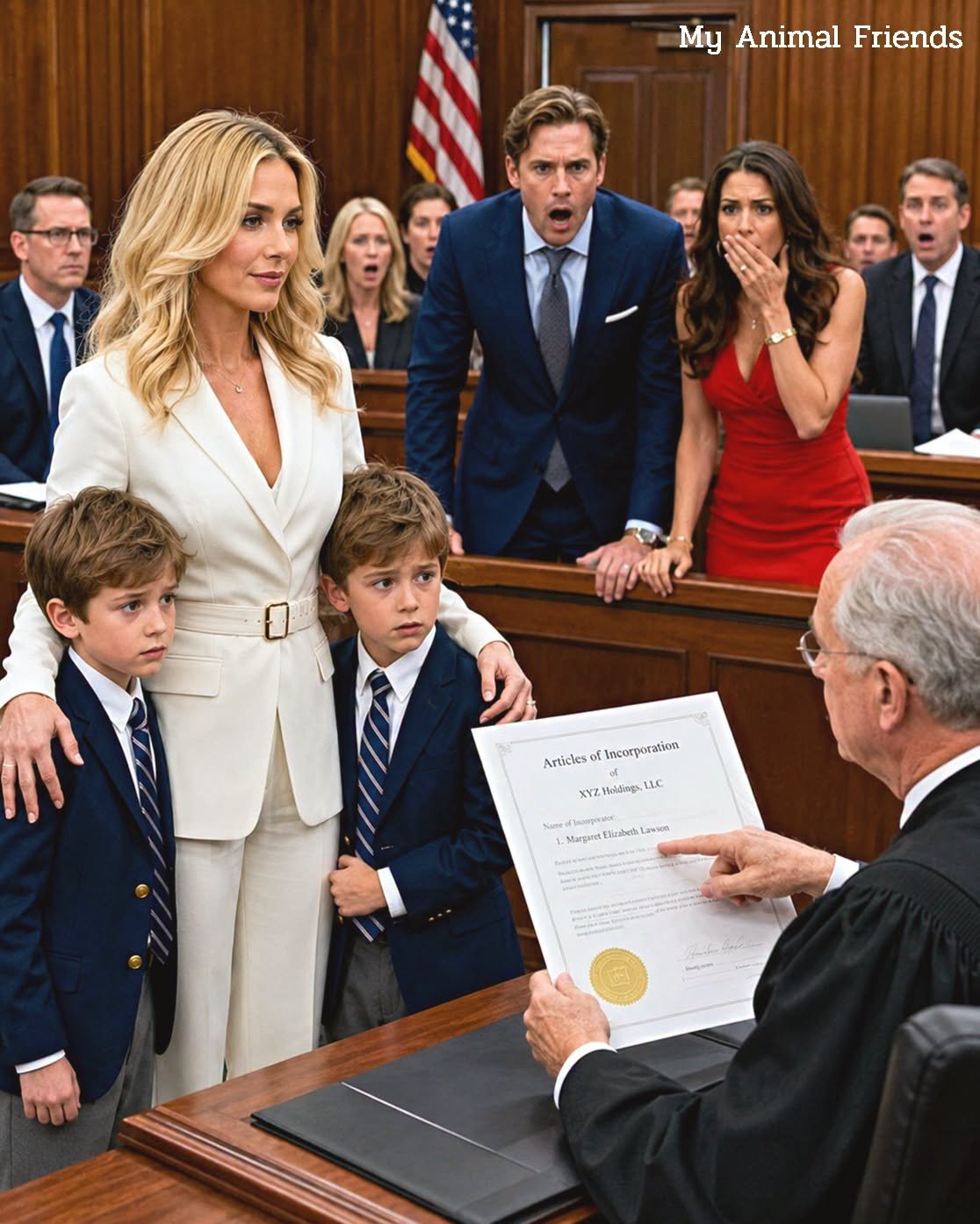
Judge Calder’s question came quietly, but it landed harder than any accusation Russell Crane had made all morning.
“Mr. Hollis,” he said, holding the incorporation papers between both hands, “why is your wife’s maiden name listed as the company’s original majority owner?”
For the first time since I had walked into Courtroom Four, Adrian did not move.
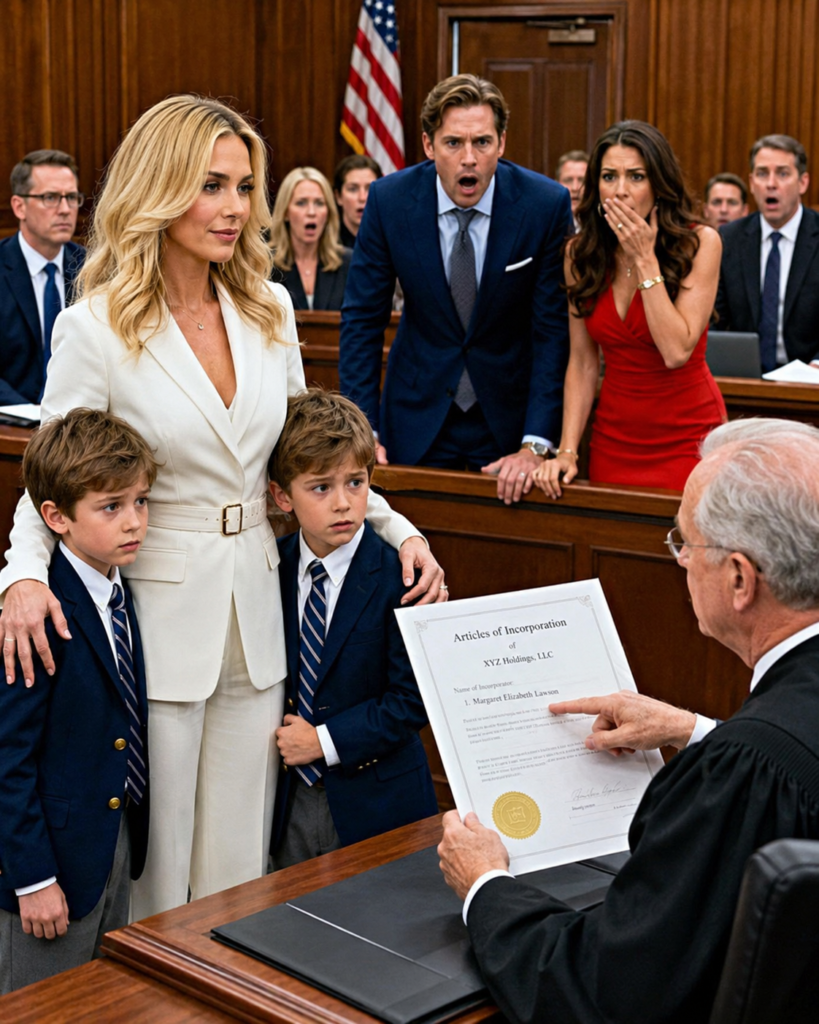
His confident smile faltered. Paige turned toward him, her polished expression tightening into confusion. Russell leaned forward so quickly his chair creaked against the floor.
“My wife’s what?” Adrian said.
The judge looked over the rim of his glasses. “Elena Lane. Seventy-two percent ownership of Hollis Transit Systems at the time of incorporation.”
A murmur passed through the courtroom.
I kept my hands folded on the table, though beneath it my fingers were trembling. Not from fear. From the sheer weight of twelve years spent waiting for the truth to be spoken aloud.
Adrian recovered just enough to laugh once, sharply and without humor.
“That’s impossible.”
“It is not impossible,” Judge Calder said. “It is printed on the original state filing.”
Russell whispered urgently to Adrian, but Adrian ignored him.
“She signed those papers as a formality,” he said. “That was before the company had value.”
The judge’s expression did not change. “Then you acknowledge the filing is authentic?”
Adrian’s face drained further.
Across the aisle, Samuel and Owen sat close together. Samuel’s eyes were fixed on his father. Owen was looking at me, searching my face for an explanation I had never wanted him to need inside a courtroom.
I gave him the smallest nod I could manage.
Russell stood. “Your Honor, we would request a brief recess to review these documents.”
“You may have ten minutes,” Judge Calder said. “But I suggest you use them carefully.”
The gavel came down.
The moment we stepped into the corridor, Adrian turned on me with disbelief rather than anger.
“What have you done?”
I looked at the man I had once loved, the man who used to fall asleep at our tiny kitchen table with fuel receipts scattered around his elbows and hope written plainly across his face.
“I told the truth,” I said.
Paige appeared beside him, her voice lowered. “Adrian, what is she talking about?”
He did not answer her.
That silence told her more than any explanation could have.
Years earlier, Hollis Transit had not been a fleet of buses with regional contracts and glossy brochures. It had been one rented van, a spreadsheet, and a man with ambition bigger than his savings account. Adrian had the charm to win clients, but no collateral, no credit, and no patience for paperwork.
I had all three.
My grandmother had left me a modest inheritance and a narrow brick house in Alexandria. I sold the house, cashed the bonds she had hidden in a metal recipe tin, and used the money to launch what Adrian called our dream.
At the time, it had been our dream.
I handled the filings because Adrian hated forms. I signed the first lease because the landlord trusted my steady job at the hospital administration office. I negotiated the first insurance policy during my lunch break. I tracked invoices at night while Adrian drove airport routes until dawn.
When the twins were born, I stepped back from public involvement because they needed me more than the company did. Or so I believed.
Adrian began calling himself founder. Then sole founder. Then self-made.
I let it pass, at first because it seemed harmless, later because correcting him in public felt like breaking something already fragile.
But when he told our sons I had contributed nothing, something inside me finally stopped protecting him.
Russell approached me during the recess with careful politeness.
“Mrs. Lane, are there additional documents we should know about?”
“Yes.”
His jaw tightened. “What kind?”
“Board minutes. Tax filings. Capital contribution records. Early loan guarantees. Emails. Payroll history.”
Adrian stepped closer. “You kept all of that?”
“I kept everything.”
Paige looked at him again. This time there was no softness in her face.
“You told me she had no involvement,” she said.
Adrian snapped, “Not now.”
The words were quiet, but their effect was immediate. Paige stepped back as though the hallway beneath her had shifted.
The boys were with a court officer near the window. Samuel pretended not to watch us. Owen did not pretend. He stared at his father with an open confusion that made my heart ache.
I crossed the corridor and knelt in front of them.
“You two okay?”
Samuel looked down. “Did Dad lie?”
I took a breath. I had promised myself I would never make the boys carry adult bitterness. Even now, especially now, I had to be careful.
“There are things he didn’t explain honestly,” I said. “But grown-up problems are not your job to fix.”
Owen’s hand found mine. “Are we still going to live with you?”
“I’m going to do everything I can to keep your lives steady,” I told him.
Samuel frowned. “But Dad said Paige already picked our rooms.”
I closed my eyes for one brief second.
When I opened them, Judge Calder’s clerk was calling us back in.
The second half of the hearing felt different from the first. Adrian no longer reclined in his chair. Russell’s voice lost its theatrical certainty. Paige sat with her hands folded tightly in her lap, no longer whispering.
Judge Calder asked me to explain the documents.
I began at the beginning, not dramatically, not with anger, but with facts.
“I provided the first capital investment. I held the majority share because the company was built using my inherited funds and personal guarantees. Adrian managed operations. I managed administration and finance until the twins were born.”
Russell rose. “Mrs. Lane, did you receive a salary during that time?”
“No.”
“So you were unpaid?”
“I deferred compensation because the company needed cash flow.”
“Convenient.”
Judge Calder glanced at him. “Counsel.”
Russell adjusted his tie. “My apologies. Mrs. Lane, why did you allow Mr. Hollis to appear publicly as sole owner?”
“Because we were married,” I said. “Because I trusted him. Because I believed protecting his confidence protected our family.”
The courtroom grew very still.
Russell tried to recover. “But the prenuptial agreement states that business assets under Mr. Hollis’s name remain his separate property.”
“It does,” I said. “But the shares listed here were never under his name.”
Adrian’s attorney opened his mouth, then closed it.
Judge Calder turned several pages. “There is also a later transfer agreement included. Unsigned.”
“Yes,” I said.
Adrian finally spoke. “Because she refused.”
I looked at him. “Because you brought it to me two weeks after my mother died and told me it was routine housekeeping.”
His face hardened.
Russell asked, “Did you understand what that document would have done?”
“Yes. It would have transferred my ownership to Adrian for one dollar.”
Paige inhaled sharply.
Even Judge Calder paused.
Adrian leaned toward his attorney. “This is irrelevant to custody.”
That word, custody, pulled me back to the only reason any of this mattered.
“Your Honor,” I said, “I am not here to punish Adrian. I am here because he filed for primary custody claiming I have no financial stability, no professional background, and no meaningful contribution to the family business. Those claims are false.”
The judge nodded slowly.
Then he asked the question I had been waiting for.
“Mrs. Lane, where have you and the children been living since the separation?”
“In a rented townhouse near their school.”
“Who pays the rent?”
“I do.”
“With what income?”
I reached into my folder and removed another packet. “Consulting contracts. I have spent the past year rebuilding my professional work quietly. I advise small transportation companies on compliance, fleet documentation, and contract bids.”
Russell took the packet as though it might bite him.
Adrian stared at me. “You told me you were helping friends.”
“I was.”
“You didn’t tell me you were being paid.”
“You stopped asking questions about my life long before then.”
The words surprised even me. They were not sharp, but they were true, and truth sometimes had its own edge.
Judge Calder reviewed the contracts. “This appears substantial.”
“It is enough for housing, school expenses, and savings,” I said. “The boys have the same pediatrician, the same school, the same friends, and the same bedtime routine.”
Samuel gave Owen a faint smile at the mention of bedtime. It nearly broke me.
For the first time that morning, Adrian looked toward them. Something like uncertainty flickered across his face.
Russell shifted tactics.
“Mrs. Lane, are you suggesting Mr. Hollis is an unfit father?”
“No.”
Adrian blinked.
I continued, “Adrian loves the boys. He takes them to baseball practice when he remembers. He reads to Owen when Owen asks twice. He knows Samuel hates tomatoes but forgets Samuel is allergic to cashews. He is not a monster. But he has been careless with their feelings because he was focused on winning.”
The courtroom silence deepened.
Adrian looked away.
Russell had no clean path from there. If he attacked me, he risked appearing cruel. If he attacked the documents, he had to confront Adrian’s omissions. If he attacked my parenting, the boys were sitting close enough to hear every word.
Judge Calder ordered a temporary arrangement: the boys would remain with me during the school week, Adrian would have scheduled parenting time on alternating weekends and one dinner evening, and both parents were forbidden from discussing the case with the children.
He also ordered full financial disclosure regarding Hollis Transit Systems.
Adrian’s face tightened at that.
The hearing ended without applause, without triumph, without the dramatic collapse people might have imagined from the gossip. It ended with papers being gathered, chairs scraping softly, and my sons walking toward me as if I were the only solid thing in the room.
Outside the courthouse, rain silvered the pavement.
Samuel climbed into the back seat first. Owen lingered.
“Mom?”
“Yes?”
“Did you really start Dad’s company?”
I brushed damp hair from his forehead. “I helped start it.”
“Why didn’t you tell us?”
Because I was tired. Because I was ashamed of how small I had let myself become. Because I thought peace meant silence.
Instead I said, “I wanted you to know your father as your father, not as someone I was arguing with.”
Owen considered that. “Can people be two things?”
I smiled sadly. “Most people are more than two.”
That evening, after the boys fell asleep, I sat at the kitchen table of our rented townhouse with the court papers spread around me. The rain had stopped, leaving the windows dark and reflective. I could see myself faintly in the glass: older than the woman who had signed those incorporation papers, but not weaker.
My phone buzzed.
Adrian.
I let it ring once, twice, three times, then answered.
“Elena.”
His voice was rough.
“Yes.”
“I didn’t think you’d use those papers.”
“I didn’t think you’d tell our children I abandoned them.”
He was silent.
Then, very quietly, he said, “I panicked.”
That almost made me laugh, not because it was funny, but because it was such a small word for what he had done.
“About what?”
“Losing everything.”
“You filed for divorce with three attorneys, Adrian.”
“I know.”
“You brought Paige.”
“I know.”
“You asked the court to take the boys from their home.”
His breath caught. “I didn’t think it would go that far.”
That was Adrian’s oldest flaw. He believed consequences were distant things, negotiable things, problems that could be charmed or delayed until someone else softened them.
“It went that far because you pushed it there,” I said.
Another silence.
Then he asked, “What do you want?”
I looked around the kitchen. The boys’ spelling lists were clipped to the refrigerator. Owen’s muddy sneakers sat by the door. Samuel’s library book lay open on the counter, facedown in a way I always told him not to leave books.
“I want honesty,” I said. “In court. With the boys. With yourself.”
“And the company?”
I closed my eyes.
There it was.
Not sorrow. Not regret. The company.
“I don’t know yet.”
“Elena, investors will panic if this becomes public.”
“It became public when you made our divorce a performance.”
“I can fix it.”
“You always say that after something breaks.”
His voice lowered. “Paige is asking questions.”
“She should.”
“She might resign.”
“That is between you and Paige.”
He exhaled. “You sound different.”
“I am different.”
“No,” he said. “You sound like the woman from the beginning.”
The words reached further into me than I expected.
For one moment I remembered him at twenty-nine, soaked from rain beside that first van, laughing because the windshield wipers had stopped working and our first airport passenger had given him a five-dollar tip. I remembered loving his optimism. I remembered believing he would never use it against me.
“That woman trusted you,” I said.
“I know.”
“Don’t call again tonight.”
I ended the call before he could answer.
The next morning, I found an envelope taped to the townhouse door.
There was no return address.
Inside was a photocopy of a company memo dated nine years earlier, when Hollis Transit had expanded into school transportation contracts. Across the top, someone had written in blue ink: You need to know what he hid before the twins were born.
My hands went cold.
The memo referenced a board meeting I did not remember attending and a resolution I did not remember signing. My name appeared beneath it in a signature that looked almost like mine.
Almost.
The boys were upstairs brushing their teeth, laughing about toothpaste foam. Their ordinary morning sounds floated down into the room while I stood frozen in the doorway, holding proof that the ownership records might be only the first door opening.
At the bottom of the envelope was a second page.
A handwritten note.
Ask Adrian why your father called him the night before the accident.
My father had died eleven years ago.
Adrian had told me he never spoke to him that week.
PART 3(END)
For several minutes, I stood in the narrow entryway with the envelope in my hand and listened to my sons getting ready for school.
Their voices drifted down the stairs in uneven bursts.
“Mom said not to use all the hot water!”
“I’m not using all of it. I’m using enough.”
“That doesn’t even mean anything.”
Normally, their bickering made the house feel alive. That morning, it felt like a thread tying me to the present while the past opened beneath my feet.
Ask Adrian why your father called him the night before the accident.
I read the sentence three times, hoping it would rearrange itself into something less impossible.
My father, Daniel Lane, had been a careful man. A retired mechanic with oil permanently worked into the lines of his hands and a habit of checking the weather before driving anywhere. He had died on a wet November road, his truck sliding through a guardrail on the way back from visiting a friend in Richmond.
That was what I had been told.
That was what I had buried.
Adrian had held me at the funeral while I shook too hard to stand alone. He had handled phone calls, insurance forms, the sale of my father’s old tools. He had been gentle then, or at least he had seemed gentle. He told me there was nothing to question. He told me grief made people search for patterns where there were none.
And now someone had left a note at my door claiming there had been a conversation he never mentioned.
“Mom?” Samuel called from upstairs. “Did you sign my permission slip?”
I folded the note so quickly the paper crackled.
“Yes,” I called back, though my voice sounded strange even to me. “It’s on the counter.”
The boys thundered down a minute later, all backpacks, damp hair, and morning energy. Owen noticed my face first.
“Are you sick?”
“No, sweetheart.” I tucked the envelope under a stack of mail. “Just thinking.”
Samuel narrowed his eyes in that careful way of his. At eight, he already watched the world like someone trying to solve it.
“About court?”
“Some,” I admitted.
Owen put both arms around my waist. Samuel joined more slowly, leaning against my side without looking up. I held them there, breathing in shampoo and toothpaste and the faint scent of laundry detergent.
Whatever the note meant, whatever Adrian had hidden, this was still the center of my life.
Not papers. Not shares. Not a company built from an old dream.
Them.
At school drop-off, the sky was pale and washed clean from the rain. Parents moved through the loop with coffee cups and distracted waves. Everything looked ordinary enough to hurt.
Samuel unbuckled but lingered.
“Dad texted me last night,” he said.
My hands tightened on the steering wheel. “What did he say?”
“He said he hoped I had a good day.”
That should have relieved me. Instead, it reminded me how easily small, gentle words could sit beside larger secrets.
“That’s okay,” I said. “You can answer him.”
Owen leaned forward between the seats. “Are you and Dad going to be mad forever?”
I turned off the engine.
“No,” I said carefully. “Being hurt and being mad are not the same as forever. Adults can be upset and still choose to do better.”
Samuel looked skeptical. “Does Dad choose that?”
I swallowed.
“I hope he does.”
That was the most honest answer I had.
After they disappeared through the school doors, I sat in the parking lot until the crossing guard tapped the hood of my car with two fingers and smiled politely, reminding me the morning needed to move on.
I drove not to my townhouse, but to the storage unit I had rented after leaving Adrian.
It was in a low beige building near a tire shop, the kind of place people passed every day without noticing. Inside my unit were the remains of a life I had not been ready to sort through: framed photographs, old Christmas decorations, boxes labeled kitchen, office, boys baby clothes, and one dented green toolbox that had belonged to my father.
I had avoided opening it for months.
The lock snapped free with a metallic click. Dust rose when I lifted the lid.
Inside were wrenches wrapped in cloth, a cracked flashlight, a pair of work gloves stiff with age, and a small notebook tucked beneath a tray of screws.
My father’s handwriting covered the first page.
Mileage. Oil change. Brake pads. Weather strip.
I turned pages slowly, smiling despite myself. He had recorded everything. Every repair, every part number, every neighbor who owed him five dollars and every one he had secretly forgiven.
Near the back, the notes changed.
Hollis van inspection.
Fuel line concerns.
Adrian rushed.
Talked to E. after holidays?
My breath caught.
E. That was me.
I turned another page.
November 14. Called A. Not right. Papers and trucks don’t match. He got angry. Said I didn’t understand business.
November 15. Call again tomorrow. Elena needs to know.
The accident had been November 16.
I sat down on a cardboard box because my knees suddenly felt unreliable.
It was not proof of anything dramatic. It did not say Adrian had caused harm. It did not say my father had been in danger. But it said Adrian had spoken to him. It said there had been an argument. It said my father had intended to tell me something.
And Adrian had let me believe there had been nothing.
My phone rang just as I closed the notebook.
The screen showed a name I had not expected.
Paige Ellison.
For a moment I considered letting it go to voicemail. Then I remembered her face in the courtroom when she learned Adrian had not told her the truth either.
I answered.
“Mrs. Lane?”
“It’s Elena.”
A pause.
“Elena. I’m sorry to call. I know I’m probably the last person you want to hear from.”
“You’re not at the top of the list,” I said.
There was a small, startled breath on the other end. Not quite a laugh.
“I deserved that.”
I waited.
“I resigned this morning,” Paige said.
That surprised me. “From Hollis Transit?”
“Yes. Adrian asked me not to. Then he asked me to wait until after the financial review. Then he said leaving now would make him look guilty.”
“That sounds familiar.”
“I believed him,” she said softly. “Not about everything. I knew your marriage was ending. I knew he was still legally married, and I told myself all the things people tell themselves when they want to feel less responsible. But I didn’t know about the company. I didn’t know about the boys.”
Her voice thinned at the end.
I looked at my father’s notebook resting open in my lap.
“Why are you calling me, Paige?”
“Because yesterday, after court, I went back to my office to clean out my desk. Someone had already been there.”
“What do you mean?”
“My files were moved. A drawer was open. And there was a flash drive taped under my keyboard.”
A cold awareness moved through me.
“What was on it?”
“I don’t know. I was afraid to open it on a company computer. But there was a label.”
I closed my eyes.
“What did it say?”
“Lane original records.”
The storage unit seemed to shrink around me.
“Where are you now?” I asked.
“In my car. Near a coffee shop on Maple Avenue.”
“Stay there,” I said. “Don’t call Adrian.”
“I wasn’t planning to.”
“I’ll meet you in twenty minutes.”
Paige was parked at the far end of the lot when I arrived, wearing sunglasses despite the gray morning. Without the polished office lighting and perfect company posture, she looked younger and more tired than I expected.
She got into my passenger seat without speaking at first.
For a while, we sat side by side watching people carry lattes and paper bags out of the coffee shop as if the world had no idea our lives were being rewritten in a parking lot.
Finally, Paige reached into her purse and handed me a small silver flash drive.
“I haven’t opened it,” she said.
“Why give it to me?”
“Because your name is on it.”
I studied her. “And because?”
She looked down at her hands. “Because Adrian has a way of making people feel chosen when he needs them. I mistook that for love.”
There was no performance in her voice. No attempt to win my sympathy. Just a tired, honest sentence.
Against my own expectations, my anger softened around the edges. Not disappeared. Not forgiven. But changed shape.
“Paige,” I said, “I’m not ready to comfort you.”
“I know.”
“But I appreciate you bringing this.”
She nodded, swallowing hard. “There’s something else.”
Of course there was.
She opened her phone and pulled up a photograph. It showed a conference room whiteboard, half erased, with names and dates written across it. At the top were the words Legacy Restructure.
“I took that two weeks ago,” Paige said. “Adrian told me it was about investor messaging. But yesterday in court, when the judge mentioned ownership, I remembered the phrase.”
I enlarged the photo.
Several names were visible. Adrian. Russell. A man named Victor Sloane, the company’s chief financial officer. Beside my name was a question mark.
And beneath it, another line:
DL file unresolved.
My hand went still.
DL.
Daniel Lane.
My father.
Paige saw my face change. “Who is DL?”
“My father.”
Her sunglasses slipped slightly as she stared at me. “Why would your father have a company file?”
“I don’t know.”
But the notebook in my bag seemed to burn with the answer I could not yet see.
I drove straight to the office of Mira Patel, a family law attorney who had once helped a friend of mine through a custody dispute. I had represented myself in court because I needed to speak plainly, and because part of me wanted Adrian to see the woman he had underestimated. But plain truth was no longer enough. There were documents now. Questions. Signatures that looked almost like mine.
Mira listened without interrupting.
She was in her fifties, with silver-threaded hair pulled into a low knot and eyes that missed very little. Her office smelled faintly of tea and old paper. She read the anonymous note, my father’s notebook entries, the memo with the questionable signature, and Paige’s photograph.
When she finished, she removed her glasses.
“Elena, I’m going to say this carefully. Do not confront Adrian alone about your father.”
My throat tightened. “You think there’s something serious here.”
“I think there are enough inconsistencies to handle this professionally.”
“Professionally means slowly.”
“Professionally means safely and correctly.”
I nodded, though every part of me wanted answers that day, that hour, that minute.
Mira leaned forward. “The custody arrangement is stable for now. Your boys are protected. The company records will be reviewed. But this matter involving your father may reach beyond divorce court.”
I stared at the photograph again.
DL file unresolved.
“What if my father knew someone was altering records?” I asked.
“Then we find out who, when, and why.”
“And if Adrian knew?”
Mira’s face softened. “Then you let the evidence speak before your fear does.”
That sentence stayed with me after I left.
Let the evidence speak before your fear does.
I repeated it while buying groceries. While helping Owen find his missing library book. While reminding Samuel that fractions became less terrifying after snacks. I repeated it through dinner, through baths, through the strange quiet that settled after the boys went to bed.
Then my phone buzzed.
Adrian again.
This time, I answered.
“Elena, we need to talk.”
His voice sounded different from the night before. Less defensive. More frayed.
“About what?”
“Paige resigned.”
“I heard.”
A pause. “She called you?”
“She gave me something.”
His breathing changed.
“What did she give you?”
I let the silence answer.
“Elena,” he said, “some things from the early years were complicated.”
“My father called you the night before he died.”
Nothing.
Not even a breath.
That silence confirmed more than any denial could have.
Finally, he said, “Who told you that?”
“Is it true?”
“Elena—”
“Is it true?”
“Yes.”
The room tilted slightly around me. I gripped the edge of the kitchen counter.
“You told me you hadn’t spoken to him.”
“I know.”
“Why?”
“Because you were grieving. Because it wouldn’t have helped.”
“What did he call about?”
Adrian exhaled, and for one strange second I heard the younger version of him beneath the polished CEO—the scared man with a rented van and too much ambition.
“He thought Victor was moving money through maintenance invoices.”
Victor Sloane. The CFO.
My father’s note came back to me.
Papers and trucks don’t match.
“He told you that?”
“He suspected it. He didn’t have proof.”
“And you didn’t tell me?”
“I wanted to handle it.”
“You always wanted to handle things by hiding them.”
“That’s not fair.”
“It is the kindest version of the truth.”
He fell quiet.
I softened my voice, not for him but for myself. “Did my father die knowing he was right?”
“I don’t know.”
“Did you?”
“No,” Adrian said quickly. Too quickly, perhaps. “No, Elena. I didn’t know. I swear I didn’t.”
I wanted to believe him. That was the painful part. Some old reflex in my heart still reached for the man who had once held my hand in hospital waiting rooms and whispered that we could survive anything.
But survival required honesty, and honesty had never been his strongest form of love.
“Why is there a file labeled DL?” I asked.
His answer came slowly.
“Because after your father died, Victor brought me documents. He said Daniel had been confused. He said your father had been asking questions that could hurt the company if they became rumors.”
“So you buried it.”
“I was trying to keep the company alive.”
“My father was dead.”
The words were not loud, but they ended whatever defense he had been building.
“I’m sorry,” he said.
I closed my eyes.
For years, I had imagined grief as a room I had already walked through. Now I realized someone had locked doors inside it and hidden the keys.
“Adrian, did you forge my signature?”
“No.”
“Did Victor?”
“I don’t know.”
“That is not good enough anymore.”
“I know.”
For the first time, he sounded as though he did.
The next day was Adrian’s scheduled dinner with the boys.
I almost canceled. Mira advised me not to unless I had a clear reason involving the children’s well-being. The court order mattered. Stability mattered. And despite everything, Adrian was their father.
He arrived at five-thirty, not in the chauffeured black SUV he favored for company events, but in his own car. He wore jeans and a gray sweater. No watch. No Paige. No entourage.
The boys ran to him with cautious happiness.
He hugged them both longer than usual.
Samuel pulled back first. “Are we going to pizza?”
“If your mom says it’s okay.”
The boys turned to me.
Pizza had suddenly become a test of civilization.
“Pizza is okay,” I said.
Owen cheered. Samuel tried not to.
Adrian looked at me over their heads. There were shadows beneath his eyes.
“Thank you,” he said.
I did not answer.
Before they left, Owen ran back and grabbed the blue hoodie he always forgot. Adrian watched him, then turned to me again.
“I told them I said things I shouldn’t have,” he said quietly. “About you. About where they would live. I told them it wasn’t fair.”
That moved something inside me I had been holding rigid.
“What did they say?”
“Samuel asked if I was only saying sorry because the judge told me to.”
Despite everything, I almost smiled. “What did you tell him?”
“That I deserved the question.”
Owen came back with the hoodie around his shoulders like a cape.
“Ready!” he announced.
They left in a swirl of small voices and closing doors.
For two hours, the townhouse felt too quiet. I did laundry I had already done. I rearranged the same papers twice. I called Mira and left a message about Adrian’s admission that my father had contacted him. Then I opened the flash drive on an old laptop disconnected from the internet, following Mira’s instructions.
There were six folders.
Original Ownership.
Maintenance Audit.
Lane Correspondence.
Victor Invoices.
Transfer Drafts.
Personal.
My hand hovered over the last folder, but I opened Lane Correspondence first.
There were scanned letters between my father and someone named M.R., all dated in the weeks before his accident. My father’s language was plain, direct, and unmistakably his.
I don’t want to accuse anyone without proof. But the numbers are wrong.
The same repair is billed twice under different van IDs.
Elena’s name is being used on documents she hasn’t seen.
Please keep copies somewhere safe.
M.R. had replied:
I’ll secure everything. Do not confront them again until we meet.
M.R.
I leaned back, heart pounding.
Who was M.R.?
A sound at the door startled me so badly I nearly knocked the laptop to the floor.
But it was only the boys returning with Adrian.
Owen had sauce on his sleeve. Samuel carried a folded paper menu like a souvenir. Adrian stood behind them, quieter than I had ever seen him after time with the boys.
“They ate actual dinner before dessert,” he said.
“Miracles happen.”
Owen threw his arms around me. “Dad said he’s going to learn how to make pancakes that aren’t burned.”
Samuel added, “He said we can judge them.”
“Harshly,” Adrian said.
The boys laughed.
It was small. Ordinary. Almost unbearable.
After they went upstairs, Adrian lingered near the doorway.
“Elena, there’s something I should give you.”
My stomach tightened.
He took an old brass key from his pocket and placed it on the entry table.
“What is that?”
“Your father had a storage locker. Not the one you know about. A smaller one near the old bus depot.”
I stared at him. “You knew this?”
“Not at first. After he died, a notice came to the company office because he had listed Hollis Transit as an emergency contact. Victor told me it was probably spare tools. I paid the fee for a while, then forgot about it.”
“You forgot about my father’s belongings?”
His face creased. “I told myself I’d tell you when things calmed down. Then time passed, and it became one more thing I was ashamed to mention.”
I picked up the key. It was warm from his pocket.
“What’s inside?”
“I don’t know.”
“Why give it to me now?”
“Because Samuel asked me tonight if grown-ups can fix lies after they tell them.” Adrian looked toward the stairs. “I told him they can try. I don’t know if that’s true, but I want it to be.”
For once, there was no performance in him. No strategy I could see. Just a man standing in the wreckage of his choices, holding out one small piece of what he had kept hidden.
I closed my fingers around the key.
“Thank you,” I said, and meant it only for that moment.
After he left, I found Samuel sitting on the stairs in his pajamas.
“You heard?”
“Some,” he admitted.
I sat beside him. “You know eavesdropping is not ideal.”
“I know.”
He leaned his head against my shoulder. “Is Dad trying?”
I thought about Adrian apologizing. About the key. About the years of silence. About how trying did not erase harm, but maybe it mattered where rebuilding began.
“I think he is starting to,” I said.
Samuel nodded as if filing that away.
“Are you okay?” he asked.
The question nearly undid me.
I kissed the top of his head. “I’m getting there.”
The next morning, after dropping the boys at school, I drove to the old bus depot on the edge of town.
The storage building stood behind a chain-link fence, its sign faded by sun and weather. An elderly manager named Mr. Alvarez checked the key, then led me down a row of narrow doors.
“Unit twelve,” he said. “Paid up through the year.”
I stopped. “Paid by whom?”
He checked his clipboard. “Automatic renewal. Name on file is Lane.”
“My father has been gone eleven years.”
Mr. Alvarez looked uncomfortable. “Then someone kept the account active.”
The lock opened with a reluctant scrape.
Inside the unit were three boxes, a folded tarp, and a metal filing cabinet.
I opened the first box and found photographs: my father holding Samuel and Owen as newborns, my mother laughing on our old porch, me at twenty-seven beside Adrian and the first Hollis van. We looked exhausted and radiant.
The second box held documents.
The third held cassette tapes.
I stared at them, confused. My father had loved old technology. He trusted physical things. Paper. Keys. Tape recordings.
On top of the filing cabinet sat a small recorder with a strip of masking tape across it.
For Elena.
My hands shook as I pressed play.
Static filled the unit. Then my father’s voice emerged, warm and familiar enough to make my chest ache.
“Elena, sweetheart, if you’re hearing this, it means I didn’t get the chance to say it plain.”
I covered my mouth.
“I know you trust Adrian. I want to trust him too. Maybe he’s just scared. Maybe he’s letting the wrong man steer him. But your name is on more than the company papers now. Someone is using it, and I think it started before the twins were born.”
A car passed outside, tires crunching over gravel.
On the tape, my father sighed.
“I made copies. Gave one set to Margaret Reed, the attorney who helped your grandmother. She said not to move too fast. She said there was something bigger underneath the invoices.”
M.R.
Margaret Reed.
“She also found a trust document,” my father continued. “Not your grandmother’s. Not mine. One connected to Hollis Transit. Elena, I don’t understand all of it, but there’s a child named in those papers.”
My breath stopped.
The tape crackled.
“Adrian may not even know. Or maybe he knows everything. I’m going to ask him tonight. If I’m wrong, I’ll apologize. If I’m right, you need to protect yourself and the babies.”
The recording clicked, then ended.
For a long moment, I could not move.
A child.
A trust document.
Connected to Hollis Transit.
I searched the filing cabinet with frantic care until I found a folder labeled REED COPY. Inside were legal pages, handwritten notes, and one sealed envelope yellowed at the edges.
On the front, in Margaret Reed’s neat script, were five words:
Open only after confirmation.
I turned it over.
The seal had already been broken.
Inside was a single birth certificate.
The child’s name was Lily Grace Hollis.
Father: Adrian Hollis.
Mother: Unknown.
Date of birth: eight years ago.
The same year my sons were born.
And clipped behind it was a recent school photograph of a smiling little girl with Adrian’s eyes.