
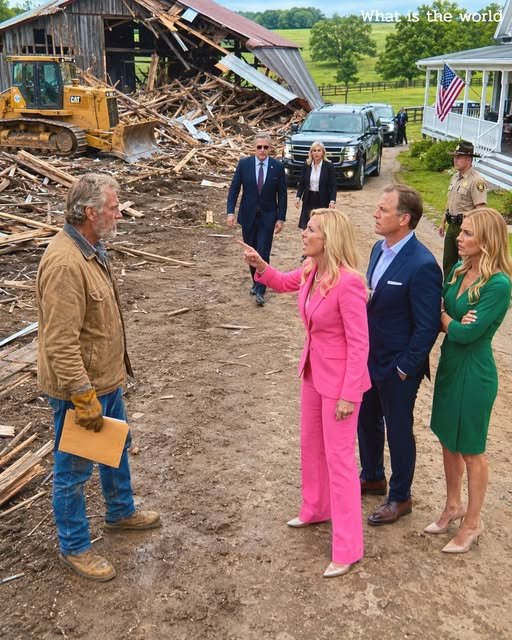
The barn was already flat when I pulled into my driveway.
Vanessa Holloway stood on top of the broken timber in white designer boots, smiling like she had won a war, and said, “Your little shack was lowering our property values, Mr. Mercer. Consider this community service.”
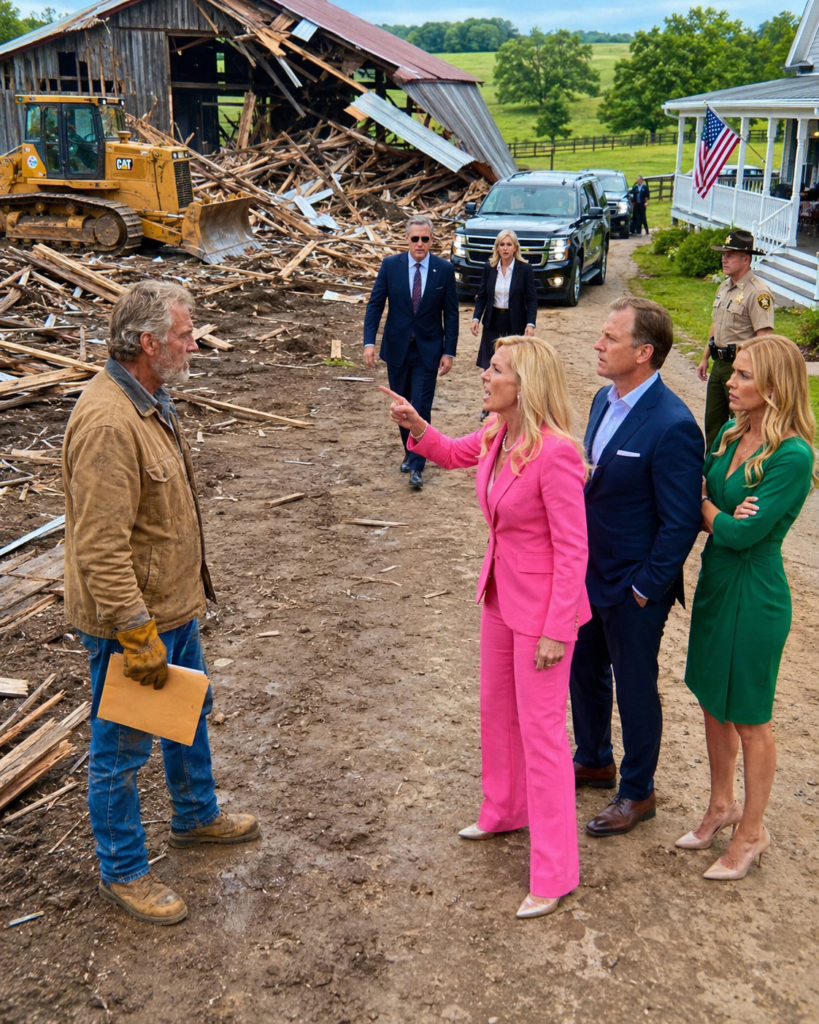
Behind her, the bulldozer idled with my father’s hand-cut beams still caught in its blade.
I did not shout.
I did not cry.
I did not run at her, even though every nail in that barn had been driven by a Mercer hand before Vanessa Holloway’s grandfather ever bought his first lake house.
I just parked my truck, stepped out into the dust, and looked at the place where the west wall used to be.
The morning sun hit the wreckage hard.
Cedar boards.
Bent tin roofing.
Split rafters.
A hay hook twisted into the mud.
My father’s old brass lock, snapped clean through.
And under it all, half-buried beneath a pile of splintered oak, was the corner of the concrete slab I had told no one about.
Vanessa didn’t notice me staring at it.
People like Vanessa only saw what they wanted to own.
She saw a road.
She saw a gate.
She saw her new luxury neighborhood finally stretching across the creek and cutting fifteen minutes off the drive to the private marina.
She did not see the black camera mounted inside the hollow fence post.
She did not see the motion sensor tucked in the cedar tree.
She did not see the little red light blinking under the broken brass lock.
And she definitely did not know that the second her bulldozer cracked that slab, it sent an alert to a man in Washington, D.C., who had been waiting eleven years for someone stupid enough to touch it.
Vanessa stepped down from the wreckage and brushed dust off her emerald-green blazer.
She had long golden-blonde hair, the kind that always looked arranged even in wind. She wore sunglasses pushed onto her head, diamond earrings, and a smile sharp enough to slice paper.
Two HOA board members stood behind her.
Grant Bellamy, a real estate developer in a navy suit with boots too clean for dirt.
And Cynthia Rowe, treasurer of Holloway Ridge Estates, clutching a clipboard like it gave her legal authority over God and gravel.
A sheriff’s deputy leaned against his cruiser near the road, looking like he wanted to be anywhere else.
My neighbor, Pete Lawson, stood by his mailbox across the ditch with his hands on his hips.
Nobody moved.
The whole hillside smelled like diesel, wet dirt, and old pine.
Vanessa lifted her chin.
“You were notified,” she said.
“No,” I said.
My voice came out calm.
That bothered her.
She had expected rage. Rage would have helped her. Rage would have turned me into the unstable farmer holding up progress.
I gave her nothing.
She held up a paper with a blue county stamp.
“Your barn violated HOA architectural standards. It was abandoned, unsafe, and placed inside a future common-access corridor.”
“My land isn’t in your HOA.”
She smiled wider.
“Not yet.”
Grant gave a small cough.
Vanessa shot him one quick look, and he shut up.
That was the first crack.
Not big.
Not enough for anyone else to notice.
But I noticed.
I always notice the first crack.
I walked past Vanessa toward the wreckage.
“Don’t climb on that,” she snapped. “It’s a demolition site.”
“It’s my demolition site.”
“It’s now evidence of compliance.”
“No,” I said. “It’s evidence.”
Her smile thinned.
I bent down and picked up a piece of wood. It was from the inside of the north door, where my father had carved my height every birthday until I turned sixteen.
The marks were split in two.
Age twelve on one side.
Age thirteen on the other.
I ran my thumb across the knife cuts.
For one second, my chest tightened so hard I had to breathe through my nose.
Then I set the wood gently in the bed of my truck.
Vanessa rolled her eyes.
“That sentimental act may work on your Facebook friends, Mr. Mercer, but this is a legally authorized HOA improvement action.”
“Who authorized it?”
“The board.”
“You don’t have jurisdiction.”
“We have an easement.”
“No.”
Grant stepped forward then.
He had the smooth face of a man who had never lost money personally, only other people’s money professionally.
“Wyatt,” he said, like we were friends. “Let’s not make this ugly.”
I looked at him.
“I don’t know you well enough for you to use my first name.”
His jaw tightened.
Vanessa laughed softly.
“This is exactly the kind of hostility the board has documented for months.”
“What months?”
“The complaints.”
“From who?”
She tilted her head toward Holloway Ridge, the neighborhood half a mile beyond my pasture fence.
A line of luxury houses sat on the hill in perfect rows. Cream stone. Black roofs. Oversized windows. Three-car garages. Flags hanging from porches. Landscaped lawns bright green in a county that had been dry for six weeks.
They looked down on my farm like teeth.
“You’ve been difficult since the day our community opened,” Vanessa said.
“I was here first.”
“That doesn’t mean you get to block development.”
I looked back at the barn.
A nail popped in the heat.
Somewhere inside the wreckage, something metal shifted and clanged.
The bulldozer operator climbed down from his cab. He was a heavy man in a yellow vest, sweating through his shirt.
“Ma’am,” he said to Vanessa, low. “We got a problem under there.”
Vanessa didn’t turn.
“Not now, Eddie.”
“I think there’s a box.”
My eyes stayed on Vanessa.
Her eyes flicked to me.
There it was.
The second crack.
Eddie wiped his forehead.
“Blade hit concrete, then something else. Not septic. Not rock. Some kinda steel hatch.”
Cynthia’s clipboard lowered.
Grant stopped pretending to be relaxed.
The deputy pushed off his cruiser.
Vanessa’s voice went cold.
“Cover it.”
Eddie blinked. “What?”
“Cover it with debris. We are not stopping for junk.”
I took out my phone and pressed record.
Vanessa saw it.
“You do not have my permission to film.”
“You’re standing on my land.”
“You’re interfering with a lawful HOA action.”
“You’re tampering with evidence.”
That word changed the air.
Evidence.
The deputy heard it too.
He walked closer, boots crunching over gravel.
“Mrs. Holloway,” he said, “maybe we should pause until county code gets here.”
Vanessa spun on him.
“Deputy Marks, your department already received the emergency nuisance request.”
“Yes, ma’am, but—”
“But nothing. That structure was a hazard.”
“It was a barn,” Pete Lawson called from across the ditch.
Vanessa turned her head slowly.
Pete was seventy-four, retired from the county road crew, and had a voice like a chainsaw starting cold.
“That barn survived three tornado warnings, two floods, and the ice storm of ’98,” Pete said. “Only hazard out here is your bulldozer driver.”
Cynthia muttered, “This is harassment.”
Pete spat into the grass.
“No, ma’am. This is Tuesday.”
A few neighbors from Holloway Ridge had started gathering near the entrance. They stood beside golf carts and shiny SUVs, whispering behind coffee cups.
Vanessa noticed them watching.
Her shoulders squared.
People like Vanessa are never more dangerous than when an audience arrives.
She lifted her voice.
“Mr. Mercer has refused every reasonable offer made by this community. He has allowed junk equipment, livestock odor, and collapsing structures to harm the peaceful enjoyment of our homeowners. The board acted within its authority.”
I looked at the broken beams.
“My grandfather milked cows in that barn.”
“And now,” Vanessa said, “children can safely bike through this corridor.”
“There is no corridor.”
“There will be.”
Grant touched her elbow.
“Vanessa.”
She ignored him.
“We offered you above-market compensation.”
“You offered me nine thousand dollars for four acres, a bridge easement, and permanent access across my driveway.”
“It was generous for unusable rural land.”
Pete laughed once.
A dry, ugly laugh.
Vanessa’s face reddened.
I slid my phone into my shirt pocket, camera still recording.
Then I walked to the bulldozer.
Eddie held up both hands.
“Sir, I just did what they paid me for.”
“Who paid you?”
He looked at Vanessa.
She stared back.
He swallowed.
“Holloway Ridge Community Association.”
“What address did they give you?”
“Old barn off County Road 16.”
“Parcel number?”
He looked confused.
“Sir, I don’t handle—”
“Did they give you my name?”
He shifted.
“No.”
“Did they give you a demolition permit?”
“Mrs. Holloway said the paperwork was handled.”
I looked at the deputy.
“You hear that?”
Deputy Marks rubbed the back of his neck.
“Wyatt, I’m gonna call this in.”
Vanessa stepped between us.
“No, you’re not.”
The deputy froze.
That was her mistake.
Not bulldozing the barn.
Not faking the notice.
Not ignoring the property line.
Her mistake was thinking every man in uniform worked for the nearest rich person with a complaint.
Deputy Marks looked at her hand on his chest.
Then he looked at me.
Then he removed her hand with two fingers.
“Yes, ma’am,” he said. “I am.”
The Holloway Ridge neighbors went quiet.
A crow landed on the fence and screamed like it was laughing.
Vanessa’s mouth opened, then closed.
Grant Bellamy stared down at his polished boots.
Cynthia began tapping at her phone.
I walked to the wreckage and climbed carefully over the broken tin.
The barn had fallen inward. That was good. It meant the slab might still be mostly covered.
But Eddie was right.
Near the center, under the old feed room, the bulldozer had exposed a steel corner.
Dark gray.
Scraped.
Not rusted.
My father had called it “the storm cellar.”
That was what I called it too when anyone asked.
Just an old storm cellar.
Nothing interesting.
Nothing worth digging into.
Nothing worth dying over.
I knelt beside it and brushed away dust.
A faded number was stamped into the steel.
Not painted.
Stamped.
US-17-DELTA.
I closed my hand over it before Vanessa could see.
Too late.
Grant had climbed closer behind me.
“What is that?” he asked.
I stood.
“Get off my property.”
His face changed.
Not fear.
Recognition.
That was the third crack.
Grant Bellamy had seen something like that before.
Maybe not this exact hatch.
Maybe not this exact number.
But he knew federal steel when he saw it.
He backed down slower than he had climbed up.
Vanessa saw him retreat and hated it.
“What did you find?” she demanded.
“Your mistake.”
A siren sounded in the distance.
Just one.
County code, I thought.
Maybe the sheriff.
Maybe fire.
Then another sound joined it.
Lower.
Heavier.
Not a siren.
Engines.
Several of them.
Black SUVs came over the ridge one by one, moving fast but controlled, dust rising behind them in a brown wall.
Nobody spoke.
Even Vanessa stopped breathing for a second.
The SUVs rolled past the Holloway Ridge entrance without slowing.
Four of them.
Then a fifth.
They turned into my gravel drive and stopped in a clean line beside the demolished barn.
Doors opened.
Men and women stepped out in dark jackets.
Yellow letters across the back.
FBI.
Cynthia made a small sound in her throat.
Grant Bellamy went pale.
Vanessa looked at me with sudden triumph, like she had been handed a gift.
“Well,” she said loudly, “it appears someone finally took your threats seriously.”
I didn’t answer.
A tall agent with silver hair walked toward us. He wore sunglasses, a navy windbreaker, and the expression of a man who had not been surprised since 1997.
Two younger agents fanned out behind him.
One photographed the bulldozer.
One photographed the debris.
One stared straight at the exposed steel hatch and said something quietly into a radio.
The silver-haired agent stopped ten feet from me.
“Wyatt Mercer?”
Vanessa’s smile returned.
“Oh, this is perfect.”
I looked at the agent.
“Yes.”
He removed his sunglasses.
His eyes were tired.
“Sir, I need you to step away from the structure.”
Vanessa folded her arms.
“For once, he might listen to authority.”
The agent did not look at her.
“Mr. Mercer,” he said, lower now, “are you injured?”
“No.”
“Has anyone opened the compartment?”
“No.”
“Has anyone removed anything from the property?”
I looked at Vanessa.
“Not yet.”
The agent followed my gaze.
“Who ordered the demolition?”
Vanessa raised one hand like she was at a board meeting.
“I did, as president of the Holloway Ridge Community Association. This man has been in violation for months, and we have documentation.”
The agent turned to her.
His face did not change.
“Ma’am, did you obtain federal clearance before disturbing this site?”
Vanessa blinked.
“Federal clearance?”
“Yes.”
“For a barn?”
“For the site beneath the barn.”
Her smile faltered.
Cynthia’s clipboard slipped lower.
Grant Bellamy took one step back.
Vanessa forced a laugh.
“I think there’s been some confusion. This is a local property matter.”
“No, ma’am,” the agent said. “It became a federal matter about twelve minutes ago.”
The wind moved through the ruined hay.
A loose piece of tin scraped against wood.
Vanessa looked from the FBI agent to me.
Then back again.
“What is he?” she asked.
The agent did not answer.
That was when I knew he recognized her.
Not her face.
Her name.
Her voice.
Something.
“Agent Carver,” one of the younger agents called from the slab. “Seal is broken. Beacon triggered. Secondary plate intact.”
Carver closed his eyes for half a second.
When he opened them, all the softness was gone.
He turned to Deputy Marks.
“Secure the entrance. Nobody leaves.”
Vanessa’s head snapped up.
“Excuse me?”
“Nobody leaves,” Carver repeated.
Grant whispered, “Vanessa.”
She whipped around.
“Be quiet.”
Too sharp.
Too fast.
Too familiar.
The Holloway Ridge residents heard it.
So did the FBI.
Carver looked at Grant.
“Name?”
Grant swallowed.
“Grant Bellamy.”
The agent’s eyes narrowed.
“Spell it.”
Grant did.
Carver gave one short nod to the agent beside him.
She typed the name into a tablet.
I watched Grant’s throat move.
He was sweating now.
Not from heat.
Vanessa tried to recover.
“Agent Carver, I’m sure whatever Mr. Mercer has been hiding here is very serious, but I want it noted that the HOA acted in good faith.”
Carver looked at her then.
Really looked.
“Mrs. Holloway, you bulldozed a restricted evidence site without a warrant, permit, clearance, or owner consent.”
Her face hardened.
“That is absurd.”
“Is it?”
“This was a barn.”
“Was.”
She hated that.
I almost smiled.
Almost.
But then my eyes went back to the wreckage, and I saw my father’s height marks in the truck bed.
I stopped smiling before it started.
Carver stepped closer to me.
“You still have the key?”
Vanessa made another sound.
“Key?”
I did not answer immediately.
Eleven years is a long time to keep a promise.
Long enough for people to think silence means weakness.
Long enough for your hair to gray at the temples.
Long enough for an HOA president to mistake your patience for poverty.
Long enough for a developer to look at your pasture and see a road instead of a graveyard of secrets.
I reached under my shirt and pulled out the chain.
The key was small, black, and ugly.
Not like a house key.
More like something made for a machine.
Vanessa stared at it.
Grant looked like he might faint.
Carver held out his hand.
I placed the key in his palm.
He did not thank me.
Men like him do not thank you until the dangerous part is over.
He walked to the hatch.
Two agents cleared debris. They moved carefully, lifting boards, cutting bent nails, shifting tin sheets by hand.
Eddie, the bulldozer driver, watched from beside his machine with both hands clasped behind his neck.
“I didn’t know,” he muttered. “I swear to God, I didn’t know.”
Pete called back, “That’s why God invented questions, son.”
Nobody laughed.
The hatch came free piece by piece.
It was larger than it first looked.
Six feet by six feet.
Steel-framed.
Set into the slab under where the old feed room floor had been.
Vanessa stepped backward.
Cynthia whispered, “Oh my God.”
Carver inserted the key.
Turned once.
Stopped.
Looked at me.
“You remember the phrase?”
The whole world narrowed.
The farm.
The wreckage.
The SUVs.
The neighbors.
Vanessa’s breathing.
The scrape of Deputy Marks setting road cones at the entrance.
All of it faded.
I heard my father’s voice instead.
Not from the day he died.
From the day before.
He was sitting at the kitchen table in his suspenders, rolling that black key between his fingers.
“If anybody comes for the barn, Wyatt, you don’t fight them with fists. You fight them with time. Time makes arrogant people sloppy.”
I looked at the hatch.
Then at Carver.
“Maple bends before winter.”
Carver’s jaw tightened.
He turned the key a second time.
The hatch unlocked with a deep metallic thud that seemed to come from under the whole farm.
Vanessa whispered, “What is this?”
No one answered her.
Carver and another agent lifted the hatch.
Cold air came up from beneath the barn.
Not cellar air.
Not dirt air.
Dry.
Filtered.
Mechanical.
The kind of air that had no business under a century-old barn in rural Tennessee.
A narrow stairwell led down into darkness.
Small lights flickered on one by one.
The Holloway Ridge neighbors murmured.
Cynthia crossed herself.
Grant Bellamy stepped behind Vanessa like she could shield him.
She could not.
Carver looked at two agents.
“Down.”
They descended with weapons low, flashlights sweeping.
For thirty seconds, nobody moved.
Then a voice came from below.
“Clear.”
Carver went down next.
I stayed where I was.
Vanessa stared at me.
Her voice had changed.
Not loud now.
Not polished.
“What did you hide under that barn?”
I looked at her boots, white leather smeared with my family’s dirt.
“My patience.”
Her face twisted.
“You think this is funny?”
“No.”
“You think because some federal agents showed up, you’re untouchable?”
“No.”
She stepped closer.
“You have no idea who you’re dealing with.”
There it was.
Not a confession.
Not the whole secret.
Just a flash of the woman under the blazer.
I leaned in slightly.
“Neither do you.”
Deputy Marks came back from the road.
“Agent says everyone needs to stay put.”
Vanessa snapped, “I need to call my attorney.”
“You can call him from here.”
“I’m not being detained.”
Marks looked at the FBI SUVs, then at the hatch, then at the demolished barn.
“Ma’am, I’m not sure what word they’re using. I’m just telling you the gate’s blocked.”
Her face went red again.
Across the ditch, Pete Lawson lifted his phone and started recording.
Vanessa pointed at him.
“Stop filming me.”
Pete said, “I’m on my land.”
I said, “Feels familiar, doesn’t it?”
Her eyes cut back to me.
For a second, I saw real fear.
Then she buried it.
Vanessa Holloway was good at burying things.
That was the problem.
Carver came back up seven minutes later carrying a clear evidence sleeve.
Inside was a red folder.
Not old.
Not dusty.
Red.
Clean.
Sealed.
He handed it to the younger agent with the tablet.
“Log it.”
She read the front and froze.
Carver noticed.
“What?”
She turned the sleeve slightly so he could see.
I could not read it from where I stood.
But Grant could.
He made a choking sound.
Vanessa heard him.
“What is it?”
Grant said nothing.
“What is it, Grant?”
He looked at her, and all the smoothness was gone.
“You said this land was clean.”
That did it.
Every face turned.
Vanessa’s lips parted.
Carver looked from Grant to Vanessa.
“Interesting choice of words.”
Grant backed up another step.
“I didn’t mean—”
Carver raised a hand.
“Don’t help yourself.”
Cynthia began crying quietly.
Vanessa looked at her.
“Pull yourself together.”
But Cynthia had seen enough.
People like Cynthia spend years pretending they are part of power until real power arrives and they realize they were just holding the clipboard.
She pointed at Vanessa with a shaking hand.
“She told us the county had already approved the connector.”
Vanessa hissed, “Cynthia.”
“She said Mr. Mercer signed an old access agreement.”
“I said be quiet.”
Carver turned to Cynthia.
“Who prepared the agreement?”
Cynthia looked at Grant.
Grant looked at the ground.
Vanessa looked at me.
I said nothing.
Silence is not empty when you know how to use it.
Silence makes guilty people fill the room.
Cynthia wiped her nose with the back of her hand.
“Grant’s office sent it.”
Grant snapped, “It was a draft.”
Vanessa said, “It was standard preliminary planning.”
Carver asked, “Did Mr. Mercer sign it?”
Nobody answered.
The younger agent looked up from the tablet.
“Agent Carver.”
She carried the red folder to him.
He opened it.
Read one page.
Then another.
His face did not change, but the air around him did.
He looked at me.
“When did you last speak to Daniel Mercer?”
My father’s name hit harder than the bulldozer.
Vanessa noticed.
Of course she noticed.
I kept my voice even.
“Eleven years ago.”
“When he died?”
“When I was told he died.”
That made the crowd shift.
Carver’s eyes stayed on mine.
“You were told?”
I glanced at the hatch.
Then at the broken barn.
Then at Vanessa.
“I saw a closed casket and a federal agent tell my mother not to ask questions. That’s what I saw.”
Vanessa whispered, “What?”
Carver closed the folder.
“Mr. Mercer, we need to speak privately.”
Vanessa laughed.
It came out wrong.
Too high.
“No. Absolutely not. This demolition concerns the entire community.”
Carver turned.
“Mrs. Holloway, your community is standing on a federal crime scene.”
That shut her up.
For about three seconds.
Then she lifted her chin again.
“My husband knows Senator Albright.”
Carver did not blink.
“Call him.”
Nobody moved.
Vanessa’s phone was in her hand, but she did not dial.
Another crack.
Pete zoomed in from across the ditch.
I saw it and almost told him to stop.
Then I didn’t.
Some moments deserve witnesses.
Carver motioned me toward the far side of my truck.
We stepped away from the crowd, but not so far that Vanessa disappeared from view.
I had learned a long time ago never to turn my back on someone who wanted your land.
Carver lowered his voice.
“This compartment was part of a sealed operation involving public corruption, development fraud, and witness relocation.”
“I know part of that.”
“How much?”
“My father kept records. He testified. Then he vanished.”
Carver watched me.
“He didn’t vanish.”
I felt my hands go cold.
The farm tilted slightly under my boots, but I did not move.
“What does that mean?”
Carver looked toward the hatch.
“It means your father stayed alive longer than we thought.”
The words went in clean.
No blood.
No noise.
Just a cold opening in my chest.
I looked at the barn.
The ruined beams.
The broken roof.
The place where my father taught me how to square a post, sharpen a blade, drive a tractor in low gear.
“How long?” I asked.
Carver hesitated.
That was answer enough.
“Agent Carver.”
He exhaled through his nose.
“Until at least eighteen months ago.”
I looked at him.
The crowd blurred behind him.
Eighteen months.
My mother had died believing she was a widow.
I had buried her beside an empty grave.
I had spent eleven years carrying a dead man’s key around my neck.
And eighteen months ago, somewhere, somehow, my father had still been breathing.
Vanessa’s voice cut across the yard.
“I am not waiting here like a criminal.”
Carver glanced back.
“She’s going to make another mistake.”
“She usually does,” I said.
He looked at me again.
“You expected something like this?”
“No.”
“But you prepared.”
“Yes.”
“Why?”
I looked at the black camera in the fence post.
“Because my father told me that people who steal land always come back wearing nicer clothes.”
For the first time, Carver almost smiled.
Almost.
Then his phone buzzed.
He checked it.
Whatever he read erased even that almost-smile.
He looked toward Grant Bellamy.
Then Vanessa.
Then the luxury homes on the ridge.
“Do you know who financed Holloway Ridge Estates?”
“Shell companies.”
“You knew?”
“I guessed.”
“Based on what?”
“They paid cash for bad soil. Built too fast. Filed drainage maps with old survey lines. Tried to buy my road before they poured the first foundation. Then they started calling my barn a hazard once Phase Two stalled.”
Carver studied me.
“You should’ve been an investigator.”
“I was raised by one.”
Before he could answer, shouting erupted near the bulldozer.
Vanessa had walked past Deputy Marks and was heading toward the hatch.
Cynthia tried to grab her sleeve.
Vanessa shoved her off.
“I want every item removed from that illegal bunker documented by my attorney!”
Carver barked, “Stop.”
She didn’t.
One of the younger FBI agents stepped in front of her.
“Ma’am, stay back.”
Vanessa slapped his hand away.
The yard went silent.
Even the crow stopped.
Agent Carver did not raise his voice.
“Mrs. Holloway.”
Vanessa froze.
The young agent looked more surprised than hurt.
Carver walked toward her with slow, measured steps.
“You are now interfering with a federal investigation.”
Her face drained.
“I didn’t assault anyone.”
“I didn’t say assault.”
“I have rights.”
“Yes.”
“I have property interests.”
“Not here.”
She looked at the ridge again.
Her neighbors were watching.
Some recording.
Some whispering.
Some already stepping away from their golf carts like proximity might be contagious.
Vanessa saw her kingdom shrinking in real time.
That made her reckless.
“You people have no idea what that man has done,” she said, pointing at me. “He’s been living here under a cloud for years. No wife. No children. No business sign. No real job. Just cameras, fences, locked buildings, and threats.”
I smiled then.
Couldn’t help it.
She had just described privacy like it was probable cause.
Carver asked, “What threats?”
Vanessa swallowed.
“He told me I’d regret touching the barn.”
“When?”
“Last month.”
“Where?”
“At the board meeting.”
I said, “I’ve never attended an HOA board meeting.”
Pete called, “He ain’t in your HOA, genius.”
Carver looked at Vanessa.
“Do you have a recording?”
Cynthia whispered, “The meeting was private.”
Carver looked at Cynthia.
“But you were there?”
She nodded.
“Did Mr. Mercer attend?”
Cynthia closed her eyes.
“No.”
Vanessa turned on her.
Cynthia stepped backward.
“I’m sorry. I’m sorry, but no. He wasn’t there. Vanessa said he sent a threatening letter.”
Carver asked, “Do you have the letter?”
Cynthia looked at the clipboard.
Her hands shook.
She flipped through pages.
Vanessa reached for it.
Cynthia pulled it away.
That little motion changed everything.
A treasurer choosing paper over loyalty.
A woman choosing fear of prison over fear of her president.
Cynthia found the letter.
Carver took it with gloved fingers.
I already knew what it would look like.
My name typed.
My signature forged.
Badly.
Carver held it up.
“Mr. Mercer?”
I glanced once.
“Not mine.”
Vanessa laughed.
“Of course you deny it.”
Carver gave the page to the agent with the tablet.
“Bag it.”
Vanessa’s laugh stopped.
Grant Bellamy closed his eyes.
The mini-payoffs started falling after that.
One after another.
The demolition notice had been mailed to an address I had never lived at.
The emergency nuisance request listed the barn as “vacant,” even though my tractor was parked twenty feet away every day.
The alleged easement map used a parcel line from 1984, before my father bought the south pasture.
The contractor invoice said “private road clearing,” not “safety demolition.”
The check came from a development account, not the HOA maintenance fund.
And the blue county stamp on Vanessa’s paper?
Fake.
Not kind of fake.
Not clerical-error fake.
Printed-from-a-scanned-PDF fake.
Deputy Marks looked like he might be sick.
“I called dispatch based on that notice,” he said.
Carver nodded.
“Then you’re a witness.”
Vanessa’s lips went white.
Grant Bellamy sat down on a broken beam without asking permission.
Cynthia kept crying.
The residents of Holloway Ridge began drifting farther back, forming little clusters.
I heard pieces of their whispers.
“Our dues paid for this?”
“Did she lie to us?”
“What federal site?”
“Is our house involved?”
That last question mattered.
Because yes, I thought.
Some of them probably were.
But not in the way they feared.
Most homeowners in places like Holloway Ridge were not evil. They were dentists, retired pilots, sales managers, insurance brokers, people who wanted stone fireplaces and walking trails and quiet roads.
They bought the brochure.
They believed the gate meant safety.
They never asked what had to be buried to make the entrance look clean.
Vanessa had counted on that.
So had Grant.
Carver’s team worked for nearly two hours.
They brought equipment down into the compartment. They photographed everything. They carried out sealed bins, old drives, paper boxes, and something wrapped in gray archival cloth.
Each time an item came up, Grant looked worse.
Each time, Vanessa pretended harder not to care.
I stayed by my truck.
Pete eventually crossed the ditch and came to stand beside me.
He didn’t say anything at first.
Then he reached into his shirt pocket and handed me a peppermint.
Pete had carried peppermints since his wife died.
He gave them out at funerals, court dates, fence repairs, and bad mornings.
I took it.
“Thanks.”
He nodded toward the wreckage.
“Your daddy build the east loft?”
“With Uncle Ray.”
“Thought so. Ray always overbuilt.”
“Not enough, apparently.”
Pete’s jaw worked.
“I should’ve called you when I saw the dozer.”
“You did.”
“Should’ve parked my truck in front of it.”
“No.”
He looked at me.
“No?”
“They would’ve arrested you. Then bulldozed it anyway.”
He looked at Vanessa.
“She always been like that?”
“Only since people let her.”
Pete unwrapped his own peppermint.
“You gonna be all right?”
I looked at the barn.
“No.”
He nodded.
Honest men do not demand hopeful lies.
A little after noon, a county vehicle arrived.
Then another.
Then the sheriff himself.
Sheriff Tom Eldridge had known my father. He had also avoided my farm for eleven years unless required.
That told me enough about him.
He stepped out of his cruiser, adjusted his belt, and approached Agent Carver with professional concern.
“What have we got?”
Carver said, “Federal scene.”
Sheriff Eldridge glanced at me.
“Wyatt.”
“Sheriff.”
His eyes flicked to the barn.
“Hell of a mess.”
“You approved the nuisance request?”
His face tightened.
“My office received paperwork.”
“From Vanessa.”
“From the HOA.”
“Same thing, today.”
He looked away first.
Carver noticed that too.
“Sheriff,” Carver said, “we’ll need copies of all communications between your office, the county, Holloway Ridge Community Association, and Bellamy Development.”
The sheriff’s face changed by half an inch.
Not enough for most people.
Enough for me.
“Of course,” he said.
But his left hand moved toward his pocket.
Carver said, “Leave the phone where it is.”
The sheriff froze.
Vanessa saw it.
For the first time all morning, she looked truly alone.
That should have satisfied me.
It didn’t.
Because my barn was still gone.
My father was still a question.
My mother had still died with a lie sitting beside her bed.
And under the sharp smell of diesel, I could smell rain coming.
Rain on exposed documents.
Rain on broken wood.
Rain on the place where the ground had finally opened.
Agent Carver walked back to me around one-thirty.
“We’re taking the compartment contents.”
“I figured.”
“We’ll post agents here until the scene is processed.”
“Fine.”
“You need somewhere else to stay?”
“No.”
His eyes moved toward my farmhouse.
“You sure?”
“I’ve got locks.”
“So did the barn.”
I looked at him.
He didn’t apologize.
I respected that.
“Why did my father hide evidence here?” I asked.
Carver’s gaze shifted toward the ridge.
“He didn’t hide it.”
“What?”
“He stored it under federal direction.”
“That’s not an answer.”
“It’s the one I can give in front of people.”
I looked at Vanessa.
She was sitting now in the back of a golf cart, talking fast into her phone while Cynthia stood several yards away with two agents.
Grant was being questioned near the bulldozer.
Eddie had signed something and looked relieved to still be breathing free air.
The sheriff stood alone by his cruiser, not touching his phone.
Carver said, “Your father was part of a case against a regional development network. Bribery. False permits. Wetland violations. Bank fraud. Public officials on payroll. It collapsed before trial.”
“Because he died.”
Carver said nothing.
That silence was worse than yes.
“What was in the red folder?” I asked.
He glanced at me.
“A name.”
“Whose?”
Before he could answer, the agent with the tablet called him over.
Carver walked away.
Pete leaned close.
“You hear that?”
“I heard.”
“You thinking what I’m thinking?”
“No.”
“You don’t know what I’m thinking.”
“You’re thinking about getting your deer rifle out.”
Pete considered that.
“Well.”
“Don’t.”
He sighed.
“You take all the fun outta federal corruption.”
Around two, Vanessa tried to leave.
She did it quietly.
That was how I knew she was scared.
No announcement.
No speech.
No attorney threat.
She simply slid from the golf cart and walked toward a champagne-colored Lexus parked near the HOA entrance.
I watched her.
Carver was busy with the sheriff.
Deputy Marks was at the road.
The younger agents were near the hatch.
Grant had his head down.
Cynthia was still crying.
Vanessa moved faster.
Not running.
Never running.
Running would look guilty.
She reached the Lexus.
Opened the door.
Then stopped.
Because Pete Lawson was standing on the other side with both hands on the hood.
“Afternoon,” he said.
Vanessa stared.
“Move.”
“No.”
“This is unlawful restraint.”
“This is a hood.”
“Get off my car.”
“Get off his land.”
Her mouth tightened.
“Do you know who my husband is?”
Pete leaned forward.
“Ma’am, at my age, I barely know who I am.”
I walked up behind her.
She turned.

For a second, with the sunglasses gone and dust in her hair, Vanessa looked older.
Not weak.
Just human.
That made what she had done worse.
Because monsters do not make choices.
People do.
“I didn’t think you’d go this far,” she said.
I almost laughed.
“You bulldozed my barn.”
“You left me no option.”
“There’s always an option that doesn’t involve a bulldozer.”
Her eyes flicked toward the FBI.
“You don’t understand what was at stake.”
“Property values?”
She said nothing.
“Phase Two?”
Nothing.
“The marina road?”
Her nostrils flared.
There.
“The road,” I said.
Her face hardened again.
“You sat on the only practical connector for twelve years.”
“I lived on my farm.”
“You blocked progress.”
“I said no.”
“That farm could have made everyone money.”
“It made hay.”
She looked at me like hay was an insult.
“You have no ambition.”
I leaned closer.
“No, Vanessa. I have boundaries.”
Her hand trembled on the car door.
Not much.
Enough.
“Tell me something,” I said. “Why rush today?”
She looked away.
“Code enforcement deadline.”
“No.”
Her jaw tightened.
“Contractor availability.”
“No.”
“Board schedule.”
“No.”
Pete smiled a little.
I said, “You knew something was coming.”
Vanessa’s eyes snapped back.
That was the fourth crack.
I heard Carver’s voice behind me.
“Mr. Mercer.”
I turned.
He was walking toward us with the red folder in one hand.
Vanessa saw it and went still.
Carver stopped beside me.
“Mrs. Holloway,” he said, “we’re going to need you to come with us.”
Her face drained again.
“Am I under arrest?”
“Not at this time.”
“Then no.”
“Then we’ll continue this conversation here, in front of your neighbors.”
Her eyes moved past him.
More residents had gathered near the road.
Someone had called someone, and now half the ridge was out there.
A man in golf shorts.
A woman in yoga pants.
A retired couple holding hands.
A teenager filming from behind a mailbox.
Vanessa swallowed.
Carver opened the red folder.
“Do you recognize the name Daniel Mercer?”
“No.”
Too fast.
Carver’s eyebrows lifted.
I felt my pulse in my wrists.
He turned a page.
“Do you recognize the name Daniel M. Voss?”
Vanessa’s face did not move.
But Grant Bellamy, still sitting near the bulldozer, lifted his head.
I saw him mouth one word.
No.
Carver saw it too.
“Mr. Bellamy,” he called, “stay seated.”
Vanessa said, “I don’t know that name.”
Carver looked at the page.
“Interesting. Because one of the documents recovered from the compartment lists Daniel M. Voss as an intermediary in a land acquisition scheme connected to the original Holloway Ridge parcel.”
“My family bought that land legally.”
“I didn’t say Holloway.”
She went silent.
I looked at Carver.
“Daniel M. Voss?”
He didn’t look at me.
“Alias.”
My stomach tightened.
“My father?”
“Maybe.”
Vanessa said, “This is absurd.”
But her voice had lost the floor under it.
Carver continued.
“The same document references a proposed connector road across the Mercer farm.”
Grant stood suddenly.
“I want a lawyer.”
Carver looked at him.
“You should have asked for one before you said that.”
Grant sat back down.
Pete whispered, “Idiot.”
Carver turned back to Vanessa.
“Why was that road important?”
“I don’t know.”
“You bulldozed a barn for it.”
“It was an eyesore.”
“You used development funds.”
“I don’t manage every account.”
“You forged a county stamp.”
“I did not.”
“You submitted a false threat letter.”
“I received that from counsel.”
“Which counsel?”
No answer.
Carver waited.
The whole yard waited.
Vanessa looked at me then, and for the first time, her mask cracked wide enough for hatred to show clean through.
“You should have sold,” she said.
Not a confession.
Not the whole scheme.
Just motive.
Simple.
Ugly.
True.
The crowd heard it.
A woman near the road covered her mouth.
Carver closed the folder.
“Mrs. Holloway, turn around.”
Vanessa stepped back.
“Wait.”
“Turn around.”
“Agent Carver, wait.”
“Hands where I can see them.”
Her voice broke.
“You don’t know what’s under those houses.”
Nobody moved.
Even the FBI agents froze.
Carver’s expression sharpened.
“What did you say?”
Vanessa realized what she had done.
The biggest crack yet.
She closed her mouth.
Carver stepped closer.
“What is under those houses?”
“I want my attorney.”
“What is under those houses?”
She stared at him.
Then at the ridge.
Then at me.
And suddenly I understood why she had rushed.
Not because of my barn.
Not because of the road.
Because something under that barn could point back up the hill.
To the perfect lawns.
The stone fireplaces.
The walking trails.
The homes built on bad soil with old survey lines and too much cash.
Carver turned to his agents.
“Get geological and evidence response out here. Expand perimeter to Holloway Ridge.”
The residents erupted.
“What?”
“Our homes?”
“Are we safe?”
“What does that mean?”
Vanessa closed her eyes.
Grant put both hands over his face.
Cynthia sat down in the grass.
I looked at the ridge.
For eleven years, I had thought the secret was buried under my barn.
I had thought my father’s last warning ended at my fence.
I had thought Vanessa Holloway wanted a road because rich people always wanted shortcuts.
But the FBI agents were now looking at Holloway Ridge like it was not a neighborhood.
Like it was a lid.
Carver walked back to me, red folder still in his hand.
His face had gone gray.
“Wyatt,” he said quietly, “there’s something else.”
I looked at the ridge.
“What?”
He opened the folder and removed a photograph.
Old.
Creased.
Taken at night.
A man stood beside my barn, half-turned from the camera, carrying a metal case.
He had my father’s shoulders.
My father’s hands.
My father’s old canvas jacket.
But the timestamp in the corner was not eleven years old.
It was from three weeks ago.
My mouth went dry.
Carver handed me the photo.
On the back, written in my father’s block letters, were five words.
DON’T TRUST THE FIRST RAID.
Before I could ask what it meant, every FBI radio on the property erupted at once.
A voice shouted through the static.
“Carver, we’ve got movement under the Holloway clubhouse.”
Then another voice cut in, breathless and afraid.
“Multiple heat signatures. They’re not coming out.”
Agent Carver drew his weapon.
The ground beneath Holloway Ridge gave a low, hollow groan.
And somewhere under the perfect luxury homes, something metal began to open.