
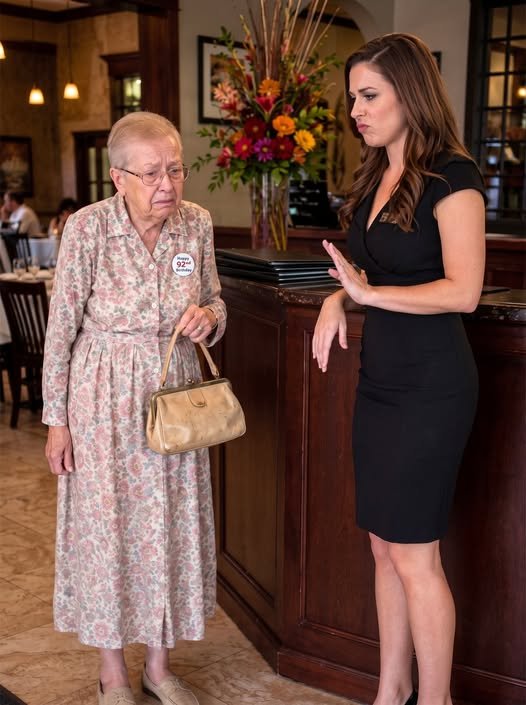
On my grandma’s 92nd birthday, a hostess at a fancy Italian restaurant looked her up and down and said, “She looks POOR.” Then she offered us a table in the hallway “so nobody has to see you.” I was about to lose my temper when a man in a suit walked over and said my grandmother’s name. I had no idea they’d met before.
Part 1: The Table in the Hallway
“Uh… I’m sorry, but we don’t have a table for you.”
The hostess said it to my grandmother, not to me.
It was 6:30 p.m. on a Saturday in late April, at a restaurant called Marchetti’s, twenty-five minutes outside Columbus, Ohio. My grandmother, Margaret Donnelly, had turned ninety-two that morning. She stood next to me in the navy blue dress she’d made herself, holding a small beaded purse with both hands like it might blow away.
I smiled the way you smile at a pharmacy counter when someone’s insurance won’t go through.
“I think there’s been a mistake,” I said. “I have a reservation. Claire Donnelly, party of two, six-thirty. I booked it three weeks ago.”
The hostess was maybe twenty-four. Her name tag said KAYLA. She tapped her tablet, then looked up and studied my grandmother from her gray curls down to her shoes. She took her time, like she was judging a contest.
Then she laughed. It wasn’t a polite little laugh. She laughed right in our faces.
“How am I supposed to let this woman in?” she said. “She looks poor. Look at what she’s wearing. Do you realize this is an upscale restaurant?”
Two couples waiting by the coat rack went quiet.
I felt my grandmother’s hand find my elbow. Her fingers were cold.
Kayla pointed down a narrow hallway past the hostess stand. Near the restroom doors there was a small two-top wedged between a fake ficus and a stack of high chairs.
“Well,” she said, still smiling, “I can offer you that table. God forbid anyone should see you.”
My grandmother’s eyes filled. She didn’t cry. Margaret Donnelly hadn’t cried in front of other people since my parents’ funeral twenty-eight years ago. But her chin started to shake, and she pulled her purse closer.
“It’s all right, Claire,” she whispered. “We can sit anywhere.”
It wasn’t all right. Nothing about it was all right.
I opened my mouth, and I already knew what I was going to say. Most of it would have gotten us thrown out.
Before I said a word, the kitchen doors at the far end of the dining room swung open, and a man in a charcoal suit started walking toward us. He walked fast, the way people do when they’ve seen something from across a room that they can’t believe.
He wasn’t looking at me. He was looking at my grandmother.
I didn’t know it yet, but the evening I’d planned for three months was about to become something else.
Part 2: The Woman Who Skipped Lunch
To understand why that hallway table nearly broke me, you need to know who my grandmother is.
My parents died on Route 33 in February 1998. A pickup slid on black ice and crossed the median. I was six. I was at a sleepover that night, and I still remember the sleeping bag I had: purple, with a broken zipper.
Grandma Peggy was sixty-four. She had already raised one child and buried a husband. She’d been planning to retire from the cafeteria at Fairfield Middle School in Lancaster and maybe finally see the Grand Canyon.
She never went to the Grand Canyon. She took me home instead.
For the next ten years she worked two jobs. From 6:00 a.m. to 2:00 p.m. she ran the lunch line at the middle school. Three nights a week she cleaned offices at an insurance company downtown, and I slept on the couch in the break room with my homework under my head.
We didn’t have much. I knew it, the way kids always know. But I always had what I needed: shoes that fit, a winter coat, and strawberry yogurt in the fridge, because once, when I was seven, I’d told her it was the only thing that made my stomach stop hurting after a bad dream.
I found out much later that some weeks there was yogurt for me and nothing for her lunch.
She would sit across from me at our little kitchen table with a cup of black coffee and say she’d “eaten at work.” I believed her for years. Kids believe the people who love them.
There was one other thing I never figured out. On top of our refrigerator sat an old Maxwell House coffee can with the letter D written on the lid in black marker. Grandma dropped her loose change into it every night. When I asked what D stood for, she said, “Donnelly, of course,” and changed the subject.
Once, when I was nine and desperate for a Lisa Frank folder, I tried to borrow two quarters from it. She caught me and, for the only time I can remember, she raised her voice.
“Not that can, Claire. That money already belongs to somebody.”
I thought she meant the electric company.
Now I’m thirty-four and a pharmacy technician at a Kroger in Grove City. I know what a co-pay costs and how fast an ordinary family can go under.
Four years ago Grandma was diagnosed with colon cancer. She had surgery, then a second surgery, then six rounds of chemo. Even with Medicare and her supplemental plan, we spent $38,400 out of pocket over two years. I sold my Honda. I moved back in with her. I took every Saturday shift I could get.
She beat it. At eighty-eight, she beat it.
When her ninety-second birthday came up, I wanted to give her one night that had nothing to do with bills, hospitals, or being careful.
What I wanted was simple: for my grandmother to feel like the most important person in a beautiful room.

Part 3: Three Months of Saving
Grandma loves Italian food. It’s an old joke between us, because she’s about as Irish as a person can get. Her maiden name is O’Keefe, and she still says “the pictures” when she means the movies. But she makes a red sauce that could stop a fistfight, and she won’t buy jarred Alfredo because she says it “tastes like a lie.”
So in January, I started looking.
I wanted somewhere special, not a chain with breadsticks. I scrolled through reviews on my lunch breaks until I found Marchetti’s. It was in an old brick farmhouse off State Route 37, with white tablecloths, candles in the windows, and handmade pasta. Entrées ran $28 to $46.
I did the math. Two entrées, an appetizer, one glass of wine for her, dessert, tax, and a decent tip came to about $190.
I had $63 left over from my last paycheck after rent, groceries, and her prescriptions.
So I saved. I packed my lunch every day for twelve weeks. I canceled my streaming service. I sold a box of old textbooks on Facebook Marketplace for $41. By the second week of April, I had $240 in an envelope in my sock drawer marked PEGGY 92.
I booked the reservation by phone. The young man who answered asked if it was a special occasion. I told him it was my grandmother’s ninety-second birthday, that she’d survived cancer, and that she’d raised me by herself.
He was quiet for a second. Then he said, “We’ll make sure it’s a good night for her.”
I wrote his name down: Marco. I thought it was sweet. Later, I’d remember that the same Marco never called to confirm anything, and that the tablet at the stand might never have shown my note.
Then came the dress.
I offered to buy Grandma a new one. I had about $40 of wiggle room. She looked at me like I’d suggested selling the house.
“I have a dress,” she said.
She meant the navy blue one with white piping along the collar. She sewed it herself in 1991 for my mother’s wedding. It’s the dress she wore to my high school graduation, and to my parents’ funeral, though neither of us ever mentions that.
It’s thirty-five years old. The hem had been let down once and taken back up twice. One elbow had a tiny darn she’d stitched so neatly you’d need glasses to find it. The fabric had gone a little shiny at the seams.
To me, it was the most beautiful dress in Ohio.
My boyfriend, Ryan, saw her trying it on that week and said, gently, “Babe, are you sure about the dress? That place looks kind of fancy.”
I snapped at him.
“She’s ninety-two. She can wear whatever she wants.”
“I know,” he said. “I’m just saying people can be weird.”
I thought he was being shallow. Now I think he was just being realistic, which is worse, because it means he could picture exactly what happened.
On the drive out, Grandma read the restaurant’s name off the confirmation email on my phone. “Marchetti’s,” she said slowly. “Marchetti.”
“You know it?”
She looked out at the fields for a long moment.
“I used to know a Marchetti,” she said. “A long time ago.”
Then she asked if I’d remembered to turn off the coffee maker, and that was the end of it.
Part 4: Little Things I Should Have Noticed
The restaurant was even prettier in person.
The gravel lot was lined with string lights. Inside, the floors were wide, old pine boards, and there was a fireplace at the far end of the dining room. It smelled like garlic and butter and something sweet baking.
Above the hostess stand hung a hand-painted wooden sign in looping cream letters:
Nobody eats alone.
I stopped and stared at it.
Grandma used to say that. Nobody eats alone at my table. She said it to my friends when they showed up unannounced, to the neighbor whose wife had left, and to the Jehovah’s Witnesses who knocked during dinner one Sunday in 2003. She fed every single one of them.
“Grandma, look,” I said, pointing. “That’s your saying.”
She looked up at the sign, and something moved across her face that I couldn’t read. She wasn’t happy and she wasn’t sad. She looked like someone who had just heard an old song in a store.
“Lots of people say that,” she said quietly.
Then we stepped up to the stand, and you already know what happened next.
Later, I went over that minute again and again, trying to figure out what I’d missed. There were three things.
First, before Kayla started laughing, Grandma’s eyes went straight past her to the open kitchen at the back. She was looking for somebody.
Second, when Kayla pointed at the hallway table, Grandma didn’t just look hurt. She looked embarrassed in a different way, almost guilty, like someone caught somewhere she wasn’t supposed to be.
Third, as Kayla went on, my grandmother kept running her thumb over the beaded clasp of her purse. I found out why later. Inside it was a folded index card, soft as cloth from being handled. She’d brought it from home. She hadn’t told me.
At the time, I only saw a cruel girl and a heartbroken old woman.
“Do you hear me?” Kayla said when neither of us moved. “That’s the table. Take it or leave it. I have actual guests.”
One of the women by the coat rack muttered, “Oh my God.” Not to defend us. She sounded thrilled, like she’d just gotten free entertainment. Her husband had his phone halfway out of his pocket.
That was what pushed me over the edge. People weren’t just watching. They were getting ready to record my grandmother’s humiliation for strangers on the internet.
“Excuse me,” I said, and my voice came out much louder than I meant it to. “My grandmother is ninety-two years old. She survived cancer. She raised me after my parents died. I saved for three months for this dinner, and you’re going to—”
“Claire,” Grandma whispered. “Please. Don’t make a scene. Not for me.”
And just then, I heard footsteps on the pine floor behind Kayla. They were quick and heavy.
Part 5: The Choice in the Doorway
I have to back up a few seconds, because before the owner got to us, I made a choice. I still think it was the most important part of the night.
My grandmother asked me not to make a scene.
That was her whole life in one sentence. Don’t make a scene. Don’t take up room. Eat at work. Keep the dress. Put the change in the can. Take the hallway table.
For thirty-four years I’d watched her make herself smaller so other people had more room. She did it so naturally I’d stopped noticing.
I had two easy options.
I could take her arm, walk her out to my car, drive home, and give her the $240 in an envelope with a card. She’d tell me it was the best birthday she’d ever had, and she’d mean it, because she always means it. She’d keep the hallway table to herself forever.
Or I could do what I was about to do: lose my temper, call Kayla every name I knew, maybe slap the tablet off the stand, and turn my grandmother’s birthday into a viral video titled Crazy Woman Freaks Out at Restaurant.
Either way, Grandma would lose.
So I picked a third option, and it scared me more than yelling would have. I decided to stay calm and refuse to move.
I took a breath. I put my hand over my grandmother’s on the purse.
“We’re not going to make a scene,” I told her. Then I looked at Kayla. “But we’re also not going to sit by the bathroom. I made a reservation. I’d like to speak to the manager, please.”
Kayla rolled her eyes. “The manager is going to tell you the exact same thing.”
“Then I’d like to hear it from him.”
It sounds small, but it cost me. My face was burning. I could feel every eye in the waiting area on my back. I knew that if this went badly, my grandmother would remember for the rest of her life that her birthday had ended in an argument with a stranger, because of me.
I also knew something else. If I walked her out that door, I’d be teaching her the same thing she taught me without meaning to: that people like us should take the hallway table and say thank you.
Grandma squeezed my hand once. I couldn’t tell if it meant stop or thank you.
Then the man in the charcoal suit got to the stand.
He was in his mid-thirties, tall, with dark hair going gray early at the temples. He had flour on one cuff, as if he’d come straight from the kitchen and thrown his jacket on over his apron. He didn’t even look at Kayla. He looked straight at my grandmother, and his face went still, the way a person’s face does when the ground shifts under them.
“Good evening,” he said. “I’m Daniel Marchetti. I’m the owner.”
His voice cracked a little on the word owner.
Then he said something I will never forget:
“Mrs. Donnelly? You still wear your hair the same way.”

Part 6: A Dollar Eighty-Five
My grandmother let go of my hand.
“Hello, Danny,” she said softly. “You got tall.”
I looked from one to the other. For a second I thought I’d misheard.
Daniel Marchetti laughed, but his eyes were wet. “I was eleven. I hope I got tall.”
Then he turned to Kayla, and every bit of warmth left his face.
He didn’t yell. If he had, I think it would have been easier for her. He spoke clearly enough that the whole waiting area and the first three tables could hear every word. Forks stopped. A man by the fireplace set down his wine glass.
“Kayla,” he said, “I want you to look at this woman. I heard everything you said. The kitchen door was open.”
Kayla’s mouth opened. Nothing came out.
“In 2001 my father left,” Daniel said. “My mother had multiple sclerosis and couldn’t work. My little sister and I qualified for reduced lunch, forty cents a day, and most days we didn’t have the forty cents. My lunch account at Fairfield Middle School was eighty-some dollars in the red. The school sent letters home. My mom cried over every one.”
He nodded toward my grandmother.
“This woman ran the lunch line. One day she saw me pick up a tray and put it back. The next day, and every school day for the next three years, she paid for my lunch herself. A full lunch, a dollar eighty-five. And every Friday she slipped a wrapped sandwich into my backpack for my sister, so she’d have something over the weekend. She never told anyone. She never told me she was doing it. I found out from the school secretary when I was in eighth grade.”
My knees actually went weak. I put my hand on the hostess stand to steady myself.
The coffee can with the D on the lid.
That money already belongs to somebody.
All those nights she’d “eaten at work.”
She hadn’t skipped meals just so I could have strawberry yogurt. She’d been feeding another child too, on a cafeteria worker’s paycheck, and saying nothing.
Daniel pointed up at the wooden sign above the stand.
“She told me once, ‘Nobody eats alone at my table.’ I painted that sign myself the week this place opened.” He looked back at Kayla. “So when you tell this woman she looks poor, you’re right. She was poor. She was poor because she spent her money on kids like me. Everything in this building started with her dollar eighty-five.”
The room was so quiet I could hear the fire popping.
“Take off your name tag,” Daniel said. “Get your things from the back. You’re done here.”
That’s when Kayla screamed.
It wasn’t words at first, just a high, furious shriek that echoed off the old ceiling beams. Then the words came.
“Are you serious? Over her? You’re firing me over some old lady in a thrift-store dress? I’ve worked here eight months! You can’t fire me for telling the truth!”
Daniel didn’t raise his voice.
“I’m not firing you for telling the truth,” he said. “I’m firing you for deciding who deserves to be seen.”
She ripped the name tag off and threw it onto the stand. It bounced and landed near my grandmother’s purse.
I’m not proud of this part, but I’m going to tell you anyway.
I just stood there smiling. The sweetest smile I’ve ever given anyone.
“Have a good night, Kayla,” I said.
She stormed through the kitchen doors. Somewhere back there, a pan hit the floor.
My grandmother bent down slowly, picked up the name tag, and set it upright on the stand so it wouldn’t get lost.
Part 7: The Best Table and the Bill
Daniel walked us through the dining room himself, with one hand under my grandmother’s elbow.
He didn’t take us to the hallway. He took us to the round table by the fireplace, the one with the view of the fields through the old wavy glass. A small card on it read Reserved – Donnelly. It had been set for us all along.
“I read Marco’s note when you booked,” Daniel told me quietly while Grandma was settling her purse. “Ninety-two. Cancer survivor. Raised her granddaughter. And the last name was Donnelly. I told myself it couldn’t be her. I’ve looked for her for years. The school district said she retired and wouldn’t give out her address.”
“She moved in 2010,” I said. “When I went to college. Smaller apartment.”
He nodded. “I came out of the kitchen to see if it was really her. I got there about thirty seconds too late.”
He brought her a glass of Chianti and a plate of his mother’s lemon ricotta cookies. Then he sat down with us, in his floury suit, in the middle of a Saturday dinner rush.
Grandma opened her purse and took out the index card I’d seen her touching. It was soft and yellowed. In her slanted cafeteria handwriting it said:
D. Marchetti — 7th gr. — $1.85/day. Sister: Gina, 3rd gr. — Fri sandwich.
Underneath was a column of tally marks, hundreds of them, in faded pencil.
“I kept count,” she said, almost apologetically. “Old habit. I don’t know why I brought it tonight. When Claire said the name, I suppose I hoped.”
Daniel held the card for a long time without saying anything.
Here’s what happened after that.
First, another choice that cost something. A woman two tables over had filmed the whole exchange at the stand. She came over and kindly offered to send it to me. “This needs to go viral,” she said. “People need to see what that girl did.”
Part of me wanted that more than I can explain. I wanted Kayla’s face on a million screens. After the hallway table and the word rags, I thought she had it coming.
I looked at my grandmother. She shook her head, just barely.
“She’s twenty-four,” Grandma said. “I’d hate to be known forever for the worst thing I did at twenty-four.”
So I asked the woman to delete it, and I watched her do it. I still think about whether that was the right call. Most days I believe it was.
Second, the bill. Daniel tried to comp everything. Grandma wouldn’t allow it.
“I have never in my life eaten a meal I didn’t pay for,” she said, “and I’m not starting at ninety-two.”
They argued about it for ten minutes, very politely. In the end the check came to $186.40, and I paid it out of the PEGGY 92 envelope. I left a $50 tip for our server, a nervous college kid named Marco, the same Marco who had taken my call.
Daniel accepted our money. Then he did something with his own.
The following Monday, he paid off every negative lunch balance at Fairfield Middle School. It came to $3,212.75, and he wired it to the district.
The letter from the principal named the fund The Peggy Donnelly Second Plate Fund.
Part 8: Every Friday
It’s October now, five months later.
Grandma and I go to Marchetti’s on the first Sunday of every month. We sit at the round table by the fire. We always pay. Daniel always sends out lemon ricotta cookies that “aren’t on the bill,” and Grandma always pretends not to notice.
His sister Gina came to dinner in June. She’s thirty-two now, a nurse in Cincinnati. She hugged my grandmother in the parking lot for so long that a man waiting for the spot honked, then saw what was happening and turned off his engine.
“You made my Fridays,” Gina told her. “I used to eat half the sandwich Friday night and save half for Saturday.”
Grandma patted her back and said, “Well, I should’ve made them bigger.”
And Kayla?
In August, a card showed up in my grandmother’s mailbox. There was no return address, just a Columbus postmark. Inside was a note in careful, round handwriting:
Mrs. Donnelly — I am sorry for what I said to you. My mom cleaned houses when I was growing up, and I was ashamed of her clothes, and I think I was ashamed of you for the same reason. That isn’t an excuse. I start a new job next month. I’m going to do better. — Kayla.
Folded into the card was a receipt for a $40 donation to the Second Plate Fund.
Grandma read it twice. Then she pinned it to the corkboard by her phone, next to my high school graduation picture.
“Are you going to write back?” I asked.
“Not yet,” she said. “Let’s see if she does better first. Saying it is the easy part.”
That’s my grandmother. She forgives, but you have to show her you mean it.
As for me, I finally asked her about the coffee can.
She admitted she’d kept it going for years after Danny graduated. There was always some kid with a negative balance and a tray they’d put back. She paid off lunches until the day she retired in 2008. She never told anyone, not even me.
“Why didn’t you tell me?” I asked.
She shrugged. “You were already carrying enough.”
So now I keep my own can. It’s on top of my refrigerator: an old Folgers can with a strip of masking tape on the lid. On the tape, in black marker, I wrote one letter: P.
Every Friday I put my loose change in it. When it’s full, I take it to Fairfield Middle School and hand it to the woman in the hairnet at the front of the lunch line. She knows exactly where it goes.
The last time I went, she smiled and said, “Your grandma used to do this.”
“I know,” I said. “I’m a little late.”
On the way out, I passed the cafeteria doors and saw a hand-lettered paper sign taped above the lunch line. A kid had obviously made it with markers.
Nobody eats alone.
My grandmother is ninety-two. She still wears the navy blue dress. She still eats every last bite of her dessert. And now, whenever she walks into a restaurant, she holds her head up.