
Emma first met the bikers on a Tuesday afternoon outside a child-advocacy center in Oklahoma City.
She had been living with Laura for less than two weeks. Most of her belongings still fit inside a pink backpack, and she slept with her shoes beside the bed because some part of her remained prepared to leave quickly.
The caseworker had mentioned that a local BACA chapter sometimes supported children who felt unsafe because of an alleged abuser, court proceedings, or ongoing intimidation.
Laura hesitated.
Motorcycle clubs were not part of her world.
She imagined loud engines, aggressive men, and a frightened child overwhelmed by strangers in leather.
Then Emma heard the word motorcycles.
“Real ones?”
The caseworker smiled.
“Very real.”
The riders met Emma outside instead of entering the therapy building. They parked far enough away that the engines would not surprise her, then approached one at a time.
Atlas removed his sunglasses.
Scout knelt several feet away.
A younger Latino American biker called Mako carried a stuffed owl tied to his handlebars. A sixty-four-year-old white American grandmother named June Bug wore purple braids and had tiny flowers tattooed across one hand.
None of them asked Emma to hug them.
None called her brave.
Atlas introduced each rider and explained one rule.
“You decide how close we stand.”
Emma pointed toward a crack in the sidewalk approximately twelve feet away.
They stopped behind it.
For nearly twenty minutes, she said nothing.
The bikers waited.
Adults often fill a child’s silence because it makes them uncomfortable. These riders seemed to understand that silence could belong to Emma without needing to be repaired.
Finally, she pointed toward Atlas’s vest.
“Are you police?”
“No.”
“Can you arrest people?”
“No.”
“Then what do you do?”
Atlas considered the question.
“We remind kids they don’t stand alone.”
Emma’s eyes narrowed.
“What if the bad person is bigger?”
Atlas glanced down at himself.
“Most people aren’t.”
That produced the first smile anyone had seen from her in days.
During later visits, the bikers did not discuss the trial unless Emma brought it up. They helped her decorate a bicycle helmet even though she did not own a bicycle. They taught her how to identify motorcycles by engine sound and allowed her to select a road name.
She chose Firefly because fireflies were small but carried their own light.
Scout had the name stitched onto a child-sized denim vest.
When she presented it, she told Emma the vest was not armor.
“Armor means you expect a fight,” Scout said. “This means you already have people.”
That distinction mattered.
The bikers never promised nothing bad would happen again. They promised that if Emma called, somebody would answer.
Then the subpoena arrived.
The prosecutor initially hoped Emma’s recorded forensic interview would prevent direct testimony. The defense challenged portions of the evidence, and the judge ruled that limited questioning in court would be necessary.
The news reopened every fear.
Emma stopped sleeping through the night.
She began asking whether Richard could leave the courtroom, whether he could speak to her, and whether he would know where she lived.
The prosecutor explained the protections in place.
Emma heard only one fact:
He would be in the room.
Three days before trial, Atlas visited the foster home. Emma sat beneath the kitchen table while he remained outside on the porch.
“I can’t see him,” she said through the open window.
Atlas did not tell her she had to.
“What would help?”
“Thirty people.”
He thought she was exaggerating.
Then she repeated it.
“Thirty big people between me and him.”
Atlas contacted the chapter president, the prosecutor, courthouse security, and Emma’s advocate.
The request was unusual.
It was also possible.
The bikers would not block the legal view of the witness, threaten the defendant, or interfere with testimony. They would sit in the gallery as members of the public and approved supporters.
Thirty volunteers signed up by evening.
Some rearranged work schedules.
Two traveled from a chapter more than one hundred miles away.
One postponed a medical appointment.
When asked why so many were necessary, Scout answered simply:
“Because thirty is the number she asked for.”
Part 3
The trial began without Emma.
For two days, investigators, medical professionals, and social workers testified. The courtroom heard evidence of manipulation, isolation, and injuries explained away as accidents.
Richard sat beside his attorney in a gray suit.
To someone who did not know the case, he appeared ordinary.
That was part of what frightened Emma.
Children are often warned about monsters as though cruelty always announces itself through a frightening face. Richard had smiled in family photographs. He had helped neighbors repair fences. He had attended school events.
Emma had learned that danger could look respectable.
On the morning of her testimony, the bikers assembled at a truck stop before sunrise. Atlas reminded them that their behavior would be watched closely.
“No staring at the defense table,” he said. “No comments. No patches turned into threats. We are furniture with heartbeats.”
Mako raised a hand.
“Can furniture wear leather?”
“Today it can.”
The joke loosened the tension.
Then Atlas became serious.
“This courtroom belongs to the law. Emma’s voice belongs to her. We don’t win anything today. We make room for her to speak.”
They arrived forty minutes early.
Court deputies searched everyone according to standard procedures. Pocketknives, chains, and several heavy key rings remained in locked motorcycle compartments.
The riders did not complain.
Their purpose required discipline stronger than anger.
When the judge entered, the courtroom rose. Emma was still outside, struggling to cross the threshold.
The prosecutor requested a short delay.
The defense objected, arguing that the child had already been given substantial accommodation.
Judge Margaret Hale, a sixty-one-year-old Black American woman known for controlled patience, looked toward the courtroom door.
“An eight-year-old witness taking five additional minutes to enter this room does not burden justice,” she said. “It reminds justice whom it is asking to speak.”
The objection ended.
Emma entered holding my hand and Laura’s.
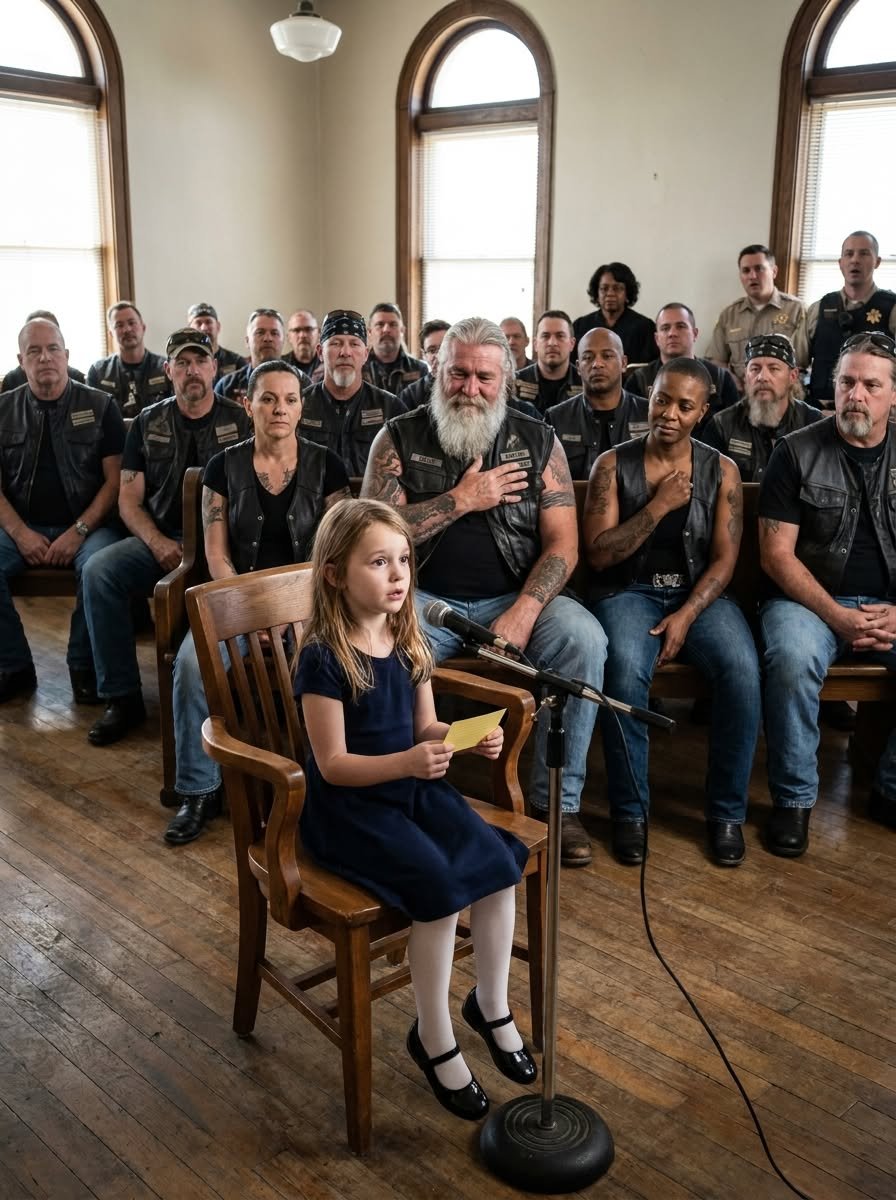
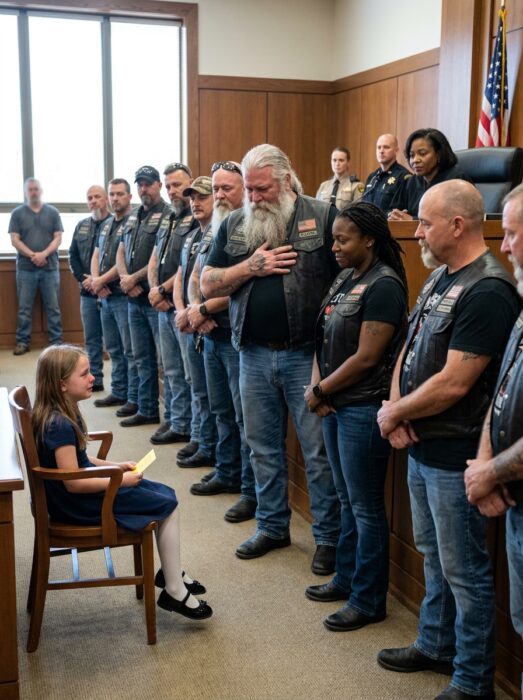
The thirty bikers stood only because everyone else had been ordered to stand. Then they sat together.
Richard looked over his shoulder.
For the first time, his expression changed.
Not fear.
I believe it was surprise.
The child he expected to enter with one advocate had arrived before an entire community of witnesses to her courage.
Emma took the oath in language adjusted for her age. She promised to tell the truth and explained the difference between something real and something invented.
The prosecutor began with easy questions.
Her age.
Her school grade.
Her favorite animal.
“Dogs,” Emma answered.
“What kind?”
“All good dogs.”
A small sound of restrained laughter moved through the gallery.
Emma glanced at the bikers.
Atlas smiled.
Then the questions changed.
The prosecutor did not demand graphic details. She asked whether Richard had hurt her, whether he told her to keep secrets, and why she had been afraid to tell another adult.
Emma’s fingers tightened around the yellow break card.
“He said nobody would believe me.”
The courtroom became still.
“Did you believe him?”
“Yes.”
“What changed?”
Emma looked toward the leather vests.
“They came.”
The prosecutor followed her gaze.
“Who came?”
“My bikers.”
Several riders lowered their heads.
Emma continued.
“They said I didn’t have to be not scared. They said I could tell while I was scared.”
The prosecutor paused.
“Are you scared now?”
Emma nodded.
“Yes.”
“Are you still able to tell the truth?”
Emma looked at Atlas, Scout, Mako, June Bug, and the twenty-six others forming the human horizon in front of her.
“Yes.”
Then she began.
Part 4
Emma testified for twenty-three minutes.
To adults, twenty-three minutes may sound brief.
For an eight-year-old speaking publicly about fear while the person responsible sat in the same room, it was an endurance event.
She used the yellow card twice.
The first break lasted seven minutes. Emma drank water in a private room while Scout sat outside the doorway.
The second happened when the defense attorney asked whether Emma might have misunderstood something Richard said.
The question was legally permitted, but Emma heard accusation inside it.
Her face lost color.
“I don’t want to do this.”
I reminded her that she could request another break.
She lifted the yellow card.
In the hallway, Atlas sat on the floor because his height made standing over her feel wrong.
“What if they think I’m lying?” Emma asked.
Atlas rested his forearms on his knees.
“I can’t decide what every person thinks.”
“Then what can you do?”
“Stay.”
Emma looked toward the courtroom.
“What if I mess up words?”
Scout answered from the wall.
“Truth doesn’t stop being true because your voice shakes.”
Emma returned.
During cross-examination, the defense attorney maintained a calm tone. He asked whether she remembered exact dates, whether adults had discussed the case around her, and whether some memories had become mixed.
Emma did not know every answer.
She said so.
“I don’t remember.”
“I’m not sure.”
“Nobody told me that.”
Those answers mattered because courage was not pretending certainty. It was refusing to replace what she did not know with what adults expected.
Then the attorney asked whether she disliked Richard before making the allegations.
Emma stared toward the biker wall.
“I didn’t want him to be bad.”
The attorney paused.
Emma’s voice grew clearer.
“I wanted him to stop.”
No one moved.
Not the judge.
Not the jury.
Not the court reporter.
Even Richard’s attorney lowered his notes for a moment.
That sentence contained the reality adults frequently misunderstand. Emma had not testified because she wanted revenge. She had wanted safety before she understood the legal meaning of consequences.
The questioning ended shortly afterward.
The judge thanked her.
Emma climbed down from the witness chair and walked toward the courtroom door. She did not look at Richard.
She looked at the thirty riders.
Atlas remained seated until she reached him.
Then Emma did something she had never done before.
She raised both arms.
Atlas glanced at Scout, silently asking whether he should respond.
Emma stepped closer.
He opened his arms carefully.
She hugged him.
The largest man in the courtroom closed his eyes while an eight-year-old girl disappeared against his leather vest.
One by one, the bikers placed hands over their hearts.
Nobody applauded.
Applause would have turned testimony into performance.
They simply acknowledged what she had done.
As the courtroom recessed, Judge Hale remained on the bench.
She looked toward Atlas.
“Mr. Callahan, is there something you wish this court to understand about your group’s presence?”
Atlas stood.
“We cannot erase what happened to her, Your Honor.”
His voice shook despite his size.
“But we can make sure she never has to be alone while telling the truth.”
The courtroom fell silent.
That was the reason.
Not intimidation.
Not revenge.
Not thirty adults arriving to frighten one defendant.
Thirty adults had arrived because one child needed the room to contain more protection than fear.
Part 5
The jury returned its verdict two days later.
Guilty on the most serious charges.
Richard showed little visible reaction.
Emma was not in the courtroom. She had already given enough of herself to the process.
Laura received the call while Emma was coloring at the kitchen table. She did not explain sentencing ranges or legal procedure immediately.
She said, “They believed you.”
Emma kept coloring.
After several seconds, she asked, “All of them?”
“The jury did.”
“What about the bikers?”
“They already believed you.”
Emma nodded as though that distinction mattered more.
The sentencing occurred weeks later. Richard received a lengthy prison term and protective orders were extended.
People later described the result as justice.
I learned to use that word carefully.
A conviction did not return Emma’s lost years, repair trust instantly, or remove nightmares. Court could hold an offender accountable.
It could not make an eight-year-old untouched by what happened.
The bikers understood.
They did not disappear after the verdict.
Atlas attended Emma’s first school concert, sitting in the back row because his size blocked several parents. Scout helped Laura find a trauma-informed swimming instructor after Emma decided she wanted lessons.
Mako taught her to repair a bicycle chain.
June Bug brought seed packets and helped her plant firefly-friendly flowers in the yard.
Their presence was not dramatic most days.
It was ordinary reliability.
That mattered more.
The group also faced criticism. Some people believed bikers had no place in a courtroom. Others worried their presence could influence jurors or appear threatening.
Atlas never dismissed those concerns.
He explained that the riders had followed every judicial instruction, made no contact with the defendant, and attended as approved supporters in public seating.
“We did not come to make the jury afraid of us,” he said. “We came so Emma could stop being afraid of him long enough to answer questions.”
The judge later wrote that courtroom safety involved more than preventing physical harm. For a vulnerable child witness, the environment could determine whether participation was possible at all.
She also emphasized that every case required individual judicial review.
The event was not a template to be copied without safeguards.
It was one solution shaped around one child’s clearly stated need.
Emma’s request had been thirty big people.
Thirty came.
Part 6
Six months after the trial, Emma returned to the courthouse.
Not for another hearing.
Judge Hale had invited her to visit an empty courtroom on a Saturday, when no defendant, jury, or reporters would be present.
Emma hesitated at the door.
Atlas and Scout waited in the hallway.
“You’re not coming inside?” she asked.
Judge Hale answered from the bench.
“Only if you invite them.”
Emma thought for a moment.
“Two.”
Atlas and Scout entered.
The huge courtroom looked different without fear occupying it. Emma walked behind the judge’s bench, examined the jury box, and tested the court reporter’s chair.
Judge Hale showed her that the witness seat was simply wood, fabric, screws, and a microphone.
“It felt bigger,” Emma said.
“Fear changes the size of rooms,” the judge replied.
Emma climbed into the chair again.
Her feet still did not reach the floor.
She looked toward the gallery where thirty bikers had once formed the wall.
“Can I say something?”
Judge Hale nodded.
Emma leaned toward the silent microphone.
“My name is Firefly.”
Atlas covered his mouth.
Scout smiled.
Emma continued.
“I told the truth here.”
This time, the courtroom did not ask her to prove anything.
It simply held the sentence.
Judge Hale later arranged for small adjustable footrests to be installed beneath child-witness chairs. The change seemed minor, but children often feel more secure when their feet have somewhere solid to rest.
Emma’s testimony had revealed another gap.
Adults had prepared questions, breaks, and legal protections.
Nobody had noticed that her feet were hanging in the air.
The courthouse also developed a clearer process for approved support groups, trained advocates, therapy animals, and other accommodations, always subject to judicial review and the rights of everyone involved.
Emma did not become the public face of those changes. Her identity remained protected outside those directly involved.
That was intentional.
She had already given the court her voice.
She did not owe the world her face.
Part 7
Four years have passed since thirty bikers sat between Emma and the defense table.
She is twelve now.
She has grown tall enough that her feet touch the floor in ordinary chairs. Her hair reaches below her shoulders, and she no longer pulls her sleeves over her hands whenever an adult speaks.
Some fears remain.
Healing is not a straight road, and no honest story should pretend otherwise.
She dislikes closed doors.
Unexpected footsteps behind her can still cause panic.
Certain dates make sleep difficult.
But Emma rides a blue bicycle decorated with firefly stickers. She performs in school plays, argues about homework, and has developed strong opinions about music Atlas considers “mechanically produced noise.”
The bikers remain part of her life.
On the anniversary of the verdict, they do not celebrate Richard’s sentence. Instead, they hold Firefly Day, collecting school supplies, comfort items, and funds for children entering foster care or preparing for difficult court appearances.
Emma chooses the project each year.
Last year, she selected night-lights.
“Dark rooms feel smaller when you can see one thing,” she explained.
Thirty bikers packed hundreds of tiny lamps into boxes.
This spring, a ten-year-old child from another case arrived at the advocacy center terrified of court. Emma was not given details and did not ask.
She sat across the room while Atlas explained that support could look different for every child.
The boy wanted to know whether the bikers would fight the person who hurt him.
Atlas shook his head.
“No.”
“Then how do you protect people?”
Emma answered before he could.
“They stay where you can see them.”
The boy looked toward her.
“Does that work?”
Emma touched the FIREFLY patch on the small denim vest she had outgrown but still carried to important events.
“It helped me tell the truth while I was scared.”
Later, outside the center, Atlas asked whether she remembered the courtroom wall.
Emma nodded.
“I thought you were protecting me from seeing him.”
“We were.”
She looked toward the parked motorcycles.
“But you were doing something else too.”
“What?”
“You made him see that I had people.”
Atlas lowered his head.
“That too.”
Emma hugged him briefly, then put on her bicycle helmet.
Before riding away, she turned back.
“You know I wasn’t brave because I stopped being scared.”
Atlas smiled.
“I know.”
“I was brave because I talked anyway.”
The motorcycles remained silent as she pedaled down the sidewalk.
No wall around her.
No adult holding the seat.
Just a girl carrying her own light forward.
Thirty bikers could not erase what happened.
They could not testify for her, choose her words, or take her fear away.
They did something both smaller and more important.
They stayed where she could see them until the truth became louder than the person who had frightened her into silence.
Follow the page for more unforgettable biker stories about rough-looking protectors who never steal someone’s voice—they stand beside it until it can be heard.