
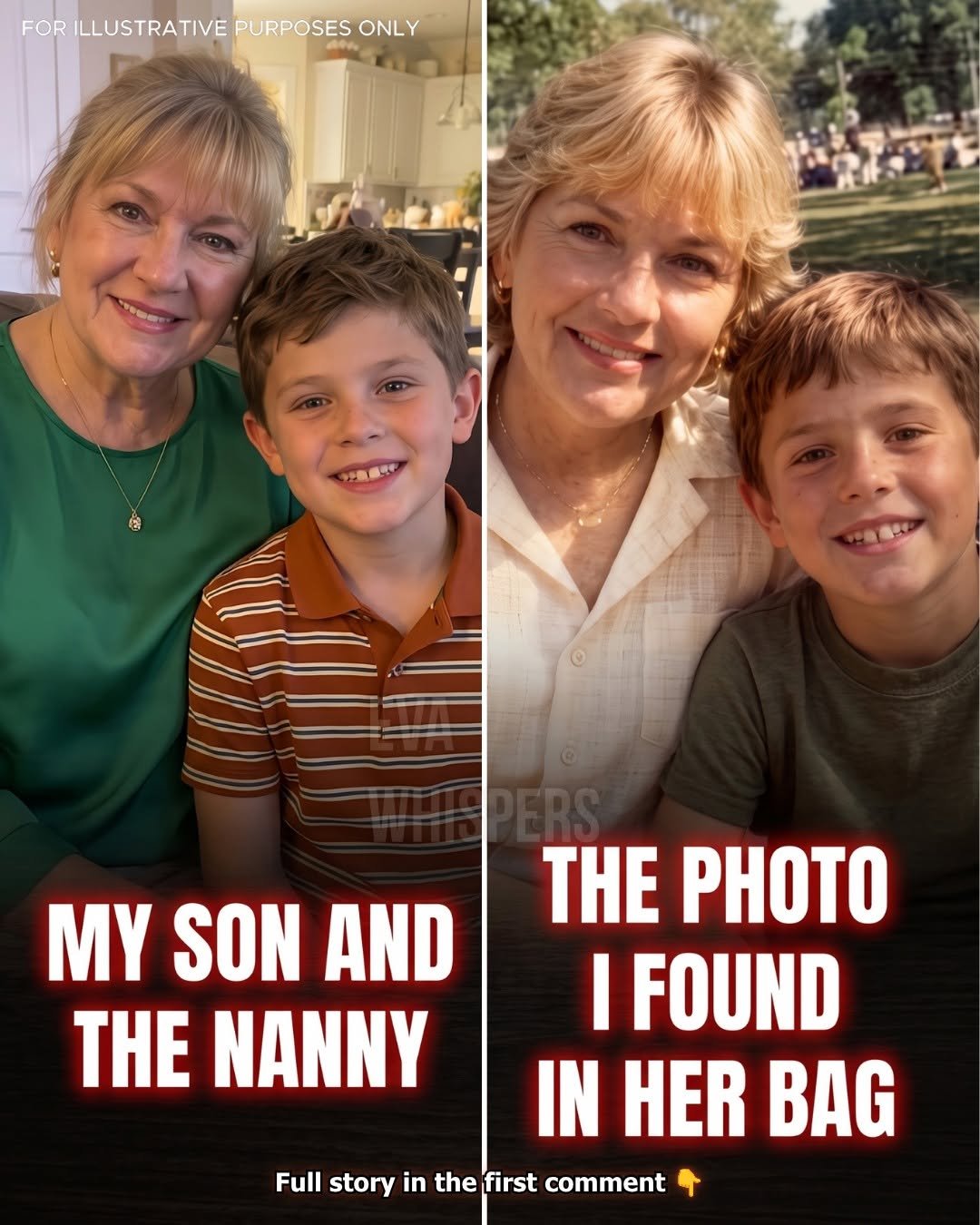
The Boy No Nanny Could Handle
My husband, Daniel, and I had grown almost desperate while trying to find a nanny for our seven-year-old son, Martin.
To strangers, Martin looked like a sweet little boy with soft brown eyes, messy hair, and a smile that could melt anyone’s heart. But inside our home, he was a storm in sneakers.
One nanny lasted a single day before he poured apple juice all over her blouse.
Another had her car keys hidden in the laundry basket and her expensive shoes painted bright blue.
A third nanny called me from the hallway, whispering like she was escaping a crime scene.
“I’m sorry, Mrs. Carter,” she said, trying not to cry, “but your son doesn’t need a nanny. He needs a magician.”
The last one didn’t even whisper.
“YOUR SON IS COMPLETELY IMPOSSIBLE!” she shouted before walking out in the middle of her shift.
I stood there holding Martin’s lunchbox, too embarrassed to answer.
Martin only sat at the kitchen table, swinging his legs, pretending not to care. But I had learned to notice the small things. The way his lips tightened. The way he stared at the floor. The way he looked almost disappointed whenever someone left.
That was what people didn’t understand.
Martin wasn’t cruel.
He was scared.
The Woman Who Came to the Door
One rainy Tuesday afternoon, an elderly woman named Evelyn came for an interview.
She arrived ten minutes early, wearing a neat gray coat and carrying a worn brown handbag. Her hair was silver, pinned carefully at the back of her head, and her hands trembled slightly when she accepted the cup of tea I offered.
I worried immediately that she might be too gentle for Martin.
Then Martin came running into the room, stopped suddenly, and stared at her.
Evelyn stared back.
For one strange second, the air seemed to change.
Her face went pale. Her fingers tightened around the cup, and she looked at Martin as if she had seen a ghost.
“Hello,” Martin said suspiciously.
Evelyn swallowed. “Hello, sweetheart.”
He frowned. “I’m not your sweetheart.”
Instead of looking offended, she smiled softly.
“No,” she said. “Not yet.”
I didn’t know what to make of that.
Daniel was even less convinced. A few minutes later, while Evelyn sat in the living room with Martin, my husband pulled me into the kitchen.
“She’s too old,” he whispered. “I don’t think this is a good idea.”
Before I could answer, Evelyn’s voice came from the doorway.
“I can work for half the salary.”
Daniel and I turned around, startled.
Her face flushed with embarrassment, but she lifted her chin.
“I’m sorry. I didn’t mean to overhear,” she said. “I just really need the money.”
Something about her voice touched me. It wasn’t begging. It was honest.
Daniel still looked doubtful.
“Martin can be difficult,” he said carefully.
Evelyn looked past him toward the living room, where Martin was loudly knocking wooden blocks onto the floor.
“I know difficult children,” she said quietly. “Sometimes they are only children who have not been understood yet.”
That sentence stayed with me.
So against Daniel’s doubts, and honestly against my own fears, we hired her.

The Impossible Happened
I expected Evelyn to quit within three days.
She didn’t.
The first day, Martin refused to speak to her. She sat on the floor nearby and folded paper airplanes without asking him to join.
By the end of the afternoon, he was secretly watching her.
The second day, he hid her reading glasses. She found them inside his toy garage and simply said, “Good hiding place. But next time, leave me a map.”
Martin laughed before he could stop himself.
The third day, he spilled cereal on purpose. Evelyn handed him a cloth and said, “Every good captain cleans his own ship.”
He cleaned it.
By the end of the first week, he was asking when she would arrive.
By the end of the second, he was waiting by the window.
By the end of the month, our house had changed in a way I could barely explain. The shouting became laughter. The slammed doors became bedtime stories. The angry silence at dinner became Martin proudly explaining how Evelyn had taught him to make tomato pasta without burning the sauce.
Daniel and I watched in complete shock.
One evening, I came home early and found them in the living room. Martin was asleep with his head in Evelyn’s lap, one hand holding the edge of her cardigan like he was afraid she might disappear.
Evelyn was gently brushing his hair back from his forehead.
Daniel stood beside me, his voice low.
“My God,” he whispered. “We’re so lucky we found this woman.”
I nodded, smiling through a strange tightness in my throat.
Then I noticed Evelyn’s handbag on the floor, half-open near the couch. It had fallen sideways, and a small stack of papers had slipped out.
I bent down to pick them up.
That was when I saw the photograph.
The Boy in the Old Picture
It was old and faded, the kind of photograph with soft edges and colors that had turned slightly yellow over time.
In the picture was a much younger Evelyn, maybe in her thirties, standing in a sunny garden. Beside her was a little boy.
My breath caught.
The boy looked exactly like Martin.
Same dark hair. Same serious eyes. Same small chin. Same half-smile that looked like he was trying not to trust the camera.
For a moment, my mind refused to understand what I was seeing.
Martin was seven.
This picture had to be at least thirty years old.
I looked at Evelyn. She had fallen asleep sitting up, one hand still resting protectively on my son’s shoulder.
I didn’t call Daniel.
I didn’t want to frighten Martin.
Instead, I carefully woke Evelyn and held up the picture.
“Explain this to me,” I whispered. “What is this?”
Her face changed instantly.
Not with guilt.
With pain.
She looked at the photograph, then at Martin, still sleeping peacefully against her.
“Oh,” she breathed. “I hoped you wouldn’t find that like this.”
My heart began to pound.
“Who is this boy?” I asked.
Evelyn’s eyes filled with tears.
“That,” she said, “is your husband.”
The Name Daniel Had Forgotten
I stared at her.
“My husband?”
She nodded, her voice trembling.
“Daniel was seven in that photograph. The same age Martin is now.”
I almost laughed because it sounded impossible.
“That can’t be,” I said. “Daniel would have told me.”
Evelyn shook her head slowly.
“No. I don’t think he remembers me clearly. Children sometimes bury painful years very deep.”
She looked down at the photograph as if it was a piece of her own heart.
“Thirty years ago, I worked as a live-in caregiver for a family named Carter,” she continued. “Your husband’s family.”
I sat down across from her.
The room felt suddenly too quiet.
Evelyn told me Daniel had been a lonely, angry child after his mother passed away. His father, overwhelmed by work and grief, had hired Evelyn to care for him.
“He was much like Martin,” she said softly. “Sharp, stubborn, always testing people. He ruined my shoes once too.”
Despite myself, I looked down at her sensible black shoes.
Evelyn smiled through tears.
“I stayed because I understood what he was doing. He was not trying to make people leave. He was trying to see who would stay.”
The words hit me so hard that I had to look away.
Because that was Martin.
That was exactly Martin.
“What happened?” I asked.
“One day, Daniel’s father remarried and moved away. I was dismissed without warning. I wrote letters for months, but they were returned. I never saw Daniel again.”
She touched the photograph carefully.
“I kept this because he was the first child I ever truly cared for.”
Daniel’s Reaction
I wanted to believe her, but I also knew I had to tell Daniel.
When Martin woke up, Evelyn asked if she could leave early. Her hands were shaking as she gathered her things.
That night, after Martin went to bed, I showed Daniel the photograph.
He stared at it for a long time.
At first, he said nothing.
Then his face went pale, just as Evelyn’s had the first day she saw Martin.
“Where did you get this?” he asked.
“From Evelyn’s bag.”
He sat down slowly.
“That’s me,” he whispered.
I felt my chest tighten.
“You remember her?”
Daniel rubbed his forehead like a locked door had opened somewhere inside him.
“Not everything,” he said. “But I remember a woman who smelled like lavender soap. Someone who made pancakes shaped like stars. Someone who sat outside my bedroom when I had nightmares.”
His voice broke.
“I used to call her Evie.”
The next morning, Daniel was waiting in the kitchen when Evelyn arrived.
For the first time since I had known him, my confident, practical husband looked like a little boy.
Evelyn stopped in the doorway.
Daniel held up the photograph.
“Evie?” he asked.
Her hand flew to her mouth.
Then Daniel crossed the room and hugged her.
Not politely.
Not carefully.
He hugged her like someone who had finally found a missing part of his childhood.
Evelyn cried into his shoulder.
“I looked for you,” she whispered.
“I think I waited for you,” he said. “But I was too young to understand why you never came.”
“I was sent away.”
“I know,” he said. “I believe you.”

The Truth Behind Martin’s Anger
After that day, everything began to make sense in a way I hadn’t expected.
Daniel had always been a wonderful father, but he was also afraid of Martin’s anger. Every tantrum seemed to pull him back into a past he didn’t fully remember. He would become tense, strict, and frustrated. Martin would become even more defiant.
They loved each other deeply, but they were speaking two different languages.
Evelyn became the bridge between them.
One afternoon, she sat with Daniel in the garden while Martin played nearby.
“Your son is not impossible,” she told him.
Daniel looked ashamed.
“I know.”
“No,” Evelyn said gently. “You say you know, but you still become frightened when he pushes people away. You think he is rejecting you.”
Daniel looked at Martin.
“He is testing me,” he said quietly.
“Yes,” Evelyn replied. “And every time you stay calm, you teach him that love does not leave just because he is upset.”
That evening, Daniel did something I had never seen before.
When Martin refused to clean up his toys and shouted, “I don’t care if you’re mad!” Daniel knelt in front of him instead of raising his voice.
“I’m not leaving,” Daniel said. “But I am still your dad, and the toys still need to be picked up.”
Martin stared at him, confused.
Then his little face crumpled.
“I thought Evelyn would leave too,” he whispered.
Daniel pulled him close.
“She’s not leaving because you made a mess,” he said. “And neither am I.”
I stood in the hallway, crying silently.
Not because our family was broken.
Because it was healing.
Why Evelyn Needed the Money
A week later, I finally asked Evelyn about the half salary.
She looked embarrassed again and folded her hands in her lap.
“My rent went up,” she admitted. “And I was behind on a few bills. I didn’t want charity.”
Daniel and I exchanged a look.
This woman had given him comfort as a child, had returned to our lives by what felt like a miracle, and had helped save our son from a loneliness we hadn’t known how to reach.
We weren’t going to let her struggle alone.
Daniel cleared his throat.
“Evelyn, we’d like to adjust your salary.”
She shook her head immediately. “No, no. I agreed—”
“To more than the original amount,” he said.
Her eyes widened.
“I can’t accept that.”
“Yes, you can,” I said gently. “Because you’re not just helping us. You’re family now.”
Evelyn’s lips trembled.
Martin, who had been pretending not to listen from the doorway, ran in and wrapped his arms around her waist.
“Does that mean Evie can come to my school play?” he asked.
Evelyn laughed and cried at the same time.
“I would be honored.”
The School Play
Two months later, Martin stood on a small stage in a cardboard crown, playing a nervous little prince in his school play.
He searched the audience until he found us.
Daniel, me, and Evelyn sitting together in the front row.
When Martin saw Evelyn, he smiled so brightly that the teacher beside the stage had to remind him to say his line.
After the play, he ran straight into her arms.
“Did I do good?” he asked.
“You did wonderfully,” Evelyn said.
Daniel stood beside them, watching with wet eyes.
Later, he took the old photograph and placed it in a new frame. Next to it, he placed another picture—Martin and Evelyn in our garden, standing in almost the exact same pose.
Thirty years apart.
Two little boys.
One woman who had stayed.
What the Photograph Really Showed
That old photograph did not show my son traveling through time, of course.
It showed something even more powerful.
It showed that love can disappear from your life for years and still find its way back.
It showed that some people are not strangers when they knock on your door. Some people are unfinished chapters.
Evelyn came to us because she needed money.
But I believe she also came because life was giving all of us a second chance.
Daniel got back the woman who had comforted him when he was a lonely little boy.
Martin found the one person patient enough to see past his anger.
And I learned that sometimes, the help we pray for arrives in a gray coat, carrying an old brown handbag and a photograph that changes everything.
People used to say my son was impossible.
They were wrong.
He was just waiting for someone who understood that difficult children are often the ones asking the quietest question:
“If I push you away… will you still love me?”
Thanks to Evelyn, we finally knew the answer.
Yes.
Always.