
Part 2
Bear moved into the house next to ours two years earlier, arriving with a moving truck, a black Harley-Davidson Road King, three tool chests, and no visible family.
The neighbors formed opinions before he finished unloading.
His motorcycle was loud.
His beard was long.
His leather vest carried patches nobody understood, and the tattoos on his arms included skulls, flames, a broken compass, and several dates written beneath small black crosses.
Parents warned their children not to enter his yard.
One woman began closing her curtains whenever his club brothers visited.
Another complained to the neighborhood association because Bear worked on motorcycles inside his garage with the door open.
He never reacted.
Every morning, he swept his driveway. Every Sunday, he placed a folded flag beside the mailbox. He shoveled snow from three neighboring sidewalks before anyone woke and repaired the loose railing outside Mrs. Calloway’s home without accepting payment.
Still, people saw the biker before they saw the man.
I was not much better.
Bear and I exchanged polite nods, but my life left little time for neighborhood friendships. Lucy and I had moved into the rental after her father disappeared when she was two. He did not die. He simply discovered that parenthood required consistency and decided distance was easier.
He sent birthday messages some years.
Money arrived less often.
I worked because there was no other choice.
The nursing-home shift began before sunrise. Afterward, I changed shirts in my car and worked four evenings each week at the pharmacy. My sister, Erin, covered the hours between school and bedtime whenever she could.
Lucy rarely complained.
That made everything worse.
She learned not to ask for complicated dinners, weekend trips, or things requiring a second adult. She packed her own school bag and left reminder notes beside my keys.
But the bicycle mattered.
Her closest friends, Emma and Jordan, learned to ride during spring break. By summer, they explored the entire neighborhood together. Lucy followed on foot until running beside them became embarrassing.
Then she stopped going outside.
I promised to teach her Saturday morning.
The nursing home called because another aide was sick.
I promised Sunday afternoon.
A pharmacy employee quit.
I promised after dinner on Tuesday.
Rain arrived.
The promises accumulated until Lucy stopped believing them.
Bear heard her crying on the one Saturday my sister was staying with her. He later told me she sat behind the fence, kicking the purple tire and saying something children often say when disappointment has begun turning inward.
“There must be something wrong with me.”
Bear put down his wrench.
He had heard people blame themselves for being abandoned before.
He would not allow a seven-year-old to begin doing it over a bicycle.
Part 3
Bear began by asking Lucy what frightened her.
“The falling,” she said.
“Anything else?”
“People watching.”
Bear looked toward the houses.
Several curtains moved.
“People always watch when they don’t have anything useful to do.”
Lucy smiled despite herself.
He checked the bicycle from front to back. The rear brake was too tight, the front tire needed air, and the seat was positioned several inches too high.
Bear fixed everything while explaining each step.
“A bike isn’t supposed to fight you,” he said. “But you still have to tell it where you’re going.”
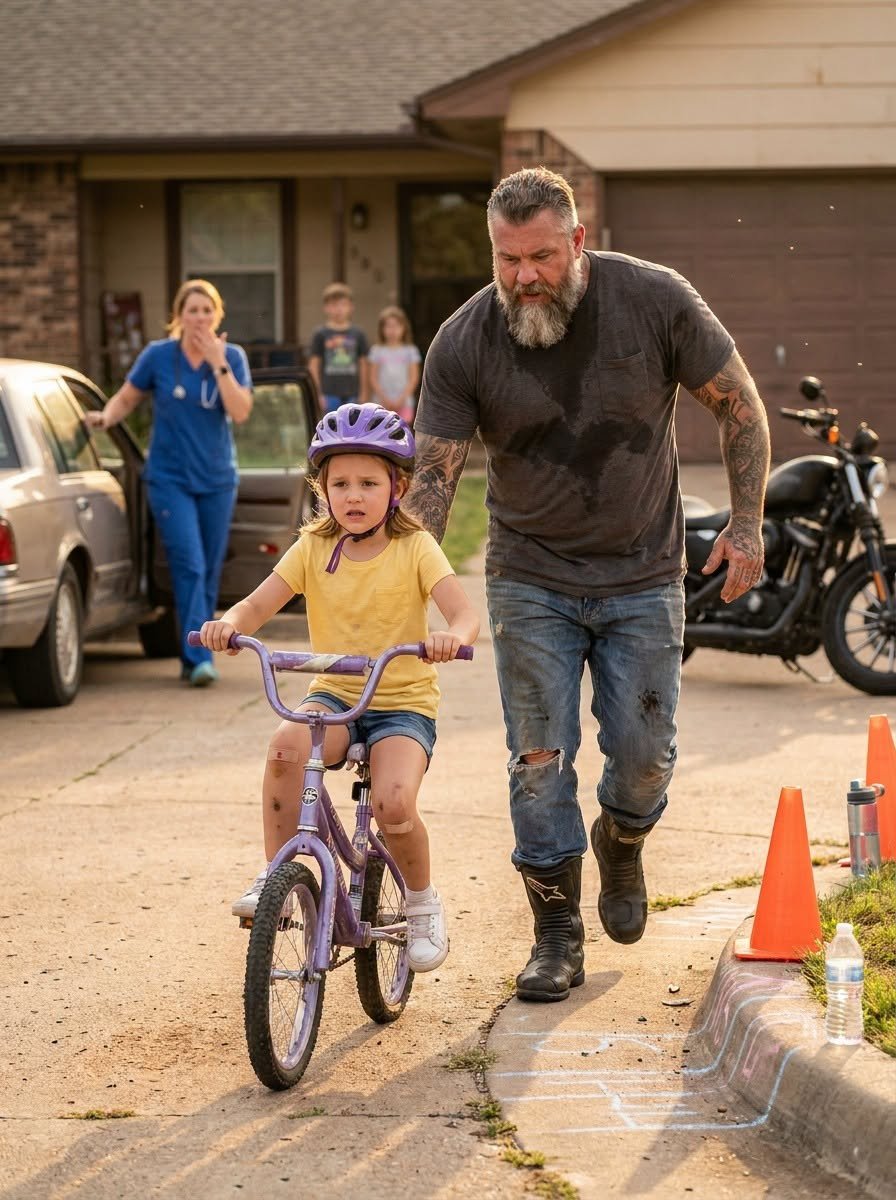
He removed the pedals at first and turned the bicycle into a balance bike, allowing Lucy to push herself with both feet. She hated the exercise because it did not look like real riding.
Bear did not argue.
He asked her to reach the mailbox without putting both feet down simultaneously.
She failed eight times.
On the ninth attempt, she coasted almost six feet.
Bear reacted as though she had crossed a state line.
“There it is!”
“That wasn’t riding.”
“That was balance. Riding is just balance with more confidence and worse decisions.”
By the end of the first hour, Lucy could coast.
During the second, Bear reattached the pedals.
The first fall happened before she completed half a rotation. Bear caught most of her weight but scraped one knee against the pavement.
Lucy expected him to become impatient.
Instead, he inspected her elbow, checked the helmet and asked, “What did the bike teach you?”
“That bikes are stupid.”
“Fair. Anything else?”
“I looked down.”
“Where did the bicycle go?”
“Down.”
“Machines are very literal.”
The second fall happened near the driveway. The third happened because Lucy turned the handlebars too sharply. The fourth came when she heard another child laugh from across the street.
Bear stopped the lesson.
He did not confront the child.
He knelt beside Lucy.
“Do you know why people laugh when someone is learning?”
“Because I look dumb.”
“Because watching you try reminds them they were once scared too.”
During the third hour, Bear drew a chalk line along the street.
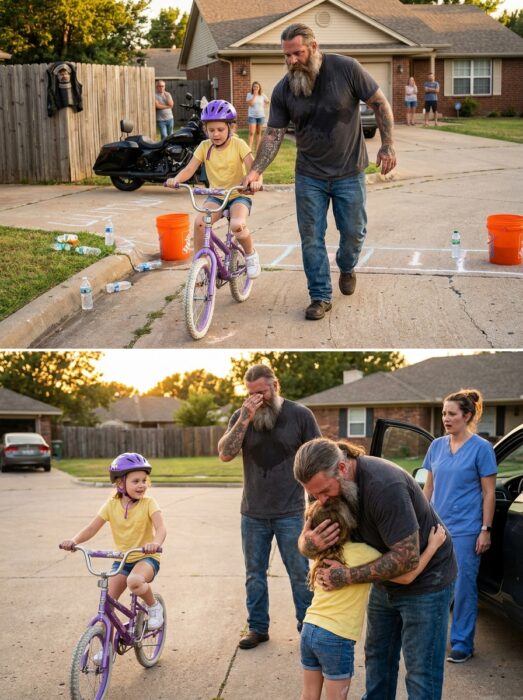
During the fourth, he placed orange buckets several yards apart and taught Lucy how to look through a turn instead of at the obstacle.
During the fifth, she nearly succeeded.
Bear released the seat too early, and Lucy rode ten feet before crashing into a hedge. She emerged covered in leaves, furious and humiliated.
“You let go!”
“Yes.”
“You said you were holding me!”
“I said I’d hold you until you didn’t need it.”
“I needed it!”
“You rode ten feet.”
“I crashed.”
“After riding ten feet.”
Lucy kicked the front tire.
“I hate this bike.”
Bear sat on the curb beside her.
For the first time all afternoon, he looked tired.
“You can quit.”
Lucy stared at him.
“You said quitting was bad.”
“No. Choosing to stop is allowed. But you should know the difference between being finished and being afraid.”
She said nothing.
Bear pointed toward the chalk line.
“If you’re finished, we put the bike away. If you’re afraid, we rest five minutes and try scared.”
Lucy rested seven minutes.
Then she stood.
“I’ll try scared.”
Bear smiled.
“That’s usually how brave people do it.”
Part 4
The other children gradually gathered around the cul-de-sac.
Emma arrived first, followed by Jordan and two older boys from the next street. Lucy stiffened when she saw them.
Bear noticed.
“You want them gone?”
Lucy considered it.
“No.”
“Then they become your audience.”
“What if I fall?”
“Then show them how to get up.”
The next fall scraped Lucy’s palm even through her gloves. She began crying, and I believe Bear nearly ended the lesson himself. But Lucy looked toward Emma, who had stopped smiling.
Then she stood without help.
Bear drew another chalk mark on the curb.
“What are those for?” Lucy asked.
“Evidence.”
“Of what?”
“That the ground has tried thirty times and still hasn’t kept you.”
At hour six, the sun had moved behind the houses. Bear set up a portable light from his garage and asked Erin to bring more water.
His knees hurt. His back had tightened, and both hands were swollen from repeatedly catching the bicycle.
Erin suggested continuing another day.
Bear looked toward Lucy.
Lucy looked at the bicycle.
“Tomorrow, everyone will know I still can’t ride,” she whispered.
Bear understood that the statement was not really about the neighborhood children.
For months, Lucy had watched other people move forward while her life remained restricted by money, schedules and one missing parent. The bicycle had become proof that she was being left behind.
Bear did not tell her this.
Adults sometimes damage children by naming wounds before children are ready to own them.
Instead, he moved the chalk finish line farther down the street.
“This time, don’t ride away from falling,” he said. “Ride toward something.”
“Toward what?”
Lucy pointed at me as my car turned into the cul-de-sac.
Bear smiled.
“Her.”
He steadied the seat.
Lucy began pedaling.
When Bear released her, she did not know.
That was the secret of nearly every important act of trust: the person letting go often knows before the person moving forward does.
She rode directly toward me.
I stood in the road with both hands over my mouth as Lucy passed, turned shakily, and continued around the circle.
“CON LÀM ĐƯỢC RỒI!” she shouted before repeating it in English for the neighborhood children. “I DID IT! I REALLY DID IT!”
Everyone cheered.
Bear did not.
He turned toward his garage.
I saw his shoulders shake once.
Then again.
When I asked whether he was okay, he gave me the sentence I would remember for years.
“I don’t have children,” he said. “But for those six hours, I understood why fathers keep running after they’re tired.”
I wanted to thank him.
He lifted one hand.
“Let her finish the lap first.”
Lucy returned and stopped by crashing gently into his stomach.
Bear caught her.
She wrapped both arms around his waist.
“Did you see me?”
“Every foot.”
“You let go.”
“You were ready.”
Lucy looked up.
“Will you teach me to turn better tomorrow?”
Bear’s face softened.
“Yes, ma’am.”
That should have been the ending.
It was only the first day.
Part 5
The child-sized helmet inside Bear’s garage belonged to no child who had ever lived.
I discovered that a week later when Lucy asked to replace the worn foam liner. Bear placed the helmet on his workbench, and I noticed a small unopened price tag still attached beneath one strap.
“Did you buy this for a niece?” I asked.
Bear shook his head.
He had purchased it fourteen years earlier.
At the time, he and his wife, Carol, had been preparing to become foster parents. They had completed inspections, attended training, and converted Bear’s office into a child’s bedroom.
Bear bought the helmet because he imagined teaching someone to ride.
The placement never happened.
Carol became seriously ill before the final approval. Over the next three years, hospital visits replaced foster-care meetings. By the time she died, Bear no longer believed he could open the room they had prepared.
He closed the door.
The marriage had given him love but not children.
Grief convinced him the second part meant he had failed.
When Bear moved beside us, the unopened helmet came with him. He could not throw it away, but he could not look at it often either.
Then he heard Lucy through the fence.
“Why didn’t you tell her?” I asked.
“A child shouldn’t have to carry an adult’s unfinished plans.”
Lucy entered the garage holding a sheet of reflective stickers shaped like stars. She placed one on the helmet before either of us could stop her.
“For going fast,” she said.
Bear touched the star carefully.
“No. For getting home.”
From then on, the helmet belonged to Lucy whenever they practiced.
Not legally.
Not permanently.
But enough.
Part 6
The video Erin recorded of Lucy’s final lap reached the neighborhood page that evening.
She had intended to send it only to me, but Lucy asked whether Emma’s mother could see it. Within two days, thousands of people had watched the enormous biker run behind the little purple bicycle, release the seat and turn away crying when Lucy shouted that she had succeeded.
Most comments praised Bear.
He disliked them.
“I taught one kid to pedal,” he said. “People need higher standards for heroes.”
But the attention revealed how many children in our area owned bicycles nobody had time to teach them to ride.
Single parents wrote.
Grandparents wrote.
Foster families wrote.
Several admitted their children’s bicycles had remained unused because the adults were afraid of letting go too soon or holding on too long.
Bear discussed it with the Cumberland Saints.
The following month, seventeen bikers gathered in the elementary-school parking lot for the first Saturday Ride School. They repaired brakes, adjusted seats, donated helmets and spent an entire morning running beside children.
The sight was almost comical.
Large tattooed men jogging behind tiny pink, blue and green bicycles while children shouted contradictory instructions.
“Don’t let go!”
“Let go!”
“Run faster!”
“Stop running!”
Bear trained every volunteer with one rule.
“Never promise a child they won’t fall. Promise they won’t fall alone.”
Lucy helped draw chalk finish lines.
By the end of the year, more than eighty children had learned to ride.
The bikers never called themselves fathers.
Some were.
Some had lost children.
Some had never wanted families.
But every Saturday, they practiced the fatherly art of running behind someone until the moment came to release them.
Part 7
Six years have passed since the afternoon Bear taught Lucy to ride.
She is thirteen now, taller, louder, and increasingly embarrassed by childhood stories unless the story includes Bear.
The purple bicycle hangs inside his garage.
Its tires are flat, its paint is scratched, and thirty small chalk-colored marks have been painted along the lower frame—one for every fall Bear counted that first day.
Lucy rides a larger bicycle now.
Bear taught her road signals, basic repairs and the difference between confidence and carelessness. He still refuses to let her ride near traffic without a reflective vest.
She calls him Bear in public.
When frightened, she calls him Dad Bear.
He pretends not to notice the difference.
Last summer, a six-year-old boy moved into the house across the street. His grandmother raised him, and the small red bicycle beside their porch remained untouched for weeks.
One afternoon, we heard him crying.
Lucy looked toward Bear.
Bear looked toward the garage.
Then Lucy took the child-sized helmet from its hook.
“I’ll teach him.”
Bear raised an eyebrow.
“You have six hours?”
“I’ll make time.”
The boy fell twice before reaching the mailbox. After the second fall, he said he wanted to quit.
Lucy sat beside him on the curb.
“You can stop if you’re finished,” she said. “But if you’re only scared, we can try scared.”
Bear stood behind the fence listening.
His eyes filled again.
This time, he did not turn away.
That evening, Lucy walked beside him toward the garage and slipped her hand into his enormous tattooed palm.
“You know you’re basically my extra dad, right?”
Bear looked toward me before answering, as though parenthood still required permission.
I nodded.
He closed his hand around hers.
“I was hoping I’d earned assistant status.”
Lucy leaned against his arm.
“Maybe promoted.”
Outside, the little red bicycle rolled another five feet before falling gently into the grass.
The boy got up.
Bear smiled.
Some fathers are present from the first breath.
Others arrive through a wooden fence, after hearing a child cry about being left behind.
Then they run beside her for six hours, catch her thirty times, and somehow discover that letting go can be another way of staying.
Follow the page for more unforgettable biker stories about rough-looking strangers who quietly become the family someone needed.