
By 12:47, the private security firm that guarded his warehouses had terminated its contract.
At 12:53, his bank’s compliance department placed a temporary hold on several commercial accounts after receiving documents my investigators had collected over the previous four years.
At 1:06, a federal prosecutor received a file containing evidence of bid manipulation, falsified invoices, and payments routed through three shell companies.
All of it was real.
All of it had existed long before that night.
I had simply chosen not to use it.
Clara had asked me once why I tolerated her father.
“Because he is family,” I had told her.
The answer had pleased her.
It had not been entirely honest.
I tolerated Gideon Mercer because confronting him would have forced Clara to choose between the family that raised her and the husband she loved. She had already spent most of her life surviving other people’s demands.
I refused to become another one.
Now Gideon stood beneath the hospital’s fluorescent lights, staring at his phone as the world he trusted quietly rearranged itself.
His eldest son, Marcus, stepped toward me.
“You can’t hold us here.”
“I’m not holding anyone.”
He looked toward the elevators.
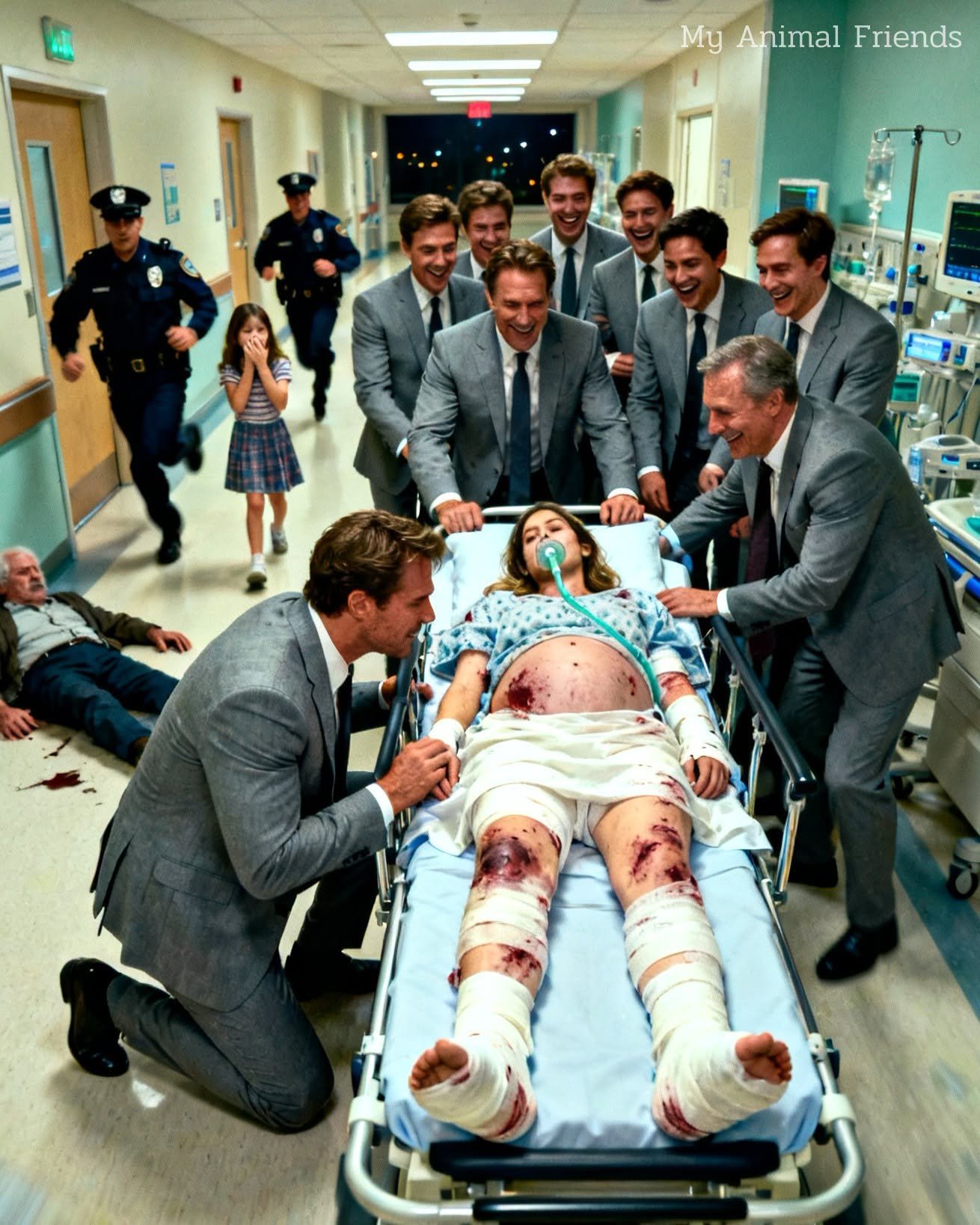
Two hospital security officers stood nearby, accompanied by a uniformed police sergeant. The men in dark suits remained farther down the corridor, speaking quietly among themselves.
Marcus mistook their calm for hesitation.
“We’re leaving.”
The sergeant blocked the hallway.
“I need all nine of you to remain available for interviews.”
Gideon found his voice.
“You have no right.”
The sergeant did not look impressed.
“A woman suffered life-threatening injuries. The attending physician reported suspected assault. That gives us more than enough reason to ask questions.”
“She fell,” one of the younger brothers said.
The sergeant looked at the swelling across his knuckles.
“Then you should have no difficulty explaining how.”
The brother shoved his hands into his pockets.
I watched them without satisfaction.
For years, I had imagined what it might feel like to see Gideon Mercer afraid.
I had expected relief.
Instead, I felt only the dull pressure of grief beneath my ribs.
My child was dead.
Clara was fighting for her life.
There was no victory available to me in that hallway.
Only consequences.
The ICU doors opened.
A nurse hurried toward me.
“Mr. Vale?”
I turned.
“Your wife’s blood pressure is dropping. The surgical team needs to take her back.”
The corridor vanished.
“What happened?”
“They believe there may be additional internal bleeding.”
I was already moving.
The nurse raised a hand.
“You can walk with us as far as the operating suite.”
Behind me, Gideon said something.
I did not hear it.
Clara’s bed emerged through the doors, surrounded by nurses and physicians. Her face was nearly hidden beneath tubes and tape. One hand had slipped from the blanket.
I took it.
Her fingers were cold.
“Clara,” I said, walking beside her. “I’m here.”
Her eyelids did not move.
The team pushed through another set of doors. A nurse gently separated my hand from hers.
“You have to wait here.”
The doors closed.
For several seconds, I stood with my palm still open.
Then someone spoke behind me.
“Adrian.”
I turned.
Elena Mercer, Clara’s mother, stood at the end of the corridor.
She wore a long gray coat over a nightgown. Her silver hair was loose, and one side of her face was marked by a fading bruise.
I had seen Elena at holidays, birthdays, and charity dinners. She was always composed, always quiet, always positioned half a step behind her husband.
That night, she looked as though she had walked out of a storm.
“How did you get here?” I asked.
“A neighbor drove me.”
Her eyes moved toward the operating-room doors.
“Is she alive?”
“Yes.”
“Will she remain that way?”
“I don’t know.”
The words nearly broke her.
She gripped the wall.
I stepped toward her, then stopped. I did not know whether she wanted comfort from me. I was not certain I could offer it.
“Where were you?” I asked.
Her gaze dropped.
“At home.”
“When they hurt her?”
“Yes.”
The answer came so quietly I almost missed it.
“Did you see what happened?”
She closed her eyes.
“Yes.”
My grief sharpened into something colder.
“You watched?”
“I tried to stop them.”
“Did you call for help?”
Her silence answered.
I took a step back.
Elena reached into her coat.
The men at the end of the corridor immediately turned.
I lifted one hand, telling them to stay where they were.
She removed a small black phone.
“This belongs to Clara,” she said.
I recognized the cracked case.
“Where did you get it?”
“Gideon took it from her.”
She held it out, but I did not take it yet.
“Why?”
“Because she recorded them.”
The corridor seemed to narrow.
“Recorded what?”
Elena looked toward the place where her husband and sons waited.
“Not the attack.”
“What, then?”
“The reason they called her to the house.”
I accepted the phone.
The screen was dark.
“There’s a passcode.”
“She changed it last month.”
“To what?”
Elena’s eyes filled.
“The baby’s due date.”
My throat closed.
She whispered the numbers.
I entered them.
The phone unlocked.
A recording application remained open. The latest file was forty-three minutes long.
I pressed play.
At first, there was only the faint sound of fabric and a car door closing.
Then Clara’s voice.
“I came because Mom said she needed me.”
Gideon answered.
“You came because you still understand obedience.”
Even through a phone speaker, his voice carried the weight that had silenced a household for decades.
Clara sounded calm.
“I’m not discussing Adrian’s companies with you.”
“You will discuss whatever I ask.”
A chair scraped.
Another voice—Marcus.
“We know he’s moving assets through the port.”
“He owns shipping companies,” Clara replied. “Assets move through ports.”
“Don’t be clever.”
“I’m not being clever. I’m leaving.”
Then Elena’s voice appeared, frightened and distant.
“Gideon, let her go.”
A sudden impact followed.
Not the attack on Clara.
Something else.
Elena gasped.
I looked up at her.
She touched the bruise on her cheek.
On the recording, Clara’s voice changed.
“If you touch her again, I’ll go to the police.”
Gideon laughed.
“And tell them what?”
“What you’ve done.”
A long silence followed.
Then Gideon spoke carefully.
“What exactly do you think you know?”
“The Mercer Foundation isn’t a charity.”
Elena’s face tightened beside me.
On the recording, several men began speaking at once.
Clara raised her voice.
“I found the accounts. Donations come in, then disappear through construction contracts awarded to your companies. You’ve been laundering money through schools, shelters, and clinics.”
Marcus said, “She’s bluffing.”
“I copied everything.”
The recording stopped abruptly.
I stared at the phone.
“That’s why they attacked her?”
Elena shook her head.
“No.”
“What happened after the recording ended?”
“Gideon took the phone. Marcus searched her bag.”
“What did they find?”
“A document.”
“What document?”
Elena’s mouth trembled.
“I don’t know. But when Gideon read it, he looked at Clara as if she had become a stranger.”
I stepped closer.
“What did he say?”
“He asked who had given it to her.”
“And Clara?”
“She refused to answer.”
“Then they hurt her.”
Elena looked down.
“Yes.”
The word contained more shame than any confession I had ever heard.
I wanted to accuse her.
To ask how a mother could remain in a room while nine men surrounded her pregnant daughter.
But the bruise on her face told only part of her story.
Her trembling hands told another.
“How long has he hurt you?” I asked.
She looked at me sharply.
I repeated the question.
“How long?”
Her shoulders lowered.
“Thirty-one years.”
I said nothing.
“I thought staying kept the children safe,” she continued. “Then I thought leaving would make him angrier. Then the boys became like him, and I told myself Clara was different because she escaped.”
“She didn’t escape,” I said. “She survived.”
Elena nodded.
“Yes.”
The operating-room doors remained closed.
I looked at Clara’s phone again.
“Where is the document?”
“Gideon has it.”
“Are you certain?”
“I saw him put it inside his coat.”
I turned toward the corridor.
Elena caught my sleeve.
“Adrian.”
I stopped.
“If you go to him now, he’ll provoke you.”
“He already tried.”
“He wants you angry. Anger makes powerful men careless.”
She released me.
“Clara used to say that about you.”
Despite everything, the words reached me.
“What else did she say?”
“That your greatest strength was also the thing she feared most.”
I looked at her.
“Control.”
The operating-room doors opened before I could answer.
A surgeon stepped into the hallway, removing her cap.
I read the exhaustion in her face and prepared myself for the worst.
“Mr. Vale?”
“Yes.”
“We found the bleeding and repaired it.”
My knees nearly weakened.
“She’s alive?”
“She is.”
The breath left me all at once.
The surgeon continued.
“The next twelve hours remain critical. But she made it through surgery.”
I pressed a hand to my mouth.
Elena began to cry.
Not loudly.
She simply folded into herself, one hand covering her face.
The surgeon looked between us.
“There is something else. Your wife briefly regained consciousness before anesthesia.”
“What did she say?”
“She asked us to make sure you received a message.”
I stepped closer.
“What message?”
The surgeon consulted a note.
“She said, ‘Don’t trust the evidence in my father’s coat.’”
Elena stopped crying.
I stared at her.
“What does that mean?”
“I don’t know,” she whispered.
But she did not look confused.
She looked afraid.
At 3:18 a.m., Detective Naomi Reed arrived.
She was in her early forties, with rain-darkened hair and the measured patience of someone accustomed to rooms full of liars.
The police separated the Mercer men.
Gideon demanded his attorney.
Marcus refused to answer questions.
Two brothers insisted they had arrived after Clara was injured. Three others claimed they had tried to restrain her when she became “hysterical.” The youngest, Daniel, sat alone with his face in his hands and said nothing.
Detective Reed listened to the recording from Clara’s phone.
Then she listened again.
“This is useful,” she said.
“Useful?”
“It establishes motive and places several people at the house.”
“It proves they threatened her.”
“It proves a confrontation occurred.”
I understood what she meant.
A recording was evidence.
It was not a conviction.
“What about the document?” I asked.
“We searched Mr. Mercer.”
“And?”
“No document.”
I looked toward Elena.
She had gone pale.
“He had it,” she insisted.
“Did anyone else touch his coat?”
“I don’t know.”
Detective Reed studied her.
“Mrs. Mercer, I need you to give a formal statement.”
Elena glanced toward the room where Gideon waited.
“He’ll know.”
“He already knows you brought us the phone,” I said.
Her face tightened.
Detective Reed’s voice softened.
“We can arrange protection.”
Elena laughed once, without humor.
“You think protection is a room with a lock?”
“No,” the detective replied. “I think protection begins when the truth stops belonging only to the person who frightens you.”
Elena looked at her for a long moment.
Then she nodded.
Before they left, Detective Reed drew me aside.
“Your people need to leave the hospital.”
“They are not interfering.”
“They are intimidating witnesses.”
“They are standing in a hallway.”
“They are making nine men believe they may not survive the night.”
I held her gaze.
“Would that concern you?”
“Yes.”
Her answer surprised me.
“Because frightened suspects coordinate stories badly,” she continued, “but they also destroy evidence, call allies, and make desperate decisions. I need them thinking the law is what they should fear. Not you.”
“The law didn’t protect Clara.”
“No,” Reed said. “But if you replace it with yourself, this becomes a war between powerful men. Your wife becomes evidence in your feud instead of the victim of a crime.”
The words struck harder than I expected.
I looked through the ICU glass.
Clara was not awake.
She could not tell me what she wanted.
But I knew what she had feared.
Control.
I removed my phone and sent a second message.
Within minutes, the men in dark suits left the corridor.
The vehicles outside drove away one by one.
Detective Reed watched them disappear through the lobby windows.
“That could not have been easy.”
“It was one message.”
“I wasn’t referring to the message.”
Daniel Mercer found me in the hospital chapel shortly before dawn.
I had gone there because it was the only room without monitors, telephones, or questions.
I did not pray.
I sat in the last row and stared at a narrow stained-glass window as the darkness outside slowly turned blue.
Daniel entered quietly.
At twenty-three, he was the youngest of Clara’s brothers by nearly a decade. She had practically raised him.
He stopped several feet away.
“You should leave,” I said.
“I can’t.”
“You can. The police haven’t arrested you.”
“They will.”
I turned toward him.
His right hand was bruised.
He noticed me looking and hid it behind his back.
“Did you hit her?”
His eyes filled immediately.
“No.”
“Then explain your hand.”
“I hit Marcus.”
I stood.
“When?”
“After he pushed Clara.”
“Why didn’t you stop the others?”
“I tried.”
“Eight men against one woman, Daniel. How hard did you try?”
He flinched.
Not from my voice.
From the truth.
“I froze,” he whispered.
I looked away.
There were excuses I could understand and still refuse to forgive.
“I thought Dad only wanted to scare her,” he continued. “He said she had stolen from the family.”
“Did you believe him?”
“At first.”
“And after?”
Daniel’s mouth trembled.
“After she fell, Marcus kicked her.”
My hands closed into fists.
Daniel stepped back.
I forced them open.
“What document did Gideon take?”
“I didn’t see all of it.”
“What did you see?”
“A letterhead.”
“From where?”
“St. Catherine’s Hospital.”
The name meant nothing to me.
“What kind of document?”
“Medical records, I think.”
“Whose?”
He shook his head.
“I only saw one word.”
“What word?”
“Paternity.”
The chapel went silent.
“Whose paternity?”
“I don’t know.”
“Why would that matter to Gideon?”
Daniel looked toward the door before answering.
“Because he started shouting that Clara had no right to call herself a Mercer.”
A cold sensation moved through me.
“What exactly did he say?”
“He said, ‘You think that paper makes you free? It makes you nothing.’”
I stared at him.
“Did Clara know what the document meant?”
“Yes.”
“How do you know?”
“Because she said, ‘It means you lied to me my entire life.’”
I sat down slowly.
Daniel remained standing.
“There’s something else,” he said.
“What?”
“Before things got bad, Clara told me to remember a name.”
“What name?”
“Thomas Bell.”
I knew it.
Everyone in the city’s legal circles knew it.
Thomas Bell had served as a family-court judge for twenty-six years before retiring abruptly after allegations of sealed adoption records and improper private placements.
He had died six months earlier.
“Why did she mention him?”
“She said if anything happened to her, you should find his daughter.”
“Did she give you a first name?”
“Mara.”
I took out my phone.
Before I could make the call, Daniel said, “There’s more.”
I looked up.
He seemed barely able to speak.
“Dad didn’t start the attack.”
My voice became very quiet.
“Who did?”
“Mom.”
For a moment, I thought I had misunderstood.
“Elena?”
Daniel nodded, tears sliding down his face.
“She slapped Clara first.”
I remembered the bruise on Elena’s cheek.
Her trembling voice.
Her claim that she had tried to stop them.
“Why?”
“I don’t know. Clara showed her the document. Mom read it, then hit her and said she should have left the past buried.”
The chapel door opened.
Detective Reed stood there.
Her expression told me she had heard enough.
“Daniel,” she said, “you need to come with me.”
He looked at me.
“I’m sorry.”
I believed him.
It changed nothing.
After he left, I remained in the chapel.
The sun had begun to rise behind the stained glass, turning the floor red and gold.
For the first time that night, I considered the possibility that the story I had built in my mind was wrong.
Gideon was violent.
His sons had followed him.
But Clara had not gone to the house merely to confront financial crimes.
She had discovered something about herself.
Something that terrified both her parents.
And Elena had lied to me.
Mara Bell lived in a narrow brownstone in Brooklyn Heights.
I did not send anyone ahead.
I did not call.
At seven thirty in the morning, I stood outside her door with rain still clinging to my coat.
She answered wearing reading glasses and holding a mug of coffee.
She was perhaps fifty, with dark hair streaked silver at the temples.
The moment she saw me, she closed her eyes.
“So it happened,” she said.
“What happened?”
“Clara went to the Mercer house.”
“You knew she was going?”
“She told me.”
“Why didn’t you stop her?”
“I tried.”
I stepped inside before she could refuse.
Her hallway was lined with framed newspaper clippings about wrongful convictions, sealed adoptions, and missing children.
Mara shut the door.
“Is Clara alive?”
“Yes.”
“And the baby?”
I said nothing.
Her face changed.
“I’m sorry.”
“Tell me what she found.”
Mara set down her coffee.
“My father kept records.”
“Illegal records?”
“Protective records, according to him. Damning records, according to everyone else.”
“Was Clara adopted?”
“Yes.”
The answer came without hesitation.
I had expected it.
Still, hearing it made something shift beneath my feet.
“Did she know?”
“She learned three weeks ago.”
“Who were her biological parents?”
Mara studied me.
“Before I answer, you need to understand what happened at St. Catherine’s.”
“I don’t need history. I need names.”
“You need both.”
She led me into a study.
A cardboard archive box rested on the desk.
Its lid bore Clara’s full name.
“Twenty-nine years ago,” Mara said, “St. Catherine’s operated a private maternity program. Wealthy families funded it. Young women with nowhere to go gave birth there. Some signed adoption papers willingly. Others were pressured.”
“And Clara?”
“Her mother was seventeen.”
“Name.”
“Rose Avery.”
I knew the Avery family.
Old money.
Old influence.
Rose Avery had died in a car accident at eighteen.
“Who was the father?”
“My father never recorded his name.”
“Why not?”
“Because the paternity test was performed years later.”
She opened the archive box and removed a sealed envelope.
“Clara found this among my father’s papers.”
“Why would Gideon care?”
“Because Gideon and Elena did not legally adopt her.”
I stared at Mara.
“What did they do?”
“They paid St. Catherine’s to alter the birth record.”
The room became very still.
“They bought her?”
Mara’s expression tightened.
“That is an ugly way to say it.”
“It is an ugly thing.”
“Yes.”
I looked at the envelope.
“And the paternity report?”
“Clara asked me to verify it independently.”
“Whose sample did she use?”
“Hair from an old family Bible.”
“Gideon’s?”
“No.”
Mara placed the envelope in front of me.
“Your father’s.”
I did not touch it.
“My father died twelve years ago.”
“Clara obtained the hair from a watch you gave her.”
I remembered the watch.
My father’s retirement gift.
Clara had repaired its broken clasp for my birthday.
“Why would she test my father?”
“Because Rose Avery’s diary named him.”
My breath stopped.
“Clara believed my father was hers?”
“Yes.”
The implications formed too quickly.
Clara and I.
Our marriage.
Our child.
Mara saw my face.
“The independent result excluded him.”
Air returned to my lungs.
“Then why did the document matter?”
“Because the first test did not.”
I looked at her.
“The report Clara took to the Mercers said your father was her biological father.”
“But that report was false?”
“Altered.”
“By whom?”
“That is what Clara wanted to learn.”
I thought of Gideon reading the document.
Of Elena striking Clara.
Of the phrase: You should have left the past buried.
“Who had access to the original records?”
“My father. St. Catherine’s administrators. The Mercers.”
“And Rose Avery?”
“She died before Clara’s first birthday.”
“Did my father know about her?”
“I don’t know.”
I picked up the envelope.
“What is inside?”
“The verified result.”
“You said it excluded him.”
“It did.”
“Then why keep it sealed?”
“Because there was a second match.”
I looked at her.
“With whom?”
Mara sat opposite me.
“Clara gave me permission to compare her DNA against a private genealogy database used in several inheritance cases.”
“And?”
“She matched a living relative.”
“Who?”
“Someone within your family.”
I felt the room tighten.
“Name.”
Mara did not answer immediately.
Instead, she slid a photograph across the desk.
It showed my father at a charity gala thirty years earlier.
Beside him stood Gideon Mercer.
And between them stood a young woman with Clara’s eyes.
Not Rose Avery.
Elena.
I looked up.
“What does this mean?”
“It means Elena Mercer was not simply the woman who raised Clara.”
My hand tightened around the photograph.
“She was her mother?”
“Yes.”
The truth rearranged everything.
Elena’s fear.
Her guilt.
The slap.
The bruise.
The years of silence.
“Who was Clara’s father?”
Mara looked toward the sealed envelope.
“That is the part your wife had not yet discovered.”
“But you know.”
“I know who the genetic match is.”
“Tell me.”
Her voice became very quiet.
“Your mother.”
For several seconds, I could not understand the sentence.
“My mother is Clara’s relative?”
“A very close one.”
“How close?”
Mara opened the envelope and placed the report in front of me.
The language blurred until one line came into focus.
Predicted relationship: maternal half-sibling.
I read it again.
Then again.
“That’s impossible.”
“Genetic tests do not explain family stories,” Mara said. “They only expose where the stories are false.”
“My mother had no sisters.”
“Then someone lied.”
I thought of my mother, dead for nine years. Of her guarded silences whenever Gideon Mercer entered a room. Of the way she had once told me never to confuse family loyalty with truth.
“Clara is my mother’s half-sister?”
“That is what the report suggests.”
The arithmetic was possible.
My mother had been born late in my grandmother’s life. Clara was nearly three decades younger.
But possibility did not make it believable.
“Who was Elena to my grandmother?”
“I don’t know.”
“What did Clara think?”
“She believed Elena knew.”
“And she confronted her.”
“Yes.”
I folded the report.
“Why would Gideon attack her over this?”
“Because blood was not the only secret Clara found.”
Mara reached into the archive box and removed a ledger.
The Mercer Foundation seal appeared on its cover.
“Your wife believed the adoption network at St. Catherine’s never truly ended. It changed names.”
I opened the ledger.
Donations.
Payments.
Family names.
Judges.
Doctors.
Politicians.
Some I recognized.
Several were people whose careers I had protected.
“What was the foundation doing?”
“Locating vulnerable mothers. Arranging private placements. Concealing identities when wealthy clients wanted no questions.”
My stomach turned.
“And Gideon ran it?”
“He financed it.”
“Who protected it?”
Mara looked directly at me.
“Your companies.”
I stood.
“No.”
“Shipping records. Property leases. Security contracts. You may not have known, but Mercer used subsidiaries connected to your organization.”
I thought of every favor I had granted because Clara asked me to keep peace with her family.
Every invoice my people had approved.
Every warehouse I had allowed Gideon to rent.
My power had not merely failed to protect Clara.
It may have protected the system that stole her identity.
My phone rang.
The hospital.
I answered immediately.
“Mr. Vale,” the ICU nurse said, “your wife is awake.”
Clara looked impossibly small against the white pillows.
The breathing tube was gone, but an oxygen line rested beneath her nose. Her face was bruised, her voice barely more than a whisper.
I sat beside her without touching her.
For once, I let her choose the distance.
Her eyes moved over my face.
“You know,” she said.
“Yes.”
“How much?”
“About St. Catherine’s. Elena. The false paternity report. The Mercer Foundation.”
She closed her eyes.
A tear slipped toward her hairline.
“I was going to tell you.”
“I know.”
“I needed proof.”
“You should have come to me.”
Her eyes opened.
“No.”
The answer hurt because it was honest.
“Why not?”
“Because you would have fixed it.”
“I could have protected you.”
“You would have surrounded me with guards, buried the files in lawyers, and decided which truth I was allowed to hear.”
I looked down.
She knew me.
Even now, after everything, she knew me better than I knew myself.
“I sent the men away,” I said.
A faint surprise crossed her face.
“The police are handling your father and brothers.”
“My father,” she repeated.
Then she shook her head.
“Gideon was never my father.”
“Did Elena tell you the truth?”
“Only part of it.”
“What part?”
Clara’s hand moved across the blanket, searching.
I placed mine near hers.
She touched two of my fingers.
Not forgiveness.
Not yet.
But contact.
“She said she gave birth to me at St. Catherine’s,” Clara whispered. “Gideon’s family wanted a daughter because it made them look respectable after his first corruption investigation.”
“They took you for appearances?”
“At first.”
“And later?”
“She said she loved me.”
“Do you believe her?”
Clara stared toward the window.
“I believe she wanted to.”
The answer carried more sorrow than anger.
I thought of Elena’s thirty-one years of fear.
“What did the paternity report say?”
“That your father was mine.”
“It was altered.”
“I know.”
“How?”
“Because he wasn’t the man named in Rose Avery’s diary.”
“Mara said Rose wasn’t your mother.”
“She wasn’t.”
“Then why did the diary matter?”
“Because Rose was Elena’s roommate at St. Catherine’s. She wrote down what happened to the girls there.”
I leaned closer.
“What happened?”
Clara’s breathing became unsteady.
“Some mothers were told their babies had died.”
The room seemed to darken.
“But they hadn’t,” I said.
She shook her head.
“Rose believed Elena was one of them.”
“What do you mean?”
“Elena gave birth to twins.”
I stopped breathing.
Clara tightened her fingers around mine.
“I wasn’t the only baby.”
“Where is the other child?”
“I don’t know.”
“Did Gideon?”
“Yes.”
“How?”
“Because he chose which baby to take home.”
A coldness moved through me unlike anything I had felt that night.
“Why you?”
“Elena said the other baby was sick.”
“What happened to her?”
“She was placed with another family.”
“Name?”
“I don’t know.”
I remembered the DNA report.
The close match to my mother.
The impossible relationship.
“Clara,” I said carefully, “Mara tested your DNA.”
Her eyes sharpened.
“She told you?”
“She found a maternal half-sibling match.”
Clara stared at me.
“With whom?”
“My mother.”
The monitors continued their soft rhythm.
For several seconds, Clara said nothing.
Then she whispered, “Your mother wasn’t my sister.”
“How do you know?”
“Because she was at St. Catherine’s the night I was born.”
My skin went cold.
“What was she doing there?”
Clara’s eyes filled with fear.
“She took the other baby.”
The door opened behind me.
Detective Reed entered with Elena.
Elena had been crying, but she stood straighter than before.
Clara turned her face away.
“Please,” Elena said. “Let me explain.”
“You had twenty-nine years,” Clara whispered.
Elena stopped at the foot of the bed.
“I thought she was safe.”
“Who?”
“Your sister.”
I rose.
“My mother raised Clara’s twin?”
Elena shook her head.
“No.”
“Then why did the DNA show a sibling relationship?”
“Because the sample you believe belonged to your mother did not belong to her.”
I stared.
“The hair from the watch?”
Elena nodded.
“Whose was it?”
Her gaze moved to Clara.
“Her twin’s.”
The room fell silent.
I remembered my father’s old watch.
The one my mother had kept after his death.
The one Clara had repaired.
A strand of hair trapped beneath the inner casing.
Not my mother’s.
Another woman’s.
A woman close enough to my family to handle my father’s watch.
“Who is she?” I asked.
Elena’s face collapsed.
Before she could answer, Detective Reed placed a clear evidence bag on the bedside table.
Inside was the document Gideon had supposedly hidden in his coat.
“We found this beneath the passenger seat of Mrs. Mercer’s car,” Reed said.
Clara looked at Elena.
“You took it.”
Elena nodded.
“Why?”
“To keep Gideon from seeing the final page.”
“What was on it?” I asked.
Detective Reed removed a photocopy and handed it to me.
It was not a paternity report.
It was a recent employment record.
A photograph appeared in the upper corner.
A woman in her late twenties.
Dark hair.
Gray eyes.
Clara’s face.
The name beneath it read:
Dr. Celeste Rowan — Director of Maternal Genetics, St. Catherine’s Renewal Center.
I looked at Clara.
Her lips parted.
“She’s alive,” she whispered.
Elena began to cry.
“Yes.”
“Where is she?”
Detective Reed answered.
“No one knows.”
She turned the page.
A security image showed Dr. Rowan entering the hospital less than an hour earlier.
She wore blue medical scrubs and an identification badge.
The timestamp was 6:12 a.m.
I looked toward Clara’s intravenous line.
The nurse had changed the medication bag at 6:18.
Detective Reed pressed the call button beside the bed.
“Do not touch anything,” she said.
Clara’s fingers tightened around mine.
On the final photograph, the woman who shared my wife’s face was looking directly into the security camera.
And beneath the printed image, someone had written a message by hand.
Clara was never supposed to survive the first night.
END OF PART 2 – LIKE, SHARE AND COMMENT “THE ENTIRE STORY” IF YOU WANT TO READ THE FULL STORY.