
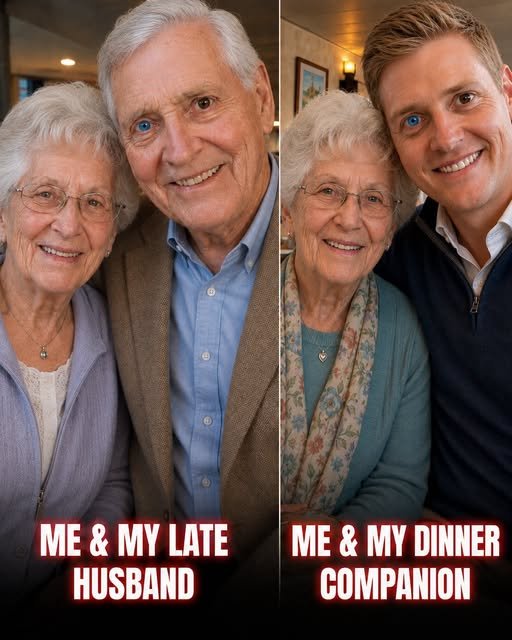
Part One: The House After John
Four weeks after my husband died, I learned that silence has a sound.
It was the hum of the refrigerator in the kitchen. The soft click of the furnace turning on. The wooden floor complaining beneath my slippers even though no one else was there to hear it.
For fifty-two years, John had filled our home without trying. He cleared his throat before speaking. He whistled when he shaved. He left the newspaper folded open beside his coffee and forgot where he had put his glasses at least twice a day.
After the funeral, all of those small noises disappeared, and the house seemed to hold its breath.
I tried to stay busy. I sorted his shirts. I washed dishes that were already clean. I opened drawers only to close them again. Every task ended in the same place: me standing in the middle of a room, waiting for John to come in and ask what I was doing.
One afternoon, I put on my coat and walked to the diner two blocks from our house.
I did not go because I was hungry. I went because the diner was warm, and people talked there. Plates clattered. Coffee poured. Someone was always laughing in the back booth. It was easier to be lonely among other people than to be lonely in my own living room.
Brenda, who had served me for years, saw me enter and immediately pointed toward the window.
“Your usual table is waiting, Mrs. Dottie.”
She brought tomato soup, toasted bread, and tea before I asked. Then she placed a small packet of crackers beside the bowl and gave my shoulder a gentle squeeze.
“You don’t have to rush home,” she said.
I looked toward the empty chair across from me.
“I know, dear. That’s the problem.”
She did not tell me to be strong. She did not say that time would heal everything. She simply touched my shoulder once more and let me sit with the truth.
I returned the next day. Then the day after that.
By the end of the first week, lunch at the diner had become the only fixed point in my days. I would wake up, make the bed on John’s side even though he would never sleep in it again, and wait for noon.
I believed I was going there to survive my grief.
I did not know that someone was already watching for me.
Part Two: The Stranger by the Window
The young man approached my table on a rainy Tuesday.
He stood there with one hand around a paper cup of coffee and the other tucked into his jacket pocket. He looked to be about thirty, perhaps a little younger. His hair was dark, his shoulders narrow, and there was a hesitation in his posture that made him seem as though he had rehearsed what he wanted to say but had forgotten the words.
“Excuse me, ma’am,” he said. “Would you mind if I sat here? Every other table is full.”
That was not true. At least three tables were empty.
Still, I moved my purse from the chair.
“Of course not. Sit down.”
He lowered himself into the seat, and I looked at him properly for the first time.
My spoon slipped from my fingers and struck the bowl.
He had John’s face.
Not the face I had grown old beside, with silver at the temples and deep lines around the eyes. He had the face from an old photograph tucked in the back of my dresser – John at thirty, smiling beside a borrowed car, his collar turned up against the wind.
The same soft brown eyes. The same crooked lift at the corner of his mouth. Even the same habit of looking down before he smiled, as if happiness embarrassed him.
The young man noticed my expression.
“Are you all right?”
I forced myself to breathe.
“You look like someone I used to know.”
“Someone important?”
“The most important person in my life.”
He glanced at the empty chair beside him, then back at me.
“I’m sorry.”
“Don’t be. Sit. You already did.”
His name was Carl. He ordered coffee and a grilled-cheese sandwich, though he barely touched the food. I told him about John’s resemblance, and Carl listened with unusual patience. He did not laugh awkwardly or change the subject. He simply kept his hands folded around his cup while I described the man I had loved since we were sixteen.
When I finished, Carl said, “He must have been good to you.”
“He was. He was stubborn, too. But mostly good.”
“And you were happy?”
The question was so direct that it caught me off guard.
I looked at the rain sliding down the window.
“For fifty-two years,” I said. “Not every day. But enough days to call it a good life.”
Carl returned the next afternoon.
He sat across from me as if the chair had been waiting for him. The day after that, he arrived five minutes before I did. Within two weeks, Brenda no longer asked whether she should bring him a menu.
She brought two bowls of soup.
Carl remembered that I disliked onions. He knew I liked my tea weak. He noticed that I always left the last piece of bread untouched.
“You hardly eat anything,” he said one day.
“At my age, conversation is more nourishing.”
“Then I should talk more.”
“You should. I know nearly everything about me, and almost nothing about you.”
He smiled, but the smile did not reach his eyes.
“There isn’t much to tell.”
“Everyone has a story.”
“Not everyone wants to open it.”
I should have recognized the warning in his voice. Instead, I reached across the table and patted his hand.
“You don’t have to open it today.”
He turned his hand beneath mine and held it for one brief second.
“Thank you, Mrs. Dottie.”
That was the first time he called me by my nickname. I remember it because the words sounded strangely familiar, as if I had been waiting years to hear them.

Part Three: The Questions He Carried
Our lunches became a quiet ritual.
Carl asked about my wedding day, the house John and I had bought, and the little habits I had once found annoying but now missed terribly.
“What did he do when he was nervous?” Carl asked.
“He polished things that were already clean. The silverware, his watch, the same pair of shoes.”
“What made him laugh?”
“Bad puns. The worse they were, the prouder he became.”
“What was he like when he was young?”
The questions seemed innocent. Yet Carl asked them with such concentration that I sometimes felt as though I were giving a witness statement instead of telling stories over lunch.
He never asked about John’s favorite movie or the music he listened to. He wanted details that lived beneath the surface – how John held a baby, what he did when someone was hurt, whether he ever spoke about the things he regretted.
So I told him.
I told him about the summer John proposed with a ring made from a twist of wire because he could not afford gold. I told him how we rented one room above a bakery after our wedding and woke every morning smelling bread we could not buy.
I told him about our children, now scattered across different states with busy lives of their own. I told him about grandchildren who knew me mostly through birthday cards and video calls.
And, without realizing it, I told him about the sorrow I had kept hidden even from people who loved me.
“John and I had a baby before we were ready,” I said one afternoon. “We were seventeen. We had no money, no home, and no idea how to become parents. We gave him to another family.”
Carl stopped moving.
The fork in his hand hovered above his plate.
“You never saw him again?”
“No.”
“Did you know where he went?”
“Only that he was placed with people who could care for him. That was all anyone would tell us.”
I stared into my tea.
“John and I told ourselves it was an act of love. Sometimes I believed that. Sometimes I thought it was simply the kindest name we could give our helplessness.”
Carl’s expression changed, but only for a moment.
“What was his name?”
I had not spoken the name aloud in decades.
“Daniel,” I whispered. “We called him Daniel.”
Carl looked toward the window.
“Did John ever search for him?”
“Not that he told me.”
The answer felt wrong as soon as I said it. John had been a good man, but he was not a man who forgot. He kept every receipt, every birthday card, every letter from our children. If he had truly closed that door forever, I had never understood how he managed it.
Carl lifted his eyes.
“Maybe he was afraid of what he might find.”
“Maybe,” I said. “Or maybe he was afraid of what he would feel.”
After that conversation, he grew quieter.
Brenda noticed before I did.
“That young man watches you as if he is trying to memorize your face,” she murmured while refilling my tea.
I smiled.
“He gives me a reason to leave the house. Don’t scare him away.”
“I wouldn’t dream of it. But I will say this: he carries sadness like an old suitcase.”
She was right. Carl listened to my memories as though each one mattered to him personally. When I described John’s hands, he stared at his own. When I mentioned the way John tilted his head while thinking, Carl unconsciously did the same.
Once, I reached across the table and touched his cheek.
“You really do look like him.”
He closed his eyes for a moment.
“I know.”
The words chilled me.
“How would you know that?”
He opened his eyes, startled by his own mistake.
“I mean, people have told me I resemble someone before.”
It was a poor explanation. I accepted it because I was afraid of losing him. The empty chair across from me had become a threat, and I could not bear the thought of it returning.
By the fourth week, I was no longer simply looking forward to lunch.
I was waiting for Carl.
That was why the trembling in his hands frightened me when he finally told me he had come to the diner for a reason.
Part Four: The Music Box
It happened on a Thursday afternoon.
The diner was louder than usual. A delivery truck had arrived, Brenda was calling orders to the kitchen, and two teenagers near the counter were arguing over a football game.
Carl sat across from me without touching his soup.
“You are going to make Brenda think I have been poisoning you,” I said, trying to lighten the mood.
He gave me a faint smile.
“I need to tell you something.”
The spoon in my hand paused.
“That sounds serious.”
“It is.”
He kept looking at the table. His fingers had gone pale around the edge of his napkin.
“Why did you choose my table that first day?” he asked.
I tried to laugh.
“Because you said every other table was full, even though they weren’t.”
“That was an excuse.”
The room seemed to narrow around us.
“Carl, what are you talking about?”
He reached inside his jacket and pulled out a small parcel wrapped in a faded blue handkerchief.
He placed it between us but did not unwrap it.
Then he leaned toward me until only I could hear him.
“Your husband begged me to stay silent,” he whispered. “But I can’t carry it any longer.”
My heart began to pound.
“John never mentioned you.”
“I know.”
“Then how did you meet him?”
Carl swallowed.
“He found me.”
The words were too vague to hold. I felt anger rising beneath my confusion.
“Found you where?”
He unfolded the handkerchief.
Inside was a small wooden music box.
I knew it before I touched it.
The wood was darker now, its corners rounded from years of handling, but I recognized the tiny carved flowers on the lid. John had made it with a pocketknife when we were seventeen. The carving was uneven. One flower had only three petals. The key had always stuck when the weather was damp.
I had not seen that music box since the day we gave away our baby.

My hand hovered above it.
“Where did you get this?”
Carl’s voice fell to a whisper.
“Do you remember putting it in a basket?”
The din of the diner faded.
I remembered a small blanket. A white cap. John’s face turned away from me because he did not want me to see him cry.
I remembered placing the box beside the baby and winding the key one last time. A soft lullaby had filled the room while I tried to memorize the shape of his fingers.
“We put it beside Daniel,” I said. “He was so small. We thought the song might comfort him.”
Carl’s eyes shone.
“It stayed with him.”
I pulled the box toward me. My fingers shook as I traced the carved lid.
“John found him?”
“He found your son years ago.”
For a moment, hope rose so sharply that it hurt.
“Daniel is alive?”
Carl looked down.
The hope disappeared before he spoke.
“No. He died before John located him. There was an accident. Your son was gone, and I was the only family he left behind.”
My breath caught.
“You were his son?”
Carl shook his head slowly.
“I am his son. Your grandson.”
I stared at him, but my mind refused to make the pieces fit. His face looked like John’s. The music box had belonged to Daniel. John had known him. Carl had chosen my table.
The truth stood before me, yet I could not touch it.
“Why didn’t John tell me?” I asked.
Carl’s mouth tightened.
“Because he was afraid the truth would destroy you.”
“Destroy me?” My voice broke through the diner. “He let me believe our first child was lost forever. He found his family and kept it from me. How could that possibly protect me?”
Several heads turned. Brenda stopped near the counter, a coffee pot in her hand.
Carl leaned closer.
“He thought he was protecting you from two losses. First, learning that Daniel had died. Then learning that he had found me too late to save him.”
“He had no right to choose what I could survive.”
“I know.”
“And you sat here every day, listening to me talk about him, knowing who you were?”
Carl’s eyes filled.
“I knew who you were before I sat down. I had seen photographs. John showed them to me. But I did not know how to walk into your life and say, ‘I am the grandson you never knew you had.’”
He pushed the music box toward me.
“Your husband gave me this after he found me. He said it was the only thing he had brought from Daniel’s first days. He wanted you to have it, but he could never find the courage to tell you.”
I closed my fingers around the box.
“Why tell me now?”
“Because he is gone, and you are alone, and I cannot keep pretending that I am only a stranger who likes tomato soup.”
The words struck deeper than his confession.
I stood so quickly that my chair scraped the floor.
“I need to go home.”
“Mrs. Dottie, please.”
“Do not follow me.”
My voice sounded nothing like my own.
I walked out into the cold afternoon, clutching the music box against my chest. Behind me, I heard Brenda call my name and Carl push back his chair.
I kept walking.
Part Five: The Truth on the Porch
At home, I locked the door and pulled the curtains shut.
The music box sat on the table in front of me, looking impossibly small for something that had carried half a century of sorrow inside it.
I was furious with John.
I was furious with Carl.
Most of all, I was furious with the years themselves. They had taken my son, taken John’s courage, and left me with a truth that arrived after everyone who should have shared it with me was gone.
As evening settled, I turned the key.
The old lullaby began, thin and wavering but still recognizable.
The moment it played, I was seventeen again. I could feel the rough wool of the blanket beneath my hands. I could hear John whispering that we were doing the right thing. I could feel the terrible weight of placing our baby into someone else’s arms.
We had promised each other we would remember him.
Then life demanded so much of us that remembrance became another kind of silence.
A knock sounded at the front door.
I did not need to look outside to know who it was.
“Go away, Carl.”
“I will, if you truly want me to. But please let me explain first.”
“You have explained enough.”
“No. I have told you the truth, but not all of it.”
I pressed my forehead against the door.
“You have turned my memories upside down.”
His answer came gently.
“I am trying to give you the memories John kept from you.”
I hated that the words reached me.
Through the curtain, I saw him sit on the porch swing. He did not knock again. He simply waited with his hands folded, looking as lost as I felt.
For nearly an hour, neither of us spoke.
Finally, I opened the door a few inches.
“Tell me about Daniel.”
Carl looked up.
“My father was adopted by a couple who loved him very much. He knew he had been adopted, but he did not know who his birth parents were. The music box was the only thing he had from before. His adoptive mother told him that his birth mother had placed it beside him.”
I gripped the door.
“How did John find him?”
“He searched quietly. He used old records, church contacts, and every name he could remember from the people who helped us when we were young. It took him years.”
“Why did he never tell me he was searching?”
“I think he was afraid to wake a grief you had worked so hard to carry.”
I let out a bitter laugh.
“He should have known it never went to sleep.”
Carl nodded.
“I think he did know.”
The porch light made him look even more like the young John in my old photograph.
“What happened to Daniel?”
Carl stared at his hands.
“He died in a car accident. I was seventeen. My mother had already passed away, and there was no one else willing to take me. I spent time in a group home. That was where John found me.”
“And he told you who he was?”
“Not at first. He came every week. He brought books, oranges, and terrible fishing stories. He taught me how to tie a hook. When I finally asked why he kept coming, he told me about you, about Daniel, and about the promise you both made when you were young.”
My eyes burned.
“He came to see you every week?”
“For years.”
That was the part that broke me. John had not simply carried a secret. He had built a second, hidden relationship while I believed his heart had gone quiet around the subject of our first child.
“Why didn’t he bring you home?”
Carl looked toward the dark street.
“He wanted to. He said he would tell you when the time was right. He kept saying, ‘Next spring. We will do it next spring.’”
Carl’s voice shook.
“But he kept waiting for a perfect moment, and life does not promise those. His heart failed before spring came.”
I covered my mouth.
“What were his last words?”
Carl’s eyes met mine.
“He asked me to watch over you. He said, ‘She has spent her whole life loving people. Do not let her believe she has been left with nothing.’”
I opened the door.
“Come inside.”
Carl stood slowly, as though he was afraid the invitation might disappear.
When he crossed the threshold, the house did not feel invaded. It felt as if a missing piece had finally found the right doorway.

Part Six: You Are Home Now
We sat in John’s study until long after midnight.
Carl told me everything he remembered. He told me about Daniel’s quiet voice, his love of old records, and the way he kept the music box wrapped in cloth so the wood would not scratch.
I showed Carl photographs. At first, I could not bear to look at them. Then I placed one after another on the table: John at twenty, John at thirty, John holding our second child, John asleep on the porch with a newspaper over his face.
Carl laughed at that last one.
“He still slept like that,” he said. “Anywhere. Anytime.”
I laughed too, and the sound surprised me. It had been weeks since laughter had crossed my lips without guilt.
Near dawn, Carl reached for the photograph of John and me on our wedding day.
“You were both so young.”
“We were frightened,” I said. “But we thought love would be enough.”
“Was it?”
I looked at the music box resting beside the photographs.
“It was enough to keep searching, even when we did not realize we were searching.”
Carl’s eyes filled, and I understood that he had spent his whole life carrying the same question I had carried: Where did I come from, and did anyone remember me?
I reached across the table and took his hand.
“I am sorry I was not there for your father.”
“You were seventeen.”
“That does not erase the years.”
“No,” he said. “But it explains them.”
That was the mercy of the night. The truth did not make the past beautiful. It did not return Daniel or give John back to me. But it gave shape to the emptiness. It showed me that the love we had felt for our first child had not vanished when we let him go. It had traveled through strangers, records, grief, and one small wooden box until it reached Carl.
Before he left, Carl stood in the hallway and looked at the empty chair beside the window.
“Will you come to lunch tomorrow?” I asked.
He smiled.
“Only if you promise to finish your soup.”
“I make no promises.”
The next day, we returned to the diner together.
Brenda took one look at us and pressed both hands to her heart. She asked no questions until we had sat down. Then she brought two bowls of soup, set a slice of pie between us, and quietly walked away.
Carl told me more about the life he had built. I told him about the garden John had planted and the Christmas ornaments he had made from scraps of wood. We spoke about Daniel by name.
For the first time, his name did not feel like a wound I had to hide.
It felt like an invitation.
That evening, Carl stayed for dinner. A week later, he helped me repair the loose gate in the backyard. A month after that, he had a drawer in the hallway and a key to the front door.
We did not pretend that thirty missing years could be recovered in a few afternoons. We did not call the pain a blessing or act as though a family reunion erased every regret.
We simply kept showing up.
Some mornings, I still woke expecting to hear John’s whistle. Some nights, I still placed my hand on the empty side of the bed. Grief did not disappear because I had found Carl.
But the house no longer felt abandoned.
One Sunday, Carl wound the music box and placed it on the mantel. The melody drifted through the room, delicate and imperfect.
I stood beside him, my hand resting on his arm.
“Your grandfather made that for your father,” I said.
Carl watched the little carved flowers turn.
“And your husband gave it to me so I could bring it back to you.”
I leaned my head against his shoulder.
For fifty-two years, I had believed that the life John and I built ended with the child we lost and the secrets we never spoke.
I was wrong.
Love had not ended. It had been waiting – in a music box, in a grandson’s careful footsteps, in the promise John made before he ran out of time.
And when I finally pulled Carl into my arms, I held him with all the love I should have given his father, all the love I had carried for John, and all the love that had survived us both.
“You are home now,” I whispered.
This time, the house answered with music.