
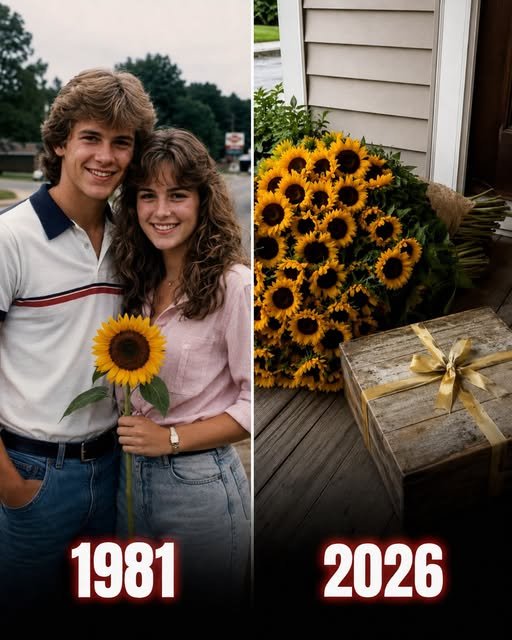
Part One: The Birthday I Expected to Pass Quietly
My sixtieth birthday began under a sky the color of old silver. I sat alone at the kitchen table with a cup of tea cooling between my hands, listening to the house settle around me. Three years had passed since my divorce, and I had learned the strange comfort of an empty home. Silence did not ask questions. It did not criticize the way I folded towels or remind me of everything I had failed to be.
My daughter called just before I finished my tea.
“Happy birthday, Mom. We are still having dinner tonight, right?”
“Of course,” I said. “Nothing elaborate. Just my favorite people, a homemade meal, and a piece of cake large enough to be irresponsible.”
She laughed. “You always make it sound as if birthdays are an inconvenience. Sixty is important.”
“Sixty is only a number,” I told her. “Besides, no one buys flowers for a woman my age.”
The words came out as a joke, but the truth beneath them was older than I wanted to admit. For most of my adult life, I had made myself grateful for scraps of affection. My former husband had betrayed me more times than I could count, and each time I had found a reason to forgive him. I told myself I was protecting our family. If I was honest, I was mostly protecting myself from the terror of being alone.
My daughter grew quiet on the other end of the phone.
“Mom, you spent too many years believing you had to accept whatever love was offered. You do not have to do that anymore.”
After we said goodbye, I carried her words with me as I crossed the room. They opened a door in my memory – one I had kept closed for decades. Behind it was a boy with sun-browned hair, an earnest smile, and a promise he had made when we were both fifteen.
Part Two: The Promise from the Summer We Were Fifteen
Danny lived three houses away from me. Before we knew enough to call it love, we were inseparable friends. We raced our bicycles down the same cracked sidewalks, shared secrets behind the garage, and believed the world would remain exactly as it was because we had never yet seen it change.
That summer, a flower stand appeared beside the road outside town. One afternoon, we stopped there on our way home. The sun was hot, the air smelled of dust and cut grass, and the buckets of flowers looked impossibly bright against the faded wooden stand.
I remember teasing him about growing old.
“When I turn sixty,” I said, “I will be invisible. No one will think to bring me flowers.”
Danny stopped walking. His expression became so serious that I nearly laughed.
“Then I will bring you sixty sunflowers,” he said. “One for every year.”
I rolled my eyes. “You will forget me long before then.”
“Never.” He held out his hand. “Shake on it.”
I placed my hand in his, expecting him to grin and turn the whole thing into a joke. He did not. His palm was warm, and his fingers closed around mine with the solemnity of a vow.
“I mean it,” he said. “Sixty sunflowers. I promise.”
At fifteen, forty-five years felt like another lifetime. We thought the only challenge would be remembering such a silly promise. We did not know that life could take someone away before he had even learned how to drive.
A few weeks later, a fireworks accident started a fire during the neighborhood Fourth of July celebration. Smoke rolled across the dark, people shouted, and families ran in every direction. Danny never made it home. By morning, the boy who had promised me flowers was gone.
Grief changed the shape of my childhood. For years, I woke from dreams filled with heat, smoke, and the sound of people calling his name. I never told anyone about the sunflowers. Not my parents. Not my closest friends. Certainly not the man I eventually married.
The promise belonged to a private world that had existed before betrayal, before fear, before I began measuring love by how much pain I could survive. I tucked it away and convinced myself that it had died with Danny. Forty-five years later, on the birthday he had named, I believed I was the only person left who remembered.

Part Three: Sixty Yellow Faces on My Porch
I finished my tea and went to collect the newspaper. It was a small habit, but small habits had carried me through the years when larger things failed. I opened the front door expecting the cool morning, the empty street, and a folded newspaper near the mat.
Instead, the porch had disappeared beneath a flood of yellow.
Sunflowers filled the steps. They leaned against the railing and crowded the welcome mat, their heavy heads turned toward the pale morning light. For a moment, I could not breathe. My heart beat so hard that I pressed my hand against my chest, certain something inside me was breaking loose.
Then I began to count.
“One, two, three…”
I moved slowly from one bouquet to the next, touching each stem as if my fingers could prove what my eyes could not. When I reached the end, my voice had nearly vanished.
“Fifty-eight, fifty-nine, sixty.”
Exactly sixty flowers.
My knees weakened. I caught the doorframe and sank onto the top step. There was no innocent explanation for that number. No accident could have arranged the past so precisely. Danny’s promise had been a secret I had guarded so carefully that sometimes I wondered whether I had imagined making it.
Behind the largest bundle, I noticed a small wooden box. Its corners were worn smooth, and a faded yellow ribbon had been tied around it. The flowers were astonishing. The box was frightening.
I picked it up with both hands and carried it into the kitchen. I set it on the table, sat down, and stared at it until the room blurred around its edges. Some part of me was afraid that opening it would destroy the magic. Another part was afraid it would confirm that someone had found the most private wound in my life and decided to press on it.
At last, I loosened the ribbon. Inside lay a folded sheet of paper resting on a square of old cloth. The paper was yellowed, but the handwriting was unmistakable. I knew that uneven, hurried scrawl as well as I knew my own reflection.
Danny’s handwriting.
The first line read: “If you are holding this, then I kept my promise after all.”
The note slipped against my fingers. Tears rose so quickly that the words dissolved.
“No,” I whispered. “You are gone. This cannot be real.”
Fear followed the grief. Had someone been listening all those years? Was this a cruel prank? Who would know about the promise when I had never spoken it aloud? The thought turned my sorrow sharp. I could bear losing Danny again. I did not know if I could bear seeing his memory mocked.
That was when someone knocked on the front door.
Three slow knocks. Evenly spaced. Patient.
I stared toward the hallway while the note rested on the floor at my feet.
“Who is there?” I called.
No one answered. The silence that followed felt deliberate. I rose, crossed the room, and placed my trembling hand on the doorknob. Nothing about that morning felt ordinary anymore.
Part Four: The Man Who Carried Danny’s Promise
When I opened the door, an older man stood on the porch. The years had changed his face, but not the familiar shape of his eyes or the stubborn line of his jaw. For one impossible second, my heart mistook him for Danny at sixty.
Then the truth settled between us.
“You are Danny’s brother,” I said. My voice sounded like it belonged to someone else.
He gave a small, apologetic nod. “I am. I am sorry if this frightened you. May I come in? I think we should talk, and you look as though you need to sit down.”
I stepped aside. He entered the kitchen and glanced at the note on the floor.
“You sent the flowers,” I said. “The box too. How did you know about them?”
He pulled out a chair but did not sit until I did.
“Our mother died in the spring,” he explained. “Last month, I was helping clear her house. In the back of her closet, I found an old shoebox filled with Danny’s things. The note was inside.”
He looked toward the porch.
“Danny had written down your name, the promise, and the date of your birthday. He had worked out the number himself. He knew exactly how old you would be.”
My tears fell silently.
“He was only fifteen.”
“He was fifteen,” his brother said, and his voice caught. “But that was Danny. When he loved something, he treated it as if it mattered forever.”
He admitted that he had searched for my address after finding the note. He had not known whether contacting me was the right thing to do. But Danny had spoken about me constantly, he said. Danny had wanted to marry me someday. When he saw the promise, he thought his brother would have wanted it honored.
I picked up the note and read it again, this time from beginning to end. The words were simple – the kind of words a boy might write when he believed a promise could outlast anything. Yet they reached into the life I had built and exposed the difference between affection and devotion.
For forty-five years, I had believed the promise existed only in my memory. I had been wrong. Danny had carried it with him too, writing it down so the future would not erase it.
“He would have brought them himself,” I said.
“I believe that,” his brother answered. “He thought you were the kind of person worth keeping a ridiculous promise for.”
I looked at the sea of yellow beyond the doorway.
“I am sixty years old,” I said, “and I am only now understanding that a boy who died at fifteen loved me more honestly than the man I spent most of my adult life trying to please.”
His brother did not rush to comfort me. He let the truth stand in the room. That kindness made it possible for me to say the rest.
“The flowers hurt,” I admitted. “Not because of Danny. They hurt because I forgot this kind of tenderness was possible. I spent decades calling endurance love. I accepted being diminished because I thought loneliness would be worse.”
“Danny would not want the flowers to hurt you,” his brother said gently.
“They are not hurting me because of him,” I replied. “They hurt because I can finally see how much I settled for after he was gone.”
I walked to the door and touched one of the sunflower heads. Its petals were bright and open, offering their color without asking anything in return.
“A tender promise should not cost someone more pain than the person keeping it,” I said. “Danny understood that at fifteen. It took me forty-five years to remember.”
His brother rested a hand on my shoulder.
“You remember it now. That counts.”
I laughed through my tears. It was the first laugh in a long time that did not feel like an apology. “Better late than never,” I said.
He smiled. “Danny used to say that. Better late than a promise left broken.”

Part Five: The Door I Finally Closed
By evening, my children and two close friends had filled the kitchen with conversation. The flowers stood everywhere – in pitchers, jars, and borrowed glasses – until the house looked less like the place where I had learned to be alone and more like a home that had remembered how to welcome people.
My daughter stopped just inside the doorway.
“Mom, where did all these come from?”
Before I could answer, another voice drifted in behind her.
“Who did you have to beg for that many flowers?”
My former husband stood in the doorway. He had not been invited, but he entered as if the years had changed nothing. His eyes moved over the flowers, and a familiar smirk pulled at his mouth.
In the past, that expression would have made me search for a way to soften myself. That evening, I felt something I had not expected: calm.
“No one had to be begged,” I said. “A boy promised me these when I was fifteen. He kept his word more faithfully after death than you ever did while standing beside me.”
The smirk disappeared.
“You are being dramatic. I only came to wish you a happy birthday.”
“You came because you still think you can walk into a room and make me feel small,” I said. My voice remained quiet. “But I am not that woman anymore.”
He looked at me as if he were waiting for the old fear to return – the fear that had kept me explaining, forgiving, and apologizing. It did not come.
“So this is how it is now?” he asked.
“This is exactly how it is now. Please leave.”
For a moment, neither of us moved. Then he turned and walked back through the doorway. The door clicked shut behind him, and the sound was softer than I expected. It did not feel like a loss. It felt like the end of an argument I had been having with myself for years.
My son came to stand beside me.
“Are you all right, Mom?”
I looked at the flowers, at my children, and at the friends who had stayed when rebuilding my life was slow and unglamorous.
“I am better than all right,” I said. “I think I finally came back to myself.”
Part Six: One Sunflower for Me
I gathered the flowers into my arms. Their stems were cool against my skin, and their weight felt almost impossible to carry. Yet for the first time, the weight did not belong to grief alone.
Danny’s love had never asked me to disappear. It had not required me to become smaller so someone else could feel powerful. Even as a boy, he had understood something I had spent half a lifetime forgetting: love should make room for you to remain fully yourself.
I divided the sunflowers among my children and friends.
“These are for you,” I told them. “You stood beside me when I had to learn how to begin again.”
They protested that the flowers were mine, but I shook my head. Some gifts were meant to be shared. Some promises grew larger when they moved from one pair of hands to another.
I kept one sunflower for myself.
I placed it in a glass of water by the kitchen window, where the last light of the evening rested on its petals. Then I stood there for a long time, thinking about the girl I had been at fifteen and the woman I had become at sixty.
For years, I had confused being needed with being loved. I had mistaken survival for loyalty and silence for peace. I had believed that if I endured enough, the life I wanted would eventually appear. But love was not supposed to be a reward for suffering.
The next morning, the sunflower was still standing. So was I.
Danny had not returned from the past to hold me there. His promise had traveled across forty-five years to remind me that tenderness had always been real – and that I was still allowed to expect it.
As I touched the edge of the glass, I understood what the flowers had truly brought me. Not a second chance with a boy who was gone. Not a reason to mourn the life I never had.
They had brought me the courage to stop mourning the woman I had been afraid to become.
The past had not come back to claim me. It had come to set me free.