
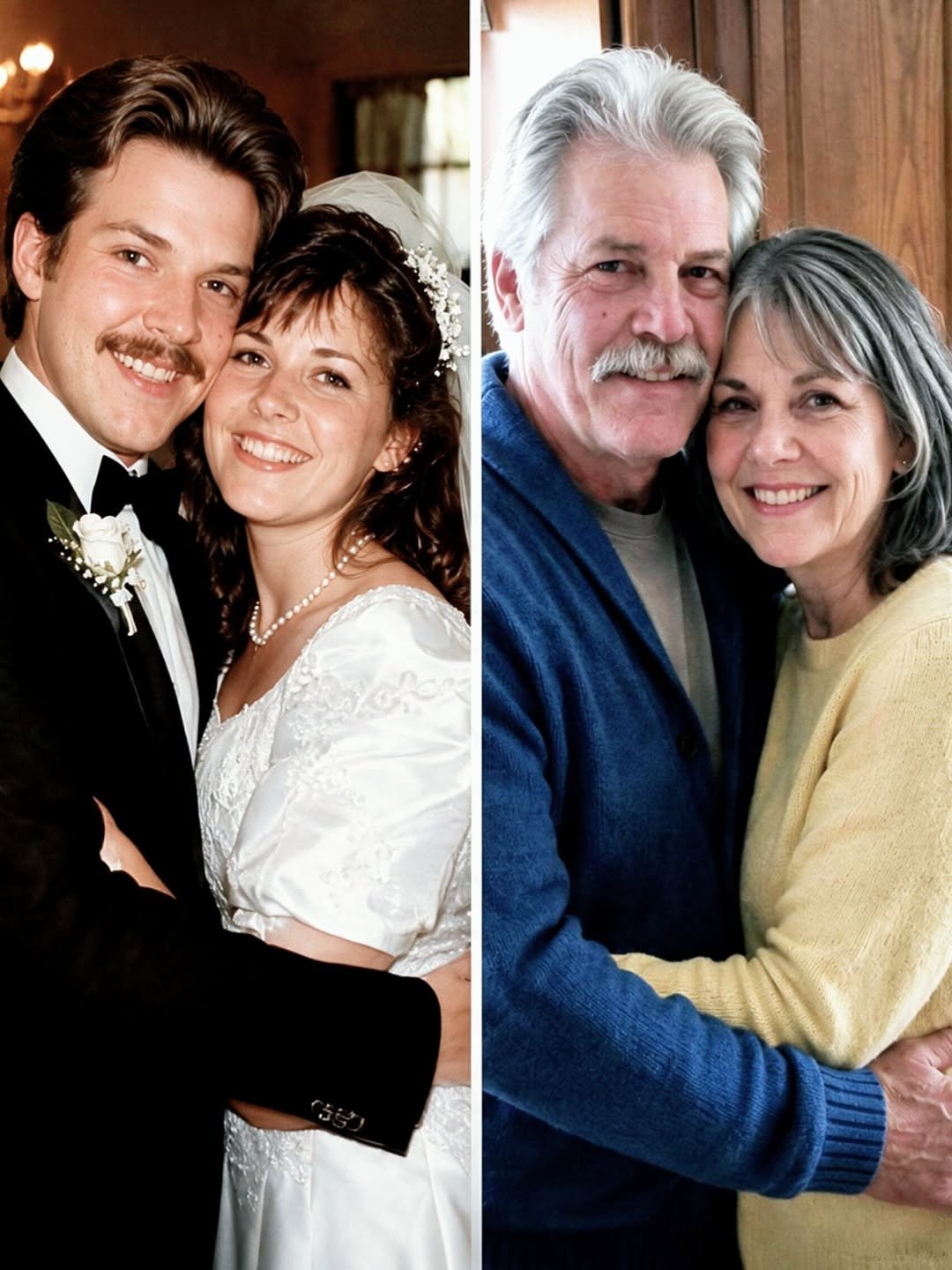
THE MAN I THOUGHT I KNEW
Richard and I met during our freshman year of college.
He was the quiet young man who always sat near the window in history class, tapping his pencil whenever he was nervous. I was the girl who borrowed that pencil one rainy afternoon and forgot to return it.
He asked for it over coffee.
That coffee became dinner. Dinner became long walks across campus. Two years later, at twenty, we stood in a tiny church with secondhand flowers, nervous smiles, and less than three hundred dollars in our bank account.
We had no idea what we were doing.
But we loved each other, and for a long time, that was enough.
We built a life the slow way. Richard worked at an insurance company, and I taught elementary school. We bought a small house, raised Michael and Claire, and spent years worrying about tuition, broken appliances, and dinner.
By the time our fifth grandchild was born, we had been married for thirty-eight years.
I thought I knew every version of Richard.
I knew how he rubbed the bridge of his nose when he was tired. I knew he hated olives but ate them when my mother cooked. I knew he cried at graduations and denied it. I knew he checked every door twice before bed.
At least, I believed I knew him.
Then he changed.
SIX MONTHS OF SILENCE
At first, the changes were small.
Richard stopped humming while he made coffee. He left for work earlier and came home later. At dinner, he pushed food around his plate while staring at nothing.
When I asked what was wrong, he gave the same answer.
“Work has been rough.”
But I had been married to him too long to believe that was all.
He looked frightened, not tired.
Some nights, he slept on the sofa in the living room and locked the door connecting it to the hallway. I would wake at two in the morning, see light underneath, and hear him moving around.
Once, I knocked.
“Richard?”
There was a long silence.
“I’m fine, Maggie. Go back to bed.”
“You’re not fine.”
“I said I’m fine.”
He had never spoken to me like that.
The next morning, he apologized, but the distance remained. He took phone calls outside and kept papers in a locked briefcase. Sometimes I caught him looking at me with an expression I could not understand.
It looked like grief.
For six months, I tried everything. I suggested a vacation. I cooked his favorite meals. I asked whether something had happened at work, whether he was worried about money, whether he was sick.
He denied all of it.
Then, one cold Thursday evening, he came home early.
I was chopping onions when he sat at the kitchen table and folded his hands.
He did not look at me.
“Maggie,” he said, “I need to tell you something.”
The knife stopped in my hand.
“I cheated on you with another woman.”
The room seemed to tilt.
I remember the onions stinging my eyes and the refrigerator humming. I waited for him to laugh, correct himself, or say I had misunderstood.
He did none of those things.
“I’m sorry,” he whispered. “I can’t lie to you anymore.”
THE END OF THIRTY-EIGHT YEARS
I forgot how to breathe.
“Who is she?”
Richard stared at the table.
“How long?”
He said nothing.
“Do I know her?”
“Maggie, please.”
“Please what? Please don’t ask questions about the woman who destroyed my marriage?”
He flinched but still would not answer.
I asked whether he loved her.
He swallowed hard.
“I don’t know what love means anymore.”
Those words ended something inside me.
Within two weeks, I moved into Claire’s guest room. Within three months, lawyers were involved. Richard never fought me over anything.
He gave me the house. He gave me most of our savings. He agreed that I should keep my pension untouched and signed over his share of a small cabin inherited from his uncle.
My lawyer said, “This is one of the most favorable settlements I’ve ever seen.”
I thought it was guilt.
On the day the divorce became final, we stood outside the courthouse beneath a gray sky.
He looked older than he had six months earlier. His shoulders were thinner, and deep lines had appeared around his mouth.
“I’m sorry,” he said.
“You already said that.”
“I know.”
“You threw away thirty-eight years.”
His eyes filled with tears, but he looked away.
“I hope one day you’ll have a peaceful life.”
“You should have thought of that before.”
Then I walked away.
I did not look back.

FIVE YEARS WITHOUT HIM
The first year after the divorce was the hardest.
I had spent nearly four decades being part of an “us.” Suddenly, every decision belonged only to me.
I hated the empty side of the bed and the mail addressed only to Margaret Turner. Songs from college could still make my hands shake.
Our children tried not to take sides. Michael rarely spoke about his father. Claire visited him occasionally, and the grandchildren saw him a few times a year.
Richard never came to events when I was there. He never called.
Eventually, I learned to build a life around the silence.
I retired from teaching. I joined a book club. I repainted the house yellow because Richard had always preferred blue. I traveled to Arizona with two friends and stood at the edge of the Grand Canyon, surprised that the world could still make me feel small in a good way.
I was not happy every day, but I was no longer drowning.
Then, five years after our divorce, the hospital called.
A calm voice told me Richard had suffered a fatal heart attack. He had died before the ambulance reached the emergency room.
For several seconds, I could not speak.
Legally, I was no longer his wife. Emotionally, I did not know what I was.
I cried for the young man by the classroom window, the father who had held our babies, the husband I had trusted, and the stranger he had become.
Most of all, I cried because there would never be answers.
Or so I thought.
THE WOMAN IN THE LAST ROW
The funeral was held in the same church where Richard and I had married.
The room was filled with former coworkers, neighbors, relatives, and old college friends. I recognized everyone except one woman.
She sat alone in the last row.
She appeared to be in her early sixties, with silver-streaked hair pulled into a low knot. She wore a plain black dress and held a thick cream-colored envelope in her lap.
She did not cry during the service, but she watched me.
After the final prayer, people gathered around Michael and Claire. I received hugs from people who did not know what to call me. Widow felt wrong. Ex-wife felt too cold.
When most guests had left, I approached her.
“Excuse me. How did you know Richard?”
Her fingers tightened around the envelope.
“My name is Laura Mercer.”
“That doesn’t answer my question.”
She glanced toward my children.
“I was Richard’s attorney.”
“His divorce attorney?”
“Among other things.”
My stomach tightened.
“Were you the woman?”
Laura’s eyes widened.
“No.”
“Then why are you here?”
She looked afraid to answer.
“For five years, I lived with questions he refused to answer. He is gone now. Please don’t tell me it’s none of my business.”
Laura guided me into a quiet side hallway.
“You don’t know the whole truth, do you?” she whispered. “You have no idea what your husband did for you—or what really happened five years ago.”
THE CONFESSION THAT WASN’T TRUE
Laura handed me the envelope, but I did not open it.
“What are you talking about?”
“Richard never had an affair.”
The hallway went silent.
“That’s impossible.”
“He lied.”
“No. He admitted it.”
“I know.”
I shoved the envelope back toward her.
“You do not say something like that at a funeral unless you can prove it.”
“I can.”
She removed a medical report dated six months before Richard’s confession.
His name was at the top.
Below it were words I barely understood, followed by one sentence I did:
Progressive cardiac disease with a high risk of sudden death.
My knees weakened.
“He had been having symptoms for months,” Laura said. “Chest pressure, shortness of breath, fainting spells. He hid them from you. His doctors warned that he might face years of costly treatment, major procedures, and possibly long-term care.”
I stared at the date.
Six months before our divorce.
Six months of locked doors and whispered calls.
“He told me it was work stress.”
“He was meeting doctors, financial planners, and me.”
“Why you?”
“Because he wanted to protect your home, retirement, and savings.”
Laura explained that Richard had become obsessed with one fear: I would spend everything we had trying to keep him alive.
Years earlier, his older sister had cared for a seriously ill husband. She exhausted her savings, borrowed against her home, and nearly lost everything before he died. Richard never forgot it.
“He believed you would never leave if you knew he was sick,” Laura said. “He said you had spent your life taking care of everyone else. He was certain you would sacrifice your retirement without hesitation.”
“So he made me hate him.”
“I told him not to. I told him to trust you with the truth. He said the truth would give you a choice, and you would choose him.”
My voice shook.
“He had no right to make that choice for me.”
“No,” Laura said. “He didn’t.”
She was not defending him.
“He was terrified,” she continued. “Fear convinced him that hurting you once was kinder than watching you lose everything slowly.”
WHAT HE HAD DONE
Laura removed more documents from the envelope.
The divorce settlement had not been generous because of guilt.
It had been designed.
Richard transferred the house to me before his medical expenses could threaten it. He paid off the remaining mortgage through the sale of the cabin. He took nearly every joint debt into his own name.
He also maintained a life insurance policy with me as the beneficiary.
“We were divorced,” I said.
“He named you again afterward.”
“Why?”
“Because he said the money belonged to the years you built together.”
He had created education accounts for all five grandchildren and left instructions that our children should not feel responsible for his medical bills. He lived modestly and worked part-time after his health forced him from his position.
The woman I had imagined for five years did not exist.
There had been no secret dinners, hotel rooms, or new love.
Only hospital visits, legal meetings, medications, and one frightened man living alone with photographs of the family he had pushed away.
“Did Michael and Claire know?”
“Not at first. Richard told them about his heart condition last year when it became difficult to hide. He did not tell them the truth about the divorce. He made them promise not to interfere because he believed you had rebuilt your life.”
I thought of Claire’s red eyes during the funeral and Michael’s clenched jaw.
“Why didn’t he tell me before he died?”
“He planned to.”
Laura handed me a sealed letter.
“He wrote this two months ago. He kept postponing the conversation because he was afraid the truth would reopen everything.”
“And then his heart stopped.”
Laura nodded.
I held the letter, suddenly furious at a dead man.
He had stolen my right to stand beside him.
He had also spent five years alone to preserve the life he believed I deserved.
Both things were true.

RICHARD’S LAST LETTER
I took the letter home and placed it on the same kitchen table where Richard had confessed.
For nearly an hour, I only stared at it.
Then I opened it.
Maggie,
The first thing you deserve to know is that I never cheated on you. There was no other woman.
I said those words because I knew illness would not make you leave. Betrayal would.
I thought anger would save you faster than love ever could.
I was wrong to take the choice from you. Laura told me that from the beginning, but I was afraid. I had seen what long illness could do to a family, and I could not bear the thought of you losing the house, your retirement, or the peaceful years you earned.
I told myself that one terrible wound was better than years of fear. But I know now that I did not protect you from pain. I only changed the kind of pain you carried.
I am not asking you to forgive me.
I only want you to know that our marriage was real to me every day of those thirty-eight years. No one replaced you.
I kept the photograph from our first apartment—the one where we sat on the floor because we did not own a couch. It reminded me that the best years of my life were never about what we had. They were about who was beside me.
I hope the life you built after me became peaceful.
I hope you painted the house any color you wanted.
And I hope that someday, when you remember me, the last lie is not louder than all the years that came before it.
Richard
I read the letter twice.
Then I shouted at the empty kitchen.
“You should have told me! You should have trusted me!”
I cried until my throat hurt.
Because I would have stayed.
I would have driven him to appointments, learned his medications, sat beside hospital beds, and spent nights listening for his breathing.
Maybe that was exactly what he feared.
But it should have been my decision.
Love is not only sacrifice.
Love is also trust.
And Richard, in trying to save me, had forgotten that.
THE TRUTH OUR CHILDREN NEEDED
The next morning, I called Michael and Claire.
We met at my house, and I placed the medical reports, legal papers, and Richard’s letter on the table.
Claire began crying before she finished the first page.
Michael stood so quickly that his chair fell backward.
“He lied to all of us,” he said.
“He was scared,” Claire whispered.
“He broke Mom’s heart.”
“And he thought he was protecting her.”
They looked at me, waiting for me to decide which version of their father was true.
I could not.
“He loved us,” I said. “He also made a terrible decision. Both things can be true.”
For hours, we talked.
Michael admitted he had avoided his father because he could not forgive the affair. Claire confessed that when Richard finally told her he had heart trouble, she had begged him to call me. He refused.
“He said you looked happy again,” she told me. “He said he had already taken enough from you.”
I looked around the yellow kitchen he had never seen.
For five years, I believed my life after divorce was proof that I had survived him.
Now I understood it was also the life he had tried, in his painful and misguided way, to secure for me.
That did not erase the lie.
But it changed the shape of it.
A week later, the life insurance payment arrived.
It was enough to make me sit down.
For a while, I could not touch the money. It felt like grief printed on paper.
Then Claire said, “Dad made every decision alone because he believed there was no better way. Maybe we can use this to help another family see that they have choices.”
WHAT I SAID AT HIS GRAVE
Three months after the funeral, our family created a small fund through the hospital where Richard had been treated.
It helps families facing long-term illness meet with financial counselors, find temporary caregiving support, and speak honestly about the decisions fear can make for them.
We named it the Open Door Fund.
Not after Richard.
Not after me.
After the one thing our marriage lost during those final six months: an open door.
On the day the fund approved its first grant, I visited Richard’s grave alone.
I brought the old photograph from our first apartment.
We were twenty-one, sitting on a bare floor with paper plates in our laps, laughing as though we had already won at life.
I placed it against his headstone.
“I know the truth now,” I said.
The cemetery was quiet except for wind moving through the trees.
“I understand why you did it. I even understand why you believed it was love. But you should have trusted me enough to let me choose.”
I told him about the yellow house. I told him Michael had begun speaking about him without anger. I told him Claire had found the college notebooks where he had written my name in the margins.
Then I said something I had not expected.
“I forgive you.”
The words did not erase five lost years or make his lie noble.
Forgiveness was not pretending he had done the right thing. It was accepting that the man I loved had been brave in many ways and terribly afraid in one.
For five years, I believed Richard’s last gift to me was betrayal.
I was wrong.
His last gift was security, bought at a price neither of us should have paid.
And the final lesson he left me was this:
Real love should never demand that one person decide everything alone.
Sometimes sacrifice is love. Sometimes staying is love.
But the deepest kind of love opens the door, tells the truth, and lets the other person choose.