
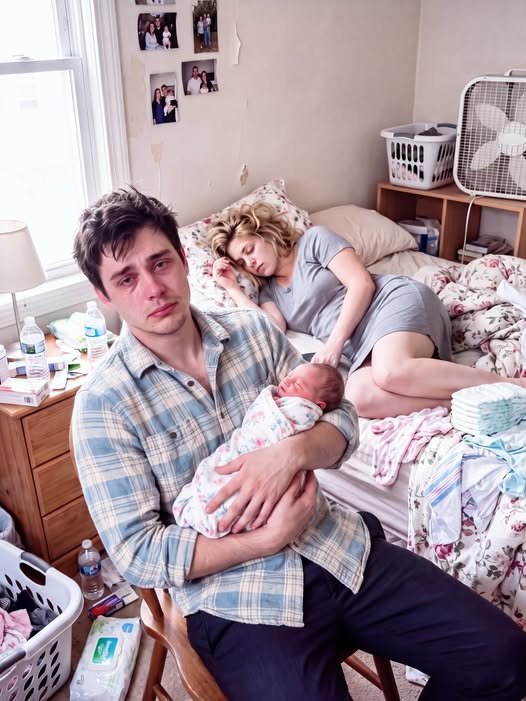
Part One: The Promise I Should Never Have Believed
My son had been alive for only seven days when I found him burning with fever beside his unconscious mother.
Until that morning, I thought fear was the most painful emotion a person could experience. I was wrong.
There is something worse than fear.
It is the moment you realize that the people you trusted most were never worthy of that trust—and that your mistake may have endangered everyone you love.
My name is Ethan Miller. At the time, I worked as a warehouse supervisor for a construction supply company in a quiet Ohio suburb. Our neighborhood was the kind of place where every lawn looked neatly trimmed and nearly every house seemed built from the same plan.
My life was ordinary, but I was proud of it.
At work, my biggest concerns were usually delayed shipments, damaged pallets, missing invoices, and employees worried about losing the steady paychecks their families depended on. I liked solving practical problems. If something was broken, I believed there was always a clear way to fix it.
My wife, Emily, understood life differently.
She noticed things most people overlooked.
She thanked cashiers even when they barely looked up. She remembered birthdays that everyone else forgot. Every December, she baked cookies for our mail carrier because she believed kindness mattered most when no one expected a reward.
The world had disappointed her more than once, yet it had never managed to harden her.
When we rented our small house, I kept apologizing for everything that needed improvement. The porch step was loose, the walls needed fresh paint, and our kitchen table was covered in scratches left by the previous tenants.
I promised Emily I would repair all of it before the baby arrived.
She only smiled.
“A home isn’t made from perfect furniture,” she reminded me.
Then she bought a pair of secondhand curtains, washed them twice, and hung them in the nursery. Somehow, with very little money, she turned that modest room into the warmest place I had ever seen.
Seven days before my life changed, Emily gave birth to our son, Noah.
He arrived tiny, red-faced, and furious with the world. His fists were hardly larger than the caps on his feeding bottles, but his cry filled the entire hospital room.
When the nurse placed him against Emily’s chest, she burst into tears.
I tried to remain composed.
I failed.
My mother, Linda, and my younger sister, Ashley, were standing nearby. Both of them looked proud and emotional.
Mom gently brushed Emily’s hair away from her forehead.
“You won’t have to handle everything alone,” she promised. “We’ll be there when you come home.”
Ashley leaned over Noah’s bassinet and whispered that he would never have to wonder whether he was loved.
I believed them.
That memory still troubles me. Whenever I think about what happened later, I return to that hospital room—to their reassuring faces and gentle promises.
It was the last moment before trust became evidence.
Two days later, I brought Emily and Noah home.
The hospital sent us away with several pages of instructions. They explained the warning signs of dehydration, infection, fever, fainting, severe weakness, and complications following childbirth.
I read every line repeatedly.
Fatherhood frightened me more than I admitted. Noah seemed so delicate that I sometimes checked his breathing even while he slept peacefully in my arms.
Emily watched me studying the paperwork at the kitchen table.
“You’re planning to memorize all of that, aren’t you?” she asked.
“Yes.”
She gave me a tired smile.
“Good.”
During those first few days, neither of us slept much.
I warmed soup, washed bottles, changed diapers with more determination than skill, and helped Emily sit up whenever she became uncomfortable. I brought her water and arranged pillows behind her back. At night, I stood over Noah’s bassinet, listening to every breath.
My mother and Ashley began visiting almost daily.
At first, their help felt like a blessing.
Mom folded laundry, prepared meals, and reorganized the kitchen. Ashley washed bottles and told me to rest whenever she noticed how exhausted I looked.
They often reminded Emily how fortunate she was to have family living nearby.
But one evening, after my mother left the bedroom, Emily reached for my hand.
“Your mom scares me a little,” she whispered.
There was embarrassment in her voice, as though she felt guilty for saying it.
I kissed her fingers and answered with the sentence I would later regret more than almost anything else.
“She means well.”
Those three words seemed harmless at the time.
Later, I understood how much damage a person can excuse by repeating them.
Four days after Emily came home, my manager called before sunrise.
Several inventory records had gone missing, and some of the documents carried my signature. The company was concerned about financial losses and possible legal consequences. He wanted me to travel to another branch temporarily and help sort through the paperwork.
I refused at first.
My wife had recently given birth. My son was not even a week old. Every instinct told me that leaving them was wrong.
My manager continued pressuring me. Senior management was already asking questions, he said. If I refused to cooperate, my job could be at risk.
I should have stayed home.
I should have accepted whatever happened at work.
Instead, I convinced myself that protecting my job was another way of protecting my family.
Fear disguised itself as responsibility, and I failed to recognize the difference.
I called my mother.
She and Ashley arrived around noon while I packed a duffel bag in the kitchen. I felt uneasy, though I could not explain why.
I reminded them that Emily needed regular meals, plenty of water, rest, and help caring for Noah. Then I pointed to the discharge instructions lying on the counter.
“If she develops any of these symptoms, call the hospital immediately,” I said.
My mother placed a hand against my cheek.
“Ethan, stop worrying. Your wife and son will be safe with us.”
Ashley rolled her eyes.
“You’re acting like no one else is capable of loving them.”
Before leaving, I returned to the bedroom.
Emily looked exhausted, but instead of asking me to stay, she tried to reassure me.
“We’ll be okay,” she said.
I kissed her forehead and then touched my lips to Noah’s tiny fist.
“I’ll be back before you know it.”
I had no idea that peaceful moment would divide my life into two parts:
The time before I left—and everything that came afterward.

Part Two: The Silence Behind the Bedroom Door
Throughout the trip, I called home constantly.
I called before work, during lunch, after meetings, and again before going to sleep. Even when everyone assured me that things were fine, a quiet warning continued pressing against the back of my mind.
Almost every call went through my mother.
She controlled the phone carefully, sometimes allowing me to speak with Emily for only a few moments before taking it away.
Whenever I asked whether Emily was drinking enough water or eating proper meals, Mom replied that everything was under control.
Ashley could often be heard somewhere in the background.
She complained about how frequently newborns cried and teased me for behaving like an anxious first-time father.
“Relax,” she said during one call. “Mom raised both of us. She knows what she’s doing.”
That was what I kept telling myself.
My mother had raised two children. I had been a father for less than a week.
I treated her experience as proof that she could not possibly be wrong.
But with every call, Emily seemed weaker.
Her face looked paler. Her lips appeared dry. Sometimes her hand trembled so badly that she struggled to keep the phone steady.
Whenever she tried to speak for more than a few seconds, Mom interrupted.
“She needs sleep,” she would say. “These emotional conversations are making things worse.”
On the second day, I heard Noah crying somewhere beyond the camera.
It did not sound like the powerful cry I remembered from the hospital. It was faint and strained.
“Let me see him,” I said.
“He just fell asleep,” Mom replied.
I could still hear him.
“Then why is he crying?”
“He’s a baby, Ethan. Babies cry.”
She spoke with such confidence that I began questioning my own instincts.
I told myself that exhaustion was making me imagine problems. I wanted to believe my family was safe, so I accepted every explanation that allowed me to believe it.
On the third night, Emily finally held the phone long enough to say my name clearly.
Her face appeared beneath the dim bedroom light. Damp strands of hair clung to her forehead.
“Emily, what’s wrong?” I asked.
She looked toward the doorway.
Before she could answer, the phone shifted suddenly, and my mother appeared on the screen.
“She’s being dramatic,” Mom said. “Women have been having babies forever. We didn’t turn the entire house upside down every time we felt tired.”
I should have stopped her immediately.
I should have defended my wife.
Instead, I became quiet.
That silence still haunts me.
Silence may feel passive, but in the presence of cruelty, it can sound like agreement.
The problem at work was resolved sooner than expected on the fifth evening. I decided to drive home without telling anyone.
Around midnight, I began calling the house.
No one answered.
I tried again and again.
Finally, at 2:03 in the morning, Ashley sent me a message.
Everyone is asleep. Stop worrying.
I read it several times.
The words were ordinary, yet something about them made my hands tighten around the steering wheel.
I drove through heavy rain, trying to ignore the fear building inside me.
By the time I reached our neighborhood, dawn was approaching. Every house stood dark and motionless.
The moment I stepped through my front door, I knew something was wrong.
A home with a newborn is rarely silent. There should have been footsteps, running water, whispered conversations, or the sound of a tired parent moving through the kitchen.
Instead, the house felt empty.
The air smelled stale. Pizza boxes, chip bags, and soda bottles covered the coffee table.
My mother and Ashley were sleeping comfortably beneath blankets on the couch.
They looked as though they had spent the evening watching television rather than caring for a recovering mother and a week-old child.
Mom woke when she saw me.
“What are you doing here?” she demanded. “Why didn’t you tell us you were coming home?”
“Where are Emily and Noah?”
She sat up slowly.
“Noah was crying earlier. Emily is probably sleeping.”
Then I heard him.
It was not a normal cry.
It was a weak, broken sound coming from the bedroom.
I ran down the hallway.
The room was unbearably warm. The windows were closed, and the fan had been switched off. The air was heavy and stale.
Emily lay motionless on the bed. Noah was beside her, wrapped in a dirty blanket.
Her skin looked pale beneath the morning light. One arm hung over the edge of the mattress, as though she had tried to rise and had not been able to continue.
I touched Noah’s forehead.
He was burning with fever.
When I lifted him, he barely reacted.
“Emily?”
I touched her shoulder.
She did not wake.
Her forehead was just as hot.
I called her name again and shook her more firmly, but she remained unresponsive.
Then I screamed for my mother.
Mom and Ashley appeared in the doorway.
Their reaction told me everything.
Neither of them hurried toward the bed. Neither asked how they could help. They simply stood there, staring at the scene as though they had never expected anyone else to witness it.
“She was fine last night,” Mom insisted.
Ashley crossed her arms nervously.
“She might be doing this for attention.”
Something inside me went still.
I did not argue.
I wrapped Noah inside my hoodie, lifted Emily carefully, and carried them toward the front door while shouting for help.
Our neighbor, Mr. Harris, stepped outside immediately.
He took one look at Emily and Noah, grabbed his car keys, and opened his SUV without wasting time on questions.
During the drive, Emily’s head rested against my shoulder.
Noah became quieter in my arms.
I repeated his name over and over, desperate for any response.
“Noah, stay with me. Daddy’s here. Please, little man.”
I had spent several sleepless nights wishing he would cry less.
Now I would have given anything to hear him scream.
At 5:42 that morning, we rushed through the emergency-room doors carrying the two people who meant more to me than everything else in the world.

Part Three: The Evidence They Could No Longer Explain Away
The hospital staff moved quickly.
The moment the nurses understood that Noah was only seven days old and had a high fever, they rushed him for an immediate pediatric examination.
Another team placed Emily on a stretcher. She responded weakly to their voices but could not fully wake.
A nurse secured a hospital bracelet around Noah’s tiny ankle and wrote across his chart:
SEVEN DAYS OLD—FEVER.
Seeing those words made the danger feel real in a way nothing else had.
I stood nearby, soaked from the rain and still barefoot, unable to stop shaking.
A doctor removed Noah’s soiled blanket and examined him carefully. Her expression changed the moment she saw his condition.
“Who was caring for this baby and his mother?” she asked.
“My mother and sister,” I answered. “I was away for work.”
The doctor looked toward the nurse beside her.
“Contact the police.”
My mother and Ashley arrived only minutes later.
Both were crying, but neither of them immediately asked about Emily or Noah.
Instead, they began explaining themselves.
Mom said Emily had been emotional and uncooperative since coming home from the hospital.
Ashley insisted they had done everything they could.
The doctor stared at them.
“Everything you could?”
Neither woman answered.
A nurse asked whether I still had Emily’s discharge instructions.
For several seconds, I panicked, unable to remember what had happened to them. Then Mr. Harris helped search the diaper bag we had brought from the house.
The papers were inside.
The warning section was still circled in blue ink—the marks I had made before leaving.
The instructions clearly stated that caregivers should seek immediate medical attention if Emily developed fever, fainting, severe weakness, dehydration, or signs of infection.
My mother looked down at the page.
She recognized my handwriting.
There was no way for her to claim she had not known what to watch for. I had shown the instructions to both her and Ashley. I had explained them repeatedly.
When the police arrived, they asked detailed questions about when I had left, how frequently I had called, and what my mother and sister had told me.
I handed over my phone willingly.
The officers reviewed my call history and read Ashley’s final message:
Everyone is asleep. Stop worrying.
Then Ashley’s phone vibrated.
The fear on her face appeared instantly.
One of the officers noticed.
“What message did you receive?” he asked.
“It’s nothing,” she replied too quickly.
“Ashley,” my mother snapped.
The warning in Mom’s voice confirmed what I had already begun to suspect.
They were hiding something.
Investigators later recovered a series of messages from Ashley’s phone.
Those conversations destroyed every excuse my mother attempted to make.
The messages showed that Emily had repeatedly asked for water, food, medicine, and help caring for Noah.
Ashley complained that Noah would not stop crying.
My mother did not express concern. Instead, she described Emily as demanding, dramatic, and manipulative.
In one message, Mom had written:
Let him cry. She wanted to be a mother.
Another message said:
Don’t call Ethan. He’ll take her side.
The final exchange was from the night before I returned.
Ashley had written that Emily looked seriously ill.
My mother’s response contained only a few words:
She’s pretending. Leave her alone.
When I read those messages, something inside me changed permanently.
Until that moment, a part of me had still been searching for an explanation. Perhaps they had misunderstood the symptoms. Perhaps they had panicked. Perhaps they had not realized how quickly Emily and Noah were becoming ill.
The messages proved otherwise.
They had seen what was happening.
They had discussed it.
Then they had chosen to do nothing.
My mother had not ignored Emily because she failed to understand the danger. She had ignored her because she believed my wife needed to be punished for failing to meet her expectations.
The doctor returned and asked to speak with me privately.
She explained that Emily was severely dehydrated and suffering from a serious infection. Noah’s fever was also extremely dangerous because newborns could deteriorate with frightening speed.
“You brought them in just in time,” she said. “Another delay could have changed the outcome.”
She meant to comfort me.
Instead, guilt tightened around my chest.
I kept returning to the moment my manager called.
I remembered packing the bag. I remembered Emily’s tired face. I remembered every warning inside me that I had pushed aside.
I had believed that leaving for work was the responsible choice.
I had trusted my mother and sister because they were family.
That trust had nearly cost me my wife and son.
Mr. Harris later returned from the house carrying a grocery bag he had collected with permission from the police.
Inside were unopened containers of formula, Emily’s unused medication, a sealed bottle of water, and the medical instructions I had marked before leaving.
Everything they needed had been available.
Food had been nearby.
Water had been nearby.
Medicine had been nearby.
Help had been only a phone call away.
Yet Emily and Noah had been left alone inside that overheated bedroom while their conditions worsened.
Once the evidence came to light, my mother began crying harder.
But as I watched her, I recognized something I had never understood before.
There is a difference between remorse and fear of being exposed.
She did not look devastated because Emily and Noah had nearly died.
She looked terrified because everyone finally knew what she had done.
Ashley eventually broke down.
She admitted that Mom had repeatedly ordered her not to contact me. Whenever Ashley suggested that Emily might genuinely need help, Mom insisted she was exaggerating to gain sympathy and turn me against them.
The moment Ashley confessed, my mother’s grief disappeared.
She became furious.
She shouted at Ashley for betraying her, and the officers quickly separated them before the argument could become worse.
I stood in the hallway, listening to their voices fade behind a closing door.
For years, I had believed my mother’s confidence meant strength. I had mistaken control for concern and criticism for experience.
Emily had seen the truth before I did.
She had told me she was afraid.
And I had answered, “She means well.”
A short while later, the doctor entered the hallway again.
She looked around until she found me.
“Mr. Miller?”
I rose so quickly that the chair scraped against the floor.
The expression on her face was serious, but impossible to read.
Behind her, machines continued beeping. Nurses hurried between rooms. Somewhere nearby, a baby began to cry.
For one desperate second, I hoped it was Noah.
The doctor took a breath and asked me to come with her.
As I followed, I understood that the next words she spoke would determine whether the family I loved had survived the consequences of my trust.