
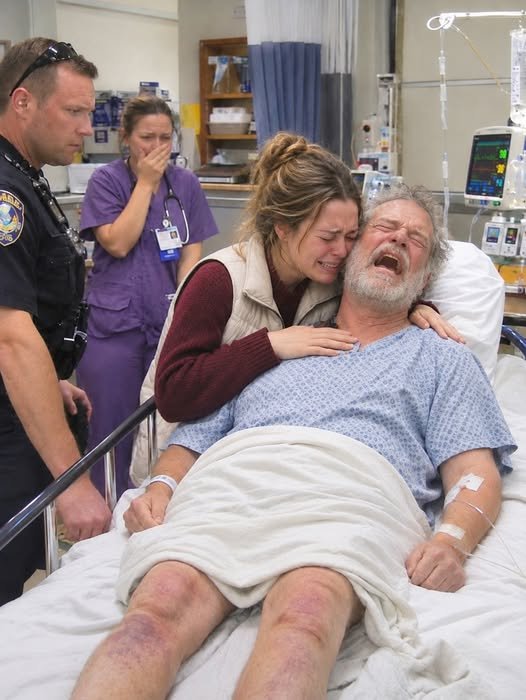
I demanded to know how he could betray the man who raised us. But then Dad reached for my hand, his sleeve slipped down, and what I saw made my blood run cold…
PART 1

At 2:27 a.m., my eighty-year-old father called me from a police station in Little Rock, Arkansas. His voice was so unsteady that I could barely understand him.
“Sweetheart, Tanya hurt me. Now she’s telling the police I’m losing my mind.”
Then he said something that frightened me even more.
“Garrett was right there. He saw everything, and he won’t tell them the truth.”
My brother had always been Dad’s favorite fishing partner, the son he’d helped through a failed business and more than one financial crisis. I couldn’t imagine him standing by while our father was accused of something he hadn’t done. But when I asked Dad whether he was hurt, he whispered, “Please just come get me,” and the call ended.
I pulled on jeans and a sweater, grabbed my keys, and drove through the nearly empty streets. I’d worked in federal law enforcement for seventeen years, long enough to know that a frightened caller rarely tells the whole story over the telephone. But this wasn’t a witness or a stranger asking for help. It was the man who’d taught me to ride a bicycle, checked the oil in my first car, and sat beside my hospital bed when I had pneumonia at twenty-three.
At the station, I found Dad sitting alone in a molded plastic chair near the wall. His gray cardigan hung loosely from his shoulders, and his hands were clasped tightly in his lap. Across the waiting area, my sister-in-law, Tanya, was speaking to an officer while Garrett stood beside her, staring at his boots.
“He’s been confused for months,” Tanya insisted. “Tonight he got aggressive. We can’t keep pretending he’s capable of living alone.”
Dad lifted his head when he heard my voice.
“I’m here,” I told him, kneeling beside his chair. “You’re coming with me as soon as we know you’re all right.”
His eyes filled with tears. “I didn’t do what she’s saying.”
“I believe you deserve to be heard, Dad. First, tell me where you’re hurting.”
He tried to stand, perhaps to prove he was fine, but his knees gave way almost immediately. I caught his elbow and helped him settle back into the chair. His cardigan sleeve slipped toward his elbow, revealing several dark marks around his wrist.
I had seen enough injured people in my career to know that marks like those required medical attention, not speculation from a daughter who happened to carry a badge.
“Dad, did someone grab your arm?”
He pulled the sleeve down.
“It’s nothing. I don’t want any more trouble.”
I looked toward Garrett. He had watched his father nearly collapse without taking a single step forward.
That was the moment I stopped thinking of this as an ugly family argument.
I approached the desk and asked for the officer handling the incident. Officer Dunning introduced himself and explained that deputies had responded to a disturbance at Dad’s house after Tanya called 911.
“My father is having trouble standing, and he has visible injuries,” I said. “Has anyone requested medical assistance?”
“He declined treatment at the scene, ma’am.”
“I’d like someone to ask him again, away from the people involved in the complaint.”
Dunning glanced toward Tanya. “We’re still sorting out conflicting statements.”
“I understand. I’m his daughter, and I also work in law enforcement. I’m not here in an official capacity, and I won’t interfere with your investigation. But he’s eighty, he’s injured, and he needs to be examined.”
I never imagined I’d have to say those words about my own father. This was the man who held my hand through every childhood fear, who worked himself tired making sure Garrett and I never went without. Now he sat trembling in a police station, afraid of causing trouble, while his own son looked away. Folks, how could my brother abandon the very man who’d never once abandoned us?
PART 2
A supervising officer came out a few minutes later. I explained what I’d observed, then returned to Dad while they arranged an ambulance. I also asked that his account be taken privately, without Garrett or Tanya listening.
Tanya approached before the paramedics arrived.
“You always do this,” she said, folding her arms. “You show up after months away and act like you know what’s going on.”
“I’m trying to get Dad medical care.”
“He needs psychiatric care. He accused me of stealing from him tonight. Then he started yelling and waving his arms around.”
Garrett finally looked at me.
“Sis, things have been getting bad. He’s forgetting stuff.”
“Then why didn’t you call me?”
He hesitated. “We didn’t want to worry you.”
“You let him get taken to a police station in the middle of the night, but you didn’t want to worry me?”
Tanya stepped closer. “Don’t make this about Garrett. We’ve been the ones looking after your father.”
I looked directly at my brother.
“Did you see what happened tonight?”
His mouth tightened. “It was a mess. Everybody was upset.”
“That’s not what I asked.”
“I don’t want to get into it here.”
Before I could answer, the paramedics arrived. Dad agreed to be examined after I assured him that going to the hospital didn’t mean he was being committed to a psychiatric facility.
As they helped him onto the stretcher, he caught my hand.
“Your brother’s going to be angry.”
I leaned close enough that only he could hear me.
“You don’t have to make decisions based on whether Garrett gets angry. Not tonight.”
At the emergency department, Dr. Whitmore examined Dad and ordered imaging of his legs and lower back. The bruising was extensive, and his left wrist was swollen. Dad kept insisting he’d be fine after a little rest, but the doctor explained that injuries in an older adult could be more serious than they initially appeared.
While we waited for the imaging results, I sat beside his bed and asked what had happened.
Dad stared at the blanket.
“Garrett and Tanya came over after supper. They brought papers.”
“What kind of papers?”
“Something about putting the houses into a trust they could manage. They wanted me to sign over control of the accounts too.”
PART 3
“Did you sign?”
“No.” He said it with a trace of the old stubbornness. “I told them I’d have Harold Pruitt look at it first. He’s done my legal work for thirty years.”
“And what did they say?”
“Tanya said Harold was too old to be trusted. Then she said I was too old to be trusted.” He swallowed. “I stood up to go to the kitchen. She grabbed my wrist and told me to sit down and sign. When I pulled away, she shoved me. I hit the edge of the table and went down.”
I kept my voice level. It was the voice I use in interviews, because anything else would have made him stop.
“Where was Garrett?”
“In the doorway. He said, ‘Tanya, that’s enough.’ But he didn’t come in. He just watched.” Dad’s chin trembled. “When I tried to get up, I couldn’t. She picked up the phone and called 911. By the time the deputies came, she had it all worked out. She told them I’d thrown a lamp and accused her of stealing. There wasn’t any lamp, honey. I haven’t thrown anything since Eisenhower.”
I almost laughed, and then I almost cried.
“Dad, there’s something I want to look at. May I see your arm?”
He hesitated, then pushed the cardigan sleeve up past his elbow.
I had expected the grip marks on his wrist. I had not expected what was above them.
There were more bruises along his forearm and upper arm. Some were yellow-green, fading. Some were purple. A few were nearly gone, pale shadows with edges I could still make out. They were different ages. Fingers, in some, and in others a flat, wide shape, as if his arm had been struck against something hard.
I looked at them for a long time. My hands, flat on the blanket, had gone cold.
“Dad,” I said carefully. “How long has this been going on?”
He pulled the sleeve down again, and the shame in the gesture broke something in me.
“Since March,” he said. “After Garrett’s business went under again. They moved in to ‘help.’ She says I bruise easily.”
It was November.
PART 4
I did what I’d been trained to do. I did not go looking for my brother, and I did not raise my voice. I took out my phone and photographed the injuries with Dr. Whitmore’s permission and a nurse present as witness, noting dates, times, and angles. I asked the doctor to document everything in the chart, including Dad’s own account, in his own words.
Then I called Adult Protective Services.
The after-hours caseworker, a woman named Renata Cho, took my report with the calm of someone who had taken a hundred like it. She asked about Dad’s living situation, finances, and mental state. Then she said something I would remember.
“Ma’am, the single most important thing right now is that he doesn’t go back to that house tonight. Can you take him?”
“Yes.”
“Then I’ll open the case and send someone first thing in the morning. And I’d advise you, if it’s safe to do so, not to discuss any of this with your brother or his wife until we’ve spoken.”
I looked through the glass of the room. Down the hall, I could see Garrett on a plastic chair, elbows on his knees, head in his hands. Tanya had gone to the cafeteria. For a moment, I almost walked down to him. I wanted to shake him. I wanted to ask whether he could look at himself in the mirror.
I didn’t.
At six in the morning, Dr. Whitmore came in. Dad’s wrist was fractured, a hairline break. His lower back was badly bruised, and one of his ribs had a crack. Nothing that would not heal, the doctor said, but it would have been far worse if I hadn’t brought him in.
“One more thing,” she said quietly. “I did a basic cognitive screening, with his consent. He scored in the normal range for his age. Whatever his daughter-in-law told the deputies, I see no evidence that he’s confused.”
“Could you put that in writing?”
“I already have.”
PART 5
APS opened the case that morning. Caseworker Cho arrived at my house by nine, where I’d put Dad in the spare room with his slippers and a stack of the westerns he loved. She interviewed him alone for an hour. When she came out, her face was tight.
“He’s very clear,” she said. “Consistent on every detail.”
“What happens now?”
“We’ll refer it to the prosecutor and the sheriff’s elder-abuse unit. But I’ll be honest. Cases like this often come down to one person’s word against another’s, especially when family members are the accusers.” She paused. “Is there anything that might corroborate his account?”
I thought about it.
Then I remembered something Dad had said two months earlier on the phone, offhand, the way he mentioned everything. The neighbor kid put a camera on my porch. Says it’ll scare off the porch pirates.
“Mr. Fenner’s grandson,” I said slowly. “He installed a doorbell camera on Dad’s front porch.”
Cho’s eyebrows rose. “Does it record to the cloud?”
“I don’t know. I’d have to ask.”
It took me two hours to get Dad’s phone password from his memory, and another to get into the account. The camera didn’t cover the living room, but it covered the front door. It covered every arrival and departure for the past eight months.
And it had an audio feed.
I sat at my kitchen table with my laptop and Caseworker Cho beside me, and I opened the file from the previous night at 10:41 p.m.
We didn’t need the living room. Through the front door, muffled but clear, we could hear everything.
“Sign it, Walter.” Tanya’s voice, sharp. “Sign it or I swear.”
“I want Harold to look at it.”
“Harold is a dinosaur. You’re a dinosaur.”
A crash. A cry of pain, short and high.
“Tanya, that’s enough.” That was Garrett, from the doorway, his voice weak and nasal, like a boy who had been caught.
“Don’t you dare ‘enough’ me. You owe forty thousand dollars to people who don’t send reminders. He’s got a house paid off and three hundred thousand in the bank, and he’s going to die with it rotting there.”
A silence. Then, quietly, Garrett: “I know.”
Cho looked at me. I looked at her.
Neither of us spoke for a long time.
PART 6
Garrett found me at my house two days later.
I let him in, because I wanted to see his face. He looked like he hadn’t slept. His shirt was wrinkled, and his hands hung at his sides.
“I got a call from a detective,” he said. “She says there’s a recording.”
“There is.”
He sat down hard on the edge of the couch.
“I didn’t know she’d gone that far,” he said. “I swear to God, Abby, I didn’t. She said the papers were just to protect him. She said it was the safest thing.”
“You stood in the doorway while she pushed him.”
“I froze.” His voice cracked. “I’ve never been able to stand up to her. When she gets like that…”
“Garrett.” I kept my voice low. “I’ve interviewed hundreds of people who say they froze. Some of them mean it. Some of them use it as a shield. I’m not sure which you are.”
He put his face in his hands.
“I know what I did,” he said. “And what I didn’t do. And the bruises. She said he’d bruise easily. I wanted to believe that.”
“How many months did you want to believe it?”
He didn’t answer.
“There’s something else,” he said finally. “I owe a lot of money. More than Tanya told you. I took out loans in Dad’s name last year. I forged his signature.”
I felt the room go quiet around me.
“You what?”
“Two loans. Eighty thousand dollars total. I was going to pay them back before he ever found out.” He looked up. His eyes were red. “That’s why the trust. If everything was under Tanya’s control, nobody would have to look at those loans.”
I thought of Dad at eighty, in a plastic chair at a police station in the middle of the night, with a cracked rib and a broken wrist.
“I can’t promise you anything,” I said. “But I can tell you what I’d do in your position. I’d walk into the prosecutor’s office this afternoon, with a lawyer, and tell the truth. Everything. Not just the loans. The bruises, the months, the doorway.”
“They’ll put me in prison.”
“Maybe,” I said. “But if you do it first, maybe they won’t. And Dad would know you tried.”
He stared at me for a long time.
“Does he hate me?”
“No,” I said. “That’s the worst part. He doesn’t.”
Part 7
Garrett went to the prosecutor that afternoon.
He gave a full statement, with an attorney beside him, about the loans, the forged signatures, Tanya’s threats, and the months of bruises he had seen and pretended not to. He turned over text messages, bank records, and a notebook in which Tanya had planned the timeline of the trust.
“We want him to testify,” the prosecutor told me. “His cooperation is the difference between a strong case and an airtight one.”
Tanya was arrested the following Monday. She was charged with felony elder abuse, financial exploitation of an elderly person, false reporting, and conspiracy to commit fraud. She screamed in the parking lot of the sheriff’s office that she had been framed, and the arresting deputy, I’m told, did not look up from his clipboard.
The trial took seven months.
Dad testified on the second day. He walked into the courtroom slowly, with a cane and a pressed blue suit he had worn to my own graduation. I had asked him whether he wanted me to sit with him. He said no, he’d do it himself.
He told the jury everything in the same steady voice I had known all my life. He didn’t exaggerate. He didn’t embroider. When Tanya’s lawyer tried to suggest that his memory was unreliable, Dad looked at him and said, “Son, I remember what I had for breakfast on every Tuesday for the past fifty years. I remember what happened to me in my own living room.”
A juror in the front row, a heavyset man in a plaid shirt, put his hand over his mouth.
The doorbell recording was played in court. It lasted four minutes and eleven seconds. When it ended, nobody moved.
Tanya was convicted on all counts. The judge sentenced her to twelve years.
Garrett pleaded guilty to forgery and the lesser charge of failing to report abuse. In exchange for his cooperation, he received five years’ probation, full restitution of the stolen eighty thousand dollars, and two thousand hours of community service. The judge said, in open court, that cooperation was the only reason he wasn’t going to prison.
“Mr. Hollis,” she said, “you were given a chance your father never had. I suggest you use it.”
Final Part
Dad didn’t go back to the house that fall. He stayed with me for two months while the cracked rib healed and the wrist knit. I took leave from work, which my supervisor granted without a single question. We ate dinner at the kitchen table every night, and he told me stories I’d never heard, about the Korean War cooks he’d bunked with, and the winter our family car froze in a ditch outside Hot Springs, and the day I was born.
Harold Pruitt came by with a folder and a thermos of coffee, and the two of them sat at my table, working for three afternoons. By the end, Dad had a new will, a durable power of attorney naming me and an independent professional fiduciary, a medical directive, and a plan to keep him in his home as long as he wanted.
“I’m not going to a facility,” Dad said firmly on the third afternoon.
“No one is making you.”
“I’d like Mrs. Alvarez from church to come three days a week,” he said. “She’s a nurse. She makes good tamales.”
“Done.”
“And I want Garrett to come to the house on Sundays.”
I set down my pen.
“Dad.”
“I’m not saying he gets a key or a check or a say in any of it.” His voice was gentle. “But he’s my son. He made a terrible mistake, and then he did the one thing that took courage. I’d like to see him, and I want you to be there.”
I thought about it for a long time.
“Okay,” I said. “Sundays. With me there.”
The first Sunday was excruciating.
Garrett arrived at noon, early, carrying a pie from the bakery near his apartment. He stood on the porch for nearly a minute before he rang the bell. Dad opened the door himself.
“Hello, son.”
Garrett burst into tears.
Dad pulled him into a hug, an old man in a cardigan holding a grown man who was shaking against his shoulder. I stood in the hallway with my arms crossed, pretending to examine the wallpaper.
Over the following months, they built something small. Garrett was never trusted with money again, and he never asked to be. He mowed the lawn. He fixed the porch step. He sat with Dad in the evenings, watching Razorbacks games, and learned how to be quiet in a way that wasn’t cowardice. He attended counseling. He attended a gambling support group. When the restitution payments came due, they were on time.
I did not forgive him all at once. Forgiveness, I’ve learned, is less a door than a staircase, and some of its steps are very steep. But about a year after the verdict, on a Sunday in the middle of October, Garrett and I were washing dishes after lunch, and he said, without looking up, “Thanks for not letting me off the hook.”
“You didn’t ask me to.”
“No.” He rinsed a plate. “But I needed someone to.”
I took the plate from him and dried it.
“I wasn’t sure what you’d do,” I said. “That night at the station. I didn’t know whether you’d back her or him.”
“I didn’t either,” he said. “Until you walked in.”
I think about that sometimes. It wasn’t a badge or a federal career that made the difference, though I used both. It was a daughter who came when her father called at 2:27 a.m., and who believed him before she had any proof.
Dad is eighty-two now. His wrist has healed, though it aches when it rains. He still fishes every second Saturday at the lake, with Garrett paddling the boat and me packing sandwiches. Last week, I noticed him watching the two of us from the dock, a thermos in his hands and a crooked smile on his weathered face.
“What?” I asked.
“Nothing,” he said. “Just thinking about the night you were born.”
“What about it?”
“The nurse put you in my arms,” he said, “and I thought, well, here’s somebody who’s going to look after me someday.” He sipped his coffee. “I was right.”
I sat down beside him on the dock, and for a long while, neither of us said anything. The sun was coming up over the water, pink and gold, and somewhere across the lake a heron lifted off the shallows.
Some families break in ways that can’t be repaired. Ours broke, and then, slowly and unevenly, with a great deal of effort and no guarantee, it was pieced back together. Not the way it was before. Better, in a way. Honest.
And on Sundays, there was pie.
THE END