
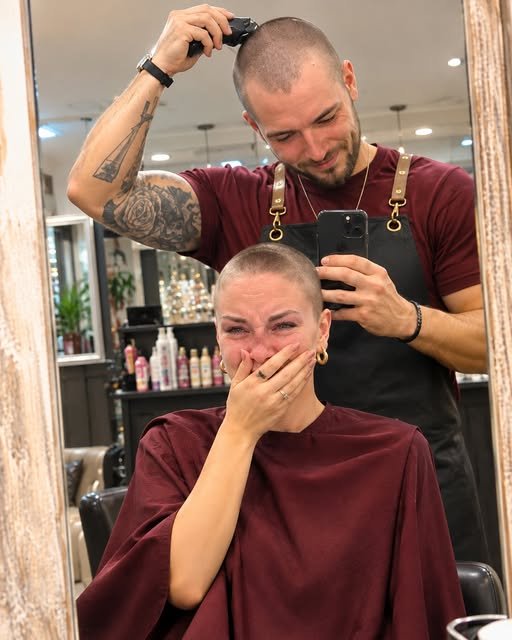
Part 1: Before We Unlocked the Door
“You’re going to pay for flirting with my wife yesterday.”
The man said it before the door had finished swinging shut behind him. He was in his fifties, in a navy suit that fit him like it had been built around his shoulders, and he was pointing one finger straight at my face.
Two men came in after him.
They weren’t just big. They were the kind of big that makes a room feel smaller. One of them stopped beside the door and folded his hands in front of his belt. The other kept walking, slow and unbothered, until he was standing a few feet from my chair.
It was 8:47 on a Friday morning. We didn’t open until nine.
“Flirting?” I said. “I wasn’t flirting with anybody. I was trying to comfort her.”
“Don’t insult my intelligence.”
I took a step back and felt the edge of the front counter press into my spine.
Twenty-four hours earlier, I had made this man’s wife smile for the first time in weeks.
Now he wanted me to pay for it. And I had no idea how much it was going to cost.
***
Let me tell you who I am, so you understand why my hands were shaking.
My name is Belle. I’m twenty-five. I don’t have parents, and I never really did. I grew up in group homes and foster placements around Columbus, Ohio, and when I aged out at eighteen, I left with a garbage bag of clothes and a voucher for one semester of beauty school.
Nobody has ever been waiting for me to call on Sundays. Nobody has a spare room with my name on it. When something breaks in my life, a car, a tooth, a lease, I’m the one who figures out how to fix it.
I rent a studio apartment above a dry cleaner on Parsons Avenue. My couch came from a church rummage sale for $40. My kitchen table is a card table with a tablecloth over it. Before I buy groceries, I check my balance on my phone, standing in the parking lot, so I know exactly what goes in the cart.
But I love my job.
I work at The Velvet Comb, a small women’s salon with five chairs, a sink that never stops dripping, and an owner named Denise who still writes appointments in pencil. I’d been there almost three years. It was the first place in my life where somebody noticed if I was ten minutes late, not because they were angry, but because they’d started to worry.
People think doing hair is about scissors and color formulas. It isn’t. It’s about the hour when a woman finally gets to stop holding everything together, because somebody else is taking care of her.
I learned young that nobody was coming to take care of me. So I got very good at taking care of other people.
I never imagined that doing it once, for the right person, on the wrong day, could put all of it at risk.
Because the man in the navy suit wasn’t really here about his wife.
Not entirely.
And it had all started the afternoon before, when one of my favorite clients walked through that same door looking like someone I’d never met.
Part 2: The Afternoon Before
Her name was Victoria.
She’d been coming to me every six weeks for over a year. She was one of those clients the other stylists talked about after she left. Camel coats. Diamond studs that caught the light every time she turned her head. A handbag that didn’t have a logo on it, which somehow made it look more expensive.
She was always polished. Always on time. Always asked how my week was going, and actually waited for the answer.
That Thursday, she came in wearing a silk scarf tied over her head.
Her coat hung off her shoulders like it belonged to someone bigger. Her face was pale under her makeup, and there were shadows under her eyes that no concealer could have touched.
“Victoria? Are you okay?”
She didn’t answer. She just sat down in my chair and slowly untied the scarf.
My stomach dropped.
Her hair, the thick, glossy, chestnut hair I’d trimmed and colored for over a year, had thinned to almost nothing in places. Along the part and behind her ears, I could see her scalp.
“Please take it all off,” she whispered.
Her eyes filled.
“Chemo?” I asked, as gently as I knew how.
She nodded.
“They told me it would happen. I thought I was ready. I wasn’t.”
I draped the cape over her shoulders and rested my hands there for a second.
“We don’t have to rush.”
“Yes, we do,” she said. “If I wait, I’ll lose my nerve.”
So I picked up the clippers.
The first strands fell onto the cape, and she started to cry. Not loudly. Just quietly, steadily, like she’d been holding it in for days.
“I’m sorry,” she said. “It’s only hair.”
“It’s your hair,” I said. “You’re allowed to be upset about it.”
She managed a small laugh. “I used to complain about my roots.”
“That was a completely reasonable complaint.”
That got another laugh, a weak one. But when I finished and turned her toward the mirror, the laughter disappeared.
She stared at herself for a long time.
“I look terrible.”
“You look like someone who’s been through hell,” I said. “And you’re still beautiful.”
“That’s a very nice way of saying I look terrible.”
I wanted to say something better. I didn’t have the words.
Then I noticed the spare clippers sitting on my station.
I didn’t give myself time to think. I pulled off the black cap I’d been wearing and grinned at her in the mirror.
“Watch this.”
I flipped the clippers on and ran them straight up the middle of my own head.
“Belle!” Victoria spun around in the chair. “What are you doing?”
“Making sure you’re not the only gorgeous bald woman in this room.”
A long brown lock slid down my shoulder and landed on the floor.
“Stop! You don’t have to do that!”
“I know.”
I kept going.
When I was finished, Victoria stood up and hugged me so hard I couldn’t breathe.
“Why would you do that for me?”
“Because nobody should have to feel alone in that chair.”
She rubbed her palm over my bare scalp and laughed through her tears.
“We look ridiculous.”
“We look amazing.”
And for the first time that afternoon, she smiled at her own reflection.
When she opened her wallet, I shook my head.
“Not today.”
“Belle, please let me pay you.”
“Keep your money. There’s a shop on High Street that sells beautiful wigs, real hair, really good quality. I’ll go with you and help you pick one.”
“At least let me pay for this.”
“You can buy me a coffee when we go wig shopping.”
She laughed. “Deal.”
Before she left, she asked if we could take a picture together. We stood shoulder to shoulder in front of my mirror, two bald women grinning like we’d just gotten away with something.
“You’re a very special young woman,” she said quietly.
I watched her walk out to her car, and I felt lighter than I had in months. My head was cold, and I kept touching it, but I didn’t regret a single strand.
I thought that was the end of it.
At 8:20 that night, my phone lit up with a number I didn’t recognize.
“Is this Belle?”
“Yes.”
“I’m calling about Victoria.”
I sat up on my couch. “Is she okay?”
“That depends on what you did to her.”
I went cold.
“Who is this?”
“Her husband.”
He wanted to know why I’d shaved my head. I told him the truth. She’d been upset. I’d wanted her to know she wasn’t alone.
“Support her,” he repeated. “Is that what you’re calling it?”
“I don’t understand.”
“You will.”
And he hung up.
I sat there staring at the screen. I thought about calling Victoria, but she’d already had the worst day of her month. I didn’t want to add to it.
Maybe he was just scared, I told myself. Maybe her diagnosis had him lashing out at anything he could reach. He’d cool off by morning.
He didn’t.
Part 3: “How Much Do You Like Working Here?”
I got to the salon early that Friday. I hadn’t slept much anyway.
June, who’s worked the chair next to mine for two years, looked up from the register as I pulled off my beanie. Her mouth fell open.
“Belle! Your hair!”
“I know,” I said, smiling. “There’s a story.”
I never got to tell it.
The front door swung open so hard the little bell above it clanged against the frame, and three men walked in.
The one in the navy suit looked around the salon like he was pricing it.
“Which one of you is Belle?”
I raised my hand. “That’s me.”
He crossed the room in about four steps.
“You’re going to pay for flirting with my wife yesterday!”
“Your wife?”
“Victoria!”
June came out from behind the counter. “Sir, you can’t come in here and start yelling.”
“Stay out of this.”
He pointed at my head.
“You think I don’t know what that little performance was about?”
“I was helping her.”
“By making yourself the center of attention?”
“She was crying,” I said. “Because of her chemo.”
“Don’t you dare use my wife’s illness as an excuse.”
The two big men moved closer. I backed up until the counter stopped me.
“Please,” I said. “I didn’t do anything wrong.”
He leaned in. I could smell his cologne, something sharp and expensive.
“You think turning down a little money makes you clever?”
I stared at him. “You know I didn’t let her pay?”
“Victoria told me everything.”
“Then you know I didn’t ask her for anything.”
He smiled, and it was the coldest thing I’d ever seen on a human face.
“Not yet.”
June grabbed the salon phone off the counter.
“Sir, leave now, or I’m calling the police.”
He didn’t even glance at her. He kept his eyes on me.
“Tell me something, Belle. How much do you like working here?”
“What?”
“This place. Your little station. Your job.” He let the words hang. “How important is all that to you?”
My stomach tightened.
He wasn’t talking about his wife anymore. He was talking about my rent.
“Why are you asking me that?”
“Because people who get involved in other people’s marriages should expect consequences.”
I gripped the edge of the counter. “I didn’t get involved in your marriage.”
“Then apologize for what you did.”
“For helping your wife?”
“For taking advantage of her.”
I looked over at June. Her face had gone white.
And for a few seconds, I did the math the way I always do.
I had $388 in checking. Rent was $725, due in nine days. If I lost this job, I wouldn’t have a cushion to land on. I wouldn’t have a parent to call. I’d have a garbage bag of clothes and nowhere to put it.
All I had to do was say I was sorry.
I’d said those words a thousand times growing up. To foster parents, to caseworkers, to girls in group homes who were bigger than me. I’d apologized for things I hadn’t done because it was faster and safer than arguing.
At eighteen, I’d promised myself I was done with that.
“No,” I said.
He blinked. “What did you say?”
“I said no. I’m not apologizing for something I didn’t do.”
His face darkened.
“Then maybe you need to learn what happens when you refuse.”
He glanced at the two men.
One of them stepped forward.
June held up the phone with her thumb over the keypad. “I’m calling the police if you don’t leave right now!”
And that’s when the bell over the door rang again.
Part 4: What She Heard Through the Door
Victoria stood in the doorway, a silk scarf clutched in one hand.
She looked at her husband. Then at the two men. Then, finally, at me, backed up against the counter with my bare head and my shaking hands.
Her whole face changed.
“Richard,” she said quietly. “What have you done?”
“Victoria, go wait in the car.”
She didn’t move.
“Why are your men scaring Belle?”
“I’m protecting you.”
“From what?”
“From a woman who’s trying to take advantage of you.”
Victoria stared at him like she’d never seen him before.
“Belle wouldn’t take my money.”
“That was part of the act.”
“She shaved her own head to make me feel better.”
“And made sure you got a picture of it!”
Victoria’s eyes narrowed. “Did you ever ask me why I was crying?”
Richard didn’t answer.
“Did you ask how it felt to look in the mirror yesterday?”
“Victoria, you’re exhausted.”
“No,” she said. “I’m finally asking you to listen.”
For the first time since he’d walked in, I could breathe.
But Richard wasn’t done.
“You’re making a scene over a hairdresser.”
Victoria turned to me. “Belle, did he threaten your job?”
“He asked how much I liked working here.”
Richard stiffened. “That’s not what I meant.”
“Then tell me what you meant,” I said.
He looked startled that I’d said anything at all.
“I meant that actions have consequences.”
“What action?” I asked. “Shaving my head? Saying no to your wife’s money?”
His jaw tightened. “Getting close to someone you barely know.”
Victoria stepped between us.
“Richard. Did you call this building’s property manager this morning?”
The salon went completely silent. Even the drip in the sink seemed to stop.
June slowly lowered the phone. “Our property manager?”
Richard looked away. “That’s business.”
“I heard you on the phone,” Victoria said. “From the hallway. At seven o’clock.”
My heart started pounding again. “What call?”
Victoria turned to me, and her eyes were wet.
“Richard knows the man who owns this building. He called the property manager and tried to talk him out of renewing the salon’s lease.”
June gasped.
“Victoria, don’t exaggerate.”
“Did you ask him not to renew it?”
“I made an inquiry.”
“Did you ask him to draw up a notice saying the lease wouldn’t be renewed?”
Richard said nothing.
I felt sick.
This wasn’t just about me. If The Velvet Comb closed, June lost her job too. So did Denise, who’d built this place one appointment at a time. He hadn’t come here to embarrass me. He’d come here to put all of us out of work.
“Why?” I asked.
“Because you needed to learn a lesson.”
“What lesson?”
“That you can’t attach yourself to wealthy people and expect to get something out of it.”
“But I didn’t get anything,” I said. “I gave your wife my time, and I refused her money. If you knew that, why did you walk in here demanding an apology?”
It was Victoria who answered.
“Because this was never really about flirting.”
She reached for the back of a chair and held on to it.
“Richard’s been angry about something else for months.”
“Victoria,” he warned.
She ignored him.
“When I was diagnosed, I decided I wanted to use some of my own money to help women going through chemo. Wigs. Scalp care. The things insurance doesn’t always cover.”
“That money was supposed to stay invested,” Richard said.
“It was mine to spend.”
“We talked about it.”
“You told me women could survive without expensive wigs.” Her voice wavered. “You said I was being emotional.”
Richard shifted on his feet.
“Then yesterday, I came home smiling for the first time in weeks,” Victoria went on. “I showed him our photo. I told him what you’d done, and that you wouldn’t let me pay.”
She looked at me.
“He said you were trying to make yourself important to me.”
“I was worried about you,” Richard said.
“You were angry because I’d finally found someone who understood why I wanted to help other women.”
He looked at the floor.
And I understood something then. The photo hadn’t made him angry. It had just shown him a door he’d been trying to keep closed.
Victoria sank into the nearest chair. For a moment, she looked completely worn out.
“Let’s go home,” Richard said.
She held up her hand. “No.”
“Victoria, please.”
“Yesterday, I thought I’d lost the woman I used to be,” she said. “Then Belle picked up those clippers, and for one minute, I stopped feeling ashamed. Do you understand what that meant to me?”
He didn’t answer.
“Instead of asking if I was happy, you decided to punish her.”
I stepped forward. “Victoria, you don’t have to fight with your husband because of me.”
She shook her head. “Sweetheart, this isn’t because of you. It’s because I let him speak for me when I was too scared to speak for myself.”
Richard’s face softened, just slightly.
“I’m scared of losing you, Vic.”
“I know,” she whispered. “But being scared doesn’t give you the right to be cruel.”
I thought it was over. Then Victoria opened her purse and took out her phone.
“There’s something else. After I heard that call this morning, I phoned the property manager myself.”
Richard’s head snapped up. “What did you tell him?”
“I asked whether he planned to do what you asked. He said he hadn’t agreed to anything. The lease talks are still going on with the salon’s owner, the same as before.”
June pressed a hand over her mouth.
“Then I called the owner,” Victoria said. “Denise. I asked if she’d be willing to work with me on something important.”
“Something important?” I repeated.
Victoria nodded. “Yesterday, you offered to help me find a wig. You had no idea I could afford a hundred of them. But you knew I needed someone standing next to me.” She swallowed. “I kept thinking about all the women who don’t have that.”
Richard stared at her. “You’re still doing the charity thing?”
“Yes.”
“After everything we discussed?”
“Especially after today. It’s my money, Richard. I don’t need your permission.”
For once, he had nothing to say.
Victoria stood. “Before you go, you’re going to apologize to Belle.”
He turned to me. “I’m sorry if I frightened you.”
I shook my head. “That’s not what you did.”
He frowned.
“You accused me of flirting with your wife. You brought two men here to scare me. And you tried to get this salon’s lease taken away.”
June stepped up beside me. “You scared both of us.”
Richard looked around the room. Color crept up his neck.
“You’re right,” he finally said. “Belle, I was wrong. I accused you without any reason, and I had no right to threaten your work. I’m sorry.”
I didn’t know if I believed him yet. But I knew what I needed to say.
“Please don’t ever do that to anyone else.”
He nodded.
Victoria pointed at the door. “Go home, Richard. I’ll find my own ride.”
He hesitated. Then he walked out, and the two big men followed him, and the bell rang one last time behind them.
The salon was quiet.
“Are you okay?” I asked her.
She wiped her cheeks with the back of her hand. “I will be.” Then she took my hand. “Belle, I owe you an apology too. I should have seen how he was treating people a long time ago.”
“You didn’t send him here.”
“No,” she said. “But I get to decide what happens next.”
Part 5: The Folder on My Station
A week later, Victoria came back. This time she was carrying a blue folder.
She set it on my station and opened it.
Inside was a plan for a small program to help women going through chemotherapy get wigs, scalp care, and gentle, private appointments with someone who’d sit with them through it. Denise had already agreed to set aside the back room. Victoria would pay the salon for every service.
“Nobody here works for free,” she said. “That matters to me.”
Then she turned to me.
“I’d like you to run it. Coordinate the appointments. Help the women choose what feels right for them. You’d be paid for the extra hours, of course.”
I stared at her. “Victoria, I’ve never run anything in my life.”
“You know how to listen. You know how to make someone feel safe in that chair. And you know when a woman needs a lot more than a haircut.”
I looked down at the folder.
She wasn’t handing me charity. She was trusting me with something that mattered to her more than anything else right now.
“Are you sure?” I whispered.
“Very.”
I hugged her. “Then yes.”
Our first client came in three weeks later.
She was a retired school bus driver named Linda, fifty-eight, and she told me right away that she’d been avoiding mirrors since her second treatment. She’d draped a towel over the one in her bathroom.
I didn’t rush her. We talked about her grandkids. We talked about the Buckeyes. She tried on one wig, then another, then a third.
The fourth was a soft silver bob, a little shorter than anything she’d ever worn.
She looked at herself for a long time. Then she turned her head to the left, and to the right, and she smiled.
“Well,” she said quietly. “Hello again.”
Victoria was standing behind me, and I heard her let out a breath.
“That,” she whispered. “That’s what I wanted.”
I knew exactly what she meant.
A few weeks later, an envelope arrived at the salon with my name on it. Inside was a handwritten letter from Richard.
He didn’t make excuses. He said he’d been terrified of losing his wife and had tried to control everything he could, because the one thing he couldn’t control was her illness. He said he’d been wrong about me, and about what Victoria needed.
Victoria told me later that they’d started seeing a counselor, but trust takes time to rebuild.
I didn’t ask for details. What mattered was that he’d left the salon alone, and Victoria was making her own decisions again.
One afternoon in early spring, Victoria stopped by while I was sweeping up between appointments.
My hair had started coming back, short and curly in a way it had never been before. She reached out and ran her fingers over it, laughing.
“Look at you.”
“Look at you,” I said. Her hair was growing back too, a soft dark layer over her scalp. “I’m so glad your treatment is finally over.”
She took my hand.
“I thought I came here that day to lose something,” she said.
“And?”
She glanced toward the back room, where Linda had sat in front of the mirror and said hello to herself again.
“I found something instead.”
I looked around our little salon. The dripping sink. The five chairs. Denise’s appointment book with its pencil smudges.
For most of my life, I’d believed that having no family meant facing everything alone.
But Victoria had stood up for me when I couldn’t protect my own job. And I’d stood beside her when she couldn’t stand to look in the mirror.
We hadn’t saved each other with money or big promises.
We’d just refused to let the other one stand there alone.
When an act of kindness puts your livelihood at risk, would you apologize for something you didn’t do to protect yourself, or stand your ground and trust that doing the right thing is worth the cost?