
Part 1 — The Dream I Had Hidden for Fifty Years
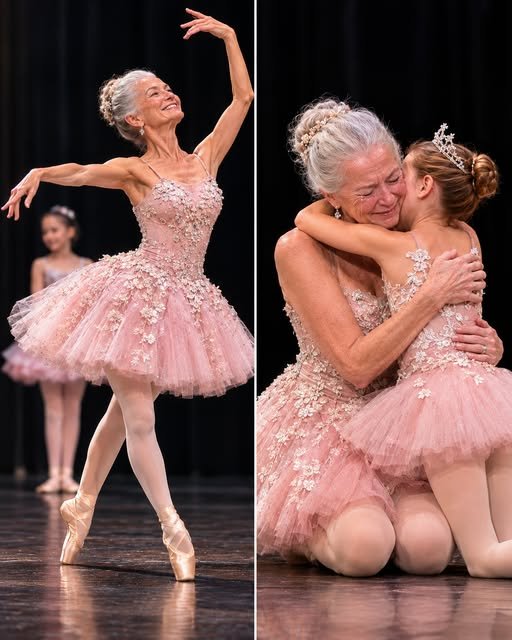
At sixty-nine years old, I never imagined that putting on a pink ballet tutu would become one of the most frightening experiences of my life.
For three months, I had secretly attended ballet classes, determined to surprise my eight-year-old granddaughter, Sophie, at her recital.
I wanted her to see that growing older didn’t mean giving up everything you loved.
I wanted to make her proud.
Instead, the moment I stepped onto the stage, Sophie jumped out of her seat and screamed something that made my heart nearly stop.
“Grandma, that’s her!”
Her little arm shot forward, pointing past me toward the side of the stage.
Then she shouted again.
“Grandma, stop! Please don’t dance!”
The music stopped.
A stagehand hurried toward me, speaking urgently into his radio.
And within moments, I learned that my granddaughter had overheard something the previous afternoon—something that might have saved me from a terrible accident.
But to understand why I was standing on that stage in the first place, I need to go back three months.
It all began with a little girl trying to balance on one foot in my kitchen.
Sophie had been taking ballet lessons for only a few weeks, but she was already completely enchanted by dancing.
She practiced everywhere.
In the living room.
In the hallway.
Sometimes even in the grocery store, much to her mother’s embarrassment.
One afternoon, while my daughter Lisa and I were putting away groceries, Sophie positioned herself in front of my refrigerator and proudly announced that she had learned something new.
“Grandma! Watch this!”
She stretched one arm gracefully above her head, grabbed the back of a kitchen chair with her other hand, and lifted one foot behind her.
For approximately two seconds, she looked like a tiny ballerina.
Then she wobbled.
Her foot landed on the floor with a loud thump.
“Oh, fiddlesticks!” she exclaimed.
I laughed.
“That’s a rather dramatic ending, sweetheart.”
“I’m supposed to stay like that longer,” she complained. “But my body won’t listen.”
Without thinking, I stepped beside her.
“Try keeping your weight centered over your standing foot. And don’t rush to lift the other one.”
Sophie stared at me.
I demonstrated a simple movement, raising my arms and shifting my weight carefully.
It wasn’t particularly impressive.
My knees were stiff, and my balance wasn’t what it used to be.
But after so many years, the familiar posture came naturally.
Sophie’s eyes widened.
“Grandma! How did you know how to do that?”
I shrugged.
“Once upon a time, I took a few ballet lessons.”
Lisa, who had been arranging groceries on the counter, suddenly stopped moving.
“A few?” she repeated.
I glanced at her.
“Well, perhaps more than a few.”
Sophie looked delighted.
“Were you a ballerina?”
I smiled.
“Not professionally, sweetheart.”
“But you know all the moves!”
“Some of them. Although my knees seem to have forgotten quite a few.”
She giggled, then studied me with the seriousness only children can manage.
“Did you want to be a ballerina when you were little?”
The question caught me off guard.
For a moment, I wasn’t standing in my kitchen anymore.
I was nineteen again, wearing a practice skirt and worn ballet slippers, staring at an audition notice I had carefully folded and carried home.
Back then, dancing had been the center of my world.
I had started lessons as a young girl.
Through childhood and adolescence, I spent countless hours practicing at the barre, learning routines, correcting my posture, and imagining what it might feel like to perform on a grand stage.
I loved everything about ballet.
The music.
The discipline.
The quiet concentration before a performance.
And that extraordinary feeling when movement and melody seemed to become one.
By nineteen, I had been preparing for an important audition.
It wasn’t a guarantee of a career, but it was an opportunity to discover how far I might go.
I kept the announcement beside my ballet shoes.
I read it so often that I could have repeated every word from memory.
Then life began moving in another direction.
I got married.
I accepted a full-time job.
There were bills to pay, responsibilities to manage, and eventually a beautiful baby girl named Lisa who needed me.
I kept telling myself I would return to dancing when things settled down.
When I had more time.
When work became less demanding.
When my daughter was older.
But the years passed.
My ballet shoes went into a cardboard box beneath my bed.
The audition notice went into the box with them.
And somewhere along the way, I stopped imagining myself dancing at all.
I never regretted becoming Lisa’s mother.
She was, and always would be, one of the greatest joys of my life.
But loving the life I had built didn’t mean I had stopped missing the dream I’d left behind.
That was something I had never quite known how to explain.
“Grandma?”
Sophie’s voice brought me back to the kitchen.
She was still waiting for my answer.
“Yes, sweetheart,” I said gently. “I did want to be a ballerina.”
She considered that.
“Then why didn’t you?”
I looked toward Lisa, who had become unusually quiet.
“Sometimes,” I answered, “life takes us somewhere different from where we originally planned to go.”
Sophie frowned.
“But you still like dancing, don’t you?”
I smiled.
“Very much.”
“Then you should do it!”
I laughed at the simplicity of her answer.
“Oh, Sophie. I’m sixty-nine.”
She blinked.
“So?”
I opened my mouth.
Then closed it.
Because, for once, I couldn’t think of a good response.
That evening, long after Lisa and Sophie had gone home, I found myself staring at the television without paying attention to anything on the screen.
My granddaughter’s question kept returning.
So?
I had spent decades believing certain doors were closed simply because I had grown older.
But what if they weren’t?
What if I had been standing outside one of those doors all this time, never bothering to try the handle?
I turned off the television, opened my laptop, and searched for ballet classes.
Most of the results showed young girls in pastel costumes or professional dancers performing movements my body hadn’t attempted in half a century.
I almost gave up.
Then I found something unexpected.
Beginner Ballet for Older Adults.
The description explained that classes were adapted for different levels of mobility and experience.
There were no promises of spectacular leaps or perfect turns.
Only gentle instruction, careful movement, and an opportunity to enjoy dancing.
I read the description twice.
Then, before I could convince myself it was ridiculous, I registered.
For the first time in fifty years, I was going back to ballet.
And I decided not to tell anyone.
Not yet.
Part 2 — Learning to Dance Again at Sixty-Nine
The morning of my first lesson, I changed my clothes three times.
The first outfit made me feel as though I were pretending to be a teenager.
The second was so loose that I worried I’d trip over myself.
Eventually, I settled on comfortable black leggings, a simple top, and a pair of flat ballet slippers.
I stood in front of my bedroom mirror.
The woman looking back at me had silver-gray hair, wrinkles around her eyes, and a body that had carried almost seven decades of living.
She looked nothing like the young dancer I remembered.
For a moment, embarrassment nearly sent me back to my closet.
Then I remembered Sophie standing in my kitchen.
So?
I picked up my bag and left.
The studio was smaller than I expected.
Soft afternoon light streamed through the windows, illuminating the polished wooden floor and the long barre mounted along one wall.
Several women were already warming up.
Some appeared to be around my age.
Others were younger.
One woman gave me an encouraging smile.
“First time?”
I nodded.
“First time in fifty years.”
She laughed.
“Well, then you’re ahead of me. I never danced before last month.”
That helped more than she probably realized.
A few moments later, our instructor introduced herself.
Her name was Helen.
She had a calm voice, a patient manner, and the reassuring habit of treating every student as though they belonged exactly where they were.
“There’s no competition here,” she told us. “We’re going to work with the bodies we have today, not the ones we remember having twenty or thirty years ago.”
I felt as though she had spoken directly to me.
We began with simple exercises.
Or at least, they looked simple.
I had forgotten how much strength and control even the smallest ballet movement required.
Within minutes, my knees complained.
My ankles felt uncertain.
And my hand clung to the barre as though it were the only thing standing between me and complete humiliation.
Helen noticed.
She came over and demonstrated a smaller movement.
“Let’s not bend quite so far,” she suggested. “Comfort and control are more important than depth.”
I tried again.
This time, my knees cooperated.
A little.
When we reached the arm movements, something remarkable happened.
My body remembered.
Not perfectly.
Not completely.
But somewhere beneath the years, the familiar patterns were still there.
My arms rose almost instinctively.
My shoulders relaxed.
For one brief moment, I felt connected to the girl I had once been.
Then I attempted a turn and nearly lost my balance.
I grabbed the barre.
Helen smiled.
“Good recovery.”
I laughed.
“I believe that’s a very generous description.”
By the end of class, I was exhausted.
While the other women collected their belongings, I sat on a bench, wondering whether I had been foolish to attempt this.
Helen approached.
“How are you feeling, Demi?”
“A little humbled,” I admitted.
She sat beside me.
“That’s perfectly normal.”
“My arms seem to remember what they’re doing. Unfortunately, the rest of me has some catching up to do.”
She chuckled.
“Muscle memory is wonderful. But we still have to respect where your body is now.”
I nodded.
“Do you think I should come back?”
Helen looked genuinely surprised.
“Do you want to?”
I thought about the music.
The barre.
The familiar movements.
The strange happiness I had felt despite struggling through almost everything.
“Yes,” I answered. “Very much.”
“Then we’ll work together and make sure you’re dancing safely.”
I went home feeling sore, tired, and unexpectedly proud.
After checking with my doctor about the discomfort in my knees and what level of exercise was appropriate, I continued attending classes.
Helen adapted certain movements.
I learned when to rest.
I stopped treating pain as something I needed to ignore to prove myself.
And gradually, things improved.
During one lesson, I completed a short sequence without needing to watch the woman beside me.
Another week, I managed to release the barre and maintain my balance for several seconds.
It wasn’t a spectacular achievement by professional standards.
But to me, it felt extraordinary.
Every Monday became something I anticipated.
I began looking forward to the music before I even reached the studio.
At home, I practiced gentle arm movements in my bedroom.
Sometimes I caught myself smiling while making breakfast.
Lisa noticed my improved mood.
“Mom, you’ve seemed unusually cheerful lately.”
“I’ve been exercising,” I told her.
She looked pleased.
“That’s wonderful. What kind of exercise?”
“Oh, a little stretching. Some balance work.”
Neither statement was entirely untrue.
I simply left out the ballet studio.
I wanted to surprise her.
More importantly, I wanted to surprise Sophie.
One evening, I finally pulled the old cardboard box from beneath my bed.
A thin layer of dust covered the lid.
Inside were the ballet shoes I had worn as a young woman.
Their ribbons had faded, and the material had grown stiff with age.
I lifted one shoe carefully.
For several moments, I simply held it.
I remembered walking to the studio after school.
I remembered counting music in my head while doing ordinary chores.
I remembered the excitement of believing that my future might unfold beneath stage lights.
Then I placed the old shoe back inside the box.
I didn’t try to wear it.
Instead, I retrieved my new ballet slippers and placed them beside the old pair.
The contrast made me smile.
The old shoes belonged to a girl who had imagined dancing professionally.
The new ones belonged to a grandmother who simply wanted to dance again.
And suddenly, that seemed enough.
As the weeks passed, Helen began helping me put together a short routine.
We chose gentle steps, flowing arm movements, and one carefully controlled turn.
Nothing elaborate.
Nothing dangerous.
Just a small dance I could perform confidently.
Then, after nearly three months of lessons, Sophie brought home exciting news.
Her ballet school was organizing a recital.
Alongside the children’s performances, there would be a special segment inviting family members to participate.
I stared at the announcement.
For a few seconds, I couldn’t quite believe what I was reading.
Then I called Sophie’s teacher.
I explained my history with ballet.
I told her about my recent lessons.
And, with my heart pounding, I asked whether I might perform as a surprise.
She loved the idea.
She agreed to coordinate with Helen and keep my participation confidential.
Neither Lisa nor Sophie would know until I stepped onto the stage.
I was thrilled.
I was terrified.
And for the first time in fifty years, I had a performance to prepare for.
What I didn’t know was that someone involved in the recital thought a grandmother had no place among the dancers.
And she was about to do far more than express an unkind opinion.
Part 3 — The Woman Who Wanted Me to Fail
The weeks leading up to the recital were a mixture of excitement and nerves.
Helen and I practiced my routine until I could follow the music without constantly counting every beat.
She reminded me that I didn’t need to impress anyone with difficult movements.
“You’re not auditioning for a professional company, Demi,” she said one afternoon.
“I know.”
“Then stop looking as though a panel of judges is hiding behind the mirror.”
I laughed.
“Old habits.”
“Let this be something you enjoy.”
I tried.
But part of me still worried about how the audience would react.
Would people think an elderly woman wearing a ballet costume looked ridiculous?
Would Sophie be embarrassed?
Would Lisa wonder why I had kept this secret?
I wanted the moment to be beautiful.
And the closer the performance came, the more vulnerable I felt.
During a walkthrough at the theater, Helen accompanied me while the stage manager explained where I would enter, how I should move across the floor, and where I needed to finish.
A small white tape marker showed the position for the end of my routine.
Above the stage hung a display of silver stars.
They were part of the elaborate decorations planned for the recital’s finale.
The stage manager explained that they would be lowered only after the performers had cleared the stage.
I admired them briefly.
Then I returned my attention to the floor.
My greatest concern was making sure I remembered my steps.
At another rehearsal, however, something happened that nearly persuaded me to withdraw.
I was approaching the backstage entrance when I overheard a woman speaking to another volunteer.
“This recital is supposed to look professional,” she complained.
Her voice carried clearly through the partially open doorway.
“We can’t just let anyone wander onto the stage because they think it would be cute.”
The other volunteer replied quietly.
I couldn’t hear the response.
Then the first woman continued.
“An older beginner in a tutu? Honestly, I don’t know what people are thinking.”
I stopped walking.
My stomach tightened.
For a moment, I hoped she might be talking about someone else.
Then she noticed me.
Her expression changed immediately.
“Oh,” she said, forcing a smile. “You’re the grandmother, aren’t you?”
“Yes,” I answered.
“My name is Demi.”
She glanced down at the clipboard in her hands.
“Right. Well, you’re on the schedule.”
Her tone made it sound as though being included was an inconvenience.
I gave a small nod and walked past her.
But her words stayed with me.
An older beginner in a tutu.
I suddenly felt painfully aware of every wrinkle in my face.
Every awkward movement.
Every year separating me from the young dancers rehearsing nearby.
Later, Helen found me sitting alone beside my bag.
I hadn’t even changed into my slippers.
“Demi? Is everything all right?”
I hesitated.
“Perhaps this was a mistake.”
She sat beside me.
“What happened?”
I told her what I’d overheard.
Helen listened without interrupting.
When I finished, she was quiet for a moment.
Then she said, “That was an unkind thing for someone to say.”
I looked at my hands.
“Maybe she’s right. Perhaps I don’t belong on that stage.”
“Do you remember why you came back to ballet?”
I nodded.
“Because Sophie reminded me how much I missed it.”
“And have you enjoyed learning again?”
“More than I expected.”
Helen smiled gently.
“Then don’t let one person’s opinion take that away from you.”
I wanted to believe her.
But the embarrassment was difficult to shake.
“What if people laugh?”
Helen considered my question.
“Some people may be surprised. Some may smile because seeing you dance makes them happy. And yes, somebody might be unkind. But none of that changes what you’ve accomplished.”
I thought about the first day I’d entered her studio.
How frightened I’d been.
How hard I’d worked.
How proud I’d felt when I could finally complete a short sequence.
Then I pictured Sophie practicing in my kitchen, refusing to give up after wobbling on one foot.
“I still want to perform,” I admitted.
“Then let’s rehearse.”
And we did.
I learned later that the woman’s name was Vivian.
She was one of the recital organizers.
At the time, I assumed she was simply someone who cared too much about appearances.
I didn’t know she had already begun taking her resentment further.
The evening before the recital, Lisa brought Sophie to my house after collecting her costume from the theater.
My granddaughter was overflowing with excitement.
She practiced a few steps in the living room before collapsing beside me on the couch.
“Grandma?”
“Yes, sweetheart?”
“Can old people dance on big stages?”
I looked at her.
“Of course they can.”
She played with the elastic strap on one of her ballet slippers.
“Even if someone might laugh?”
Something about her question made me pause.
I remembered Vivian’s remarks.
But I assumed Sophie was nervous about performing.
“People laugh for different reasons,” I told her. “Sometimes they’re happy. Sometimes they’re surprised. And sometimes they simply haven’t learned to be kind.”
Sophie looked thoughtful.
“Would you keep dancing if someone laughed at you?”
I considered the question carefully.
“I hope I would,” I said. “If I was safe and still wanted to dance, I’d try not to let anyone else make that decision for me.”
She was quiet.
Then Lisa called us to dinner.
The conversation ended there.
I didn’t realize that Sophie wasn’t asking an imaginary question.
She was trying to make sense of something she had heard backstage earlier that afternoon.
And I would understand the importance of that conversation only when it was almost too late.
Part 4 — The Scream That Stopped the Performance
On the morning of the recital, I stood in front of my bedroom mirror wearing a pink tutu.
It felt strange.
Almost impossible.
For fifty years, I had kept my dancing memories hidden away in a cardboard box.
Now I was preparing to step onto a stage again.
I carefully pinned up my gray hair.
One stubborn strand kept falling loose, so I secured it with another pin.
Then I looked at myself.
The woman in the mirror was not the young dancer who had once dreamed of auditions.
Her posture was less effortless.
Her body had changed.
Her face carried the evidence of an entire life.
But she was still standing there.
Still willing to try.
I reached for my ballet bag.
Inside were my new slippers.
I smiled.
“Here we go, Demi.”
The theater was already buzzing when I arrived.
Children hurried through the hallways in colorful costumes.
Parents searched for missing hair accessories.
Teachers checked schedules while volunteers attempted to keep everyone moving in the right direction.
Helen found me backstage, inspecting my slippers for what must have been the third time.
“They haven’t disappeared since you checked them five minutes ago,” she said.
I laughed nervously.
“I’m trying to find something useful to worry about.”
She helped me warm up with the familiar movements we’d practiced.
Then she leaned closer.
“Lisa and Sophie are seated together. Sophie has already performed with her class.”
My heart fluttered.
“She did well?”
“Beautifully.”
I smiled.
“Of course she did.”
Helen squeezed my hand.
“Now it’s your turn.”
A little later, the stage manager pointed toward the entrance.
He reminded me where I was supposed to finish and gestured toward the white marker.
From backstage, the mark looked slightly farther across the stage than I remembered.
I noticed it.
I also noticed that one section of the floor reflected the lights more brightly than it had during rehearsal.
But I assumed the theater lighting had changed my perspective.
I had no idea how important those small details would become.
Then the opening notes of my music began.
Helen touched my shoulder.
“You’ve got this.”
I took one careful breath.
And stepped through the curtain.
The audience applauded.
For a moment, the stage lights dazzled me.
I couldn’t see individual faces clearly.
But I knew my daughter and granddaughter were out there somewhere.
Watching.
Waiting.
I moved into the opening position and lifted my arms.
The music filled the theater.
My feet followed the steps we’d practiced.
One movement.
Then another.
A gentle turn.
A slow extension of my arms.
I was nervous, but I was dancing.
Really dancing.
And for a few wonderful seconds, nothing else mattered.
Then a child’s voice rang out above the music.
“Grandma, that’s her!”
I recognized Sophie’s voice immediately.
My arms faltered.
I looked toward the audience.
Sophie was standing beside Lisa, pointing urgently toward the side of the stage.
At first, I thought she was surprised to see me.
Perhaps she hadn’t recognized me in my costume.
Perhaps the secret had startled her.
Then she shouted again.
“Grandma, stop!”
My heart began pounding.
I glanced toward the wing.
Vivian was standing there with her clipboard.
Sophie pointed directly at her.
“That’s the lady!”
I froze.
The music continued for another few seconds before cutting off.
Confused murmurs spread through the audience.
Lisa had risen from her seat and was trying to calm Sophie, but my granddaughter was already moving toward the side steps.
“Grandma, please don’t go over there!”
Her voice was trembling.
I stepped toward the edge of the stage rather than continuing my routine.
Lisa reached Sophie near the side entrance.
A moment later, my granddaughter hurried toward me.
She caught the edge of my tutu with both hands.
“You can’t dance there!” she cried.
I knelt slightly so I could see her face.
“Sophie, sweetheart, what’s wrong?”
Her eyes were filled with tears.
“Yesterday, I heard them talking!”
“Who?”
She pointed toward Vivian.
“That lady. And someone else.”
I looked up.
Vivian had gone very still.
Lisa put an arm around Sophie.
“Take your time, honey. Tell us what you heard.”
Sophie struggled to get the words out.
“They were talking about an old lady who was going to dance.”
My stomach tightened.
“They said everyone would laugh when she fell.”
I looked toward the shiny section of floor.
Sophie continued.
“I didn’t know they meant you, Grandma. Not until I saw you in your pink costume.”
She gripped my hand.
“I saw them doing something to the floor yesterday. I didn’t understand why.”
A cold feeling spread through me.
I turned toward the white tape marker.
That was where my routine was supposed to end.
And directly around it was the unusually shiny patch I had noticed earlier.
A stagehand approached, concerned by the interruption.
“Ma’am, is something wrong?”
I pointed toward the floor.
“Could someone please check that area? My granddaughter thinks something was done to it.”
He looked at the marker.
Then at the patch of floor.
His expression changed.
He immediately lifted his radio.
“Hold all stage activity. Nobody comes onto the floor until we inspect it.”
I felt my knees weaken.
Lisa gently guided Sophie toward the side entrance.
I began moving after them.
Then Sophie suddenly looked upward.
Her face changed.
“Grandma!”
She pointed above the stage.
“They said you had to stand on the white mark!”
I followed her gaze.
The silver stars hanging over the stage were moving.
At first, I couldn’t understand what I was seeing.
The decorations weren’t supposed to descend until the finale.
And the finale wasn’t supposed to begin while performers were still onstage.
Yet the stars were slowly lowering.
A metal support appeared behind the decorations.
Then a sharp mechanical sound echoed through the theater.
The stagehand looked up.
His face went pale.
“Get off the stage! Now!”
He grabbed my arm and hurried me into the wing.
Lisa pulled Sophie through the nearby side entrance.
Someone shouted urgently over the radio.
“Stop the scenery cue! Stop it!”
For a terrifying moment, the mechanism continued moving.
Then the silver stars halted above the empty stage.
I stood just inside the curtain, trembling.
My hand gripped the heavy fabric.
I could hear people talking, but their voices seemed distant.
Only moments earlier, I had been standing beneath those decorations, preparing to move toward the white marker.
Now I was staring at the place where I’d nearly finished my routine.
The stage manager hurried over.
“Is everyone clear?”
The stagehand answered.
“Yes. She’s off.”
Another voice came through the radio.
“The scenery is stopped.”
Only then did I realize how frightened I was.
Sophie ran toward me.
“Grandma!”
I held her tightly.
She began sobbing against my costume.
“I’m sorry! I’m sorry!”
I pulled back enough to see her face.
“Sweetheart, what are you apologizing for?”
“I ruined your dance!”
My heart broke.
I sat down on a nearby chair and pulled her close.
“No, Sophie.”
I brushed the tears from her cheeks.
“You didn’t ruin anything.”
“But everybody stopped!”
“Yes,” I whispered. “And that was exactly what needed to happen.”
She stared at me.
I kissed her forehead.
“You made sure I could dance another day.”
The remaining performances were canceled.
The theater staff needed to secure the overhead decorations and examine the stage.
We were escorted into a dressing room away from the equipment while the crew investigated.
Sophie refused to let go of my hand.
Lisa sat beside us.
For several minutes, none of us spoke.
Finally, Sophie whispered, “I thought they were just being mean.”
I looked at her.
“What do you mean, sweetheart?”
She explained that the previous afternoon, while Lisa was collecting her costume, she’d been waiting near the backstage area.
She had overheard Vivian talking to another volunteer.
They were discussing an older woman who would be performing in the family segment.
Sophie remembered hearing them say the audience would laugh when the woman fell.
She’d also noticed people moving around the stage floor.
But she hadn’t understood what she was seeing.
And she certainly hadn’t realized they were talking about her own grandmother.
“Last night,” she whispered, “that’s why I asked if old people could dance.”
I closed my eyes.
I remembered our conversation on the couch.
Her questions.
Her nervous expression.
The way she’d asked whether I would keep dancing if people laughed.
I had thought she was worried about herself.
Now I understood.
She had been worried about someone else all along.
Lisa looked devastated.
“I heard you asking Grandma those questions,” she told Sophie. “I should have asked more about why you were worried.”
Sophie lowered her eyes.
“I didn’t know how to explain.”
Lisa gently took her hand.
“Then we’ll practice explaining things together. And I promise to listen more carefully.”
Sophie looked at me.
“Even when I don’t know what something means?”
“Especially then,” I answered.
She leaned against my shoulder.
I wrapped my arms around her.
And for the first time that afternoon, I allowed myself to cry.
Not because my performance had been interrupted.
Not because someone had tried to humiliate me.
But because my eight-year-old granddaughter had been brave enough to speak when something felt wrong.
And her courage had protected me.
Part 5 — The Dance That Meant More Than Any Applause
Over the following days, the theater director contacted our family several times.
The staff had begun reviewing rehearsal footage and speaking with people who had been working backstage.
What they discovered was deeply upsetting.
A recording showed Vivian moving the white tape marker that had been positioned during my approved rehearsal.
The crew also discovered a slippery residue on the stage floor near the marker’s new location.
Another volunteer confirmed hearing Vivian speak cruelly about my upcoming performance.
When confronted, Vivian admitted that she had wanted me to look foolish in front of the audience.
She had assumed an older beginner performing ballet would be entertaining for all the wrong reasons.
The idea that someone could resent a grandmother’s harmless attempt to make her granddaughter happy was difficult for me to understand.
But I no longer felt embarrassed.
I felt angry.
And beneath the anger was sadness.
Because I knew how close I’d come to letting that woman’s words persuade me to give up.
The director removed Vivian from her volunteer position and reported the incident to the appropriate authorities.
He also made one important distinction.
The problem with the overhead decorations was being investigated separately.
The technical crew had apparently mistaken the sudden interruption in the music for a cue to begin lowering the finale scenery.
The equipment should never have moved while performers were still onstage.
There was no evidence that Sophie had witnessed anyone interfering with the machinery.
Nor was there evidence connecting Vivian to the premature movement of the decorations.
Those were separate safety failures.
What Sophie had heard and observed about the floor was serious enough.
The theater remained closed while the necessary inspections and corrections were completed.
I appreciated that the director didn’t try to dismiss what had happened as a misunderstanding.
An older dancer’s safety was no less important than anyone else’s.
And what had happened was not harmless teasing.
That evening, after receiving another update from the theater, I sat alone in my bedroom.
The old cardboard box was open beside me.
Inside lay the ballet shoes I hadn’t worn in fifty years.
My new slippers rested across the lid.
I picked up one of the old shoes and ran my fingers over its faded ribbons.
For so long, I had believed my dancing days were behind me.
When I’d finally dared to return, I’d encountered someone determined to make me regret it.
Part of me wondered whether I should simply be grateful that nobody had been hurt and leave the stage behind forever.
Then I heard a soft knock.
“Mom?”
Lisa stood in the doorway.
“Can I come in?”
“Of course.”
She sat beside me on the bed.
For a moment, she watched me holding the old shoe.
Then she noticed a folded piece of paper inside the box.
“What’s that?”
I smiled sadly.
“Something from a very long time ago.”
She picked it up carefully.
It was the audition notice.
The one I’d saved when I was nineteen.
The paper had yellowed, and the creases were beginning to tear.
Lisa unfolded it slowly.
She read the heading.
Then she looked at me.
“Mom, you were going to audition?”
I nodded.
“Yes.”
“For a ballet company?”
“It was an opportunity. I don’t know whether I would have been accepted.”
She studied the date.
“Did you ever go?”
“No.”
“Why not?”
I looked down at the shoe in my lap.
“I kept thinking there would be another chance.”
Lisa was quiet.
Then she asked, “Do you wish you’d done things differently?”
It was a question I had spent half a century avoiding.
Because every answer felt complicated.
I had loved being a wife.
I had loved becoming a mother.
I had loved raising Lisa, watching her grow, and eventually becoming Sophie’s grandmother.
But I had also loved dancing.
And for years, I’d believed that admitting I missed it would somehow diminish everything else.
I placed the shoe beside me.
“Some things,” I answered.
Lisa looked down.
I reached for her hand.
“Not you, sweetheart.”
Her eyes filled with tears.
“I know, Mom.”
“No,” I said gently. “I need you to understand. I never regretted having you. I loved being your mother. But sometimes I missed being a dancer, too.”
Lisa swallowed.
“Why didn’t you ever tell me?”
I thought about that.
“Because I was afraid you would hear regret when all I meant was longing.”
She leaned against my shoulder.
For several minutes, we sat together in silence.
Then Lisa whispered, “You know something?”
“What?”
“I wish I’d known you wanted this.”
I smiled faintly.
“I wasn’t very good at admitting it to myself.”
She glanced at the new slippers.
“Are you going back to class?”
I hesitated.
“I haven’t decided.”
Lisa straightened.
“Mom, you spent three months working toward something you loved. One cruel person doesn’t get to decide whether that ends.”
I looked at her.
She smiled through her tears.
“Besides, Sophie is already planning your next performance.”
I laughed.
“She is?”
“Oh, absolutely. She’s been drawing costumes all afternoon.”
As if summoned by her name, Sophie appeared in the doorway.
“Grandma?”
“Yes, sweetheart?”
She hurried toward us carrying a sheet of paper.
“I made you something.”
I took the drawing.
Two ballerinas stood beneath a row of pink stars.
One had long brown hair.
The other had gray hair, which Sophie had colored with such determination that the paper was nearly torn.
They were holding hands.
I stared at the picture.
“Is that us?”
Sophie nodded enthusiastically.
“That’s you and me!”
I smiled.
“It’s beautiful.”
She climbed onto the bed.
“Grandma, can we dance together next time?”
My throat tightened.
“Together?”
“Yes! You can teach me the parts you know, and I can teach you the parts I know.”
I laughed.
“That sounds like a very good arrangement.”
She looked serious.
“And we won’t do anything too hard for your knees.”
Lisa burst out laughing.
I pretended to look offended.
“Excuse me, young lady. My knees and I are currently in negotiations.”
Sophie giggled.
Then she wrapped her little arms around me.
“Please, Grandma?”
I looked at her drawing again.
Two dancers.
Two generations.
Holding hands beneath the stars.
“Yes, sweetheart,” I whispered.
“We can start practicing now.”
During the following weeks, something changed in our family.
I stopped hiding my lessons.
Lisa began asking about my classes instead of simply assuming I was attending an exercise group.
Sometimes she even drove Sophie over so the two of us could practice together.
Helen was delighted when I told her about my granddaughter’s idea.
“A duet?” she said.
I nodded.
“If you think we can manage it.”
She smiled.
“Of course. We’ll create something appropriate for both of you.”
We began working on a simple routine.
Nothing elaborate.
We practiced gentle movements, small steps, and a coordinated ending that allowed Sophie and me to bow together.
Sometimes she moved too quickly.
Sometimes I needed to stop and rest.
Occasionally, we both forgot what came next.
But instead of becoming frustrated, we laughed.
And gradually, we learned something wonderful.
Dancing together wasn’t about matching each other’s abilities.
It was about paying attention.
Sophie learned to slow down when I needed more time.
I learned to trust her enthusiasm rather than worrying constantly about making mistakes.
We stopped watching ourselves in the mirror so much.
Instead, we watched each other.
And what began as an effort to prepare another performance became something far more meaningful.
For the first time, Sophie and I were sharing a dream.
Several weeks later, the theater reopened after completing its safety inspections.
The moving decorations had been removed from the replacement recital.
Before our rehearsal, Helen and I carefully walked the stage.
This time, when something looked unfamiliar, I asked questions.
I checked the floor.
I confirmed our positions.
And I made sure I understood where we needed to enter and exit.
I had spent too much of my life feeling embarrassed about asking for things I needed.
I wasn’t going to make that mistake again.
On the evening of the rescheduled performance, Sophie stood beside me backstage.
She wore her ballet costume.
I wore my pink tutu.
She looked up at me.
“Grandma?”
“Yes?”
“Are you nervous?”
“A little.”
She nodded.
“Me too.”
I smiled.
“Then I suppose we’re in good company.”
She reached for my hand.
“Don’t worry. We’ll do it together.”
I squeezed her fingers.
“Yes, sweetheart. We will.”
Our music began.
Sophie stepped onto the stage first.
She moved to the position we’d practiced and turned toward me.
Then she extended her little hand.
I walked into the light.
This time, I wasn’t trying to prove that I could still dance like a nineteen-year-old girl.
I wasn’t worrying about whether the audience thought I looked foolish.
I wasn’t trying to reclaim the past.
I was simply a sixty-nine-year-old grandmother standing beside the little girl who had reminded me that dreams don’t have expiration dates.
I took Sophie’s hand.
And we danced.
Our movements weren’t perfect.
There were no spectacular leaps.
No complicated turns.
No dazzling professional technique.
Just two people moving together with care, patience, and joy.
At one point, Sophie glanced up at me.
Her smile was so bright that I nearly forgot the next step.
I smiled back.
And somehow, we continued.
When the music reached its final notes, we stood side by side.
Then we bowed.
The applause began immediately.
I could hear people cheering.
But for a moment, all I saw was Sophie.
She looked up at me with shining eyes.
“Grandma,” she whispered, “we did it!”
I nodded.
“Yes, sweetheart.”
My voice trembled.
“We did.”
In the front row, Lisa stood applauding, tears streaming down her face.
For once, she hadn’t watched the performance through her phone.
She had simply watched us.
And I was grateful.
Because some moments deserve to be experienced rather than recorded.
After the performance, Sophie hugged me so tightly that I nearly lost my balance.
I laughed.
“Careful, sweetheart. Your grandmother is still attached to these knees.”
She giggled against my shoulder.
“You were beautiful, Grandma.”
I kissed the top of her head.
“So were you.”
Then she pulled back.
“Can we do another dance someday?”
I pretended to think.
“Well, I suppose we’ll have to ask Helen.”
Sophie grinned.
“She’ll say yes.”
I laughed.
“She probably will.”
That evening, when I returned home, I placed my old ballet shoes carefully back inside their box.
I no longer needed to keep taking them out to remind myself of everything I had once wanted.
The girl who had worn them was part of my story.
But she wasn’t the end of it.
I put my new slippers on the dresser beside Sophie’s drawing.
Two ballerinas.
Holding hands.
Dancing beneath pink stars.
Then I walked to the calendar hanging in my kitchen.
For years, it had been filled with other people’s appointments.
Lisa’s work commitments.
Sophie’s school activities.
Family birthdays.
Doctor visits.
Reminders of things I needed to do for everyone else.
I picked up a pen.
And beside the following Monday, I wrote:
BALLET CLASS.
I stood there looking at those two words.
Then I smiled.
At sixty-nine, I had finally learned something that my eight-year-old granddaughter seemed to understand instinctively.
You don’t have to be young to begin again.
You don’t have to be perfect to belong.
And you don’t have to abandon the things you love simply because life once took you somewhere else.
Sometimes, all you need is the courage to return.
And sometimes, that courage comes from a little girl who holds out her hand and says:
“Come on, Grandma. Let’s dance.”